
Dental accounts receivable is money owed to the practice, split into insurance claims and patient balances. Work it by age: review the aging report weekly, follow up on unpaid claims before they reach 30 days, send clear patient statements, set payment plans and a written write-off policy, and collect within the law.
A practice can collect most of what it earns and still carry a long aging report. The money sits in two places: claims that stopped moving and patient balances nobody asked about. This guide is for owners and office managers who want a weekly routine for both, built on the ADA and CMS guidance on denials, write-offs, remittances and collections rules.
It begins after the claim is sent. The steps before that point are in the dental revenue cycle management guide, and the wider operating picture is in the dental practice management guide. This guide is educational, and payer, state and contract terms vary.
Key takeaways
- Split dental accounts receivable into insurance and patient balances, and give each one owner.
- Work the aging report by age and amount; a report that is only reviewed does not collect.
- Set claim follow-up day counts in writing and read the remittance reason before choosing fix, appeal or bill the patient.
- Noncovered and covered-but-nonpayable services create different patient liability; record which one applies.
- Write the write-off policy first, and ask an attorney about collection agencies and hardship discounts.
What is dental accounts receivable, and why split it in two?
Dental accounts receivable is every dollar the practice has earned but not yet collected. Split it into insurance A/R and patient A/R, because the causes, the owners and the fixes are different.
Insurance A/R is a claim that is sitting with a plan or has come back short. It is usually a process problem: unverified eligibility, a missing attachment, a plan limit nobody checked. Patient A/R is a balance the patient owes after the plan pays, and it is usually a conversation problem: an estimate that sounded like a promise, a statement the patient could not read, no payment option offered. A 2022 DrBicuspid article traces aging claims to the same places: unverified eligibility, patients leaving without paying their estimated share, and missing payment agreements.
Dental trade writing offers two rules of thumb. Total A/R should not exceed about a month of production or collections (DrBicuspid, 2022; EisnerAmper, 2021), or sit at roughly 1 to 1.5 times monthly collections (Wisdom). Treat both as starting points to compare with your own history, not standards. For A/R days, a dental billing company’s 2025 article shows the arithmetic: $75,000 in A/R divided by $90,000 of monthly charges, times 30 days, is 25 days (Outsource Strategies).
This guide covers the follow-up work after the claim leaves the office. For the steps before it, from benefit checks to estimates, see the dental insurance verification guide.
How should a dental practice read its A/R aging report?
Read the aging report in buckets, insurance and patient side by side, and ask what happened to the oldest and largest items first. The total hides the problem; the buckets show when it began.
Most dental software groups balances as current, 0 to 30, 31 to 60, 61 to 90 and over 90 days (EisnerAmper; Wisdom). Check how your system counts age: from the date of service, the claim date or the statement date. Count insurance from the claim date and patients from the first statement.
| Bucket | What it usually means | Action | Owner |
|---|---|---|---|
| Current to 30 days | Claims in the plan’s normal processing window; new patient balances | Confirm the claim was accepted; send the first statement | Billing coordinator |
| 31 to 60 days | Slow or stuck claims; first statement unpaid | Check claim status; call the plan; call the patient | Billing coordinator |
| 61 to 90 days | Probable denial, missing attachment or secondary plan not billed | Read the remittance reason; resubmit or appeal; second patient contact | Billing lead |
| Over 90 days | Missed follow-up, passed filing limit or unreachable patient | Senior review: appeal, write down or send to collections by policy | Office manager |
| Credits and unapplied | Overpayments, misposted or duplicate payments | Refund or reapply; fix the posting cause | Office manager |
Source: bucket structure from EisnerAmper (2021) and Wisdom; actions are RCM Finder suggestions to adapt to your own policy.
One of the vendor sources above suggests keeping balances over 90 days under about 10% of total A/R, and working insurance claims older than 30 days within 14 to 21 days (Wisdom). Use any target only after reviewing three to six months of your own reports.
Make the report a work list
Print or filter the report by owner and age, work the oldest high-dollar items first, and log every call or submission in the account note. A report that is only reviewed, never worked, does not change the numbers.
What claim follow-up cadence works for insurance balances?
A workable cadence checks a claim at a fixed day count, not when someone remembers. Set the day counts in writing, assign one owner per payer group, and record the result of each check.
Check status electronically where you can. CMS lists the claim status inquiry and response transaction (X12 276/277, version 5010) as a HIPAA standard, effective January 1, 2012, with federally mandated operating rules effective January 1, 2013 (CMS). CMS also says the EFT should carry the same trace number as the 835 remittance, and that payers must use standard claim adjustment reason and remark codes, not proprietary ones (CMS). So read the code on the remittance first.
| Days since claim sent | Step | What to record |
|---|---|---|
| 1 to 5 | Confirm the clearinghouse and plan accepted the claim; fix rejections the same day | Acceptance report; correction date |
| About 14 | Run a claim status check if there is no payment or remittance | Status, reason code, plan reference number |
| About 30 | Call or use the plan portal; confirm attachments and secondary plan were received | Name of representative, call reference, promised date |
| About 40 | If the plan has not resolved it, contact the patient about their responsibility | Date, what was said, patient’s response |
| About 45 | Escalate to a plan supervisor or resubmit with support; do not let it reach 60 days idle | Escalation path, documents sent |
| 60 and beyond | Appeal in writing, or decide by policy to write down or bill the patient where the contract allows | Appeal date, deadline, approver |
Source: day 40 patient contact and 45-day payment target from DrBicuspid (2022); 14 to 21 day follow-up window from Wisdom; remaining day counts are RCM Finder starting points, not published benchmarks.
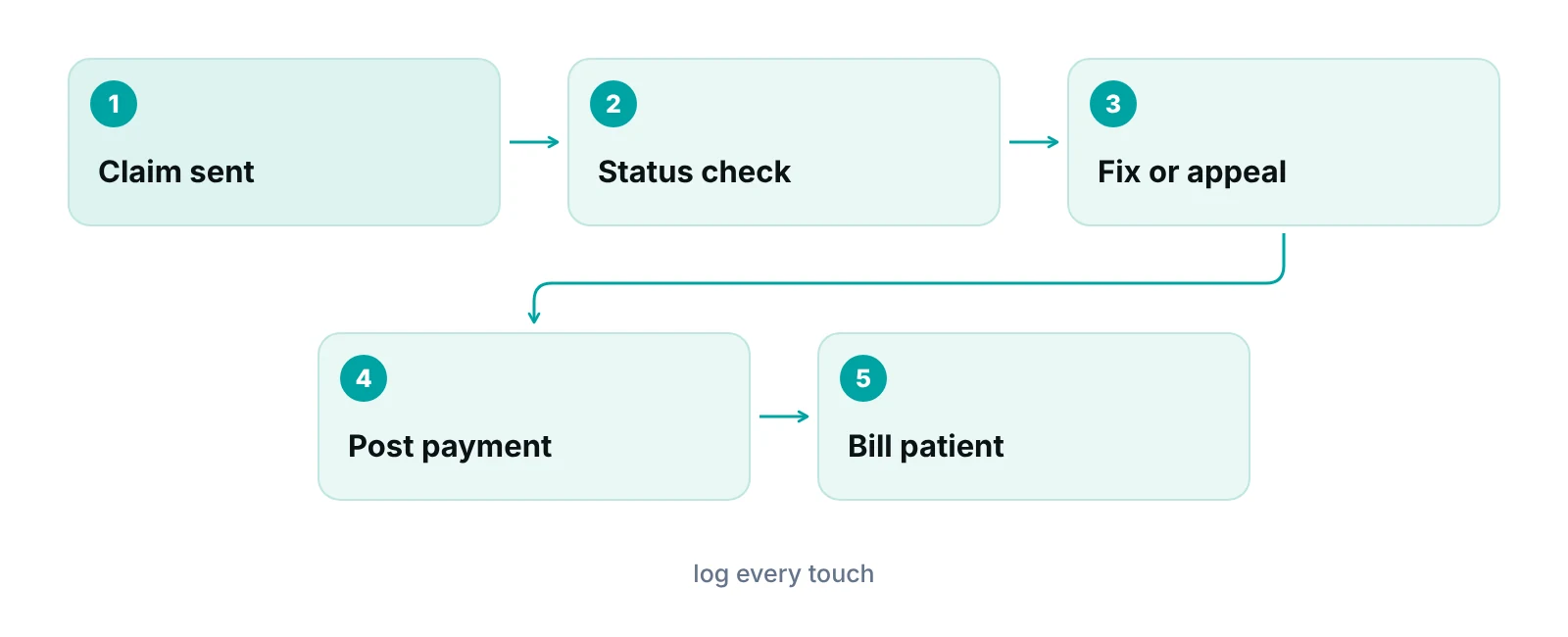
For two plans, post nothing as a write-off until both have paid. The ADA’s coordination-of-benefits guidance defines the write-off as the difference between the full fee and all plan and patient payments, and warns that posting one after the primary and again after the secondary can wrongly credit the patient. A medical plan is primary over a dental plan, and the secondary claim goes out with the full fee and a copy of the primary explanation of benefits (ADA).
How should dental claim denials and short payments be worked?
Sort every unpaid or short-paid claim into one of four groups before touching it: fix and resubmit, appeal, bill the patient, or accept. The remittance reason decides the group.
- Fix and resubmit. A coding error, missing field, wrong subscriber or unreported secondary plan. The ADA’s first step is to check for a coding error.
- Appeal. The code is right and the plan disagrees on necessity, bundling, downcoding or an alternate benefit.
- Bill the patient. The plan paid as designed: deductible, frequency limit or exhausted maximum.
- Accept. The plan paid the contracted amount; post the difference as a contractual adjustment once every plan has paid.
For appeals, the ADA advises a written request that uses the word “appeal” in the title, text and cover letter, sent on the carrier’s form with documentation that was not on the original claim. Ask the plan’s dental consultant to call, and use every appeal level before escalating (ADA). The full denial-reason table is in the dental revenue cycle management guide. Appeal deadlines are set by each plan, so record them the day the denial is read.
On downcoding, the ADA’s June 2026 guidance is to read the explanation of benefits first. If it says the payment reflects benefit design, no appeal is needed; if it explains nothing, appeal in writing and keep the clinical documentation (ADA News). For denial analysis across many claims, see the denial management guide.
Noncovered versus covered but nonpayable
A noncovered service is one the plan never recognizes, so the patient may owe the full fee, subject to the contract. A covered but nonpayable service is blocked by a plan condition, such as a used-up maximum, frequency limit, unmet deductible or waiting period, and the patient owes up to the contracted amount. The ADA’s March 2026 article reports that 44 states have noncovered-services laws, which generally apply to fully insured plans, while self-funded plans may claim an exemption (ADA News). Record the category in the ledger and bill the full fee on the claim.
How do you bill and collect patient balances without losing the patient?
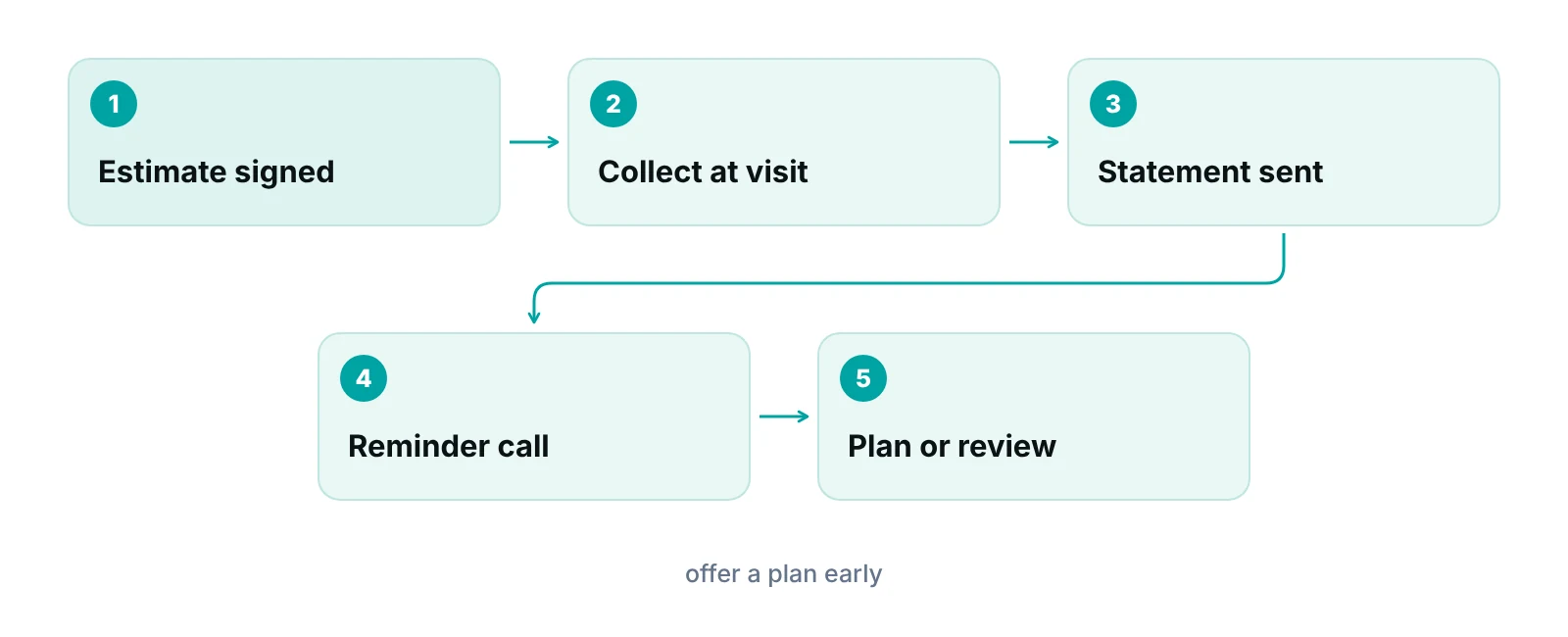
Collect the estimated patient share at the visit, send a clear statement for the rest, and offer a payment option before the balance is old.
DrBicuspid advises collecting the estimated patient portion at the time of service, ideally before the patient is seated, with the expected insurance payment and patient cost in the treatment plan. An estimate is not a promise: the ADA says benefits follow eligibility and remaining benefits on the date of service, and a preauthorization should state it is not a guarantee of payment (ADA).
For out-of-network patients, the ADA’s May 2026 guidance says the patient remains responsible for the full office fee even if the office waits for the claim to process, and that an explanation of benefits showing zero patient responsibility when the plan has not paid the full fee should be challenged. It recommends a written financial policy and signed acknowledgments at intake (ADA News).
Statements should show the date of service, fee, what each plan paid, the adjustment and what is due now, with a way to pay; the patient-friendly billing statement guide covers layout. Use a fixed reminder rhythm: statement, text or email, phone call, final notice. One dental billing article suggests a follow-up within five days of the due date and a call for accounts more than 30 days past due (Outsource Strategies, 2025).
Write payment plan terms simply: amount, number of payments, due dates, what happens after a missed payment, and a signature. Offer a plan before the account ages; the patient payment plan guide has the wider structure. Lending and disclosure rules can apply when an office charges interest or fees, and they differ by state, so have an attorney review any plan beyond simple interest-free installments.
What belongs in a dental write-off and adjustment policy?
A write-off policy states which reductions are allowed, who may approve them and where they are recorded. Without one, adjustments can hide problems or create billing exposure.
Keep contractual write-offs, adjustments and bad debt separate. A 2020 DentistryIQ column separates writing off the gap between the office fee and an insurer’s contracted fee from an adjustment such as a discount, and says altering amounts without documentation raises the question of fraud or false advertising at a minimum (DentistryIQ). That is a columnist’s opinion, not legal advice, but it points to the control: an audit trail.
Be careful with routine waivers of the patient’s share. A 2025 Decisions in Dentistry article says accepting a third-party payment as full payment without telling the insurer the patient’s portion will not be collected can be overbilling, and that routine waivers can breach payer contracts (Decisions in Dentistry). It suggests limiting waivers to charitable or free aid programs.
| Type | What it is | Rule to write down | Approval |
|---|---|---|---|
| Contractual adjustment | Difference between the office fee and the contracted fee | Post only after all plans have paid (ADA COB guidance) | Posted by billing; reviewed monthly |
| Courtesy or hardship adjustment | A reduction given to the patient | Written reason, amount cap, patient notice; review with counsel before routine use | Office manager or dentist |
| Small balance | A trivial balance not worth the cost of billing | Dollar limit set by the practice; documented | Office manager |
| Uncollectible balance | Patient balance that stayed unpaid after the full reminder sequence | Define the steps first; record the dates and contacts; decide collections or write-off | Dentist or owner |
| Credit refund | Overpayment owed to a plan or patient | Refund on a fixed timeline; check state and plan refund rules | Office manager |
Source: ADA coordination-of-benefits guidance; DentistryIQ (2020); Decisions in Dentistry (2025). The dollar limits and timelines are for each practice to set.
When do debt-collection laws apply to a dental practice?
The federal Fair Debt Collection Practices Act and its CFPB rule, Regulation F, mainly target third-party debt collectors. A practice collecting its own patient balances in its own name is generally outside the federal definition, but a collection agency it hires is not, and state laws can be broader.
Regulation F defines a debt collector as a person whose business principally collects debts, or who regularly collects debts owed to someone else. It excludes a creditor’s officer or employee collecting in the creditor’s own name, but includes a creditor that uses a different name suggesting a third party is collecting (12 CFR 1006.2, via Cornell LII). So a letter from an invented “collections department” can change the answer.
If you use an agency, the rule gives you things to ask about. A collector is presumed compliant with call limits if it places no more than seven calls about a debt in seven consecutive days, and none for seven days after a phone conversation about it. It should not call before 8:00 a.m. or after 9:00 p.m. local time without knowledge to the contrary. Validation information is due with or within five days of the first contact, followed by a 30-day validation period, and credit reporting requires prior contact with the consumer (eCFR, 12 CFR Part 1006). Ask any agency how it meets each.
Keep your own calls fair anyway
Even where the federal rule does not bind the office, state consumer-protection and collection laws may. Use a polite script, call at reasonable hours, and share only the minimum information needed with anyone but the patient or guarantor. This guide did not verify state collection or credit-reporting rules; confirm them with your attorney before sending an account to collections.
Who owns each task, and what should the team review each week?
Give every bucket a named owner and a weekly review. A task that two people each think the other is doing does not get done.
Wisdom’s guidance sets a rhythm many offices adopt: check new over-30-day balances daily, review insurance aging claim by claim weekly, compare totals and over-30 and over-90 figures with the prior month monthly, and keep separate owners for insurance and patient A/R (Wisdom). Pair this with the A/R report metrics guide. The aging report is only as good as its filters, so test it using the demo script in the dental practice management software guide.
“The aging report does not collect anything. People with a day count, a script and permission to escalate do.”
— Awais Afzal, Healthcare Operations & Data Analyst
See where your A/R is stuck
A free practice audit looks at recent aging, denials and patient balances and shows where follow-up stops. Pricing is quoted after the audit.
Our recommendations
- Split A/R into insurance and patient, with one owner each. We would start here. The two sides break for different reasons and need different scripts, reminders and escalation paths.
- Write the follow-up day counts down. Choose the days for status checks, plan calls, patient contact and appeals, and print them next to the aging report.
- Work the report by age and dollar amount. Open the oldest, largest items first, log every touch and review the whole report weekly.
- Read the reason before choosing the action. Read the remittance reason code, then fix, appeal, bill the patient or accept. Track the top reasons monthly and fix the cause upstream.
- Put the estimate disclaimer and financial policy in writing. Say plainly that benefits follow the date of service, name the patient’s share and get a signature, especially for out-of-network patients.
- Write the write-off policy before you need it. Define each reduction type, the approver and the audit trail, and have an attorney review hardship discounts and any agency agreement.
Bottom line
Dental accounts receivable improves when follow-up is scheduled, owned and written down: buckets worked by age, claims checked on set days, denials sorted by reason, patients told their share before treatment and a clear write-off policy. Start with the dental practice management guide for the wider picture. RCM Finder’s revenue cycle management service covers claim follow-up and denial management for practices that want help running this work.
Frequently asked questions
What is a good dental accounts receivable number?
There is no official standard. Dental writing often cites total A/R of no more than about a month of production or collections, and under 10% of A/R beyond 90 days, but those are rules of thumb from trade sources. Compare your own last six months, then set targets from that history.
How long should a dental practice wait before following up on an unpaid claim?
Set a fixed day count in writing. Many offices run a first status check about two weeks after submission and an active call by day 30. One dental source advises contacting the patient at 40 days if the plan has not resolved the claim and getting claims paid before 45 days.
Can a dental office write off a patient's copay or balance?
Be cautious. A contractual write-off is normal once all plans have paid. Routinely waiving the patient’s share can breach payer contracts and may be treated as overbilling, according to one 2025 dental billing article. Put hardship discounts in a written policy and have an attorney review it first.
Does the FDCPA apply to dental offices collecting their own bills?
Generally the federal rule targets third-party debt collectors. Under Regulation F, a creditor’s employee collecting in the creditor’s own name is excluded, but a creditor using a different name that suggests a third party is collecting is included. A hired collection agency is covered, and state laws may reach further. Ask your attorney.
What is the difference between a noncovered and a nonpayable dental service?
A noncovered service is one the plan never recognizes as a benefit, so the patient may owe the full fee. A covered but nonpayable service is blocked by a plan condition such as an exhausted maximum or frequency limit, and the patient owes up to the contracted amount. State law and plan funding affect the answer.
When should a dental practice send a patient balance to collections?
Only after the policy’s full sequence is complete: statements, reminders, a phone contact and an offer of a payment plan, all documented. Set the timing in the written policy, confirm the agency follows Regulation F and state law, and make sure the balance is not still pending with a plan or an appeal.
Get your free practice audit
Tell us about your practice. We will contact you using the details you give.
- A review of your recent claims, denials and A/R aging
- Where your front desk and prior authorizations slow payment
- A prioritized fix list you keep, whether or not you hire us
Pricing is quoted after the audit, based on your volume and the services you choose. Prefer to talk? Call +1 (302) 556-2288.
Sources
- Responding to Claim Rejections — American Dental Association (n.d.)
- ADA guidance on coordination of benefits — American Dental Association (n.d.)
- Pre-authorizations and predeterminations — American Dental Association (n.d.)
- Dear ADA: Noncovered services — ADA News (2026)
- Dear ADA: Out-of-network billing — ADA News (2026)
- Dear ADA: Downcoding — ADA News (2026)
- Adopted standards and operating rules — CMS (n.d.)
- Health care payment and remittance advice / EFT — CMS (n.d.)
- 12 CFR Part 1006 (Regulation F) — eCFR (current)
- 12 CFR 1006.2 Definitions — Cornell Legal Information Institute (current)
- Negotiating Accounts Receivable When Buying a Dental Practice — EisnerAmper (2021)
- Is insurance aging killing your profits? — DrBicuspid (2022)
- AR Aging Report Explained — Wisdom (n.d.)
- How to Reduce Aging A/R in Dental Practices — Outsource Strategies (2025)
- Thursday Troubleshooter: altering amounts in patient accounts — DentistryIQ (2020)
- How to Avoid Falling Victim to These 5 Illegal Dental Benefit Plan Billing Practices — Decisions in Dentistry (2025)
Disclaimer: This article is educational and is not legal, tax, coding or compliance advice. Payer contracts, state collection and consumer-protection laws, and plan rules vary and change, so confirm current requirements with your attorney, your state dental board and each payer before acting. Day counts and dollar limits in the tables are starting points for a practice to set, not published standards. CDT is a registered trademark of the American Dental Association.
