
Dental insurance verification is the front-desk check of a patient's plan before treatment: coverage dates, annual maximum remaining, deductible, frequency limits, waiting periods, missing-tooth and alternate-benefit clauses, and other coverage. Do it before the visit, record it, and give the patient an estimate, never a guarantee.
A new patient books a bridge. The card shows active coverage, so the office quotes the plan’s usual percentage. After the visit the explanation of benefits shows a missing-tooth exclusion, and the patient is angry about a bill nobody mentioned. The code was right. The check was too shallow.
This guide covers a better routine. It sits inside the wider dental practice management guide. For the whole cycle, see dental revenue cycle management; for code-level claim detail, the dental billing and coding guide. This post stays at the front desk.
Key takeaways
- “Active coverage” is not a benefit check; confirm limits, waiting periods and exclusions for the planned procedure.
- CMS lists the X12 270/271 as the adopted eligibility standard; ask which dental plans answer electronically.
- Check at booking, again before costly treatment, and at each plan-year start.
- Record who answered, when, and what they said.
- Give estimates in writing and say they are not guarantees.
What does dental insurance verification actually cover?
Dental insurance verification means confirming that the patient is covered and then working out what the plan is likely to pay for the planned treatment. The second part is where most offices stop short. Active coverage says nothing about how much of the annual maximum is gone.
The cost shows in industry data. Dental eligibility and benefit verification spending rose 15% to $2.1 billion in 2023, the largest increase in dental administrative spending, per the 2024 CAQH Index; automated electronic checks could save the industry $580 million (ADA News).
Which benefit details should the front desk confirm?
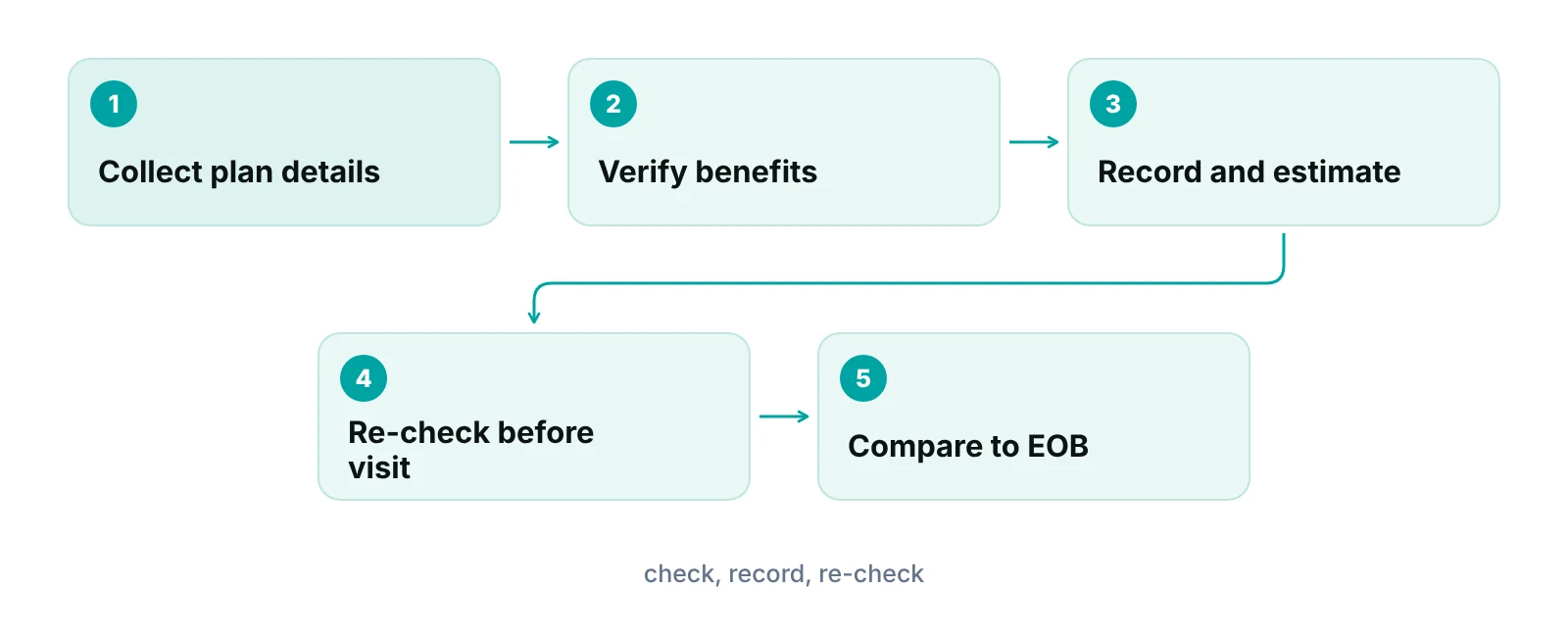
Confirm eight things for every patient, and add procedure-specific questions for costly work. The table below turns each plan term into a question the person on the phone, or the screen, can answer.
| Field | Question to ask | What goes wrong if skipped |
|---|---|---|
| Effective dates and subscriber | Is coverage active on the date of service, and is the patient the subscriber or a dependent? | Claim goes to the wrong plan or to a plan that ended |
| Annual maximum remaining | How much of this year’s maximum is left for this patient? | Estimate assumes full benefits that were used earlier in the year |
| Deductible | Has it been met, and which service categories does it apply to? | Patient is under-collected at the visit and billed later |
| Frequency limits | When was this service last paid, by any dentist, and what is the interval? | Denial for a service done too soon, such as a repeat full-mouth series |
| Waiting periods | Does this procedure category have a waiting period, and has it ended? | Major work is booked before benefits start |
| Missing-tooth (pre-existing) clause | Does the plan exclude replacing a tooth missing before coverage began? | Bridge, implant or partial denture is denied outright |
| Alternate benefit (LEAT) | Will the plan pay only for a less costly option? | Plan pays for a removable partial when a fixed bridge was planned |
| Coinsurance and network status | What percent applies to this procedure, and is the dentist in network for this specific plan? | Wrong fee schedule and wrong patient share |
Source: ADA, Introduction to Dental Benefits; ADA, Responding to Claim Rejections; DentistryIQ (verification scope).
The ADA primer says an annual maximum is a yearly dollar cap, commonly $1,000 or $1,500, and that an alternate-benefit provision may pay for a removable partial when a fixed bridge was recommended. Patients may not learn of it until the explanation of benefits (ADA primer).
Maximums bind fewer patients than owners expect: a 2024 ADA Health Policy Institute analysis found 3.4% of patients reach a typical annual maximum and another 3.3% come within $100 (ADA News). Ask most carefully before large treatment plans.
How do you check frequency limits, waiting periods and the missing-tooth clause?
Ask for each limit by procedure, not in general. The three limits below are the ones that most often turn a correct claim into a denial, and a general “yes, it’s covered” answer rarely tells you about them.
Frequency limits
The ADA’s claim-rejection guidance gives examples: cleanings and exams are often limited to twice per plan year or every six months, so a visit scheduled early may be denied; many plans pay for only one full-mouth radiograph series in five years; and scaling and root planing retreatment may be denied inside a window such as 24 months (ADA). Ask for the last paid date; another office may have done the service.
Waiting periods
A waiting period is the time before a member can receive benefits for certain services. Delta Dental of Illinois describes typical patterns: none for cleanings and exams, possibly six months for fillings, and possibly 12 months for crowns and dentures, with prior continuous coverage sometimes waiving them (Delta Dental of Illinois). Those are one carrier’s examples; ask for the end date on the specific category.
Missing-tooth and pre-existing clauses
The ADA primer says some group plans restrict coverage for dental conditions present before enrollment, with missing teeth as the example. It describes prior creditable coverage reducing the exclusion period, and says a break of 63 days or more can mean the earlier coverage does not count (ADA primer). The ADA’s claim-rejection guidance quotes a typical rule: no coverage for replacing a tooth missing before the effective date, and notes such a denial does not mean the treatment was unnecessary (ADA).
Script for a costly restorative or prosthetic case
“I am verifying a bridge for a patient. Does the plan have a missing-tooth or pre-existing clause, and when did this patient’s coverage begin? Is there a waiting period for major services, and has it ended? Is there an alternate-benefit provision? What is the remaining annual maximum? What is the date of any prior payment for this tooth or area?” Write each answer in the record as it is given.
Which verification method should a dental office use?
Use the electronic transaction where the plan supports it, the portal next, and the phone for the rest. ADA News describes three tiers in its account of the CAQH Index: fully electronic through an automated HIPAA-standard transaction, partially electronic through a plan portal, and manual by phone, fax, email or mail (ADA News).
On the standard: CMS lists the X12 270/271 Version 5010 as the adopted eligibility standard, with a standard date of January 1, 2012 and federally mandated operating rules from January 1, 2013. The same CMS page lists dental claims under the 837 standard but does not mention dental in the 270/271 row (CMS, adopted standards and operating rules). Covered providers, health plans and clearinghouses must use the adopted standards for electronic transactions (CMS). Ask your software vendor or clearinghouse which of your dental plans answer an electronic inquiry and which fields from the table above come back.
| Method | How it works | Strength | Watch for |
|---|---|---|---|
| Electronic 270/271 through software or a clearinghouse | The system sends the inquiry and reads the response | Fast, repeatable, can run for a whole day’s schedule | Responses may not cover every field or every plan; confirm which fields return |
| Plan portal | Staff log in per carrier and read the benefit screens | Often shows history and limits for that carrier | One login per plan; screens differ; easy to copy only the headline |
| Phone call to the plan | Staff speak to a representative using the number on the card | Can ask procedure-specific questions | Slow; the answer is only as good as the note taken |
| Patient or HR office check | Patient calls the plan or employer benefits office | Useful for plan-design questions the plan will not answer for the office | Never the only check |
Source: ADA News on the 2024 CAQH Index; CMS, Adopted Standards and Operating Rules; ADA, Pre-authorizations and Predeterminations.
Whatever the method, verify participation for the specific plan, not just the carrier (DentistryIQ).
When should verification happen: at booking, before the visit, or both?
Both. Verify when the appointment is made and again before costly treatment, because benefits follow the coverage in force on the date of service. A check done weeks earlier can be out of date.
The ADA says benefits are based on what is allowable at the time of service, advises submitting predeterminations for costly work as close to the service date as possible, and warns about authorizations received in one year with treatment in the next, since policies can change at plan-year start (ADA).
- At booking. Collect the carrier, member ID, group number, subscriber details and every other plan, and scan both sides of each card.
- Same or next business day. Run the check and record the table fields. Our suggestion: do not leave new-patient checks to the morning of the visit.
- Before costly treatment. Re-verify remaining maximum, waiting-period end date and frequency history, and consider a predetermination for complex cases.
- At the visit. Ask whether jobs, plans or dependents changed since the check.
- At plan-year start. Treat the first visit of each plan year as a new verification.
- After the explanation of benefits. Compare payment with the note and log any gap.
For general eligibility work across specialties, see the patient insurance verification guide.
How do you work out which plan is primary?
Confirm the order of plans before the first claim, using the rules below and a call to the customer service number on the card. The ADA notes that coordination of benefits applies to group plans only; individual policies do not coordinate (ADA).
| Situation | Which plan is primary | Note |
|---|---|---|
| Patient is the employee or main policyholder on one plan and a dependent on another | The plan where the patient is the employee or policyholder | The dependent plan is secondary |
| Child covered by both parents | The parent whose birthday falls earlier in the calendar year (birthday rule) | Not the parent’s age |
| Divorced or separated parents | Set by the court decree | Ask for the decree terms |
| Plans from two employers | The plan that has covered the patient longest | Changing carriers does not reset the clock |
| Active employer plan and COBRA or retiree plan | The employer plan for current employment | Applies to both parts of the stack |
| Medical plan with dental benefits and a dental plan | The medical plan is primary, per the ADA | Some states differ |
| Medicaid | Typically secondary to other benefit plans | Confirm state rules |
Source: ADA, Guidance on Coordination of Benefits; ADA, Introduction to Dental Benefits.
Record the COB method and whether the plan is self-funded: the ADA says non-duplication is typically used in self-funded plans, which may be exempt from state COB laws. Send the claim to the primary plan first, then its explanation of benefits to the secondary, and post no write-offs until all plans have paid (ADA).
What should a verification record contain?
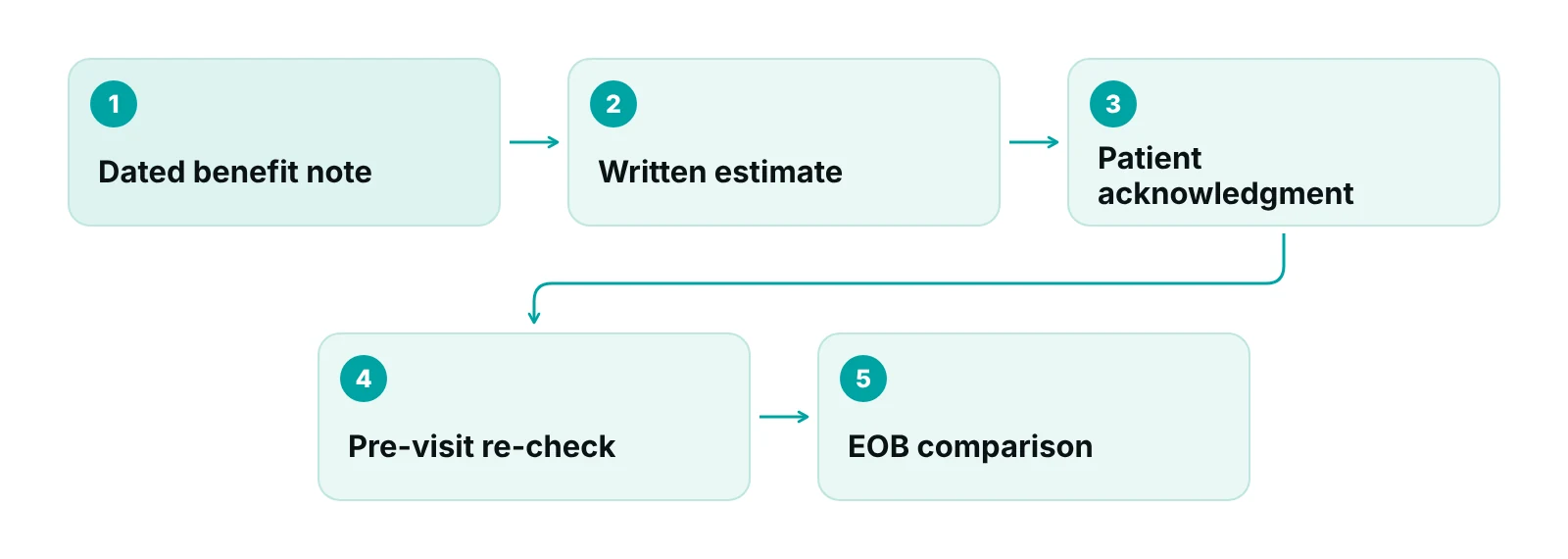
- Who and when: date, staff member, and the plan representative or portal screen used.
- Reference number: the call or inquiry number, if the plan gives one.
- The fields: every item in the first table, as given, including “plan could not say”.
- Limits: remaining maximum, last paid dates, waiting-period end dates, COB order and method.
- The estimate and caveat: what the patient was told, in writing, with the date.
- The patient’s acknowledgment: signed, especially when the patient accepts a less costly option under an alternate-benefit clause.
Keep a signed financial policy on file as well. The ADA calls establishing one a “must-do” and notes that patients often assume recommended treatment is covered (ADA). A dated note also helps when a denial needs an appeal, since the ADA’s appeal guidance asks for dated, supported records (ADA).
Privacy needs a line too. HHS says a provider that sends PHI to a health plan for payment does not need a business associate agreement with that plan, because each acts on its own behalf. A vendor or remote assistant who verifies benefits for you is different: PHI may be shared with a business associate only after satisfactory assurances in a written contract (HHS). The dental billing services guide lists BAA questions for outside partners.
How do you word an estimate so it is not a guarantee?
State the plan’s expected share, the patient’s expected share, and that neither is a guarantee. The ADA says carriers generally mark estimated payments as not guaranteed, and claims can still be denied if the patient is no longer eligible, the annual maximum has been paid, or time limits have passed. If coverage ends or other benefits are paid after the estimate and before the claim, benefits may change (ADA).
Preauthorization and predetermination are different
Preauthorization is required by many DHMO plans before a specialist referral; predetermination is a voluntary estimate common with DPPO and indemnity plans. “Pre-approved” is generally not a payer term, so avoid it with patients (ADA).
Plain wording helps: “This is what the plan told us today, based on what it has paid so far this year. The plan decides final payment when it processes the claim.” The ADA encourages patients to call their payer for procedure-specific benefits and says payers generally expect the payer, not the office, to explain covered benefits (ADA).
What the patient owes when the plan does not pay is covered in the dental revenue cycle guide, and the dental accounts receivable guide shows what wrong estimates cost later; software that stores these notes is covered in the dental practice management software guide.
Who should run verification, and when is help worth it?
Our Virtual Medical Assistants run eligibility checks as part of remote front-desk support, working inside the practice’s existing systems and time zone. The dental virtual assistant guide covers what remote dental support includes. Automated real-time eligibility is not live in our portal today. Any partner should sign a business associate agreement before touching patient data.
Want a second pair of eyes on your verification routine?
We will review how benefits are checked, recorded and handed to billing. Pricing is quoted after the audit.
Our recommendations
- Verify the procedure, not just the policy. Confirm remaining maximum, frequency history, waiting periods and exclusions for the planned code, and write each answer down.
- Check twice for costly treatment. Verify at booking and again close to the treatment date, because benefits follow coverage on the date of service.
- Make the record readable by anyone. One location, one format, with who answered and when.
- Say "estimate", never "approved". Put not-a-guarantee wording on every written estimate and file the patient’s acknowledgment.
- Map coordination of benefits at the first visit. Confirm primary and secondary order and whether each plan is self-funded.
Bottom line
Dental insurance verification works when it covers the procedure, the limits and the other plan, happens close to treatment, and is written down. For the wider operating picture, return to the dental practice management guide. If your front desk cannot keep up with daily checks, our Virtual Medical Assistants take on eligibility work, starting from a free practice audit.
Frequently asked questions
What is dental insurance verification?
It is the check a dental office makes before treatment to confirm that a patient’s coverage is active and to learn what the plan is likely to pay. A good check covers the annual maximum remaining, deductible, frequency limits, waiting periods, exclusions, alternate-benefit terms and any other coverage.
How far ahead should we verify dental benefits?
Verify when the appointment is booked, and again close to the treatment date for costly work. The ADA notes that benefits are based on what is allowable at the time of service, and advises submitting predeterminations for complex procedures as close to the proposed service date as possible.
Is a dental benefit verification a guarantee of payment?
No. A verification or predetermination is an estimate based on the information the plan has when it responds. The ADA says claims can still be denied if the patient is no longer eligible, the annual maximum has been used, or time limits have passed. Give the patient the estimate in writing with that caveat.
What is a missing-tooth clause?
It is a plan provision, described by the ADA as a pre-existing condition exclusion, that limits coverage for a tooth missing before the patient’s coverage began. A typical rule allows no coverage for replacing such a tooth. Ask whether the plan has one before quoting any bridge, implant or partial denture.
Does the HIPAA eligibility transaction work for dental plans?
CMS lists the X12 270/271 Version 5010 as the adopted eligibility standard, and ADA News describes dental offices using a HIPAA-standard electronic check. The CMS eligibility row does not name dental, so ask your software vendor or clearinghouse which of your dental plans respond and which fields come back.
Can a remote assistant verify dental insurance for us?
Yes, many practices use remote staff for this. Because the assistant will see patient information, HHS expects a written business associate agreement with satisfactory assurances before PHI is shared. Our Virtual Medical Assistants run eligibility checks inside the practice’s own systems, after we put a Business Associate Agreement in place.
Get your free practice audit
Tell us about your practice. We will contact you using the details you give.
- A review of your recent claims, denials and A/R aging
- Where your front desk and prior authorizations slow payment
- A prioritized fix list you keep, whether or not you hire us
Pricing is quoted after the audit, based on your volume and the services you choose. Prefer to talk? Call +1 (302) 556-2288.
Sources
- Adopted Standards and Operating Rules — CMS (2026)
- Health Care Transactions Basics — CMS (n.d.)
- Benefit verification drives increased administrative spending in dental offices — ADA News (2025)
- Introduction to Dental Benefits — ADA (n.d.)
- Pre-authorizations and Predeterminations — ADA (n.d.)
- ADA Guidance on Coordination of Benefits — ADA (n.d.)
- Responding to Claim Rejections — ADA (n.d.)
- Dear ADA: Annual maximums — ADA News (2025)
- Participating in a Plan — ADA (n.d.)
- Benefit Waiting Period — Delta Dental of Illinois (n.d.)
- What dental insurance verification actually means for a practice — DentistryIQ (n.d.)
- Business Associates — HHS (n.d.)
Disclaimer: This article is educational and is not legal, coding, tax or compliance advice. Dental plan terms, state laws and payer rules differ and change, so confirm current requirements with each plan, your state dental board and your attorney before acting. CDT is a registered trademark of the American Dental Association.
