
A clearinghouse in medical billing is a go-between that receives your claims, checks them for format and data errors, converts them into the standard electronic format and routes each one to the right payer. It then sends back reports showing which claims were accepted or rejected, so you can fix errors before a payer reviews the claim.
Most practice managers meet the clearinghouse the first time a claim bounces with a code nobody recognizes. This guide explains what the clearinghouse does at each step, what it cannot fix, how to read its reports, and how to compare vendors. It replaces our earlier overview, which carried figures we could not source. If you want the narrower topics, we cover claim scrubbing and clearinghouse rejection codes in their own posts.
Key takeaways
- A clearinghouse checks and formats claims; it does not decide whether a payer will pay them.
- Federal rules adopt a specific electronic claim standard (X12 837, version 005010), and clearinghouses exist to meet it.
- A rejection stops a claim before adjudication and is usually fast to fix; a denial comes after review and needs an appeal or correction.
- Choose on payer coverage, report quality, EHR fit, support and HIPAA terms, not on a headline price.
- Someone in your office must own every rejection report, whichever clearinghouse you use.
What does a clearinghouse in medical billing do?
It sits between your billing system and the payer and makes sure the claim arrives in a form the payer’s system can read. Under the HIPAA rules, a health care clearinghouse is an entity that processes health information received in a nonstandard format into standard data elements or a standard transaction, or the reverse (see the definition in 45 CFR 160.103). The same rule lists a clearinghouse as one of the three types of HIPAA covered entity, alongside health plans and certain providers.
The standard matters because payers do not accept whatever your software exports. Federal rules at 45 CFR 162.1102 adopt ASC X12 837 version 005010 for health care claims: 005010X222 for professional claims, 005010X223 for institutional claims and 005010X224 for dental claims. A clearinghouse builds, validates and transmits those files so you do not have to connect to every payer separately.
The path a claim takes
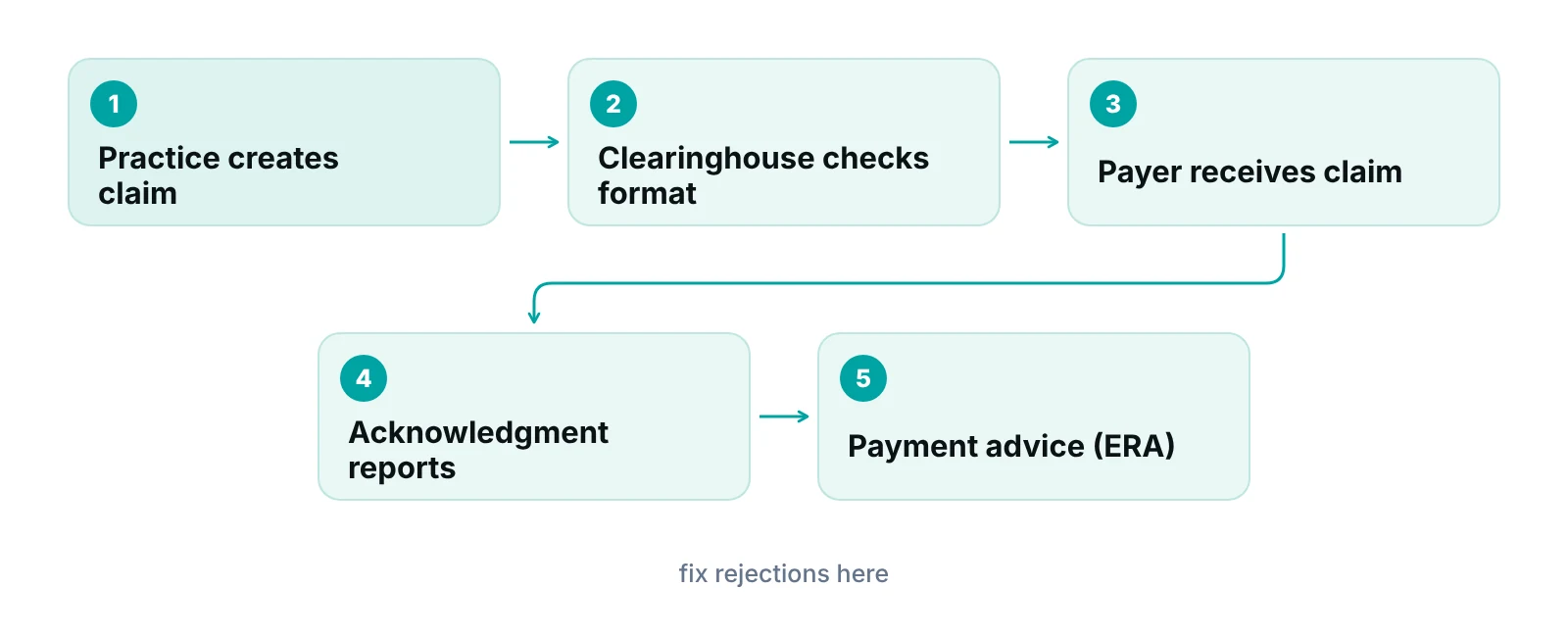
| Step | What happens | What you get back |
|---|---|---|
| Receive | Your billing or practice system sends a batch of claims. | A receipt that the file arrived. |
| Check | Format and data checks run against the standard and payer-specific rules. | Errors flagged before the payer sees the claim. |
| Convert | Data is put into the 837 standard file (for example 837P for professional claims). | A file the payer’s system can read. |
| Route | Each claim is sent to the correct payer connection. | Acknowledgment reports from the clearinghouse and payer. |
| Report | Accepted and rejected claims are listed, often with error codes. | Work lists for your billing staff. |
Source: 45 CFR 160.103 (HHS) and 45 CFR 162.1102 (eCFR) for the standard; the step breakdown is our plain-language summary.
Many clearinghouses also return the payer’s payment explanation in the standard electronic form. Our guide to electronic remittance advice explains how to read it, and our EDI overview covers the wider set of electronic transactions.
What can a clearinghouse not fix?
A clearinghouse cannot make a payer agree to pay. It catches format and data problems before submission. Coverage decisions, medical necessity, missing prior authorization and out-of-network rules are decided by the payer after the claim is accepted.
The difference between a rejection and a denial is the most useful idea in this post. A rejection means the claim failed an edit and never entered the payer’s review. A denial means the payer reviewed the claim and refused to pay all or part of it. A clearinghouse mainly reduces rejections. Reducing denials needs front-end work such as eligibility checks and authorizations, plus good documentation and coding.
KFF’s analysis of 2023 CMS transparency data shows why expectations should stay modest. HealthCare.gov insurers denied about 20% of in-network claims in 2023 (86 million of 436 million), and individual insurers’ denial rates ranged from 1% to 54%. These are ACA marketplace plans only, not all payers, so treat the figure as a signal rather than a benchmark for your payer mix. KFF also found the largest reason category was ‘other’ (34%), followed by administrative reasons (21%), excluded services (14%), lack of prior authorization or referral (9%) and medical necessity (about 6%). Fewer than 1% of denied in-network claims were appealed.
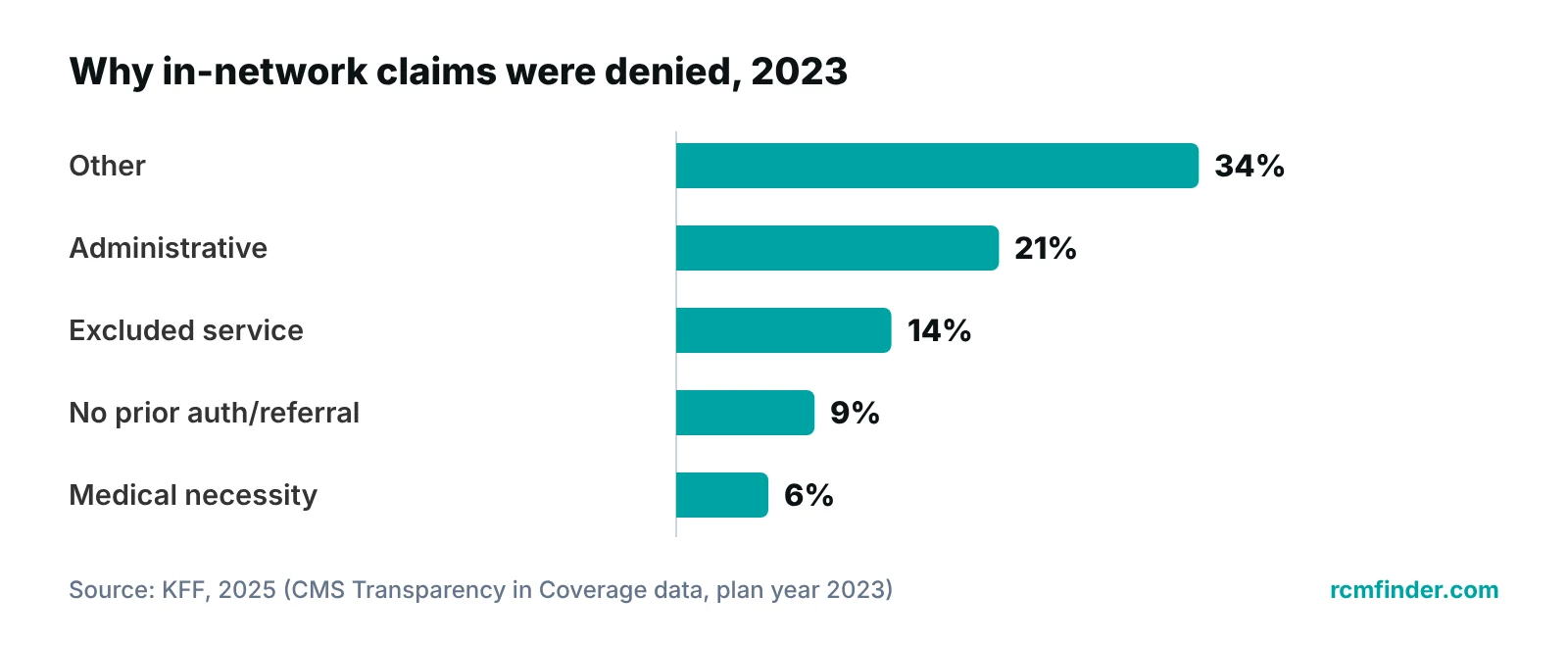
Read the chart carefully
Several of these categories, such as missing authorization or an excluded service, begin at scheduling and eligibility, well before a clearinghouse sees the claim. Pair claim checks with the front-end work in our guides to clean claims and denial management.
How do you read clearinghouse acknowledgment reports?
Each report tells you how far the claim got. Learn the three common ones and you can tell in minutes whether a problem is a bad file, a bad format or a bad claim. CMS describes them in a 2010 national presentation on 5010 acknowledgments; vendor screens may use different names, so check how yours labels them.
| Report | What it tells you | If it is rejected |
|---|---|---|
| TA1 (interchange acknowledgment) | Whether the whole file was accepted or rejected at the envelope level. | None of the claims in that file are processed. Correct and resend the file. |
| 999 (implementation acknowledgment) | Whether each group or transaction set was accepted, accepted with errors or rejected, and which syntax rules were broken. | A rejected set is not passed on. Claims in it can be returned. |
| 277CA (claim acknowledgment) | Status of individual claims: accepted, or rejected with error codes. Accepted claims get a claim number. | Fix the listed error and resubmit that claim. |
Source: CMS, Acknowledgements national presentation (2010), HIPAA 5010 implementation.
Two practical points follow from the CMS material. First, use unique control numbers on each file and claim so every acknowledgment can be matched to what you sent. CMS’s 5010 implementation notice names the interchange, transaction set and claim-level control fields for this purpose. Second, if a Medicare claim seems lost, check with your clearinghouse first: CMS notes that Medicare may never have received claims that failed edits during handoffs.
The error codes themselves vary by payer. We list the common ones in our clearinghouse rejection code guide and explain one frequent cause in entity code rejections.
Does a practice need a clearinghouse?
Practices that bill electronically usually reach payers through a clearinghouse, whether they contract with one directly or get it through a billing company or billing software. The alternative is to build and test a separate connection to each payer, which takes staff time. Electronic submission is also the default expectation in Medicare.
The Administrative Simplification Compliance Act generally requires Medicare suppliers to submit claims electronically. The Noridian Medicare guidance lists exceptions, including providers with fewer than 10 full-time equivalent employees, dental claims and certain unusual circumstances. Suppliers that do not qualify and send paper claims will have them denied with remark codes M117 and MA44. Check your own Medicare contractor’s page before relying on an exception.
If you use a clearinghouse for Medicare claims, CMS says you must ask your Medicare Administrative Contractor for authorization to use 5010 in production and name your clearinghouse so the contractor can link you to the submitter. Ask whoever sets up your connection to confirm this step is complete.
Three ways to get claims to payers
- Your own clearinghouse account: you choose and pay the vendor and your staff work the reports.
- Clearinghouse built into your EHR or practice management software: one login, but you inherit the vendor’s payer list and report screens.
- A billing company submits for you: they use their own connection and work rejections. Ask for the reports, not just the totals.
Procedure-heavy specialties add their own edit risks, such as modifiers and documentation requirements; our pain management billing page shows how that works for one specialty.
How do you choose a clearinghouse?
Compare vendors on how well they fit your payers, your software and your staff, not on the lowest listed fee. Use the same questions with every vendor and write the answers down.
| Area | What to ask | Why it matters |
|---|---|---|
| Payer coverage | Which of our top payers do you reach electronically? Does each one need separate enrollment or testing? | A gap means paper, portal entry or a second vendor. |
| Software fit | How do claims and reports move between our EHR or practice system and your platform? | Manual uploads create delay and errors. |
| Edits and reports | Which checks run before submission? Can we see the payer’s rejection reason in plain words? | You can only fix what you can read. |
| Fees | How are fees structured (per provider, per claim, per transaction type)? What costs extra? | Eligibility, remittance and statement features are often separate. |
| Support | Who do we call when a batch fails? What hours? | Rejections age while you wait. |
| HIPAA terms | Will you sign a business associate agreement? Who can see our claim data? Is access logged? | Claims contain protected health information. |
On fees, we deliberately give no typical price here. Vendor prices change and depend on what is bundled, so ask for a written quote that lists every add-on.
What a clearinghouse does not do for HIPAA
Using a clearinghouse does not make your practice compliant. A clearinghouse is itself a covered entity under the rule, so it has its own duties, but your practice still owns its policies, access controls and staff training. Penalties are tiered. In HHS’s January 2026 inflation adjustment, published in the Federal Register, the lowest tier starts at $145 per violation and the highest per-violation amount is $73,011, with calendar-year caps of up to $2,190,294. Amounts are adjusted every year, so check the current figures. Our HIPAA billing compliance guide has a practical checklist.
Not sure where your claims are getting stuck?
We review your rejection reports, payer mix and software setup in a free practice audit, then tell you whether the problem is your clearinghouse, your front end or your workflow.
What happens after the clearinghouse accepts the claim?
The claim now belongs to the payer, and your job shifts to tracking it. Many practices lose money here because a rejection report arrives and nobody is assigned to it. Put one named person on rejections each day and set a rule for how long an unacknowledged claim can sit.
A practice management system that tracks claims by stage, with an owner on each, is one way to close that gap. RCM Finder’s practice management system is built around claim tracking, data-completeness checks before submission and underpayment flags; it is a claim-centred system, not an EHR. If you outsource, our medical billing services cover claim preparation, submission and follow-up, and our team works with the EHR you already use.
Rejections that become denials move to appeals. See our denial management services and our guide to medical claim forms for the paper-form equivalent of the electronic claim.
See what rejected claims may be costing you
Use the free calculator to estimate the revenue tied up in rework and delayed claims, using your own numbers.
Our recommendations
- Assign one owner for rejection reports. We would name one person and one backup who open the report every business day. An unread rejection is the most common way a clean-looking process leaks cash.
- Learn the three acknowledgment types. Train billing staff to tell a file-level rejection (TA1) from a format rejection (999) and a claim-level rejection (277CA). It cuts diagnosis time.
- Separate rejections from denials in reporting. Track them as different counts. Rejections point to claim-building and clearinghouse setup. Denials point to eligibility, authorization, coding and documentation.
- Test before you switch. Run a sample batch for each of your top payers before moving fully. Confirm acknowledgments and remittances come back and match your control numbers.
- Get HIPAA terms in writing. Ask for a business associate agreement and a description of who can see claim data. Keep a copy with your vendor file.
- Review the clearinghouse once a year. Check payer coverage, support response and report quality against what you were promised. Fees and features change.
Track every claim by stage after the clearinghouse accepts it.
RCM Finder's practice management system is claim-centred: each claim sits in a stage with an owner, with data-completeness checks before submission and underpayment flags afterward. It is not an EHR.
See how the RCM Finder portal works · Create a portal account
Disclosure: RCM Finder builds and sells this portal. It is a practice management system, not an EHR.
Bottom line
A clearinghouse in medical billing is a checkpoint, not a cure. It gets clean, standard claims to payers and shows you what failed; it cannot change a payer’s coverage rules. Pick one on payer fit, reports, support and HIPAA terms, then make sure a person owns every rejection. If you want help with that workflow, our medical billing services and denial management services are built for it.
Frequently asked questions
What is a clearinghouse in medical billing?
It is an entity that receives claims from a provider, checks them, converts them into the standard electronic format and sends them to the payer. HIPAA defines a health care clearinghouse as an entity that processes nonstandard health information into standard transactions or the reverse, and treats it as a covered entity.
What is the difference between a claim rejection and a claim denial?
A rejection means the claim failed a format or data edit and was not accepted for review, so you fix and resend it. A denial means the payer reviewed the claim and refused to pay all or part of it. Denials usually need an appeal or a corrected claim.
Do I need a clearinghouse if I use an EHR or practice management system?
Probably yes, but it may be built in. Many systems connect to a clearinghouse behind the scenes. Ask your vendor who the clearinghouse is, which payers it reaches, and where you see the rejection reports. You are still responsible for working them.
Can a clearinghouse prevent claim denials?
Only some of them. It can catch format errors, missing fields and some payer-specific edits. It cannot fix a lapsed policy, a missing authorization or a medical necessity dispute. KFF’s 2023 data on ACA marketplace plans shows those reasons make up a large share of denials.
How much does a clearinghouse cost?
It depends on the vendor, the number of providers and which extras you add. We do not quote typical prices because they change. Ask for a written quote that shows per-provider or per-claim fees, plus charges for eligibility checks, remittance and support.
Is a clearinghouse HIPAA compliant?
A clearinghouse is a HIPAA covered entity, so it must follow HIPAA, but using one does not make your practice compliant. Ask for a business associate agreement, find out who can access your claim data and keep your own policies and training current.
Get your free practice audit
Tell us about your practice. We will contact you using the details you give.
- A review of your recent claims, denials and A/R aging
- Where your front desk and prior authorizations slow payment
- A prioritized fix list you keep, whether or not you hire us
Pricing is quoted after the audit, based on your volume and the services you choose. Prefer to talk? Call +1 (302) 556-2288.
Sources
- 45 CFR 160.103 Definitions (health care clearinghouse; covered entity) — HHS / U.S. Government Publishing Office (2013 CFR edition)
- 45 CFR 162.1102 Standards for health care claims or equivalent encounter information transactions — eCFR (current)
- Administrative Simplification Compliance Act (ASCA) — Noridian Medicare (CMS contractor) (current)
- Claims Denials and Appeals in ACA Marketplace Plans in 2023 — KFF (2025)
- Acknowledgements national presentation (HIPAA 5010) — CMS (2010)
- Important update regarding HIPAA version 5010 D.0 implementation — CMS (2012 notice)
- Annual Civil Monetary Penalties Inflation Adjustment — HHS via Federal Register (2026)
Disclaimer: This article is educational and is not legal, coding, compliance or financial advice. Payer rules, clearinghouse features and penalty amounts change, so confirm current requirements with your payers, your Medicare contractor and your own advisers before acting.
