
Memory loss icd 10 coding starts with R41.3, other amnesia, which lists memory loss NOS as an inclusion term. Use R41.1 or R41.2 when the provider documents anterograde or retrograde amnesia. When a cause is diagnosed, such as mild cognitive impairment (G31.84) or dementia, code the diagnosis instead, because R41 carries Excludes1 notes against several of them.
A patient says they cannot remember things, and the front desk wants one code. The answer depends on what the provider writes, not on the complaint alone. The symptom code is correct only until the provider confirms a cause.
This guide covers the R41 symptom codes, the diagnoses that replace them, the Excludes notes that trigger claim edits, and a worked example. It is written for coders, billers and practice managers, and it covers coding only, not clinical care.
Key takeaways
- R41.3 is the symptom code for memory loss NOS; R41.1 and R41.2 name anterograde and retrograde amnesia.
- A confirmed cause replaces the symptom code: MCI goes to G31.84, dementia to an F code, transient global amnesia to G45.4.
- R41 and R41.3 carry Excludes1 notes, so pairs such as R41.3 with G31.84 are a coding conflict.
- Outpatient claims cannot carry “probable” or “suspected” diagnoses; code the symptom until the provider confirms.
- Check every code against the FY2027 tabular list, which took effect on 1 October 2026.
What are the main memory loss ICD-10 codes?
The main code is R41.3, other amnesia. Its listing shows “Amnesia NOS” and “Memory loss NOS” as inclusion terms, so a note that says only “memory loss” lands here. No R41 code is titled “memory loss” by itself, which is why a coder who searches code titles alone can miss it. The table lists the codes a biller is most likely to meet, with what each one describes and the check it needs.
| Code | What it describes | When it fits | Status checked |
|---|---|---|---|
| R41.3 | Other amnesia; inclusion terms amnesia NOS and memory loss NOS | Memory loss is documented and no cause or amnesia type is named | FY2027 listing: billable |
| R41.1 | Anterograde amnesia | The provider names anterograde amnesia | Billable on a page of unclear edition; confirm in the FY2027 tabular |
| R41.2 | Retrograde amnesia | The provider names retrograde amnesia | FY2027 listing: billable |
| R41.82 | Altered mental status, unspecified | A change in mental status is documented, not memory alone | FY2027 listing: billable |
| R41.81 | Age-related cognitive decline (senility NOS) | The provider documents age-related cognitive decline | Seen on an FY2026 listing only |
| G31.84 | Mild cognitive impairment of uncertain or unknown etiology | The provider documents mild cognitive impairment with no known cause | FY2027 listing: billable |
| G45.4 | Transient global amnesia | The provider documents transient global amnesia | FY2027 listing: billable |
| F03.90 | Unspecified dementia, unspecified severity, without added disturbances | The provider documents dementia with no further detail | FY2027 listing: billable |
Source: HCC Buddy FY2027 code pages; Unbound Medicine; Find-A-Code R41 group (2026). Secondary references; confirm against the CMS FY2027 tabular list.
Code set year
The FY2027 ICD-10-CM code set took effect on 1 October 2026 and runs to 30 September 2027, per the CDC FY2027 guidelines. Code status in this guide comes from reference pages that state they use the FY2027 order file, so run the check in the official tabular list before you load a code. R41.81 was seen only on an FY2026 listing.
If the memory loss is sudden and the provider suspects a vascular event, the code question moves to the G45 block, which the TIA ICD-10 codes guide covers. If the memory complaint is documented as part of a mental disorder, see the mental health ICD-10 codes guide.
When is memory loss a symptom code and when is it a diagnosis?
Report memory loss as a symptom only while the provider has not confirmed a diagnosis that explains it. The FY2027 ICD-10-CM guidelines say in section I.B.4 that sign and symptom codes are acceptable for reporting when a related definitive diagnosis has not been confirmed. Section I.B.5 adds that signs routinely associated with a disease process should not be coded in addition to it, unless the classification says otherwise.
In practice that means the symptom code leaves the claim once the diagnosis arrives. A patient with dementia does not also get R41.3 for the forgetfulness that comes with dementia. The R40-R46 section adds an Excludes2 note for symptoms that form part of a pattern of mental disorder (F01-F99), which points the same way.
Excludes notes that matter for memory loss
An Excludes1 note means the two codes are not reported together. The guidelines (section I.A.12.a) allow an exception when the two conditions are unrelated, and they say to query the provider when it is unclear. An Excludes2 note means the excluded condition is not part of the one named, so both can be reported when both apply.
- R41 category, Excludes1: dissociative [conversion] disorders (F44.-) and mild cognitive impairment of uncertain or unknown etiology (G31.84).
- R41.3, Excludes1: amnestic disorder due to a known physiological condition (F04), amnestic syndrome due to psychoactive substance use (F10-F19 with a .6 fifth character), mild memory disturbance due to a known physiological condition (F06.8) and transient global amnesia (G45.4).
- G31.84, Excludes1: dementia (F01-F03), age-related cognitive decline (R41.81), altered mental status (R41.82), cerebrovascular diseases (I60-I69) and mild neurocognitive disorder due to a known physiological condition (F06.7-).
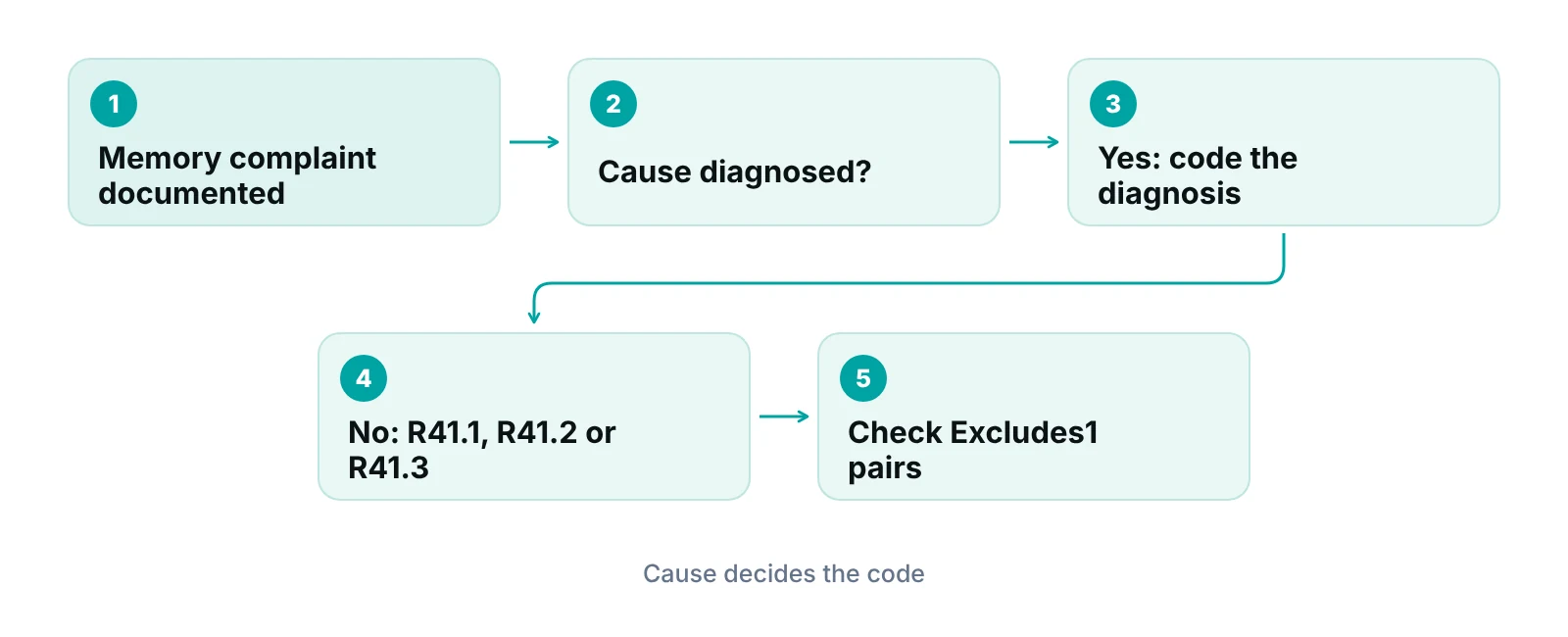
| Provider documents | Code direction | Why |
|---|---|---|
| Memory loss, no cause named | R41.3 | Symptom codes are allowed when no definitive diagnosis is confirmed (I.B.4); memory loss NOS is an inclusion term |
| Anterograde or retrograde amnesia named | R41.1 or R41.2 | R41.3 is the “other amnesia” code, so a named type has its own code |
| Mild cognitive impairment, cause unknown | G31.84 | The R41 Excludes1 note names G31.84; do not add R41.3 |
| Transient global amnesia | G45.4 | R41.3 lists G45.4 in its Excludes1 note, and G45.4 lists R41.3 in return |
| Dementia | An F-code, for example F03.90 when nothing more is documented | Memory loss is routinely part of dementia (I.B.5); G31.84 also excludes dementia |
| Amnestic disorder or syndrome due to a known condition or a substance | F04, or F10-F19 with a .6 fifth character | These are named in the R41.3 Excludes1 note |
| Memory deficit after a stroke | A sequela code in I69, for example I69.911 for an unspecified cerebrovascular cause | G31.84 excludes the I69 cognitive deficit codes; confirm the exact code and billable character |
Source: CDC FY2027 ICD-10-CM Guidelines (2026); HCC Buddy FY2027 code pages and AAPC code listing (2026). Confirm in the official tabular list.
One note links memory loss to a common comorbidity. G31.84 carries a code-to-identify list that includes hypertension (I10-I1A), alcohol abuse and dependence, and tobacco use. If your patients with memory complaints often have hypertension, the hypertension ICD-10 codes guide covers how to report it.
What must the provider document to support a memory loss code?
The note has to show the complaint, whether a cause was established by the end of the visit, and the provider’s own diagnostic words. Coders code from what is written, so the wording decides the code. These are the elements that make each choice defensible:
- The complaint in clinical terms. “Memory loss” or “amnesia” supports R41.3. A vague phrase such as “cognitive concerns” may need a query before a code is chosen.
- The amnesia type, if the provider knows it. Only the provider can name anterograde or retrograde amnesia. A coder should not infer it from the history.
- Whether a diagnosis was confirmed. “Mild cognitive impairment” and “dementia” are diagnoses. “Possible” or “probable” versions are not codable on an outpatient claim.
- The cause, when known. A named cause, such as a prior stroke or substance use, can move the code to a different chapter.
- The reason for any test or referral. The diagnosis on the order should match the diagnosis in the note, because the claim diagnosis points to the service.
- Coexisting conditions the provider addresses. Outpatient guidance is to report documented conditions that coexist and affect care at the visit.
Uncertain diagnoses in the outpatient setting
Outpatient and professional coders do not code “likely” or “possible” diagnoses. They code the sign or symptom instead, as Healthicity’s summary of the outpatient guidelines explains, and as ICD10monitor describes. A note that says “suspected dementia” supports R41.3 or another symptom code, not an F code.
Neurology and geriatrics practices see this wording problem often. Our neurology and geriatrics pages describe the billing context. The documentation habit that helps most is a closing line in the assessment that states the diagnosis or says plainly that none is established yet.
Why do memory loss claims get held or denied?
Most problems come from code-pair conflicts, vague codes on services that need a specific reason, and a claim diagnosis that does not match the note. Payer policies differ, so treat the table as patterns to test against your own payers, not as payer rules.
| Pattern | Why it fails | Fix | Owner |
|---|---|---|---|
| R41.3 and G31.84 on the same claim | The R41 category Excludes1 note names G31.84 | Keep the confirmed diagnosis; query the provider if both are documented as separate conditions | Coder |
| R41.3 added to a dementia code | Memory loss is routinely part of dementia (I.B.5); the R40-R46 Excludes2 note points to F01-F99 | Report the dementia code for the memory symptom | Coder |
| R41.3 and G45.4 together | Each code lists the other in an Excludes1 note | Report G45.4 only when the provider documents transient global amnesia | Coder |
| “Suspected dementia” coded as an F code | Outpatient claims cannot carry uncertain diagnoses | Code the symptom until the provider confirms the diagnosis | Coder |
| A symptom code on a service with a payer diagnosis list | The payer policy may require a specific diagnosis for that service | Check the payer policy before scheduling; do not swap codes to fit a list | Biller and front desk |
| Out-of-date code tables at the scrubber | FY2027 began on 1 October 2026 and codes are checked by date of service | Load new code tables each October and spot-check R41 and G31.84 | Billing manager |
Source: CDC FY2027 ICD-10-CM Guidelines (2026); Healthicity (2020) outpatient summary. Payer-specific edits vary.
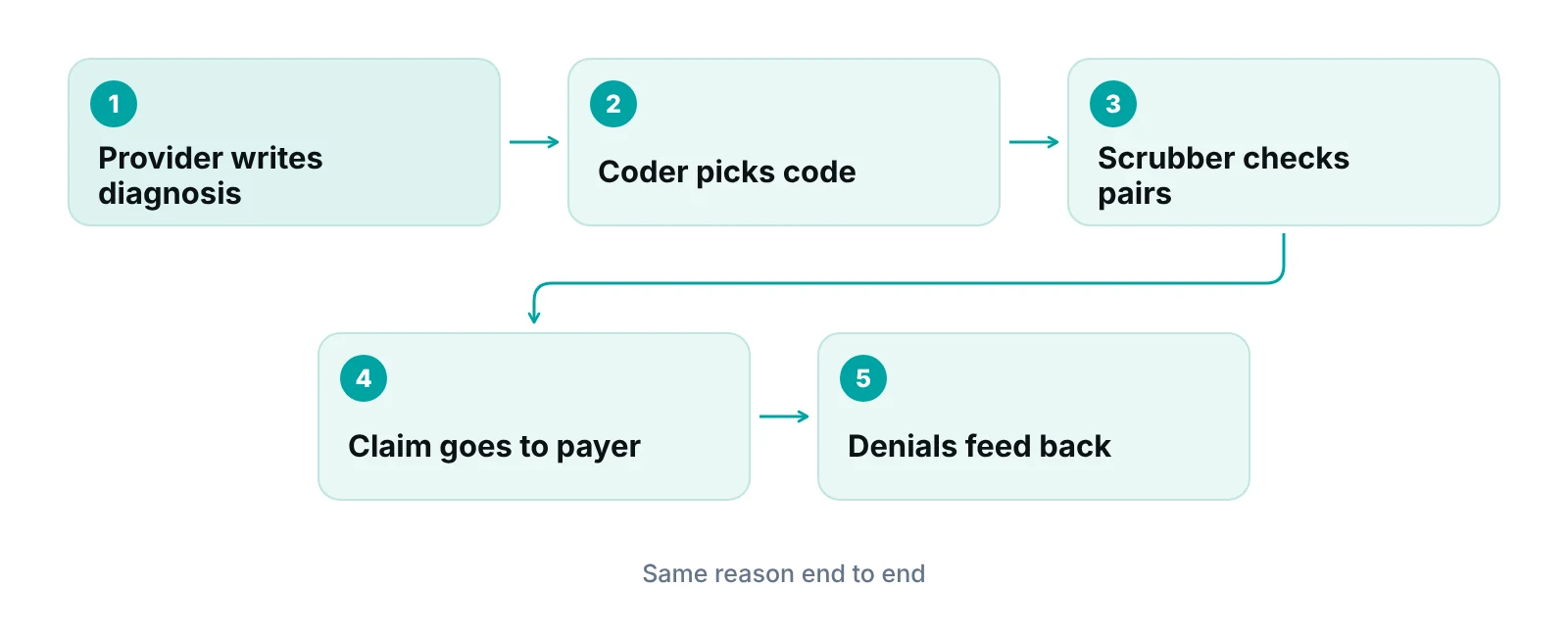
A scrub rule can catch the first three patterns before release. If you want to see how a pre-submission check works, read our claim scrubbing guide and the clean claims guide. For denials already in your queue, the guide to medical billing denials explains how to sort them.
Are symptom-coded claims coming back?
Send a sample of held or denied neurology and geriatrics claims. A free practice audit shows whether the gap is the note, the code pair or the payer list.
Worked example: one patient, three visits, three codes
Example (made up, de-identified). A practice sees an adult who reports trouble remembering recent events. Read how the code changes as the documentation changes.
- Visit 1. The provider documents “memory loss” and orders an evaluation. No diagnosis is established. The coder reports R41.3, because the complaint is a symptom with no confirmed cause and memory loss NOS is an inclusion term.
- Visit 2. The provider documents “mild cognitive impairment, cause undetermined.” The coder reports G31.84 and drops R41.3, because the R41 Excludes1 note names G31.84. If hypertension is documented and addressed, it is reported with its own I10-I1A code.
- Visit 3. The provider documents “dementia” with no type or severity. The coder reports F03.90 and does not add R41.3 or G31.84. G31.84 excludes dementia, and the memory symptom is part of the diagnosis. If the provider later adds a type or severity, the coder queries for the more specific code.
The patient and the complaint never changed. The documentation did, and each change moved the code. The cost of getting this wrong is an edit at the scrubber or a payer denial, not a clinical error, so a short provider query is cheaper than a resubmission.
“The symptom code is a placeholder for a diagnosis the provider has not made yet. Treat it as temporary and review it at every visit.”
— Awais Afzal, Healthcare Operations & Data Analyst
Our recommendations
- Put the inclusion term on your coder cheat sheet. Write “memory loss NOS is an inclusion term under R41.3” where coders will see it. It stops searches that fail because no code title contains the phrase.
- Add a pair check for R41.3. Hold any claim that carries R41.3 with G31.84, an F-code for dementia or amnestic disorder, or G45.4. Our workflow rules can flag a claim for review so a person looks at the pair before release.
- Use a one-line provider query. Ask: “Has a diagnosis been established for the memory complaint at this visit?” Keep the answer in the note, not in a side message.
- Never code uncertain outpatient diagnoses. Teach billers that “suspected” and “probable” mean a symptom code on an outpatient claim. Review a sample each quarter.
- Refresh code tables every October. Assign one person to load the new code set and spot-check R41 and G31.84 against the official tabular list before the first claims of the new fiscal year go out.
- Review symptom-coded claims on a schedule. In the claim data we have worked with from a neurology and pain practice setting, symptom codes were the ones that needed the most human review. Sort them monthly and ask whether a diagnosis has since been made.
Bottom line
Memory loss icd 10 coding is a documentation decision. Report R41.3 for memory loss NOS, move to R41.1 or R41.2 when a type is named, and replace the symptom code once the provider confirms a cause. If claims keep stalling on code pairs, our medical billing services and denial management services can review the pattern with you.
Frequently asked questions
What is the ICD-10 code for memory loss?
R41.3, other amnesia. The listing shows memory loss NOS and amnesia NOS as inclusion terms. Use R41.1 or R41.2 when the provider names anterograde or retrograde amnesia, and use a diagnosis code once the provider confirms a cause.
What is the difference between R41.3 and R41.82?
R41.3 is for amnesia and memory loss. R41.82 is altered mental status, unspecified, which has its own Excludes1 notes for altered level of consciousness (R40.-) and delirium NOS (R41.0). Choose by what the provider documents, not by which code is easier to find. If the note only says the patient is confused or disoriented, ask whether the provider means memory loss or a broader mental status change.
Can I report R41.3 with G31.84?
Not as a rule. The R41 category lists mild cognitive impairment of uncertain or unknown etiology (G31.84) in an Excludes1 note. The guidelines allow an exception when the conditions are unrelated, and they say to query the provider when that is unclear.
How do I code memory loss in a patient with dementia?
Report the dementia code and leave out R41.3. Memory loss is routinely part of dementia, and guideline I.B.5 says signs routinely associated with a disease should not be coded in addition. Use F03.90 only when nothing more specific is documented.
Can an outpatient claim use “suspected dementia”?
No. Outpatient and professional coders report the sign or symptom when the diagnosis is uncertain. Code R41.3 or another documented symptom until the provider confirms dementia or another diagnosis. Confirm your payer’s rule as well, and ask the provider to state a confirmed diagnosis in the assessment as soon as there is one.
Did FY2027 change the memory loss codes?
A published summary of the FY2027 update did not mention R41, G31 or G45, but a summary is not the addenda. Read the FY2027 addenda and tabular list for the codes you use, because new, revised and deleted codes took effect on 1 October 2026 and there is no grace period for claims with a date of service on or after that day.
Get your free practice audit
Tell us about your practice. We will contact you using the details you give.
- A review of your recent claims, denials and A/R aging
- Where your front desk and prior authorizations slow payment
- A prioritized fix list you keep, whether or not you hire us
Pricing is quoted after the audit, based on your volume and the services you choose. Prefer to talk? Call +1 (302) 556-2288.
Sources
- FY 2027 ICD-10-CM Official Guidelines for Coding and Reporting — CDC/NCHS (2026)
- ICD-10 codes (FY 2027 files listing) — CMS (2026)
- R41.3 Other amnesia (FY2027) — HCC Buddy (2026)
- R41.2 Retrograde amnesia (FY2027) — HCC Buddy (2026)
- G31.84 Mild cognitive impairment (FY2027) — HCC Buddy (2026)
- R41.82 Altered mental status, unspecified (FY2027) — HCC Buddy (2026)
- R41.81 Age-related cognitive decline — HCC Buddy (2026)
- F03.90 Unspecified dementia (FY2027) — HCC Buddy (2026)
- G45.4 Transient global amnesia (FY2027) — HCC Buddy (2026)
- I69 Sequelae of cerebrovascular disease (FY2027) — HCC Buddy (2026)
- I69.911 Memory deficit following unspecified cerebrovascular disease — AAPC (2026)
- R41 Other symptoms and signs involving cognitive functions and awareness — RapidClaims codebook (2026)
- R41.3 Other amnesia — Unbound Medicine (2026)
- R41.1 Anterograde amnesia — Unbound Medicine (2026)
- ICD-10-CM Diagnosis Codes in Group R41 — Find-A-Code (2026)
- ICD-10 Reminder Series: Section IV outpatient guidelines — Healthicity (2020)
- Don't Be Uncertain About Uncertain Diagnoses — ICD10monitor (MedLearn) (2022)
- FY 2027 ICD-10-CM Update: What Your Practice Needs to Know — KZA (2026)
Disclaimer: This article is educational and is not legal, coding, billing, medical or compliance advice. ICD-10-CM codes, guidelines and payer policies change each fiscal year and vary by payer. Verify current requirements with the official code set, your payers and your counsel before you act.
