

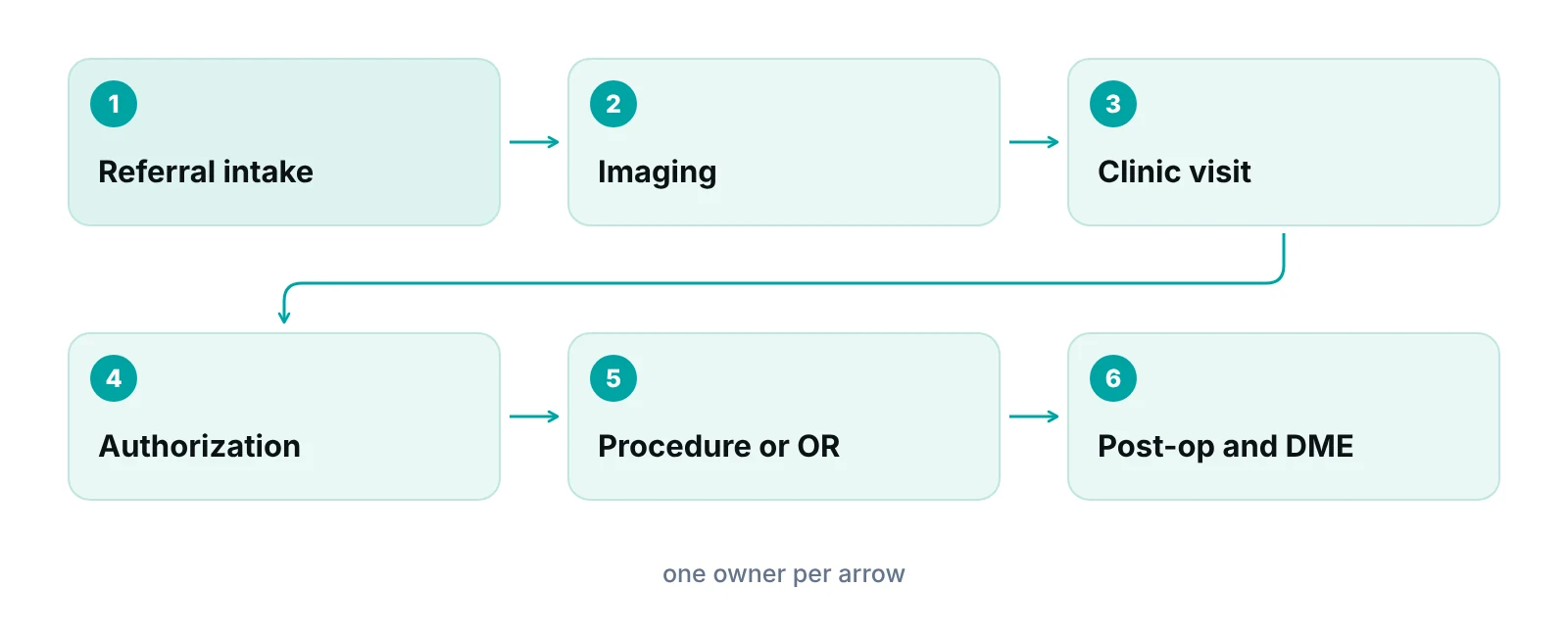
Orthopedic practice management is the daily work of moving a patient from referral to imaging, clinic visit, authorization, procedure or surgery, and recovery without losing time, orders or charges. It covers intake, clinic and operating-room scheduling, in-office procedures and DME, staffing, software and patient communication.
A busy orthopedic group is a chain of small handoffs. One missing authorization or report can stall the whole chain.
This guide is for owners and administrators. It covers what to build at each handoff and what to test in orthopedic practice management software, with no products or pricing. Rules from Medicare are labeled, and other payers may differ. See also our practice management software guide.
Key takeaways
- Treat the patient path from referral to post-op as one chain, with a named owner for each handoff.
- Track imaging as orders with statuses, and have the report in hand before the visit.
- Gate every surgical booking on authorization, paperwork, equipment and, for self-pay patients, a good faith estimate.
- Orthoses can sit on Medicare’s required prior authorization list, so give the DME list one owner.
- Test orthopedic practice management software with your own referrals, cases and data export before you sign.
What does orthopedic practice management cover?
Orthopedic practice management covers every handoff between the first referral call and the last post-operative visit. One patient can touch the clinic, imaging, a procedure room, an ambulatory surgery center (ASC) or hospital, a brace fitting and therapy within a few weeks. Each handoff can lose an authorization, an order or a charge.
Becker’s Spine Review interviewed an orthopedic group leader about what growing groups struggle with: business training gaps, limited time, hiring administrators, physician disagreements, marketing and patient experience (Becker’s Spine Review)).
This guide stays on operations. See our orthopedic billing services guide for billing partners, orthopedic revenue cycle management for payment, the orthopedic coding guide for modifiers and globals, and the orthopedic marketing plan for referral growth.
How should an orthopedic group run referral intake?
Run intake as a queue with a clock, not a fax pile. Every referral is logged, checked, matched to a provider and given a first-contact deadline. Referral requirements vary by plan, so the checklist asks. For electronic referral certification and authorization, the HIPAA standard CMS lists is the X12 278 version 5010, so ask your software or clearinghouse whether it supports it (CMS).
| Stage | What to capture | What goes wrong | Owner |
|---|---|---|---|
| Receive | Source, date and time received, urgency, contact number | Referral sits in a fax tray or inbox | Intake coordinator |
| Complete | Injury date and cause, body side, work-related or liability claim, referral requirement of the plan, prior imaging and where it was done | Missing side or claim type means wrong slot or payer | Intake coordinator |
| Verify | Active coverage, plan type, authorization needs for the visit and any imaging | Lapsed or different coverage at check-in | Front desk or virtual assistant |
| Match | Subspecialty, provider, location and visit length | Spine patient booked with a sports surgeon | Scheduler with clinical lead |
| Close the loop | Appointment date sent back to the referring office | Referrer never learns the patient was seen | Intake coordinator |
Source: RCM Finder operations framework; CMS adopted standards for the X12 278 (2026).
Hold same-week slots for acute injuries, and track referral-to-visit days by referring source.
How do you manage the imaging and MRI workflow?
Treat every image as a tracked order: ordered, authorized if required, scheduled, performed, report received and reviewed before the visit.
- Have physicians write which presenting problems may have imaging ordered before the consult, so schedulers do not decide clinical questions.
- For outside imaging, request images and report at scheduling, not check-in, and log arrival.
- Decide where each modality happens: your office, a partner facility or a hospital. The choice changes who bills and which legal rules apply.
- On Medicare, the appropriate use criteria program for advanced diagnostic imaging is paused. CMS says it rescinded the regulations at 42 CFR 414.94 and that providers should no longer put AUC consultation information on Medicare fee-for-service claims (CMS). Other payers keep their own imaging rules, so check each one.
Owning imaging adds a legal question. The AMA’s ancillary services checklist says radiology and certain other imaging are designated health services under the Stark law, and the in-office ancillary services exception depends on group practice requirements and on where, and by whom, the service is performed and billed (AMA). Get an attorney’s review before buying an MRI, and check state rules.
Under Medicare’s global surgery rules, diagnostic tests, including diagnostic radiology, are outside the global package (CMS MLN global surgery booklet). Post-op visits should allow time for a film, and the film should be captured as a charge.
How do you schedule clinic time against OR time?
Schedule the OR and the clinic as one system, because a surgeon’s block time and clinic template draw on the same hours. We suggest fixed clinic days and OR days per surgeon where possible, since mid-day moves between sites create idle rooms and late starts.
| Scheduling item | Rule or fact | What it means for the template |
|---|---|---|
| Post-op visits | Under Medicare’s 90-day global period, the package covers one pre-operative day, the surgery day and 90 days after, and routine post-op visits are included in the surgical payment | Use short post-op visit types and report them separately from clinic productivity |
| Decision for surgery | The first E/M visit that results in the decision for major surgery, on the day before or the day of surgery, can be billed separately with modifier 57 | Flag these visits so they are not coded as post-op; see the coding guide |
| Site of service | For 2026 CMS began a three-year phase-out of the inpatient only list, removing 285 procedures, mostly musculoskeletal, and added 289 procedures to the ASC covered procedures list | Review the site mix yearly; this is Medicare policy and other plans differ |
| Self-pay surgery | Uninsured or self-pay patients get a good faith estimate when care is scheduled at least 3 days ahead, and an updated one is due no later than 1 business day before service if the scope changes | Add the estimate to the surgery booking checklist |
Source: CMS MLN Global Surgery booklet (December 2025); CMS CY 2026 OPPS/ASC final rule fact sheet (2025); CMS Good Faith Estimates FAQ.
CMS says removed procedures can be paid in the hospital outpatient setting when clinically appropriate, and that 271 codes removed from the list were added to the ASC list. That is a payment rule; surgeons decide where a case belongs. Our joint replacement billing and coding guide and the post on ASC versus HOPD billing cover the billing side.
The good faith estimate applies to providers and facilities scheduling care for uninsured or self-pay patients, not generally to Medicare or Medicaid patients. The convening provider asks co-providers for expected charges within one business day (CMS FAQ).
A gate before any case is booked
- Authorization approved, or documented as not required, with the reference number.
- Clearance and pre-operative paperwork requested.
- Implants, instruments and any DME ordered and confirmed.
- Good faith estimate sent, for self-pay patients.
- Patient has written pre-op instructions and a post-op appointment already on the books.
What should you build around in-office procedures and DME?
Injections, supplies and braces are small items that are easy to forget, so capture the charge at the point of care. The rule: nothing leaves the room without a charge, an order and a name on it.
DME has an extra layer for Medicare. CMS keeps a master list of DMEPOS items that may need a face-to-face encounter and written order, prior authorization or both, and a smaller required prior authorization list where authorization is a condition of payment. CMS says it updates the master list at least once a year, and it added orthoses to the required list in 2026 (CMS).
The DME MAC CGS lists knee, spinal and ankle-foot orthoses under required prior authorization, with thoracic-lumbar-sacral codes L0456, L0457 and L0486 added nationwide from October 28, 2026. Decisions come within 5 business days (not over 7 calendar days), affirmed orthosis decisions last 60 calendar days, and the tracking number goes on the claim (CGS Medicare). CGS serves jurisdictions B and C; other DME MACs, such as Noridian for A and D, may differ.
The knee orthosis codes include L1832 and L1851. A draft policy article posted in July 2025 describes L1832 as a prefabricated, custom-fitted knee orthosis with adjustable joints and L1851 as an off-the-shelf single-upright knee orthosis for osteoarthritis pain (CMS Medicare Coverage Database). It is a draft, so confirm the final wording.
The AMA checklist also places DME, orthotics and physical therapy among Stark’s designated health services, so a bracing program needs the same legal review as imaging. Give one person the DME list.
Who should own authorization, and when?
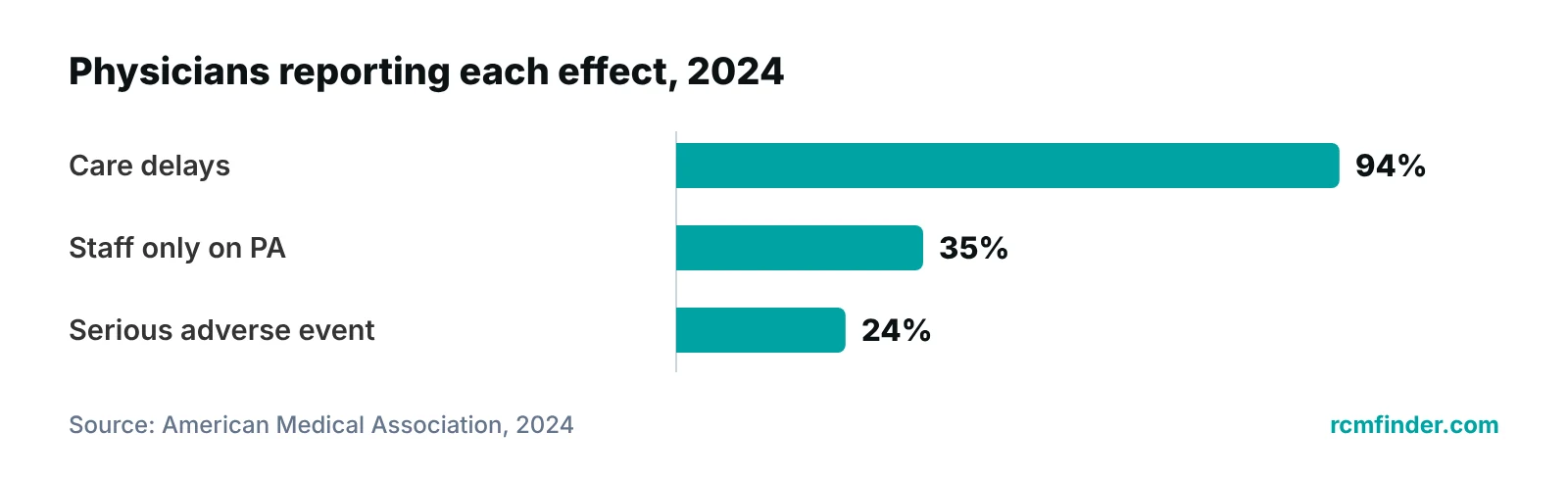
One named owner should run authorization, from scheduling until the claim is paid. The burden is large. In the AMA’s 2024 survey, physicians reported an average of 43 prior authorizations per week and 12 hours of physician and staff time spent on them, and 94% said prior authorization delays care (AMA).
Some relief is coming for patients on certain plans. CMS’s interoperability and prior authorization rule requires impacted payers to answer expedited requests within 72 hours and standard requests within seven calendar days from January 1, 2026, and to build prior authorization APIs from January 1, 2027. It covers Medicare Advantage, Medicaid and CHIP programs and exchange plans, and not traditional Medicare fee-for-service or drugs (CMS). Many orthopedic patients fall outside it.
- Keep one tracker for every authorization with request date, payer, reference number, decision date, approved dates and expiry.
- Link each approval to the scheduled date so an expiring approval raises a flag.
- Record any denial reason with the case.
- Hand repeatable steps to trained staff. Our prior authorization guide covers the front-desk steps, and our virtual medical assistants run authorizations inside your EHR in your time zone.
How should you staff scribes, MAs and the front desk?
Staff by task, not title. An orthopedic day has four kinds of work: documentation, rooming and procedures, scheduling and intake, and authorization. Each can have a different owner.
- Scribes. On Medicare, First Coast Service Options says the provider should sign the entry, and that Medicare does not require the scribe to sign or date it (February 2026). That is one MAC’s guidance, so check yours.
- Medical assistants. MAs room patients, prepare injection and cast supplies and track imaging. A written room checklist gives the physician the same setup each time. Scope of practice varies by state.
- Surgical scheduler. One person who holds the booking gate above.
- Authorization coordinator. The tracker owner.
- Front desk and intake. This is where eligibility, intake forms and scheduling live. Our team books and confirms visits, checks eligibility and handles intake inside your existing EHR, on your practice’s clock.
“If the authorization, the images and the equipment are not ready, the slot is not really booked.”
— Awais Afzal, Healthcare Operations & Data Analyst
Becker’s notes that administrators with business skills often lack clinical knowledge, so pair them with a clinical lead (Becker’s Spine Review).
What should orthopedic practice management software do?
Orthopedic practice management software should run the intake-to-payment chain, so test it against your workflow, not a feature list. Our EMR vs EHR guide covers the record side. Use this checklist for the practice side.
| Area | Test in the demo | Why it matters |
|---|---|---|
| Referral and intake queue | Log a faxed referral with injury details and see its age and owner | Referrals do not get lost |
| Imaging orders | Track an outside MRI from order to report | The report is back before the visit |
| Schedule and cases | Show clinic templates and a surgical case | Clinic and OR time are planned together |
| Authorization tracking | Enter an approval with expiry date and link it to a surgery date | Expired approvals are caught |
| Charge capture | Capture an injection, cast supplies and a brace at the visit | Small items reach the claim |
| Claim checks and rejects | Show edits before submission and how rejections are worked | Errors are fixed before the payer sees them |
| Security and access | Role-based logins, an audit log and a signed business associate agreement | Protects patient data |
| Reports and export | Claims by stage, denials by reason and a full data export | You can leave with your data |
Source: RCM Finder framework; HHS business associate guidance; CMS adopted standards.
HHS lists billing and practice management among functions that make a vendor a business associate, and a business associate agreement generally must be in place before patient information is shared (HHS). Ask for it before any demo uses real data.
RCM Finder’s practice management system is a billing-operations portal. Today it tracks claims by stage, checks claim data before submission, flags underpayments, runs workflow rules, and uses role-based permissions with an audit log. Appointment scheduling is in early access. Credentialing and in-portal real-time eligibility are not live, so those stay with your EHR and our team. We put a Business Associate Agreement in place before accessing patient data.
See where your own handoffs break
Our free practice audit reviews how your front desk, authorization and billing steps hand work to each other and gives you a plain list of where claims and cases stall.
How should an orthopedic practice handle patient communication?
Send the same few messages at the same points every time. HHS says the Privacy Rule does not prohibit unencrypted email for treatment-related messages when reasonable safeguards apply, but providers should limit content and offer another channel to a patient who asks (HHS). That FAQ covers email only, so settle a texting policy with your attorney.
- Before the first visit: what to bring, imaging to send, forms and the right location.
- Before imaging or surgery: preparation, arrival time and who to call.
- For self-pay surgery: the good faith estimate.
- After surgery: the next appointment, equipment instructions and a number that reaches a person.
Keep clinical detail out of messages; put instructions in the message and diagnosis in the portal or the call.
Our recommendations
- Draw the path from referral to post-op on one page. List every handoff and name an owner. Gaps show up as an arrow without a name.
- Put a gate in front of the OR schedule. No case is booked until authorization, paperwork, equipment and any estimate are confirmed.
- Track images as orders. Give every MRI and outside film a status and an owner, and make the report a pre-visit task.
- Give one person the DME list. Review it whenever CMS publishes an update and keep each approval with its tracking number and expiry date.
- Write job cards, then staff to them. Define what MAs, schedulers, scribes and the authorization coordinator own before hiring more people.
- Run a six-task demo, then review four numbers monthly. Test intake, an MRI, a case booking, an authorization, a brace charge and a data export on any software. Then watch referral-to-visit days, imaging turnaround, authorization-to-surgery lead time and post-op load.
Bottom line
Orthopedic practice management comes down to owners, gates and tracking: a named person for every handoff, a checklist before every booking and a status on every order. See what our practice management system, lists as live today, and read about our revenue cycle management service for the billing side.
Frequently asked questions
What does orthopedic practice management include?
It includes referral intake, imaging workflow, scheduling clinic and operating-room time, in-office procedures and DME, authorizations, staffing, software, patient communication and reporting. The goal is that each patient moves from referral to recovery without a lost order, authorization or charge, and that the practice can see where work is stuck.
How should we handle orthopedic referrals?
Log each referral the day it arrives, check it against a standard list, verify coverage, match it to the right provider and send the appointment date back to the referrer. Hold same-week slots for acute injuries and track referral-to-visit days by source, so you know which referrers wait longest.
Do we need Stark review before adding MRI or DME?
Imaging, DME, orthotics and physical therapy are designated health services under the Stark law, and the in-office ancillary services exception has group practice, location and billing conditions. Have a health care attorney review the plan first, and check your state’s rules as well.
How do global periods affect scheduling?
Under Medicare, a major procedure’s 90-day global period covers one pre-operative day, the surgery day and 90 days after, and routine post-op visits are part of the surgical payment. Create short post-op visit types and track them separately. Other payers may differ.
Does a knee or back brace need prior authorization?
For Medicare, some orthoses are on the DMEPOS required prior authorization list. CGS lists knee, spinal and ankle-foot orthoses, and the list changes. Check the list for your DME MAC and each commercial plan before delivery, and keep the approval number.
What should orthopedic practice management software do?
It should track referrals, imaging orders, the schedule and surgical cases, authorizations with expiry dates, charge capture and claims. It should offer role-based access, an audit log, a business associate agreement and a data export. Test each one in a demo with your own workflow and data.
Get your free practice audit
Tell us about your practice. We will contact you using the details you give.
- A review of your recent claims, denials and A/R aging
- Where your front desk and prior authorizations slow payment
- A prioritized fix list you keep, whether or not you hire us
Pricing is quoted after the audit, based on your volume and the services you choose. Prefer to talk? Call +1 (302) 556-2288.
Sources
- Global Surgery Booklet (MLN907166) — Centers for Medicare & Medicaid Services (2025)
- CY 2026 OPPS and ASC final rule fact sheet — Centers for Medicare & Medicaid Services (2025)
- Good Faith Estimates FAQ — Centers for Medicare & Medicaid Services (2022)
- Scribe services — First Coast Service Options (Medicare) (2026)
- DMEPOS Prior Authorization — Centers for Medicare & Medicaid Services (2026)
- Orthoses Required Prior Authorization — CGS Administrators (DME MAC) (2026)
- Knee Orthoses Policy Article (draft, DL33318) — Centers for Medicare & Medicaid Services, Medicare Coverage Database (2025)
- Private practice checklist: ancillary services — American Medical Association (2022)
- Appropriate Use Criteria Program — Centers for Medicare & Medicaid Services (2024)
- AMA survey indicates prior authorization wreaks havoc on patient care — American Medical Association (2024)
- CMS Interoperability and Prior Authorization Final Rule (CMS-0057-F) fact sheet — Centers for Medicare & Medicaid Services (2024)
- Adopted Standards and Operating Rules — Centers for Medicare & Medicaid Services
- Does HIPAA permit health care providers to use email to discuss health issues with patients? — U.S. Department of Health and Human Services
- Business Associates — U.S. Department of Health and Human Services
- 6 challenges for orthopedic physician practice leaders and how to overcome them — Becker's Spine Review
Disclaimer: This article is educational and is not legal, coding, tax or compliance advice. Medicare policy differs by contractor and payer rules differ by plan and state, and both change over time, so confirm current requirements with your MAC, each payer and your attorney before acting. CPT is a registered trademark of the American Medical Association; official code descriptors are not reproduced here.
