

Orthopedic revenue cycle management is the control of every step from the first scheduling call to the last patient payment. Orthopedics has distinct pressure points: authorizations for imaging, surgery and DME, charge capture across clinic, in-office and operating room work, global-period rules, high deductibles and workers' compensation deadlines.
Orthopedic practices bill across a clinic room, a procedure room, a brace shelf and an operating room, often with a work-injury claim beside ordinary insurance. Each setting loses charges in its own way.
This guide walks the cycle in order and ties each rule to a source. For code selection see the orthopedic coding guide; for choosing outside help, see orthopedic billing services.
Key takeaways
- Authorization is a tracked work queue: 39 requests and 13 hours per physician each week in the AMA’s 2024 survey.
- Charges are missed outside the visit note: procedures, supplies, dispensed DME and surgery.
- A Medicare 90-day global period counts 92 days, and related recovery care is inside it.
- Medicare denies claims received more than 12 months after service; other payers set their own limits.
- About one-third of covered workers face a deductible of $2,000 or more (KFF, 2025), so estimates belong before surgery.
What are the stages of the orthopedic revenue cycle?
Seven stages carry an orthopedic claim from the phone call to the last payment, and orthopedics adds a parallel track for workers’ compensation. Table 1 shows where each tends to break.
| Stage | Where it tends to break | Control to put in place |
|---|---|---|
| Schedule and authorize | Request filed late; approval does not match the surgery date, site or code | Authorization tracker with an owner and a surgery-date check |
| Register and verify | Injury-related visit registered as ordinary health insurance | Injury questions at scheduling; eligibility check before the visit |
| Capture charges | Procedure done, charge never entered; visit billed inside a global period | Daily reconciliation against the schedule and procedure log |
| Code and edit | Modifier missing or unsupported; code pair bundled | Pre-submission edit review by someone who reads the note |
| Submit and post | Rejections not worked; short pays not noticed | Daily submission; posting compared with expected amount |
| Work denials and A/R | Denials sorted by payer, not cause; filing limits missed | Denial log by reason; weekly aging review |
| Collect from patients | Balance first discussed after the claim is paid | Estimate and payment conversation before the service |
| Workers’ compensation | Bill late, wrong carrier, no authorization number | Separate payer class with its own calendar |
Source: RCM Finder editorial framework; individual rules are sourced in later sections
Coding detail lives in our orthopedic coding guide, vendor questions in orthopedic billing services, and scheduling operations in the orthopedic practice management guide. Becker’s Spine Review (2011) made the point that payment work starts at first patient contact.
How should an orthopedic practice handle authorization for imaging, surgery and DME?
Treat authorization as a tracked work queue, not a task that lives in someone’s inbox. The AMA reported from its late-2024 survey of 1,000 physicians that practices complete an average of 39 prior authorizations per physician per week, spending 13 hours of physician and staff time, and 40 percent of physicians have staff who work only on prior authorization. Figures cover all specialties.
Failures differ by request. Imaging and injections get done before the approval posts. Surgery approvals are tied to a procedure, facility and date range, so a changed case needs a recheck. For braces and DME, the approval, the item dispensed and the code billed must agree.
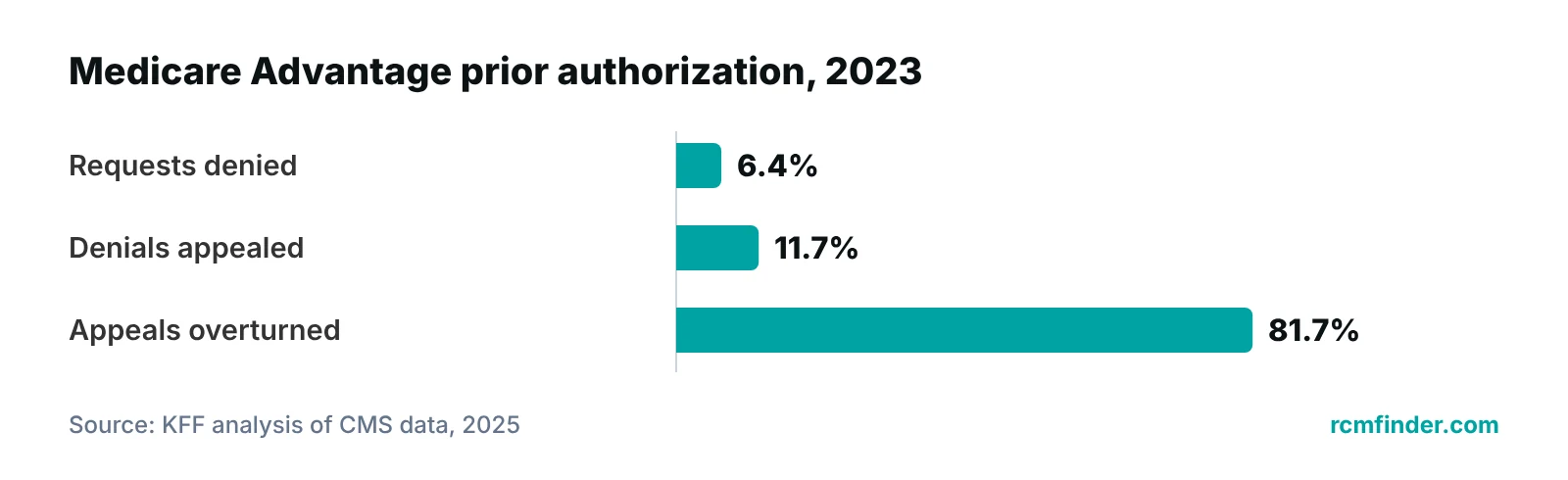
Medicare Advantage is where many practices feel the most friction. According to a KFF analysis of CMS data, Medicare Advantage insurers made about 49.8 million prior authorization determinations in 2023 and denied about 3.2 million of them, in full or in part. That is 6.4 percent. Only 11.7 percent of those denials were appealed, and of those appeals, 81.7 percent were overturned in full or in part. This is Medicare Advantage only, not a commercial or traditional Medicare rate.
Two changes are worth tracking. First, the CMS interoperability and prior authorization final rule sets decision timeframes of 72 hours for expedited requests and seven calendar days for standard requests, beginning primarily in 2026, for Medicare Advantage, Medicaid and CHIP payers, and requires a specific reason for a denial. CMS’s release does not say it reaches commercial employer plans, so read each payer’s policy. Second, CMS’s WISeR model began adding prior authorization to traditional Medicare in six states (Arizona, New Jersey, Ohio, Oklahoma, Texas and Washington) in 2026. The CMS list, which is subject to change, includes epidural steroid injections, cervical fusion, percutaneous vertebral augmentation and arthroscopic lavage or debridement for the osteoarthritic knee. A Georgetown summary reports two services delayed in April 2026, and Becker’s Payer reports the Senate blocked a repeal motion on July 16. Check current status, and ask your Medicare Administrative Contractor which of your services are on the list.
For the how-to, see our prior authorization guide. If your team is stretched, a virtual medical assistant can run the tracker while clinicians make every clinical decision.
What has to be right at registration and eligibility?
Two questions matter most: who is the primary payer for this visit, and is the visit related to an injury. Orthopedic patients often arrive after a fall, a car accident or a work injury. If the visit is registered as ordinary health insurance, the claim can be denied later, or a workers’ compensation carrier can be billed after a deadline has passed.
- Ask the injury question at scheduling and record it in a field, not a free-text note.
- For work injuries, collect the carrier, claim number, date of injury, adjuster and employer at the first visit.
- Verify coverage before the visit and again before surgery. Our patient insurance verification guide explains the checks.
- Save what the payer said, with the date and reference number.
Where do charges get missed across clinic, in-office procedures and surgery?
Charges get missed where the work happens outside the visit note: procedures done in a room, supplies handed to the patient, and the operating room. Table 2 sorts the three settings by what must reach the claim and what the payer will check.
| Setting | What must reach the claim | Rule to know |
|---|---|---|
| Clinic visit | The visit, and any separate decision-for-surgery visit | The first visit that leads to a decision for major surgery is outside the global package and takes modifier 57 |
| In-office procedure | The procedure, supplies and any separately payable visit | Modifier 25 marks a significant, separately identifiable visit on the procedure day; the note must support it |
| Post-operative visit | Usually nothing, unless unrelated or a return to the operating room | Related recovery care is inside the global package; modifiers 24, 78 and 79 cover unrelated or return situations |
| Surgery | The operation, assistant or co-surgeon work, staged procedures | A 90-day period counts 92 days; 58 covers a planned staged procedure; 54 and 55 split surgical and post-operative care |
Source: CMS Global Surgery Booklet, MLN907166 (December 2025). Medicare definitions; other payers may differ.
In the CMS Global Surgery booklet (December 2025), a 90-day period covers one day before surgery, the day of surgery and the 90 days after. Related recovery care, dressing changes and suture removal fall inside it; a visit unrelated to the surgical diagnosis does not. Look up each code’s global period, and note that commercial payers can set their own rules. For arthroplasty specifics, see our guide to joint replacement billing and coding.
In-office DME is a revenue stream and an enrollment decision
If your practice dispenses braces or other durable medical equipment, billing Medicare is not automatic. According to CMS, a DMEPOS supplier must obtain accreditation from a CMS-approved organization, hold an NPI for each location, enroll through PECOS and post a $50,000 surety bond for each NPI. CMS says certain professionals may be exempt from accreditation without saying which, so confirm your status with your enrollment contractor before dispensing. Then feed the dispensing log into the charge list the same day.
“Most missed orthopedic revenue is work that was done and never charged. Daily reconciliation catches it while someone remembers the room.”
— Awais Afzal, Healthcare Operations & Data Analyst
What should a claim edit check before an orthopedic claim is sent?
It should check the things a payer’s system will check, before the payer does. The National Correct Coding Initiative procedure-to-procedure edits exist to prevent improper payment when incorrect code combinations are reported, and Medicare contractors apply them during routine claim processing. Under the NCCI policy manual (2017 introduction), when two codes in a pair are reported for the same patient on the same date, the first can be paid and the second is denied unless a clinically appropriate NCCI-associated modifier is reported.
A pre-submission edit list for orthopedics has five checks:
- The authorization number, dates and facility match the claim.
- Every modifier is supported by words in the note.
- The patient is not inside a global period for a related service.
- Laterality or site is present where the code requires it.
- Workers’ compensation claims carry the claim number and authorization number.
A modifier added only to clear an edit is a compliance problem, not a fix. Our clean claims guide explains the method.
How do you manage orthopedic denials and A/R?
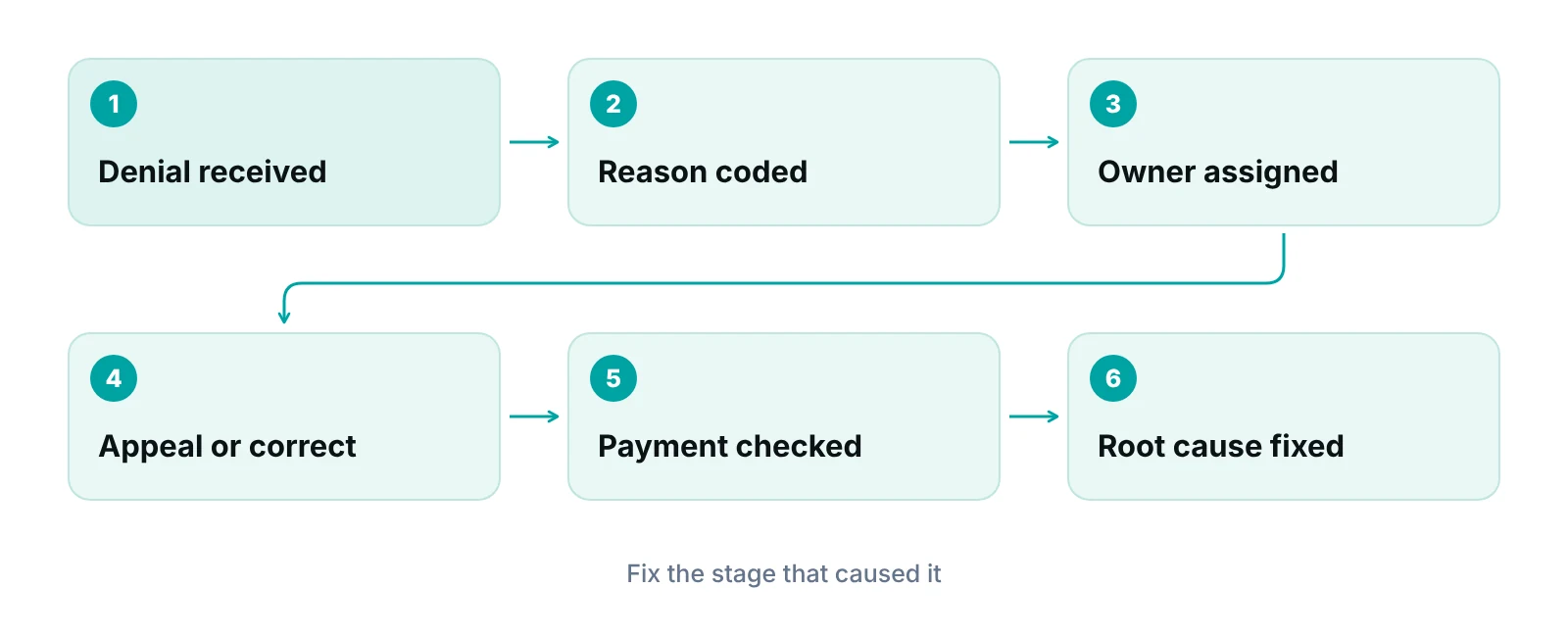
Work denials by cause, not payer name. A denial log with a reason, owner and deadline shows whether the root problem is the front desk, the coder or the payer. Our guides to denial management and accounts receivable cover the general method.
- Authorization denials: compare the approval’s code, date and facility with the claim. Many are mismatches.
- Global-period denials: confirm the service was truly unrelated before appending a modifier, then send the note.
- Medical necessity: bring imaging reports, conservative-care history and function. Build the checklist from each payer’s published criteria.
- Underpayments: compare payments with the contracted amount and keep a file by payer for contract renewal (Becker’s Spine Review, 2011).
Filing limits are firm. According to the Medicare Claims Processing Manual (CMS transmittal 12909, October 2024), Medicare denies a claim as untimely when it is received more than 12 months after the services were furnished, with limited exceptions such as administrative error or retroactive entitlement. Commercial and Medicare Advantage limits are set by contract; put each in your A/R worklist.
How do high deductibles change patient balances in orthopedics?
They make the patient the second-largest payer on an elective surgery, and they put the balance conversation before the service. The KFF 2025 Employer Health Benefits Survey found that 88 percent of covered workers with single coverage have a general annual deductible, the average is $1,886 among those with one, and 34 percent face a deductible of $2,000 or more. The survey covered 1,862 employers with ten or more workers.
Medicare patients carry cost sharing too. For 2026, CMS lists a Part B annual deductible of $283 and 20 percent coinsurance for covered services, which a supplemental plan may or may not cover.
- Estimate before surgery from verified benefits, the expected allowed amount and the remaining deductible, and call it an estimate.
- Ask for the expected portion at scheduling or pre-op, and put any payment plan in writing.
- Explain separate bills from surgeon, facility and anesthesia.
- Send statements promptly after the explanation of benefits.
Patient-balance rules also depend on state law and your payer contracts, so have your attorney review your financial policy.
Why does workers' compensation need its own track?
Because the clock, the authorization and the rules about billing the patient differ from health insurance, and each state sets its own. Texas is one example; your state will differ.
Under 28 Texas Administrative Code 133.20, a provider must not submit a medical bill later than the 95th day after the date of service, with limited exceptions. The Texas Department of Insurance’s provider billing guide (2025) adds that carriers must pay, reduce, deny or decide whether to audit a complete bill by day 45, reconsideration requests are due within 10 months of the date of service, the injured employee generally should not be billed for compensable care, and an approved preauthorization number goes in field 23 of the CMS-1500.
| Payer class | Rule that changes the work | Control |
|---|---|---|
| Traditional Medicare | 12-month filing limit; global surgery package; NCCI edits | Filing-limit date on every A/R line |
| Medicare Advantage | Prior authorization on many services; appeal rights | Authorization tracker; appeal inside the plan’s window |
| Commercial plans | Contract-specific rules; high deductibles; own authorization lists | Payer rules sheet; patient estimate before service |
| Workers’ compensation | State fee schedule; in Texas, a 95-day bill limit and 45-day carrier decision | Separate calendar by state; claim and authorization numbers on the bill |
Sources: CMS (2024, 2025); KFF (2025); Texas Department of Insurance, Division of Workers’ Compensation (2025). Other states and payers differ.
For the deeper workers’ compensation view, see our workers’ compensation benefits and the revenue cycle post. Liability cases after accidents need their own tracking, with rules that depend on the state; ask your attorney.
Where does your orthopedic revenue cycle leak?
Share a sample of denied, short-paid and aged claims. A free practice audit maps them to the stages above. Pricing is quoted after the audit.
What should an orthopedic practice measure each week?
Five numbers are enough to start, each with one owner:
- Authorizations open past their target date, by payer.
- Charges entered within one day of the procedure log.
- First-pass rejections and denials, grouped by reason.
- A/R older than 90 days, split into payer and patient.
- Workers’ compensation bills nearing the state deadline.
Estimate the cost of slow or denied claims
Enter your claim volume to estimate what delayed and denied claims may cost.
Set targets against your own baseline and payer mix.
Our recommendations
- Name one owner for each stage. Each stage needs a person, a list and a weekly review. A stage with no owner is where revenue leaks.
- Build the authorization tracker around the surgery date. Track approval, facility, code and date range, and confirm all four match before each case.
- Ask the injury question every time. One field at scheduling that routes work injuries to the workers’ compensation track prevents late bills.
- Reconcile charges daily. Compare the schedule, procedure log and dispensing log with the charge list at day’s end.
- Work denials by cause. Log the reason, find the stage that caused it and fix that stage, or the denial returns.
- Give every surgical patient an estimate. Verify benefits and state the expected patient portion before the date of surgery.
Bottom line
Orthopedic revenue cycle management is a set of small, owned controls at predictable stages. Start with the stage in Table 1 that hurts most and measure it weekly. If you want a second set of eyes, our end-to-end revenue cycle management service starts with a free practice audit.
Frequently asked questions
What is orthopedic revenue cycle management?
It is the management of every step from scheduling and authorization through registration, charge capture, coding, claim submission, denials, A/R and patient balances. In orthopedics, the stress points are imaging and surgery authorizations, charges for in-office procedures and supplies, global-period rules, high deductibles and workers’ compensation deadlines.
Which stage of the orthopedic revenue cycle loses the most money?
We cannot give a reliable single figure, because it depends on the practice. Compare your own data: missed authorization dates, procedures with no charge, denials by reason and A/R past 90 days. Start with the largest dollar total.
Does Medicare require prior authorization for orthopedic surgery?
Traditional Medicare generally does not require it for most orthopedic services, but CMS’s WISeR model adds prior authorization for a short list of services in six states, and Medicare Advantage plans often require it. The WISeR list is subject to change, so check with your Medicare Administrative Contractor.
How long do you have to bill Medicare?
Medicare denies a claim as untimely when it is received more than 12 months after the date services were furnished, with limited exceptions listed in the Claims Processing Manual. Commercial and Medicare Advantage plans set their own limits by contract, and workers’ compensation limits are set by each state.
Why is workers' compensation billed differently?
The payer is a workers’ compensation carrier under a state system, with its own fee schedule, forms, deadlines and rules about billing the injured worker. In Texas, for example, bills are due by day 95. Rules differ by state, so set up a separate track and confirm each state’s requirements.
How should we handle patients with high deductibles before surgery?
Verify benefits, estimate the patient’s portion from the remaining deductible and expected allowed amount, and discuss it before surgery. Put any payment plan in writing and have your attorney review your financial policy.
Get your free practice audit
Tell us about your practice. We will contact you using the details you give.
- A review of your recent claims, denials and A/R aging
- Where your front desk and prior authorizations slow payment
- A prioritized fix list you keep, whether or not you hire us
Pricing is quoted after the audit, based on your volume and the services you choose. Prefer to talk? Call +1 (302) 556-2288.
Sources
- Fixing prior auth: Nearly 40 prior authorizations a week is way too many — American Medical Association (2025)
- Medicare Advantage insurers made nearly 50 million prior authorization determinations in 2023 — KFF (2025)
- 2025 Employer Health Benefits Survey: Summary of Findings — KFF (2025)
- CMS Finalizes Rule to Expand Access to Health Information and Improve the Prior Authorization Process — CMS (2024)
- WISeR Model Request for Applications — CMS (2025)
- CMS launches new model to target wasteful and inappropriate services in Original Medicare — CMS (2025)
- CMS's WISeR Model Faces Potential Repeal Following GAO Determination — Georgetown University Center for Health Insurance Reforms (2026)
- Senate Republicans block effort to repeal Medicare AI prior authorization pilot — Becker's Payer Issues (2026)
- Global Surgery Booklet (MLN907166) — CMS (2025)
- Medicare Claims Processing Manual Chapter 1, Transmittal 12909 — CMS (2024)
- Medicare Deductible, Coinsurance and Premium Rates CY 2026 (MM14279) — CMS (2025)
- 28 Tex. Admin. Code 133.20: Medical Bill Submission by Health Care Provider — Cornell Legal Information Institute (Texas Administrative Code) (2025)
- Health Care Provider Billing Procedures — Texas Department of Insurance, Division of Workers' Compensation (2025)
- Enroll as a DMEPOS Supplier — CMS (2025)
- CMS National Correct Coding Initiative Edits — HHS guidance repository (CMS) (2025)
- NCCI Policy Manual, 2017 Introduction — CMS (2017)
- Managing the Revenue Cycle: 10 Areas of Improvement for Orthopedic Practices — Becker's Spine Review (2011)
Disclaimer: This article is educational and is not legal, coding, tax or compliance advice. CPT is a registered trademark of the American Medical Association. Medicare rules shown are national or from the cited documents; Medicare contractors, commercial payers and states differ, and rules change, so confirm current requirements with your payers, Medicare Administrative Contractor and attorney before acting.
