
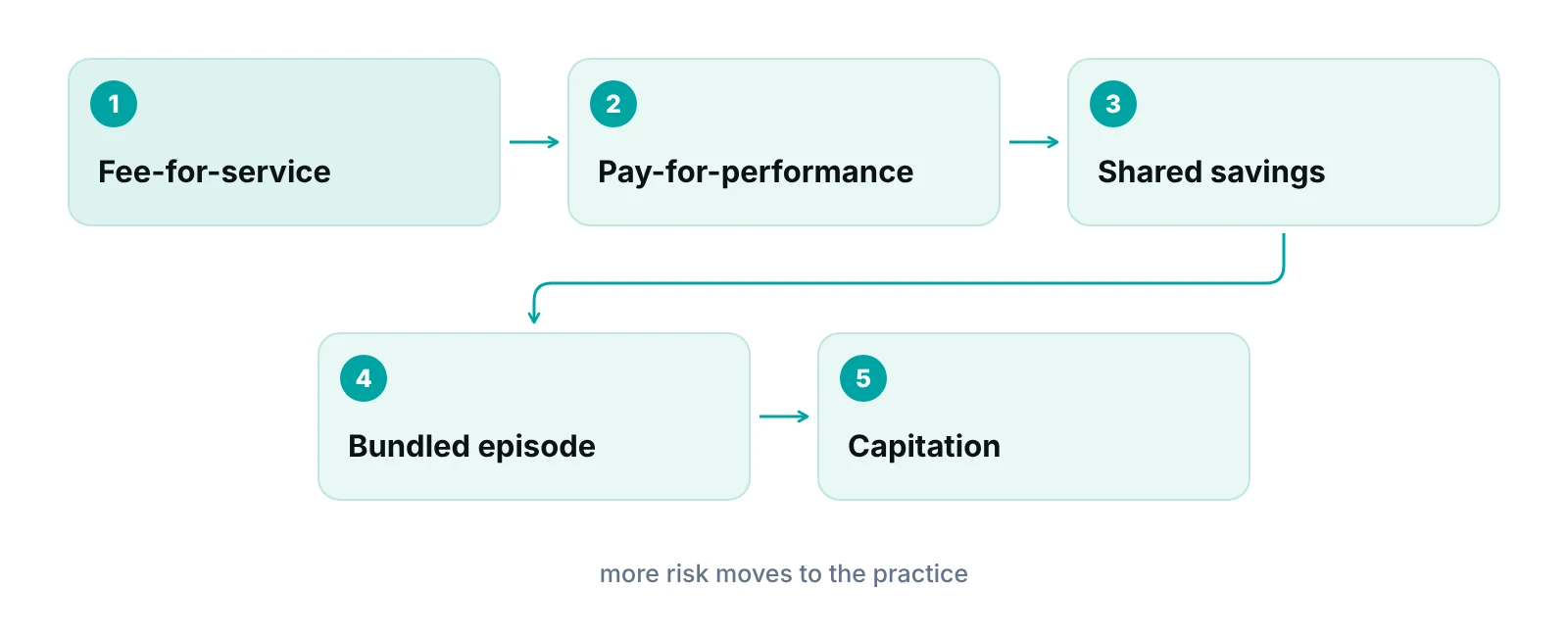
The main types of reimbursement in healthcare are fee-for-service, pay-for-performance, shared-savings value-based care, bundled payments and capitation. They differ in what triggers payment: a service, a quality result, savings against a benchmark, a whole episode of care, or an enrolled patient. Most practices are paid under a mix of them.
You open last month’s remittances and the deposits do not follow visit volume. The cause is often not a billing mistake. It is the payment model behind the contract. This guide covers the five models, what each one asks of your front desk, coders and physicians, and how to tell which one a payer is using. It is written for practice owners and managers who are comparing contracts or planning the year. For a deeper look at the two ends of the range, see our guide to fee-for-service vs value-based care, and for the wider payment-systems picture see provider payment systems in healthcare.
Key takeaways
- Five models cover most payer contracts: fee-for-service, pay-for-performance, shared savings, bundled payments and capitation.
- Fee-for-service is still the base: 82.8% of physicians were in practices with some FFS revenue in AMA’s 2024 survey.
- The model sets where financial risk sits, so it decides which numbers you must watch each month.
- Read the contract language, not the payer’s name, to know which model applies to a claim.
- RAND’s 254% figure describes hospital and facility prices in 2022. It is not a measure of physician fees.
What does reimbursement mean in healthcare?
Reimbursement is the payment a provider receives from a payer for care delivered. The payer may be Medicare, Medicaid or a commercial plan. The payment model sets what triggers the payment and who carries the financial risk if costs run above or below plan.
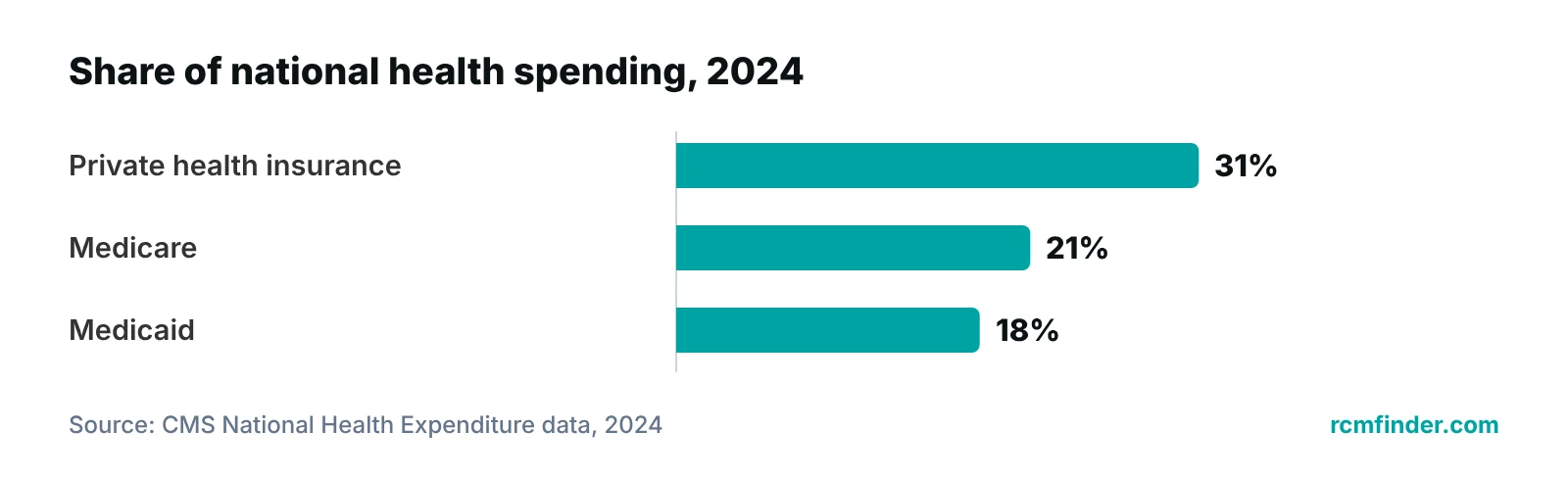
The scale is large. CMS reports that U.S. national health spending grew 7.2% to $5.3 trillion in 2024, about $15,474 per person and 18.0% of GDP. Private health insurance paid for 31% of that spending, Medicare 21% and Medicaid 18%.
Each of those payers can use more than one model, and a single practice often holds contracts under several at once. The AMA’s 2024 survey shows it: 82.8% of physicians were in practices with some fee-for-service revenue, 20.3% had some capitation, and 62.4% were in practices using at least one of four alternative payment models the survey asked about. Those shares add up to far more than 100%, which only works if practices are paid under a mix.
| Measure | Figure | Data year | Source |
|---|---|---|---|
| Physicians in practices with some FFS revenue | 82.8% | 2024 | AMA |
| Share of practice revenue from FFS | 67.7% | 2024 | AMA |
| Physicians in practices with some capitation | 20.3% | 2024 | AMA |
| Medicare beneficiaries (Parts A and B) in Medicare Advantage | 35.2 million of 64.2 million (55%) | 2026 | KFF |
| Lives in accountable care arrangements (survey participants, partial data) | 88.5 million | 2023 | HCP-LAN |
Source: AMA Physician Practice Benchmark Survey (2025); KFF (2026); HCP-LAN 2024 APM Measurement (2025).
What are the five main types of reimbursement in healthcare?
The five models below are the ones practice managers meet most. They sit on a range from paying for volume to paying for results to paying for a patient or an episode. The Health Care Payment Learning & Action Network (HCP-LAN) APM Framework classifies payments by how far they reward the value of services rather than the volume of services, and the grouping below follows it loosely.
1. Fee-for-service (FFS)
Fee-for-service pays for each service delivered. In the HCP-LAN framework it is the base category, with no link to quality (Category 1) or with bonuses or penalties tied to reporting or performance (Category 2). It is still the most common model. The AMA Physician Practice Benchmark Survey (2024 data, published September 2025) found that 82.8% of physicians were in practices that received at least some revenue from FFS, and 67.7% of practice revenue came from it.
Under FFS, every service needs its own clean claim. Cash flow therefore depends on charge capture, coding accuracy and how fast denials are worked. The numbers to watch are denial rate, days in A/R and net collection rate. Our guide to revenue cycle KPIs shows how to calculate each.
2. Pay-for-performance (P4P)
Pay-for-performance adds a bonus or a penalty to a base payment, based on quality or cost results. HCP-LAN places pay for reporting and pay-for-performance inside FFS-based Category 2. Medicare’s main example is MIPS, the Merit-based Incentive Payment System.
For the 2024 performance year, which sets 2026 Medicare Part B payments, CMS’s payment adjustment guide lists a performance threshold of 75 points and a maximum negative adjustment of 9% (2026 MIPS Payment Adjustment User Guide). A score at the threshold gives a neutral adjustment. Positive adjustments are scaled to keep the program budget neutral, so the size of any bonus depends on a scaling factor that CMS sets from the national score distribution. The practical point is the asymmetry: the penalty ceiling is fixed at 9%, while the bonus depends on how everyone else scores. Our MIPS categories and scoring guide covers the scoring detail.
3. Value-based care with shared savings
Value-based care is an umbrella term, not one model. Its most common payment form for practices is shared savings, often through an accountable care organization (ACO). In the HCP-LAN framework, shared savings sit in Category 3, which is built on an FFS base. They can carry upside only or upside and downside risk. In the AMA’s 2024 survey, 53.5% of physicians were in practices that participated in at least one type of ACO.
HCP-LAN’s 2024 measurement effort, which reports calendar-year 2023 payments, counted 88.5 million lives in accountable care arrangements among survey participants. HCP-LAN labels that figure partial industry data, so read it as a floor, not a market total. For a practice, results are measured from submitted data. Anything that is not documented and reported cannot count toward the result.
4. Bundled (episode-based) payments
Bundled payments set one price for an episode of care and compare actual spending to it. The clearest current case is the CMS Transforming Episode Accountability Model (TEAM). Per CMS, TEAM launched on January 1, 2026 and runs for five years. It is a mandatory, episode-based model for acute care hospitals in selected metropolitan areas, with a one-time opt-in for some hospitals from earlier bundled programs. The five episode types are lower-extremity joint replacement, surgical hip and femur fracture treatment, spinal fusion, coronary artery bypass graft and major bowel procedures.
The CMS TEAM overview explains the mechanics. Hospitals keep billing Medicare fee-for-service and receive a preliminary target price before each performance year. CMS later compares actual episode spending to the final target price, adjusts for quality and applies stop-gain and stop-loss limits. Each episode runs through the 30th day after discharge. CMS published a list of 743 hospitals across 187 metropolitan areas in September 2024, as reported by LeadingAge, and the final participant list may differ.
TEAM puts accountability on the hospital, not on your practice. If your surgeons work with a TEAM hospital, ask whether it plans any arrangement that touches your payments or your documentation. Spine and joint episodes are the obvious overlap, so orthopedic groups should read our orthopedics billing and RCM page with that question in mind.
5. Capitation
Capitation pays for services based on the number of patients covered over a set period. A CMS glossary describes it as an agreed monthly amount for each patient enrolled, instead of payment for each service (CMS State Resource Center glossary). The unit is usually written PMPM, per member per month. In the AMA’s 2024 survey, 20.3% of physicians were in practices that received some capitation payment.
Capitation moves utilization risk to the practice. Each visit, referral and test is a cost against a fixed payment. A capitated panel therefore needs regular utilization data from the payer, not a year-end summary. Medicare Advantage enrollment tells you about payer mix, not about contract terms: KFF reports that 35.2 million of 64.2 million Medicare beneficiaries with Parts A and B, or 55%, were in Medicare Advantage in 2026. How a given plan pays your practice is set by your contract.
How do the reimbursement models compare?
The models differ most in where risk sits and what you should ask before signing. The table puts the five side by side. It is a decision aid, not contract advice: the actual terms are in your agreement.
| Model | What triggers payment | Where the risk sits | Ask before you sign |
|---|---|---|---|
| Fee-for-service | Each service billed | Payer sets the price list; practice carries claim quality and denial risk | Which fee schedule applies, how often it updates, the timely filing limit |
| Pay-for-performance | A base payment plus a bonus or penalty from quality or cost results | Limited to the adjustment on top of the base payment | Which measures count, who reports the data, when results become final |
| Shared savings | A share of savings against a benchmark | Upside only, or upside and downside | How the benchmark and patient attribution are set, and when results settle |
| Bundled payment | One target price for an episode of care | The episode owner carries spending above target, within any stop-loss limits | What is inside the episode, the length of the window, how gains and losses are shared |
| Capitation | An agreed amount per enrolled patient per period | The practice carries utilization risk | Roster size, PMPM rate, utilization reports, services carved out |
Source: HCP-LAN APM Framework factsheet (2025); CMS State Resource Center glossary; CMS TEAM overview. The “ask before you sign” column is our own checklist.
“Pull the contract, not the payer's name, to learn which model applies. Two plans from the same insurer can pay a practice in different ways.”
— Awais Afzal, Healthcare Operations & Data Analyst
How do you tell which model a payer is using?
Start with the contract and the remittance together. The contract names the model. The remittance shows how it plays out on actual payments. If you cannot match the two, you do not yet know what your payer is paying for.
| Model | Where you see it | Your first check |
|---|---|---|
| Fee-for-service | A payment on each claim line | Compare the allowed amount to the contracted fee schedule |
| Pay-for-performance | A MIPS adjustment on Medicare remittances: CARC 144 for positive, CARC 237 for negative, RARC N807 when direction is not stated | Compare it with your performance feedback in your QPP account |
| Shared savings | Contract terms on benchmarks, attribution and settlement | Confirm the data you must send and the settlement date |
| Bundled payment | A target price set before the performance year and a reconciliation after it | Confirm which costs count toward the episode |
| Capitation | A periodic payment per enrolled patient rather than per claim | Reconcile the payment to your attributed roster |
Source: CAP, 2026 Medicare pay: check your remittance advices; CMS TEAM overview; CMS glossary. Other cells are our own checklist.
The MIPS row deserves a note. The College of American Pathologists reported in 2026 that some practices with high 2024 scores appear to have received neutral or negative adjustments instead of positive ones (CAP). Compare the adjustment on your remittance to your own performance feedback, and raise a mismatch with your registry or MAC. Our guides to reading an ERA and to the explanation of benefits explain the documents where these codes appear.
A contract that pays below its stated schedule, or a recurring adjustment you cannot explain, is a billing-workflow question as well as a contract question. Our team works inside your existing EHR (for example PrognoCIS, eClinicalWorks or athenahealth) to review claim-level payments against the contract, as part of our medical billing services. Network status also changes what you are paid, which our guide to in-network vs out-of-network billing explains.
Not sure which model each payer uses?
Our free practice audit reviews your top payers and shows where the contract, the claim and the payment do not line up. Pricing, if you want help afterwards, is quoted after the audit.
Do commercial plans pay more than Medicare?
On average for hospitals and other facilities, yes. RAND’s Round 5.1 study, published in December 2024, found that employers and private insurers paid 254% of what Medicare would have paid for the same services in 2022 (RAND). The study used 2020 to 2022 claims data.
Read that number for what it is. It describes hospital and facility prices, not the physician fees in your own contracts, so do not use it to benchmark your fee schedule. It also hides wide state differences: only Arkansas was below 170% of Medicare, while eight states were above 300%: California, Delaware, Florida, Georgia, New York, South Carolina, West Virginia and Wisconsin. RAND also reported that ambulatory surgery center services averaged 171% of Medicare.
For a practice, the lesson is to price your own payer mix instead of relying on a national average. Take each major payer’s contracted rate for your top ten services, compare it to the Medicare fee schedule, and weight it by volume. Our revenue calculator gives a first estimate from your claim volume and average claim value.
Price your own payer mix
Enter your monthly claim volume and average claim value to see what a shift in payer mix could mean for revenue. No account needed.
Which abbreviations show up on reimbursement paperwork?
Staff shorthand varies, but these model-related terms recur in contracts and payer notices. Search your payer portal with these terms rather than with the word “reimbursement”.
- FFS: fee-for-service, payment for each service delivered.
- PMPM: per member per month, the usual unit of a capitation payment.
- APM: alternative payment model, the HCP-LAN term for payment that rewards value rather than volume.
- ACO: accountable care organization, a common vehicle for shared savings.
- MIPS: Medicare’s Merit-based Incentive Payment System, the pay-for-performance program for Part B clinicians.
- TEAM: the CMS Transforming Episode Accountability Model, a mandatory bundled-payment model for selected hospitals.
Our recommendations
- Tag every payer contract with its model. List your top payers and write the payment model next to each, based on the contract language. We build our billing logic around payer-specific rules, and that work, tested against real claims from an affiliated multi-provider pain management and neurology practice in Indiana, reinforced the habit of reading the contract instead of assuming the model from the payer’s name.
- Reconcile remittances to the contract each quarter. For FFS, compare allowed amounts to the fee schedule. For capitation, compare the periodic payment to your attributed roster. Do it by payer, because one underpayment pattern can hide inside a healthy total.
- Check MIPS adjustments against your own feedback. Before each payment year, open your performance feedback in your QPP account and compare your final score and adjustment to what appears on the remittance. Raise any mismatch quickly.
- Ask for utilization and attribution data in writing. Under capitation or shared savings, request the payer’s utilization and attribution reports as a standing contract term. A verbal “you are on budget” is not data.
- Ask your hospital partners about TEAM. If your surgeons work at a hospital that may be in TEAM, ask now whether any arrangement will touch your payments, documentation or post-discharge care. Do it before the next contract cycle.
- Keep the claim-level basics steady under every model. Whatever the model, clean claims, fast denial follow-up and an A/R review keep revenue moving. Track denial rate, days in A/R and net collection rate monthly.
Bottom line
Healthcare reimbursement is a set of models, not one system, and your practice is probably paid under several. The model decides where risk sits and which numbers you must watch. Map each payer to its model, then reconcile what you are paid to what the contract says. If you want a second pair of eyes on that, our end-to-end revenue cycle management team can review it with you, and a free practice audit is the first step.
Frequently asked questions
Is fee-for-service being phased out?
No. In the AMA’s 2024 survey, published September 2025, 82.8% of physicians were in practices that received some FFS revenue, and 67.7% of practice revenue came from FFS. The AMA’s data also show many practices hold alternative payment contracts at the same time, so most practices work under a blend of models, not one.
What is the difference between capitation and fee-for-service?
Fee-for-service pays for each service delivered, so more services mean more claims. Capitation pays an agreed amount for each enrolled patient for a period, whatever number of services that patient uses. FFS risk is mostly claim quality and denials. Capitation risk is utilization against a fixed payment.
What is the difference between value-based care and pay-for-performance?
Pay-for-performance is one form of value-based payment. It adds a bonus or penalty to a base payment based on measured results. Value-based care is the wider term and also includes shared savings, bundled payments and population-based payments. The HCP-LAN framework places pay-for-performance in Category 2 and shared savings in Category 3.
Does TEAM apply to physician practices?
TEAM’s participants are acute care hospitals in selected metropolitan areas, plus some hospitals that opted in. CMS says hospitals keep billing Medicare fee-for-service and receive a target price for each episode. A physician practice is not itself a TEAM participant, but a TEAM hospital may ask surgeons and groups to coordinate care and documentation.
How does a MIPS adjustment appear on a remittance?
The College of American Pathologists reports that positive MIPS adjustments appear under claim adjustment reason code 144, negative ones under code 237, and remark code N807 signals a MIPS adjustment without showing its direction. Compare these lines with your performance feedback in your QPP account if an amount looks wrong.
Do commercial plans pay more than Medicare?
For hospitals and other facilities, on average. RAND found private plans paid 254% of Medicare prices in 2022, with wide state differences. That figure does not describe physician fees. To know your own gap, compare your contracted rates for your top services with the Medicare fee schedule, weighted by volume.
Get your free practice audit
Tell us about your practice. We will contact you using the details you give.
- A review of your recent claims, denials and A/R aging
- Where your front desk and prior authorizations slow payment
- A prioritized fix list you keep, whether or not you hire us
Pricing is quoted after the audit, based on your volume and the services you choose. Prefer to talk? Call +1 (302) 556-2288.
Sources
- National Health Expenditure Fact Sheet — CMS (2024)
- Physician Practice Benchmark Survey, payment models and ACO/APM participation — AMA (2025)
- Medicare Advantage in 2026: Enrollment Update and Key Trends — KFF (2026)
- APM Framework Factsheet — HCP-LAN (2025)
- 2024 APM Measurement Infographic — HCP-LAN (2025)
- MLN Matters MM14215: Implementing TEAM — CMS (2025)
- TEAM overview — CMS (2025)
- CMS list of 743 hospitals required to participate in TEAM — LeadingAge (reporting CMS list) (2024)
- Prices Paid to Hospitals by Private Health Plans, Round 5.1 — RAND (2024)
- State Resource Center Glossary — CMS (n.d.)
- 2026 MIPS Payment Adjustment User Guide — CMS (copy hosted by Northwest AHEC) (2025)
- 2026 Medicare pay: check your remittance advices — College of American Pathologists (2026)
Disclaimer: This article is general education on healthcare reimbursement models. It is not billing, coding, legal or compliance advice. Contract terms, payer rules and Medicare program details change, and they vary by payer, state and contract. Verify current rules against primary sources and your own agreements, and consult a qualified professional before making decisions for your practice.
