
The 90837 CPT code reports individual psychotherapy lasting 53 minutes or longer with the patient. Shorter sessions go to 90834 (38 to 52 minutes) or 90832 (16 to 37 minutes). Document the start and stop times, bill one unit, and check each payer's edits before the claim goes out.
Because a few minutes decide between 90834 and 90837, this code is where time rules, notes and payer edits meet. A claim can fail because the clock times are missing, because a long session was billed as two units, or because family time was counted as individual time.
This guide covers the 53-minute rule, the difference from 90834 and 90847, the documentation that holds up, payer limits and the denials to prevent. It stays on 90837. For the neighboring codes, see our 90832 guide, the 90836 add-on guide and the 90846 time-range guide.
Key takeaways
- 90837 is reportable from 53 minutes of documented psychotherapy; 38 to 52 minutes is 90834.
- The 60-minute name is a label; the minutes in the note decide the code.
- 90847 is family psychotherapy with the patient present, not a longer individual session.
- One cited Medicare contractor denies more than one unit of 90837, and some payers cap psychotherapy hours per day.
- Exact start and stop times are the single best defense against time-based denials.
What is the 90837 CPT code?
The 90837 CPT code is the stand-alone individual psychotherapy code for a session of 53 minutes or longer. Medicare contractors list it as the longest code in the individual psychotherapy family, next to 90832 and 90834 (First Coast Service Options, 2026). It is billed when the clinician provides psychotherapy and no separate E/M visit is billed for the same encounter.
The AMA owns the official descriptor and the CPT manual is paywalled. The working label, psychotherapy, 60 minutes with patient, matches the wording reported by Psychiatric News (2016), which said the descriptor changed from “with patient and/or family member” to “with patient” as of 2017. Confirm the exact text in your current CPT manual.
The “60-minute” name is a label, not a threshold. The reportable band starts at 53 minutes, so a 55-minute session supports the code even though it is short of an hour. When the same clinician also bills an E/M visit that day, the psychotherapy goes on as an add-on instead. The matching add-on for 53 minutes or more is 90838, covered in our 90836 add-on guide.
The floor and the ceiling
A session shorter than 16 minutes does not support any psychotherapy code (First Coast Service Options, 2026). At the other end, a very long session is still one unit of 90837 on that contractor’s claims, so length alone never adds a second line.
How many minutes do you need to bill 90837?
Bill 90837 when the documented psychotherapy time reaches 53 minutes. The same bands appear on First Coast Service Options and on the CGS Administrators psychotherapy decision tree, and the American Psychiatric Association overview lists the same 53-plus band for the 60-minute code.
| Documented minutes | Code | Common label | What the claim line needs |
|---|---|---|---|
| Under 16 | None | Not reportable | No psychotherapy code; the time is not billable as therapy |
| 16 to 37 | 90832 | 30-minute | Start and stop times, one unit |
| 38 to 52 | 90834 | 45-minute | Start and stop times, one unit |
| 53 or more | 90837 | 60-minute | Start and stop times, one unit, note that supports a long session |
Source: First Coast Service Options, Psychotherapy services (2026); CGS Administrators, Psychotherapy services decision tree (reviewed 2026); American Psychiatric Association, CPT overview.
The practical edge is 52 versus 53. A 52-minute session belongs in 90834 and a 53-minute session belongs in 90837, so the clock times in the note decide the code, not the length of the appointment slot. A 60-minute booking that starts late or ends early can land in either band.
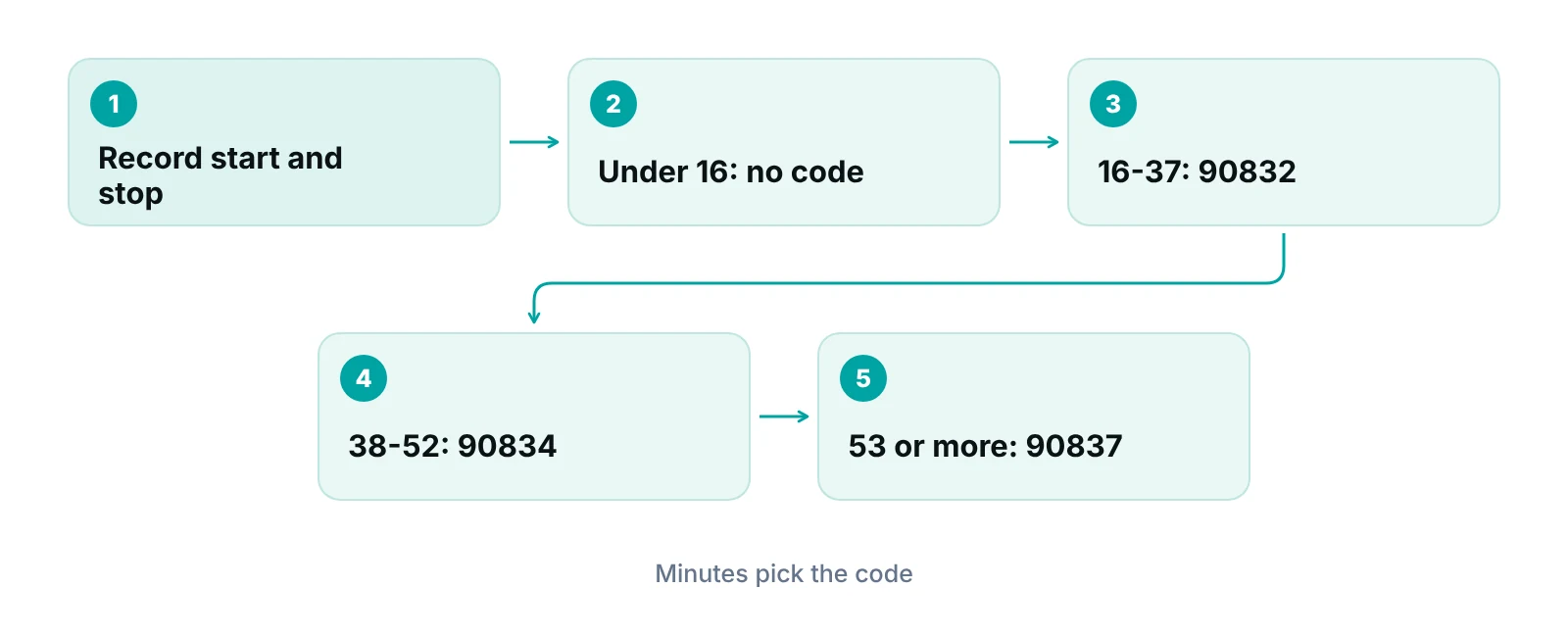
Count the time of the psychotherapy encounter itself. The contractor rule is that the medical record must show the length of time spent in the encounter (First Coast Service Options, 2026). As a working habit, leave out check-in, payment talk and charting done after the patient leaves, and keep any interval where the patient was not in session out of the total.
How does 90837 differ from 90834 and 90847?
90837 and 90834 differ only in time: 53 minutes or more versus 38 to 52 minutes. 90847 is a different service altogether, family psychotherapy with the patient present, and it is not a longer version of an individual session.
| Code | Time basis | Who is in the session | Use it when |
|---|---|---|---|
| 90834 | 38 to 52 minutes | Patient (family may join) | The individual session fell below 53 minutes |
| 90837 | 53 minutes or more | Patient (family may join) | The individual session reached 53 minutes |
| 90838 | 53 minutes or more, add-on | Patient, same clinician as an E/M visit that day | Psychotherapy is added to an E/M visit instead of billed alone |
| 90847 | 50-minute code; reportable from 26 minutes under the CPT time rule | Family or significant others with the patient present for most of the service | The main purpose is treating the patient through the family interaction |
| 90846 | 50-minute code; reportable from 26 minutes under the CPT time rule | Family without the patient | The patient is not in the room; see the time-range guide |
Source: First Coast Service Options (2026); Psychiatric News, American Psychiatric Association (2016); University of Florida College of Medicine – Jacksonville, LCD L33252 checklist (2018).
90837 versus 90834
The clinical content does not change between the two codes. Only the documented minutes do. That is why a longer code draws attention: the CGS Administrators tree says prolonged periods of psychotherapy must be well supported in the medical record, and it asks whether treatment frequency fits accepted medical practice. The shorter session is covered in our 90832 guide, and 90834 is covered in a separate guide in this series.
90837 versus 90847
The University of Florida checklist for Medicare contractor policy L33252 describes 90847 as family psychotherapy where the patient is present for the majority of the service and the main purpose is treating the patient’s condition. Psychiatric News (2016) reported that the family codes became 50-minute codes in 2017, reportable once more than half of the time, 26 minutes, is reached. Individual bands do not use that midpoint logic, so a 30-minute family session cannot be moved into an individual code.
The same date can hold both services. First Coast Service Options states that family psychotherapy may be reported on the same date as 90832 through 90838 when it is a separate and distinct service in a separate time interval. The minutes of the two services do not pool. For the family side, see our 90846 time-range guide.
What should the note show to support 90837?
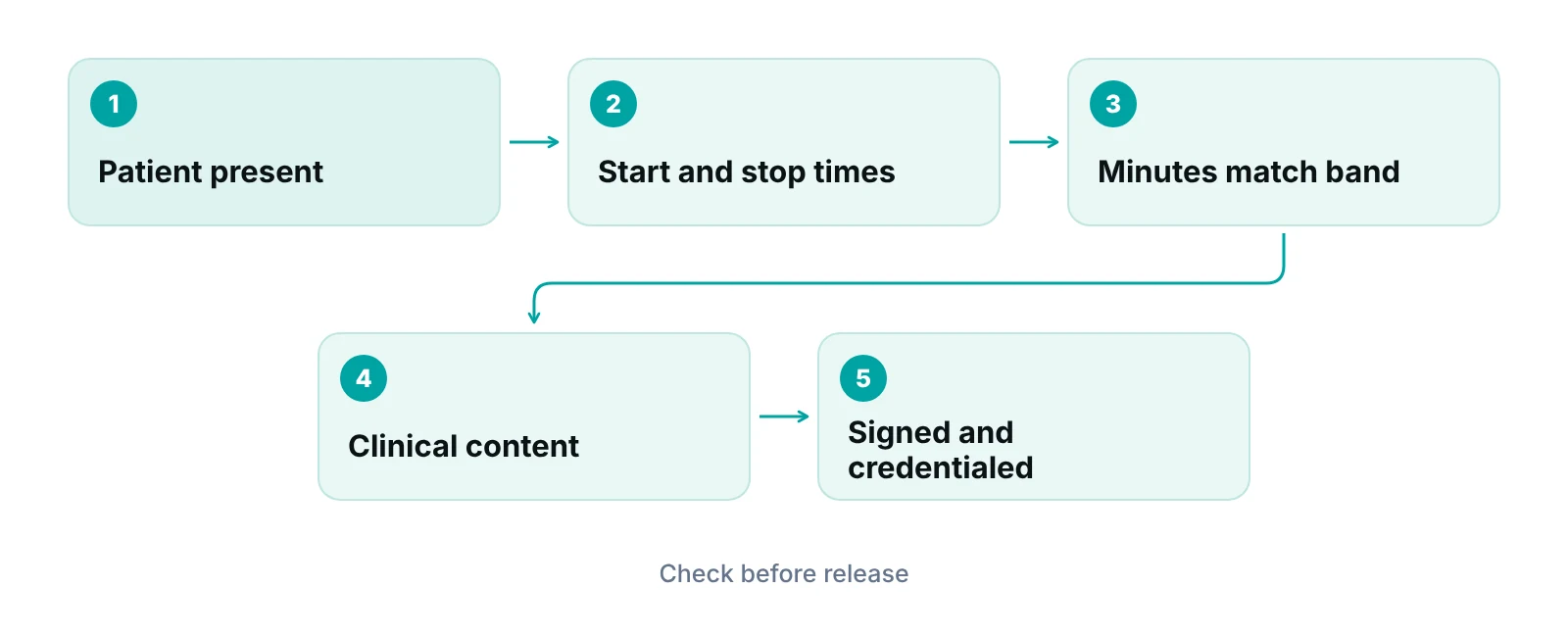
The note should show exact times, who was present, what was done and why it was necessary. The CGS Administrators fact sheet (revised May 2021) says exact times must be documented in the medical record, and the LCD L33252 checklist adds start and stop times and total minutes.
- Start time, stop time and total psychotherapy minutes, entered by the clinician.
- Who attended. The CGS fact sheet says family members may take part but the patient must be present for all or part of the time; Psychiatric News (2016) reported a stricter reading, that the patient be present for most of the session. Contractor wording differs, so follow your own.
- Clinical content: the CGS fact sheet lists diagnosis, symptoms, functional status, a focused mental status exam, treatment plan, prognosis and progress.
- Therapeutic work that produced change, such as interventions used and the patient’s response, since the CGS decision tree asks for supportive or interpretive interaction that leads to therapeutic change.
- A treatment plan with type, amount, frequency, duration, diagnosis and goals, with a periodic review of progress.
- Provider name, signature and credentials on each note.
If interactive complexity (90785) applies, the same documentation rules extend to it. The CGS fact sheet says 90785 can be reported with the psychotherapy codes 90832 through 90838, and the American Psychiatric Association overview says the documentation must clearly indicate exactly what the complexity was.
The auditor’s test
Read the note as a reviewer would. Can you point to the exact minutes, the reason a session of this length was needed, and what changed for the patient? The CGS fact sheet is clear that Medicare allows only the medically necessary portion of a visit, so a complete note on a session that ran long for scheduling reasons can still lose payment.
Which payer limits apply to 90837?
Payers limit 90837 in four ways: units per day, hours per day, sessions per period and minimum minutes. Every plan sets its own numbers, so a rule from one payer cannot be assumed for another. The examples below show the kinds of limits that exist, not a universal list.
- One unit per date (Medicare contractor example). First Coast Service Options says codes 90832 through 90834 and 90836 through 90838 should not be billed with more than one unit, except in place of service 52, and that effective July 1, 2022 services are denied when more than one unit is reported.
- Daily hour cap (Medicaid plan example). In a June 2025 notice, CareOregon said psychotherapy over eight hours in a single day by one rendering provider, in any combination of 90832 through 90838, is denied for the entire day, with claims back to January 1, 2024 possibly affected. Its notice also listed 53 minutes as the minimum for 90837 and 38 minutes for 90834, and asked for records or an appointment log with check-in and check-out times to dispute a denial.
- Session counts (state Medicaid example, old). A South Carolina Medicaid bulletin from 2014 listed 90837 at one per date of service for a service group limited to six sessions per month. It is dated, so treat it as an illustration of a cap type, not current policy.
- Frequency and necessity review. The CGS decision tree asks whether treatment shows continued improvement and whether frequency falls within accepted medical practice.
The daily-hours edit matters most to group practices where one clinician’s schedule is long or where claims are billed under a supervising provider’s number. The rendering provider on every line has to be the person who delivered the session. Pull each payer’s numbers from its contract, provider manual and portal, and check benefit limits at scheduling; our behavioral health eligibility guide shows how.
Why do 90837 claims get denied, and how do you fix them?
Most 90837 denials trace to time, units or an incomplete note, and nearly all can be prevented before the claim is released. The table below groups the common patterns, what the payer sees and the fix, using the contractor and payer rules cited above.
| Pattern | What the payer sees | Fix | Owner |
|---|---|---|---|
| Documented time under 53 minutes | Minutes in the note do not reach the 90837 band | Rebill at 90834 or 90832 if the note supports it; stop scheduling slots as billing codes | Clinician and coder |
| No start and stop times | Only an appointment length, no exact times | Make start, stop and total minutes required fields before the claim releases | Clinician |
| More than one unit | A long session billed as two units | Bill one unit; check the payer’s rule for long sessions | Billing |
| Daily hours over the payer cap | Total psychotherapy hours for one rendering provider exceed the plan limit | Verify rendering provider on every line; send the day’s records or appointment log on appeal | Billing manager |
| Family time counted as individual time | 90837 minutes include a family-only portion | Move the family service to its own code and time interval, or exclude those minutes | Clinician and coder |
| Session count or authorization exhausted | Visits beyond the plan or authorization limit | Track used visits at scheduling; request more before the limit is reached | Front desk |
| Thin clinical content | Note lacks treatment plan, progress or interventions | Add the required note elements; audit long sessions first | Clinical lead |
Source: First Coast Service Options (2026); CareOregon (2025); CGS Administrators (2021, reviewed 2026); American Psychiatric Association.
Work denials by cause rather than claim by claim. A pile of time-based denials points to the note template; a pile of unit denials points to charge entry. Our denial management services sort denied claims by cause and owner.
Are time-based edits holding up your therapy claims?
Send a sample of recent 90837 claims and denials. A free practice audit shows whether the cause is the note, the code or the payer rule.
How should a practice manage 90837 day to day?
Build the control into the workflow instead of auditing after denials arrive. That means a note template that forces times, a scrub rule that compares minutes to the code, and a payer rules sheet that billers update each January and after each payer bulletin. Our medical billing services can run this as part of claims, and the behavioral and mental health operations page describes the specialty setup.
Keep the surrounding codes consistent. The behavioral health coding cheat sheet puts the psychotherapy, family and group codes on one page, and the mental health CPT codes guide gives the wider overview.
What do repeat behavioral health denials cost you?
Use the revenue calculator to put a number on denied and delayed claims before deciding where to fix the process.
Our recommendations
- Make the clock part of the note. Require start time, stop time and total minutes before the note can be signed. Compare the total with the code band automatically.
- Code from the note, never the calendar. Give billers one rule: the code comes from documented minutes, not from the appointment type. A 60-minute slot can hold a 90834 or a 90837.
- Add a scrub rule for units and minutes. Hold any claim that carries 90837 with more than one unit or with documented minutes under 53. These two checks catch most of the avoidable denials.
- Keep a one-page payer rule sheet. List each payer’s unit limit, daily-hours cap, session limit and authorization trigger, with the source and date. Update it each January and after each bulletin.
- Check rendering provider on long days. Before release, confirm that every line names the clinician who delivered the session, especially where a payer applies daily-hour edits.
- Audit a small sample each quarter. Pull a handful of 90837 notes per clinician and read them against the checklist above. Share the pattern with the clinicians, not only the coder.
Bottom line
The 90837 CPT code is a time-based code, so the claim is only as strong as the clock times in the note. Fix the template and the scrub rule first, keep a sourced payer rule sheet and audit a sample each quarter. If time and unit denials keep returning, our denial management services can work them by cause, or you can talk to our team and request a free practice audit.
Frequently asked questions
What is the 90837 CPT code and how many minutes does it need?
The 90837 CPT code is individual psychotherapy with the patient, the 60-minute code. It is reportable from 53 minutes of documented psychotherapy time. Below 53 minutes the session belongs in 90834 (38 to 52) or 90832 (16 to 37). Under 16 minutes, no psychotherapy code applies.
Is 90837 the same as 90847?
No. 90837 is individual psychotherapy. 90847 is family psychotherapy with the patient present, a 50-minute code that can be reported from 26 minutes under the CPT time rule. Both can appear on one date only as separate services in separate time intervals, and their minutes are not combined.
Can I bill 90837 for a 50-minute session?
No. A 50-minute session falls in the 38 to 52 minute band, which is 90834. The 90837 band begins at 53 minutes. If the note supports 53 minutes or more of psychotherapy, 90837 fits; otherwise the lower code should be billed.
Can I bill two units of 90837 for a very long session?
Not on the contractor page cited here. First Coast Service Options says services are denied when more than one unit of 90832 through 90838 is reported, except in place of service 52. Other payers set their own rules for long sessions, so check each contract.
Can 90837 be billed on the same day as 90834 or 90847?
The cited contractor allows family psychotherapy (90846 or 90847) on the same date as 90832 through 90838 when it is a separate and distinct service in a separate time interval. For two individual psychotherapy codes on one date, no rule was verified, so confirm with each payer.
What note details prevent a time-based denial?
Record start time, stop time and total psychotherapy minutes, who was present, the interventions used, the patient’s response and the treatment plan, and sign with credentials. CGS says exact times must be documented. Add payer-specific items, such as an appointment log, for appeals on daily-hours edits.
Get your free practice audit
Tell us about your practice. We will contact you using the details you give.
- A review of your recent claims, denials and A/R aging
- Where your front desk and prior authorizations slow payment
- A prioritized fix list you keep, whether or not you hire us
Pricing is quoted after the audit, based on your volume and the services you choose. Prefer to talk? Call +1 (302) 556-2288.
Sources
- Psychotherapy services — First Coast Service Options (Medicare Administrative Contractor) (2026)
- CPT overview — American Psychiatric Association
- Psychiatric News CPT article — Psychiatric News, American Psychiatric Association (2016)
- Outpatient psychotherapy fact sheet (LCD L34353) — CGS Administrators (Medicare Administrative Contractor) (2021)
- Psychotherapy services decision tree — CGS Administrators (Medicare Administrative Contractor) (2026)
- LCD L33252 checklist — University of Florida College of Medicine – Jacksonville, compliance office (2018)
- Psychotherapy high day billing changes — CareOregon (2025)
- Medicaid Bulletin MB 14-036 (DAODAS frequency change) — South Carolina Department of Health and Human Services (2014)
Disclaimer: This article is educational and is not legal, coding, billing or compliance advice. CPT codes are owned by the AMA, and code descriptors, payer policies and federal rules change and vary by payer and state. Verify current requirements with the official CPT manual, your payers and your counsel before you act.
