
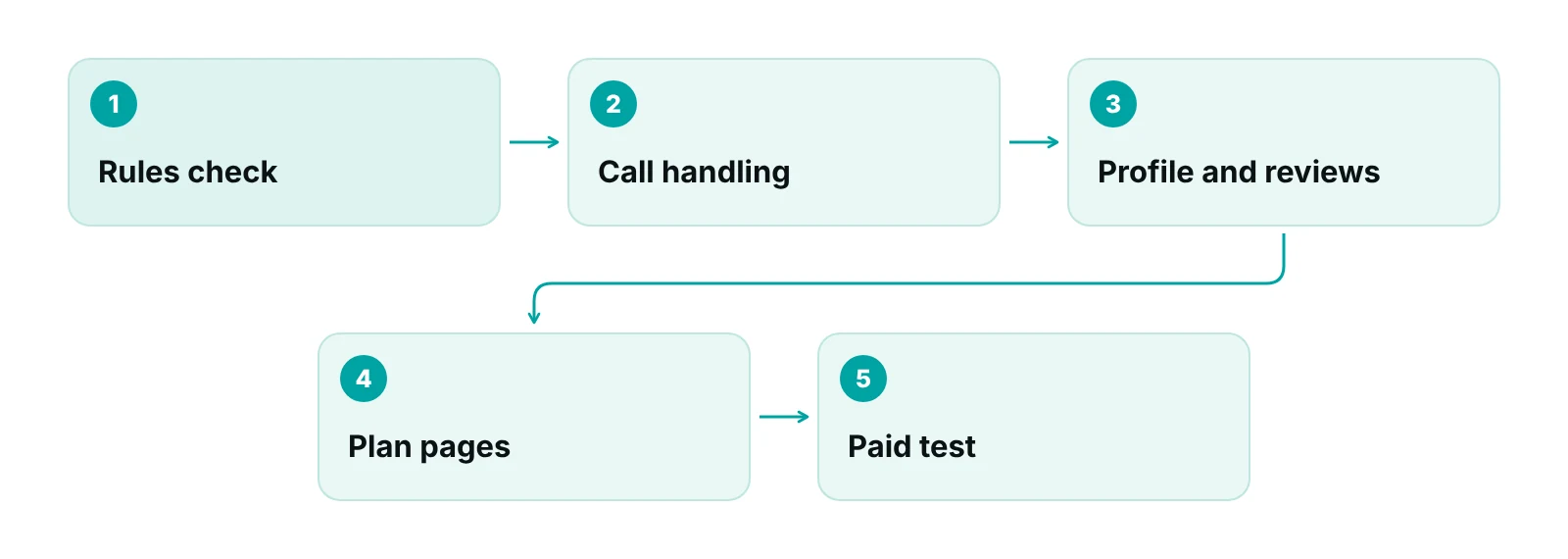
Dental marketing works as a sequence, not a list of tactics. Confirm the advertising, review and privacy rules first, then fix how new-patient calls are handled, then build local search and reviews, and test paid channels only once tracking is in place. A 90-day plan keeps every step small enough to finish.
A practice can spend months on a new website and still lose the new patient who calls at 8:05 a.m. and reaches voicemail. A plan fixes the order of work. This guide is for dentists, office managers and group owners who want one page that ties the rules, the front desk and the channels together.
It does not repeat the search-ranking how-to in the dental SEO guide. It sets out the guardrails, a 90-day sequence and the numbers worth tracking. Three companion guides go deeper on dental digital marketing channels, budget and tracking, dental revenue cycle management and dental billing services.
Key takeaways
- Sequence beats volume: rules first, call handling second, local search and reviews third, paid channels last.
- Dental ads answer to the ADA Code, the state board and the FTC at once, and state rules differ.
- Patient photos, stories and review replies can disclose protected health information; a Dallas practice settled with OCR for $10,000 over replies to online reviews.
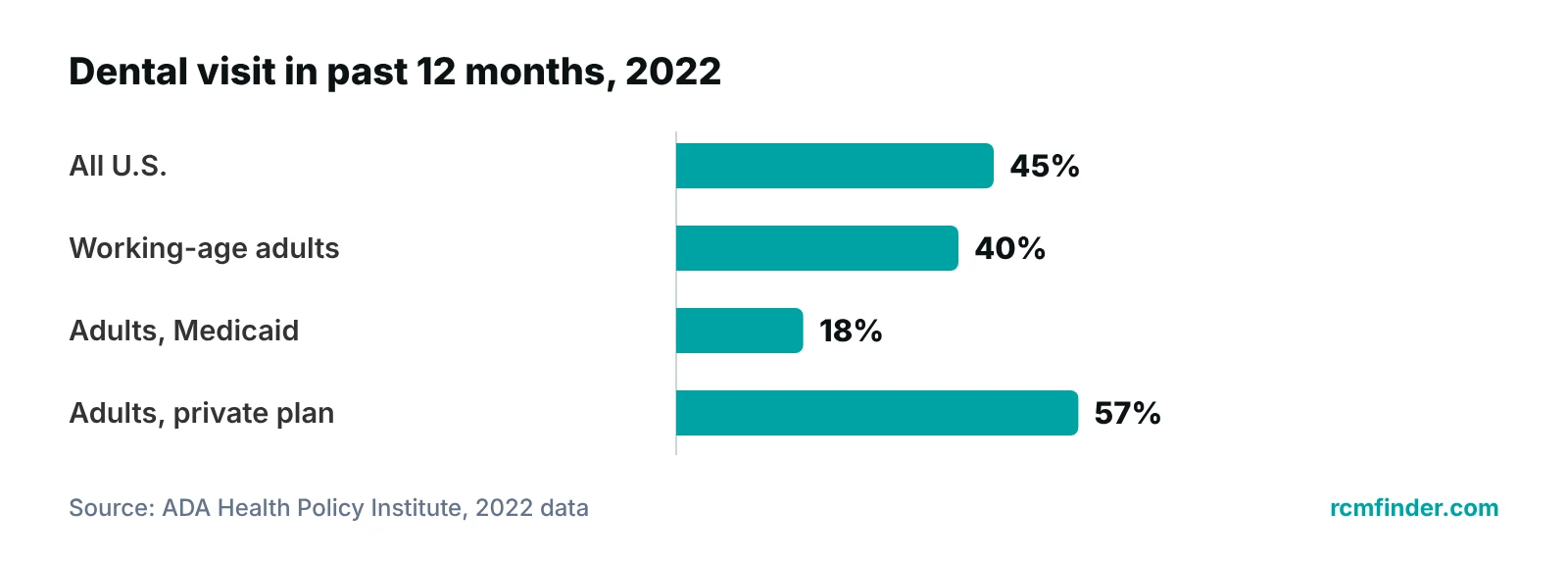
- In 2022, 18% of adults with Medicaid had a dental visit versus 57% of privately insured adults, so plan-specific messaging matters.
- Track booked, seen and paid new patients by source, not clicks.
What should a dental marketing plan include?
A dental marketing plan should say who the practice wants to attract, what it may legally say, how a new-patient inquiry is answered, which channels create inquiries and how results are counted. Anything less is a list of tactics.
The market is uneven, which is why the plan starts with who. The American Dental Association’s Health Policy Institute reports that in 2022, 45% of the U.S. population had a dental visit in the past 12 months, 40% of working-age adults and 18% of adults with Medicaid, against 57% of privately insured adults (ADA Health Policy Institute). The same page puts national dental spending at $189 billion in 2024, with out-of-pocket spending the largest share.
Those gaps shape the message. A practice that takes a state Medicaid program, a mostly fee-for-service practice and an office in network with three PPOs are speaking to different people. The website, the Google profile and the phone script should each say which one applies.
Which advertising rules apply to a dental practice?
Three layers apply at once: the ADA Code of Ethics, the state dental board and state consumer-protection law, and federal FTC rules. State rules differ, so the safe habit is to read the board’s current rules before an ad runs.
The ADA Code bars advertising that is false or misleading in any material respect, and its advisory opinion names unjustified expectations of results and unsubstantiated claims of superiority as examples (ADA Code, section 5.F). The same section says a website must be truthful and that SEO techniques must comply with the Code. An opinion added in the 2025 update applies the standard to social media and says influencers must disclose paid partnerships; a change to the split-fee opinion treats paying an influencer a share of patient fees as fee splitting (ADA News, February 2025).
State rules get specific. California’s Business and Professions Code section 651 (2018 text) requires before-and-after patient images to identify the procedures, present comparable views and state that results may differ, bans phrases such as “as low as” and “and up” in price ads, and bars superiority claims without objective scientific evidence (Justia). Texas requires “General Dentist” after the dentist’s name in ads for specific services, in type no smaller than the largest font used for the services (22 TAC 108.55). The ADA’s advertising page adds that every state has consumer-protection law and that Florida and Indiana each require advertised fees to stay available for 90 days after the last ad (ADA).
| Source of rule | What it covers | Example from the sources |
|---|---|---|
| ADA Code of Ethics (section 5.F) | Truthful ads for members, including websites, SEO and social media | No unsubstantiated superiority claims; influencers disclose paid ties (2025 update) |
| State dental board and state law | Fees, specialty wording, patient images, disclaimers | California image and price rules; Texas “General Dentist” designation |
| FTC | Truthful, substantiated advertising; reviews and endorsements | Consumer reviews rule effective October 21, 2024 |
| HIPAA Privacy Rule | Use of patient information in marketing | Written authorization generally required for marketing communications |
| Google policies | Business Profile content and review conduct | No free or discounted services in exchange for reviews |
Source: ADA Code of Ethics; ADA News (2025); Justia (Cal. Bus. & Prof. Code 651, 2018 text); Cornell LII (22 TAC 108.55); FTC; HHS; Google Business Profile Help.
Check the current text
The California text above is the 2018 version, and the source page notes that newer versions exist. Treat each state citation as an example and read the current rule from your own state board before publishing.
How do HIPAA and review rules affect photos, stories and replies?
Reviews, photos and patient stories sit under two rule sets: the FTC’s review rule and HIPAA. A practice should treat any identifiable patient material in marketing as needing the patient’s written authorization.
HHS guidance says marketing communications generally require written authorization, with exceptions such as a practice’s own services, treatment communications, face-to-face conversations and promotional gifts of nominal value (HHS). The ADA’s advertising page warns that photos or videos of patients can be protected health information and that even confirming someone is a patient may violate privacy law (ADA).
The risk is documented in dentistry. In 2019 the HHS Office for Civil Rights announced a $10,000 settlement with a Dallas dental practice that disclosed patients’ information in replies to online reviews, with two years of monitoring under a corrective action plan (California Dental Association, October 2019). Google advises short, professional replies and an invitation to continue offline (Google Business Profile Help).
On review collection, the FTC’s Consumer Reviews and Testimonials Rule took effect October 21, 2024. It bars fake reviews, incentives conditioned on a positive or negative opinion, undisclosed insider reviews and suppression by intimidation or unfounded legal threats (FTC Q&A). The FTC sent warning letters to ten companies on December 22, 2025, citing civil penalties of up to $53,088 per violation (FTC). Google separately prohibits free or discounted services in exchange for reviews (Google).
A review routine that holds up
- Send the same request to every patient after a visit, with no screening by satisfaction.
- Offer no gift, discount or free service for a review.
- Reply in general terms, never confirm that the reviewer is a patient, and move details to a phone call.
- Ask staff and relatives to disclose their connection if they post, as the FTC advises.
The guide to online reputation management for doctors covers the wider routine.
How does marketing turn into booked patients?
An inquiry becomes revenue only when the front desk converts it. Plans that stop at the click skip the step where many leads are won or lost: the phone. Before adding channels, map the first call. Who answers, within what window, what is asked and what happens when the line is busy?
- Capture the reason for the call, the plan name and the member ID.
- Note the plan type (PPO, DHMO, indemnity or Medicaid) and state the office’s network status plainly.
- Verify benefits before the visit where possible, so the patient hears a realistic cost.
- Offer the next new-patient appointment and confirm by text or call.
- Return missed calls the same day and log the source of every inquiry.
Coverage questions come early. The ADA’s benefits primer, citing 2022 market data, puts PPOs at 86% of the dental benefit market (ADA, Introduction to Dental Benefits), so whether the office takes a caller’s plan is usually the first question.
Where a virtual assistant fits
Offices short on front-desk coverage sometimes add remote staff. A virtual medical assistant can answer calls, check eligibility, take intake details and chase missed calls in the practice’s own time zone. The virtual medical assistant services page describes the model, and the dental virtual assistant guide covers insurance, phones and scheduling in detail.
What does a 90-day dental marketing plan look like?
A 90-day plan has three stages: rules and foundations, local visibility and proof, then one paid test. Each stage ends with a number the practice can read.
| Days | Focus | Main outputs | Number to read |
|---|---|---|---|
| 1 to 30 | Rules and foundations | One-page ad rules (ADA, state board, FTC, HIPAA); first-call script; Google profile checked against Google guidelines | Calls answered live; inquiries logged by source |
| 31 to 60 | Local visibility and proof | Website and profile list services, plans accepted and practitioners; one review routine for every patient | Inquiries by source; review requests sent |
| 61 to 90 | Test and decide | One paid channel at a small fixed budget, with call and form tracking and a privacy check on tags | Cost per booked new patient; show rate |
| After 90 | Monthly review | Keep, cut or scale each channel | Revenue collected by source |
Source: RCM Finder planning framework; rule references from the sources cited in this article.
Google’s guidelines say the profile name must match the real-world name used on signage and stationery, without taglines or service descriptions. They also say a public-facing dentist can have a practitioner profile while hygienists, assistants and front-desk staff should not create their own, and they bar private information such as records or images with personal data (Google Business Profile Help). Service pages, citations and technical work are covered in the dental SEO guide.
What should a dental practice track?
Track people, not clicks: inquiries by source, booked new patients, patients who showed, treatment accepted and revenue collected. Clicks help diagnose a channel but do not pay the practice.
| Number | Question it answers | Where it lives |
|---|---|---|
| Calls and forms by source | Which channels create inquiries | Call log and form inbox |
| Booked new patients | Does the front desk convert inquiries | Practice schedule |
| New patients seen | How many bookings turn into visits | Practice schedule |
| Treatment accepted | Whether leads fit the services offered | Treatment plan records |
| Revenue collected | Which sources actually pay | Billing ledger |
Source: RCM Finder framework.
Collecting those numbers touches patient information, so keep marketing tools away from clinical data. Google says Google Analytics comes with no business associate agreement and no representation that it meets HIPAA requirements, and that HIPAA-regulated customers must not send it data that may be protected health information (Google Analytics Help). HHS says tracking tools on pages that collect health information, such as appointment scheduling, can involve PHI, and that a vendor receiving PHI is a business associate needing an agreement (HHS). The full setup is in the dental digital marketing guide.
Should a dental practice run marketing in-house or hire help?
Keep marketing in-house when one person owns it weekly and knows the rules above. Add outside help when the work slips, the group has several locations, or reports do not tie to booked patients.
Ask any agency for five things: ad accounts, profiles and the domain in the practice’s name; a monthly report tied to booked patients; written adherence to ADA, state board and FTC rules; no purchased or incentivized reviews; and a business associate agreement if the agency will see patient information. HHS lists billing, practice management and similar services involving PHI as business associate work (HHS).
A common budget rule of thumb, around 10% of gross revenue, is mentioned in an AACD guide, which then suggests focusing on the order channels are built instead (AACD, 2023). The guide was sponsored by an agency, so treat its dollar ranges as vendor estimates. RCM Finder offers healthcare digital marketing covering local SEO, Google Ads and reputation, and quotes pricing after a free practice audit.
See where new-patient inquiries stall
A free practice audit reviews how inquiries, benefit checks and claims move through the practice, and what to fix first.
Our recommendations
- Write the practice's ad rules on one page. List the ADA Code points, the state board’s rules on specialty wording, fees and patient images, and the FTC review rules. Date the page and review it each year.
- Answer every new-patient call live or return it the same day. Measure answered calls and missed calls before spending more on traffic. A busy line wastes the budget already spent.
- Use one review routine for every patient. Send the same request to all patients, offer no incentive and reply without confirming that the reviewer is a patient.
- Keep patient photos and stories out of marketing without written authorization. File the authorization with the chart and check the state board’s rules on before-and-after images.
- Add one paid channel at a time. Set a small fixed budget, track calls and forms through to booked patients, and run a privacy check on every tag.
- Review the funnel monthly. Keep, cut or scale each channel based on booked new patients and revenue collected, not clicks.
Bottom line
Dental marketing grows a practice when the rules, the phone and the tracking are settled before the budget grows. Start with the 90-day sequence, then read the dental digital marketing guide for channels and tracking, and the dental revenue cycle management guide and dental billing services guide for what happens after the patient is booked. Coverage and the software behind the front desk are covered in the dental practice management software guide. Practices that want help can start with RCM Finder’s healthcare digital marketing service.
Frequently asked questions
What should a dental marketing plan include?
A plan should name the patients the practice wants, the advertising and privacy rules it must follow, a first-call process, the channels in use and the numbers that prove results. The numbers should run from inquiries to booked, seen and paid new patients, not stop at clicks or impressions.
Can a dental practice post patient photos or testimonials?
Only with care. The ADA warns that patient photos and videos can be protected health information and that revealing someone is a patient may breach privacy law. Written authorization is the safer course. State boards also set rules, for example on before-and-after images, so check yours first.
Can a practice offer a discount for a Google review?
No. Google prohibits free or discounted services in exchange for reviews. The FTC rule also bars incentives conditioned on a positive or negative opinion. Send the same plain request to every patient, offer nothing in return and reply to each review without confirming the reviewer’s patient status.
Does a dental practice need a business associate agreement with a marketing agency?
It depends on what the agency handles. HHS says a business associate creates, receives, maintains or transmits protected health information for a covered entity. An agency that only edits public web pages may not qualify. One that sees call recordings, form entries or patient lists likely does.
Which comes first: website, SEO or ads?
Fix the phone and the profile first, then the website’s service and plan pages, then paid ads. Ads send people to a page and a phone line, so weak ones waste spend. Test one paid channel only after calls, forms and booked patients can be tracked.
How should a practice measure dental marketing?
Count inquiries by source, booked new patients, patients who showed, treatment accepted and revenue collected. Review them monthly. Cost per click and impressions are diagnostic numbers only. A channel that produces cheap clicks but few booked patients should be cut or changed.
Get your free practice audit
Tell us about your practice. We will contact you using the details you give.
- A review of your recent claims, denials and A/R aging
- Where your front desk and prior authorizations slow payment
- A prioritized fix list you keep, whether or not you hire us
Pricing is quoted after the audit, based on your volume and the services you choose. Prefer to talk? Call +1 (302) 556-2288.
Sources
- Principles of Ethics and Code of Professional Conduct: Veracity (section 5.F) — American Dental Association (2025)
- ADA Code updates address ethical concerns with social media influencers — ADA News (2025)
- Marketing and advertising — American Dental Association (undated, read 2026)
- California Business and Professions Code section 651 (2018 version) — Justia (2018)
- 22 Tex. Admin. Code section 108.55, advertising for general dentists — Cornell Legal Information Institute (amended 2021)
- The Consumer Reviews and Testimonials Rule: Questions and Answers — Federal Trade Commission (2025)
- A warning letter (or ten) for businesses: comply with the FTC's Consumer Review Rule — Federal Trade Commission (2025)
- Marketing (HIPAA Privacy Rule) — HHS Office for Civil Rights (undated, read 2026)
- Dental practice pays $10K to settle disclosures of patients' PHI on social media — California Dental Association (2019)
- Guidelines for representing your business on Google — Google Business Profile Help (undated, read 2026)
- Tips to get more reviews — Google Business Profile Help (undated, read 2026)
- HIPAA and Google Analytics — Google Analytics Help (undated, read 2026)
- Use of Online Tracking Technologies by HIPAA Covered Entities and Business Associates — HHS Office for Civil Rights (2024 (reviewed June 26, 2024))
- The Dental Care Market — ADA Health Policy Institute (2026)
- Introduction to Dental Benefits — American Dental Association (undated, read 2026)
- Business Associates — HHS Office for Civil Rights (undated, read 2026)
- Digital Marketing Budgeting Guide for Dentists — American Academy of Cosmetic Dentistry (AACD) (2023)
Disclaimer: This article is educational and is not legal, coding, tax or compliance advice. Advertising, privacy and payer rules differ by state and by plan and change over time, so confirm current requirements with your state dental board, your attorney and each payer before acting. CDT is a registered trademark of the American Dental Association and CPT is a registered trademark of the American Medical Association; official code descriptors are not reproduced here.