
Dental digital marketing is the set of online channels a practice uses to win new patients: local search, the website, paid search, social media, email and reviews. Choose channels by goal, set the budget from what a new patient is worth to the practice, and track booked patients by source without sending protected health information to analytics tools.
Most guides on this topic list channels and quote agency fees, and those fee ranges come from the agencies selling the work. This guide takes a different route. It sets out the rule that limits each channel, a budget method built from the practice’s own numbers, and a tracking setup that respects HIPAA.
It is the channel-level companion to the dental marketing plan, which covers the 90-day sequence, and the dental SEO guide, which covers search work. Once an inquiry arrives, the dental virtual assistant guide explains how phones and insurance checks are handled.
Key takeaways
- Pick dental channels by job (found, trust, convert, return) and check the rule that limits each one.
- Set the budget from first-year collections per new patient and chair capacity; published fee ranges are agency estimates, not benchmarks.
- Google says Analytics has no business associate agreement, so regulated practices should not send it data that may be PHI.
- A June 2024 court ruling cut back HHS tracking guidance, but tracking on pages that collect health information, such as scheduling, can still involve PHI.
- Count booked, seen and collected patients from practice systems; use marketing tools only for the lead.
What does dental digital marketing include?
Dental digital marketing covers four jobs: being found, earning trust, converting an inquiry and bringing patients back. Local search, the Google profile and paid search handle being found. The website, reviews and social media build trust. Phone, forms and scheduling convert. Email and recall messages bring patients back.
Each job has its own rule and its own number. A practice that picks channels first and rules second tends to find the limits only after money is spent. The sections below work in the reverse order: the limit, the budget, the measurement.
The website is where every channel lands. It should state which services the office provides, which plans it accepts, where it is and how to book. The ADA Code requires a truthful website (section 5.F.6), and any form that asks about symptoms, insurance or the reason for a visit becomes a place where patient information is collected. That matters for the tracking rules later in this guide.
Search rankings are covered in the dental SEO guide and the broader healthcare digital marketing service page, so this guide treats search as one channel among several and focuses on what limits it.
Which channels fit which goal, and what limits each one?
Every channel has a rule worth checking before launch. The table pairs each with its main limit and the number to read.
| Channel | Rule to check first | Number to read |
|---|---|---|
| Google Business Profile and local search | Name must match the real-world name, with no service descriptions; no private patient information; practitioner profiles only for public-facing dentists | Calls from the profile, by month |
| Paid search (Google Ads) | Dental insurance ads are not restricted; Health sensitive-category rules bar audiences built from the practice’s own data | Booked new patients per ad dollar |
| Reviews | FTC reviews rule since October 21, 2024; Google bans free or discounted services in exchange for reviews | Review count and recency by month |
| Email and recall messages | CAN-SPAM: truthful headers, ad disclosure, postal address, opt-outs honored within 10 business days | Opt-outs and bookings per campaign |
| Social media | ADA Code opinion 5.F.7 and FTC disclosure of paid ties; percentage-of-fee deals with influencers count as fee splitting | Inquiries traced to social |
| Website and online forms | Forms that collect health information can involve PHI; ADA Code 5.F.6 requires truthful sites | Form submissions that become booked visits |
Source: Google Business Profile Help; Google Ads policy pages; FTC; ADA Code of Ethics and ADA News (2025); HHS.
Two rules deserve a closer look. On paid search, Google’s Health personalization policy says advertiser-curated audiences such as Customer Match, audiences built from the advertiser’s own data, audience expansion and lookalikes cannot be used in that category, while predefined Google audiences and location targeting remain available, and users under 18 are not eligible for personalized ads (Google Ads policy). The category covers personal health content including invasive procedures, so whether a given dental campaign falls inside it depends on what the ad and landing page say. Google’s healthcare policy states that ads exclusively for dental, vision or travel health insurance coverage are not restricted (Google Ads healthcare policy).
On email, the FTC’s CAN-SPAM guide applies to all commercial messages, requires honoring opt-outs within 10 business days, and lists penalties of up to $53,088 per violating email (FTC). The business stays responsible for email sent on its behalf by a vendor. HHS adds that marketing communications that use patient information generally need written authorization, apart from exceptions such as a practice’s own services and treatment communications (HHS).
How should a dental practice set a digital marketing budget?
Start from what a new patient is worth and how many the schedule can absorb, not from a percentage of revenue. A percentage says nothing about whether the spend produces booked patients.
An American Academy of Cosmetic Dentistry guide from August 2023 mentions a common rule of thumb of around 10% of gross revenue and then recommends choosing the order in which channels are built instead; the guide was sponsored by a marketing agency (AACD). Agency pages on the topic quote dollar ranges per channel, and those ranges are the agencies’ own estimates. This guide does not repeat them, because a figure from a seller is not a benchmark.
| Input | How to get it | Decision it drives |
|---|---|---|
| First-year collections per new patient | Average collected revenue from last year’s new patients, from the billing ledger | The ceiling on cost per booked patient |
| New-patient capacity | Open new-patient slots per week | Whether more demand can be served at all |
| Cost per booked new patient, by source | Spend divided by booked patients for each channel | Which channel to scale, change or cut |
| Payback period | Months the owner will wait to recover spend | Size of a paid test |
| Plan mix of inquiries | Share of inquiries by plan type and network status | Whether ads attract plans the office accepts |
Source: RCM Finder planning framework.
The method is simple. Decide what share of a new patient’s first-year collections the practice will spend to win one, which sets the ceiling on cost per booked patient. A channel above the ceiling gets changed or cut. A channel below it gets more budget only if the schedule has room.
How do you track dental marketing without breaking privacy rules?
Track conversions on public marketing pages, keep names, health details and reasons for visit out of analytics, and measure booked and paid patients from the practice’s own systems. The marketing tool counts the lead. The schedule and the ledger count the patient.
The regulatory picture is partly unsettled. On June 20, 2024, a federal court in American Hospital Association v. Becerra vacated the part of HHS’s online tracking bulletin that treated an IP address linked to a visit on a public page about specific conditions or providers as PHI, and HHS said it was evaluating next steps. The page still says tracking on authenticated pages such as patient portals can involve PHI, that tracking on pages collecting health information, such as appointment scheduling, can involve PHI, and that a tracking vendor receiving PHI is a business associate needing an agreement (HHS).
Google’s own guidance is stricter in practice. Google Analytics Help says Google offers no business associate agreement for Analytics and makes no representation that it meets HIPAA, that regulated customers must not send it data that may be PHI, and that tags should not be set on authenticated pages or on pages more likely to be covered by HIPAA, such as unauthenticated pages related to providing health care (Google Analytics Help). Its PII policy adds that URLs, page titles, form and search fields, campaign parameters and imported data can all carry personal information (Google Analytics Help, PII).
| What to measure | Where it comes from | Privacy check |
|---|---|---|
| Calls from ads and the profile | Call tracking number or platform call report | If recordings or transcripts exist, treat the tool as handling PHI and get a BAA, or turn the feature off |
| Form submissions | Thank-you page view or form event | No names, emails or reasons for visit in URLs, page titles or event labels |
| Booked new patients | Practice schedule, matched to source by staff | Keep patient-level data inside practice systems, not in ad tools |
| Treatment accepted and collections | Billing ledger | Share totals by source with vendors, not patient lists |
| Imported offline results | Upload of booked-patient data to an analytics tool | Google lists data import as a PII risk; upload no identifiers |
Source: RCM Finder framework; Google Analytics Help (PII and HIPAA pages); HHS.
Call tracking needs one more check. Google’s profile guidelines say not to use numbers that redirect to other numbers, so confirm the rule before placing a tracking number on the profile (Google Business Profile Help). The HIPAA compliance checklist for medical practices covers the wider safeguards.
What changes when reviews and social media join the mix?
Reviews and social posts are marketing channels and disclosure risks at once. The practice controls neither the platform nor the patient, so the rules focus on what the practice asks for and how it replies.
The FTC’s reviews rule bans fake reviews, incentives conditioned on a particular opinion, undisclosed insider reviews and review suppression through intimidation or unfounded legal threats (FTC Q&A). Warning letters went to ten companies on December 22, 2025 (FTC). In dentistry the privacy side has precedent: a Dallas practice paid $10,000 in 2019 after revealing patient information in replies to online reviews (California Dental Association).
On social media, the ADA Code applies its false-or-misleading standard to posts and requires influencers to disclose paid partnerships; paying an influencer a share of patient fees is treated as fee splitting (ADA News, February 2025). The dental marketing plan lists the full guardrails and a review routine, and the reputation management guide covers replies in more depth.
Where do calls, scheduling and follow-up fit?
Digital marketing creates inquiries by phone, form and text. How fast and how accurately they are answered decides whether they book. A channel that sends calls to voicemail pays for nothing.
Offices without enough front-desk coverage sometimes add remote staff to answer calls, verify eligibility, take intake details and follow up on missed inquiries in the practice’s own time zone. The virtual medical assistant services page describes how RCM Finder staffs this, and the dental guide covers the dental detail.
The online-booking and patient-communication features of the practice’s own software also matter, because HHS says scheduling pages can involve PHI. They are a core comparison point in the dental practice management software guide. After the visit, the dental revenue cycle management guide and the dental billing services guide follow the patient through claims and payment, which is where the marketing number turns into collected revenue.
Should the practice run digital marketing in-house, with an agency, or both?
Run it in-house when one person owns the weekly work and the reports tie to booked patients. Use an agency when the work slips, the group has several locations, or the technical setup is beyond the team. A hybrid, with strategy and patient communication in-house and technical work outside, is common.
A good monthly report should show, in plain language:
- Calls and forms by source, and how many were answered or returned.
- Booked, seen and accepted new patients by source.
- Cost per booked new patient against the practice’s ceiling.
- Changes made to ads, pages and profiles, and why.
- Any review activity, with confirmation that no incentives were used.
Ad accounts, the Google profile and the domain should sit in the practice’s name. RCM Finder’s healthcare digital marketing work covers local SEO, Google Ads and reputation, and pricing is quoted after a free practice audit. The medical marketing ROI guide explains how to read the returns.
Find out where new-patient revenue leaks
A free practice audit looks at inquiries, benefit checks and claims together, so marketing spend is not lost after the patient is booked.
Our recommendations
- Give every channel one job and one number. Assign found, trust, convert or return to each channel, and pick the single number that shows whether it did the job.
- Set the cost-per-booked-patient ceiling first. Use last year’s collections from new patients to decide what the practice will pay to win one before buying traffic.
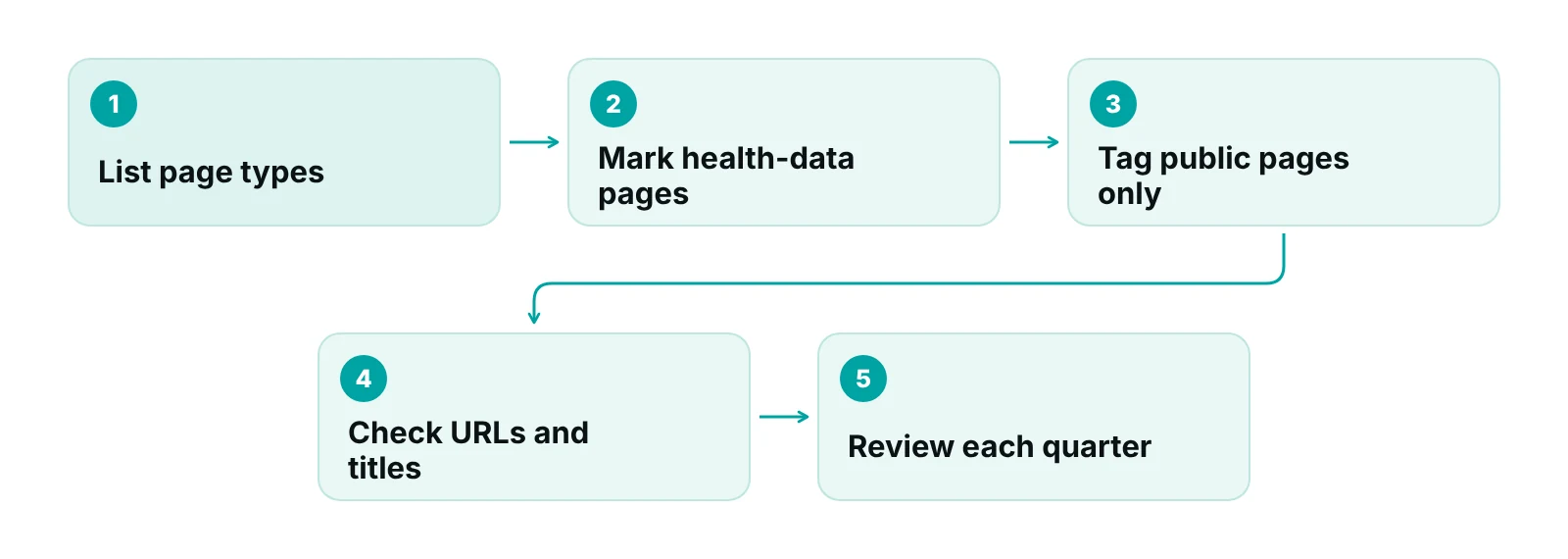
- Keep tags off pages that collect health information. Decide which page types are public marketing pages, and keep names and reasons for visit out of URLs, titles and event labels.
- Get a business associate agreement from any vendor that sees patient information. That includes call-recording tools and form handlers. If a vendor will not sign, turn the feature off.
- Keep the accounts in the practice's name. Own the ad account, the Google profile and the domain so a change of vendor does not mean a loss of data.
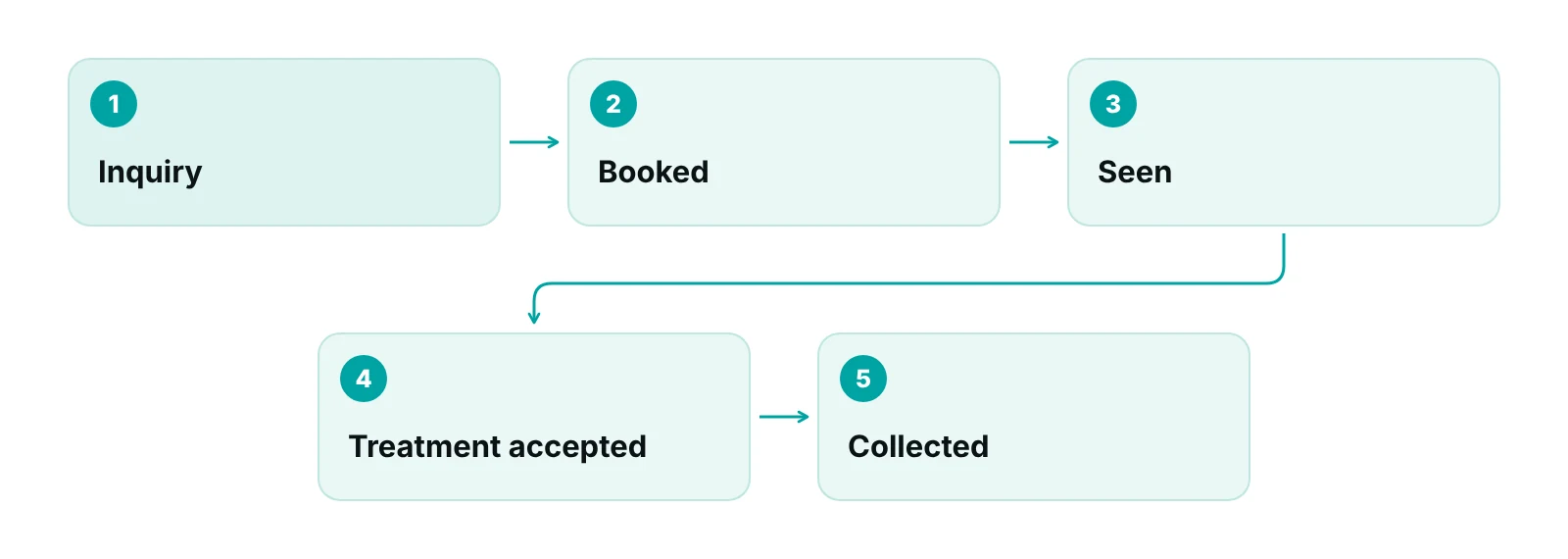
- Review the funnel monthly. Follow inquiries through booked, seen, accepted and collected, and move budget toward the sources that produce collected revenue.
Bottom line
Dental digital marketing pays when each channel has a job, a limit and a number, and when tracking stays on the marketing side of the privacy line. Use the budget inputs above to set a ceiling, check the rule for each channel before launch, and measure booked and collected patients, not clicks. The dental marketing plan gives the 90-day order of work, and RCM Finder’s healthcare digital marketing service is available for practices that want outside help.
Frequently asked questions
What are the main dental digital marketing channels?
The main channels are local search and the Google Business Profile, the website, paid search, social media, email and recall messages, and online reviews. Each does a different job: being found, earning trust, converting an inquiry or bringing a patient back. Pick them by goal and limit.
How much should a dentist spend on digital marketing?
No independent benchmark exists. An AACD guide from 2023 mentions a rule of thumb of around 10% of gross revenue but advises deciding the order channels are built. A better method is to set a ceiling on cost per booked new patient from the practice’s own collections.
Is Google Analytics safe for a dental website under HIPAA?
Google says it offers no business associate agreement for Analytics and makes no HIPAA representation. Regulated customers must not send it data that may be protected health information, and Google advises against tags on pages more likely to be covered, such as authenticated pages. Review page types with counsel.
Can a dental practice upload its patient list to an ad platform?
Treat it as a disclosure of patient information that needs a legal basis. HHS says marketing uses of patient information generally need written authorization, and Google bars audiences built from an advertiser’s own data in its Health category. The safer course is to avoid uploading patient lists.
Do marketing emails to patients have special rules?
CAN-SPAM applies to all commercial email. It requires truthful headers, a clear ad disclosure, a postal address and opt-outs honored within 10 business days, with penalties up to $53,088 per email. HIPAA marketing rules may add an authorization requirement, so ask counsel before using patient lists.
How do you track phone calls from ads?
Use a call-tracking number or the platform’s call report and match booked patients to source in the practice’s schedule. Check whether the tool records or transcribes calls, because recordings can hold health information and may need a business associate agreement. Google also warns against redirecting numbers on a profile.
Get your free practice audit
Tell us about your practice. We will contact you using the details you give.
- A review of your recent claims, denials and A/R aging
- Where your front desk and prior authorizations slow payment
- A prioritized fix list you keep, whether or not you hire us
Pricing is quoted after the audit, based on your volume and the services you choose. Prefer to talk? Call +1 (302) 556-2288.
Sources
- Guidelines for representing your business on Google — Google Business Profile Help (2026)
- Tips to get more reviews — Google Business Profile Help (2026)
- Health in personalized advertising — Google Ads Policy Help (2026)
- Healthcare and medicines — Google Ads Policy Help (2026)
- HIPAA and Google Analytics — Google Analytics Help (2026)
- Best practices to avoid sending PII — Google Analytics Help (2026)
- Use of Online Tracking Technologies by HIPAA Covered Entities and Business Associates — HHS Office for Civil Rights (2024 (reviewed June 26, 2024))
- Business Associates — HHS Office for Civil Rights (2026)
- Marketing (HIPAA Privacy Rule) — HHS Office for Civil Rights (2026)
- Collecting, Using, or Sharing Consumer Health Information? — HHS Office for Civil Rights (2026)
- CAN-SPAM Act: A Compliance Guide for Business — Federal Trade Commission (2026)
- The Consumer Reviews and Testimonials Rule: Questions and Answers — Federal Trade Commission (2025)
- A warning letter (or ten) for businesses: comply with the FTC's Consumer Review Rule — Federal Trade Commission (2025)
- Principles of Ethics and Code of Professional Conduct: Veracity — American Dental Association (2025)
- ADA Code updates address ethical concerns with social media influencers — ADA News (2025)
- Dental practice pays $10K to settle disclosures of patients' PHI on social media — California Dental Association (2019)
- Digital Marketing Budgeting Guide for Dentists — American Academy of Cosmetic Dentistry (2023)
Disclaimer: This article is educational and is not legal, coding, tax or compliance advice. Advertising, privacy and payer rules differ by state and by plan and change over time, so confirm current requirements with your state dental board, your attorney and each payer before acting. CDT is a registered trademark of the American Dental Association and CPT is a registered trademark of the American Medical Association; official code descriptors are not reproduced here.