
Dermatology SEO is the work of making a skin practice easy to find for three kinds of searches: a symptom, a treatment and a nearby dermatologist. It rests on an accurate Google Business Profile, one clear page per condition or procedure, provider pages with verifiable credentials, and honest proof of experience.
Skin conditions are common, and patients often start with a search box rather than a referral. The American Academy of Dermatology reports that skin disease affected 84.5 million Americans, about one in four, in an analysis of 2013 claims data, and that about one in three of them was seen by a dermatologist (American Academy of Dermatology).
This guide is for practice owners and managers who want to understand how that search behavior maps to a website and a Google listing. It leans on Google’s own documentation rather than agency folklore, flags the claims a dermatology site should be careful with, and leaves paid ads, review programs and online booking to the companion posts on dermatology digital marketing and dermatology marketing for medical and cosmetic patients.
Key takeaways
- Patients search in three modes: a symptom, a treatment, and a nearby provider. Each needs a different page type.
- Google says local ranking rests on relevance, distance and prominence, and that no one can pay for a better local ranking.
- The Google Business Profile has hard rules on names, categories and descriptions. Keyword-stuffed names risk suspension.
- A dermatology site is a health topic, so Google expects visible authorship, sourcing and real expertise.
- Credential claims and patient photos carry legal rules that sit outside SEO. Check them before they go on a page.
How do patients search when they need a dermatologist?
Patients search in three ways: by symptom, by treatment, and by provider or location. A symptom search (“a mole that changed”) comes from someone who is unsure what is wrong. A treatment search (“laser treatment for acne scars”) comes from someone who has already decided something. A provider search (“dermatologist near me”) comes from someone ready to book. The same practice needs a different page for each.
The AAD figures above matter for one reason: most people with a skin condition are not yet in a dermatologist’s chair. The page that explains the condition in plain language, says when to be seen and shows how to book is often the first contact. Table 1 matches each search type to the page that should answer it.
| Search type | What the patient is asking | Page that should answer | Service line |
|---|---|---|---|
| Symptom or condition | What is this and should I be seen? | Condition page: plain-language explanation, when to call, what a visit involves | Medical |
| Screening or concern | Can someone check this spot or skin change? | Skin check page with who should book, what happens and how to schedule | Medical, surgical |
| Treatment or procedure | What does this treatment involve? | Procedure page: what it treats, how it is done, recovery, who performs it | Medical, surgical, cosmetic |
| Cosmetic interest | What can be done about this and what does it cost? | Treatment page with consultation step and a clear note on self-pay | Cosmetic |
| Provider or location | Who is nearby and can I book? | Provider pages, location pages and the Google Business Profile | All |
| Insurance | Do you take my plan? | One verified insurance page, kept current by the front desk | Medical |
Cosmetic and medical interest often sit side by side in the same practice, and patients do not label their own search. A page that mixes the two confuses both. The related question of which services insurance pays for is covered in the dermatology insurance coverage guide; link to it instead of restating coverage rules on every treatment page.
Which pages does a skin practice need first?
Start with one page per thing a patient could search for, then connect them. A workable order is the home page, a hub for each service line, one page per condition and procedure, a page per provider, and a page per location. Everything else is optional until these exist.
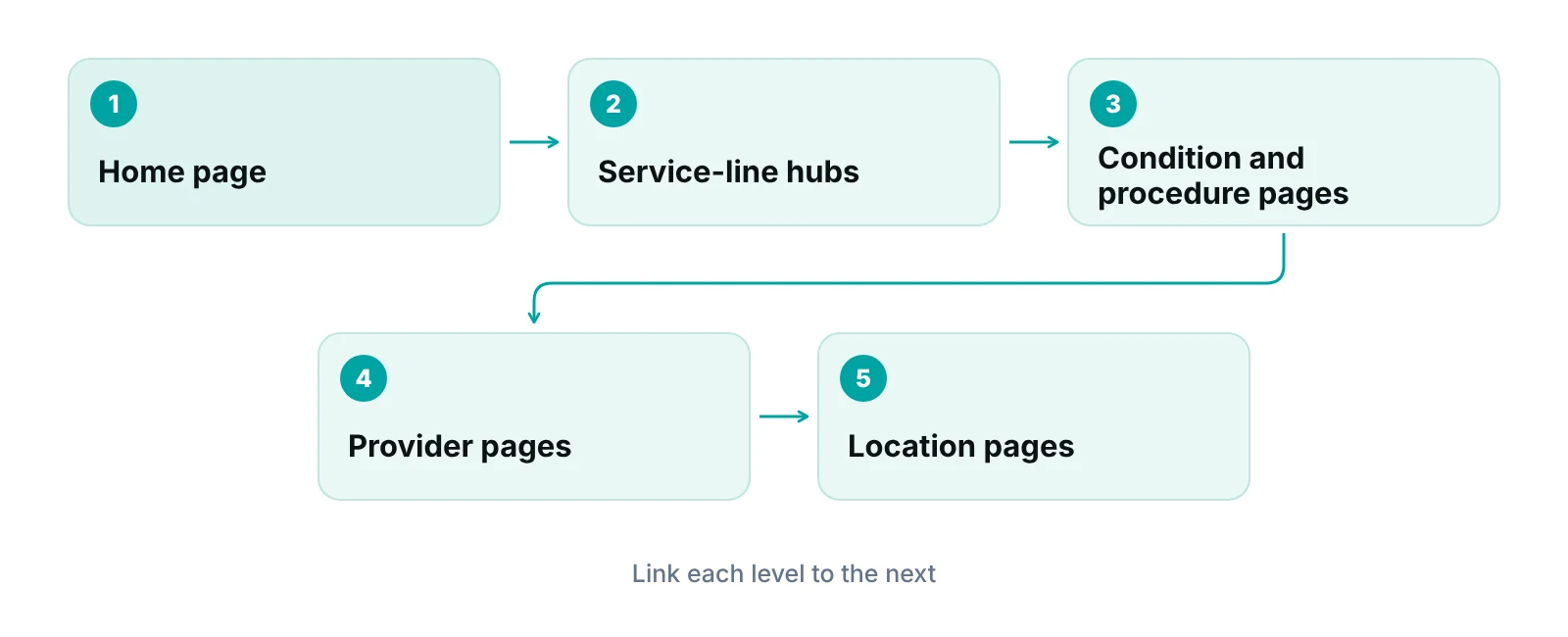
What each page type has to do
- Service-line hubs (medical, surgical, cosmetic) explain who each line is for and link to the detail pages beneath them.
- Condition and procedure pages answer one question each, begin with a direct answer, say when to call, and link to booking.
- Provider pages state training, credentials and clinical focus, and match what the state license record shows.
- Location pages carry the address, phone, hours and parking exactly as they appear on the Google profile.
Google’s guidance on helpful content asks three questions of any page: who created it, how it was made, and why it exists. It says the “why” matters most, and that content written mainly to attract search traffic is a warning sign (Google Search Central). The same page says Google has no preferred word count, so a short, accurate page can outrank a padded one.
How should the Google Business Profile be set up for a skin practice?
Set it up exactly as the practice appears in real life, and keep it short. Google’s guidelines require a real-world business name, one profile per location, and categories chosen to describe what the business is. The profile feeds the map results that “near me” searches return.
Google says local ranking depends on relevance, distance and prominence, and states that there is no way to request or pay for a better local ranking (Google Business Profile Help). Prominence includes review count and rating, so the profile and the review process are linked. Table 2 turns the guidelines into a checklist.
| Setting | What Google's guidelines say | Dermatology application |
|---|---|---|
| Business name | Use the real-world name. Taglines, service descriptions and phone numbers are not allowed in the name. | Do not add “Botox, Fillers and Acne Specialist” to the practice name to chase searches. |
| Categories | Choose the fewest categories that describe the core business, as specific as possible. Categories say what the business is, not what it offers. | Pick the category that fits the practice itself. Treatments belong on the website pages, not in extra categories. |
| Locations | Each location gets one profile. Duplicates and virtual offices do not qualify. | One profile per staffed office. Do not create a second profile for a service line in the same suite without checking the rules first. |
| Description | No links, no promotions or prices, no low-quality content. | Describe the practice and its providers. Leave specials and pricing for the website. |
| Reviews | Businesses may remind customers to leave reviews and may reply. Incentives for reviews are prohibited. | Ask every patient the same way. Never offer a discount or a gift for a review. |
Source: Google Business Profile Help, guidelines for representing your business and read-and-reply-to-reviews pages (accessed 2026)
Reviews also fall under federal law. The FTC’s rule on consumer reviews and testimonials has applied since October 21, 2024 and prohibits fake reviews, buying reviews, undisclosed insider reviews and review suppression through groundless legal threats or intimidation (Federal Register; FTC). A practice that asks every patient for a review in the same way, and replies to all of them, stays well inside both Google’s rules and the FTC’s.
Check the cosmetic brand question before building a second profile
Many skin practices run a cosmetic brand under the same roof. Google’s guidelines treat co-located businesses as separate only when they are genuinely separate businesses with different names. Whether a cosmetic arm of the same practice qualifies is a judgment call, so confirm it against the current guidelines before creating a second listing.
What makes a dermatology page trustworthy to Google and to patients?
Visible authorship, accurate credentials and honest sourcing do. Google describes health topics as “Your Money or Your Life” subjects and says it gives even more weight to strong trust signals on them (Google Search Central). It recommends bylines linked to author information and warns against invented names or false credentials.
For a dermatology site that means a clinician’s name and a review date on every condition page, and no stock “doctor” photos presented as staff. It also means getting credential wording right. California’s advertising statute, for example, lets a physician say “board certified” only for certification by a recognized board, and treats false or misleading statements as grounds for discipline (California Business and Professions Code section 651). Other states have their own rules, so check your state medical board before publishing credential claims.
Patient photos are a second trap. The HHS Office for Civil Rights settled with a physical therapy practice for $25,000 in 2016 after it posted patient testimonials with full names and full-face photos on its website without valid HIPAA authorizations (HHS OCR). Before-and-after galleries are common in dermatology, so the authorization process has to exist before the gallery does. The aesthetic practice marketing guide covers the photo and testimonial rules in more depth.
“A skin practice website is a clinical document with a phone number on it. Treat every claim like one.”
— Awais Afzal, Healthcare Operations & Data Analyst
What structured data and tracking basics apply?
Mark up the practice with LocalBusiness structured data, keep it identical to the visible page, and be careful with analytics tags. Google’s documentation lists name and address as required and recommends hours, telephone, URL and geographic coordinates, and tells sites to use the most specific business subtype available (Google Search Central). It limits review and rating markup to sites that capture reviews of other local businesses, so a practice should not mark up its own testimonials as ratings.
Tracking is a privacy question as much as a technical one. The HHS bulletin on online tracking technologies says tools on pages where a visitor schedules an appointment or enters symptoms can involve protected health information, and that a vendor handling such data needs a business associate agreement. A federal court vacated one part of the bulletin on June 20, 2024, and HHS says the bulletin does not carry the force of law (HHS OCR). Have a privacy officer review every tag on booking and symptom pages. The paid-media side of this is in the dermatology digital marketing post, and the wider checklist is in the HIPAA compliance checklist for medical practices.
How should dermatology SEO be measured?
Measure booked visits by service line, not rankings. Rankings move for reasons unrelated to revenue, and a first-page position for a cosmetic term means little if the phone is not answered. Agency guides often quote timelines of several months for first results, but the ones reviewed for this post cite no research for them, so treat any timeline as an assumption to test, not a promise.
| Measure | Where it comes from | What it tells you | How it misleads |
|---|---|---|---|
| Search queries and pages | Google Search Console | Which symptom, treatment and provider queries reach which pages | Impressions rise without any booked visit |
| Profile actions | Google Business Profile insights | Calls, direction requests and website clicks from the map | Calls that go unanswered still count |
| Booked visits by line | Practice scheduling records | Medical, surgical and cosmetic visits traced to a source | Needs the front desk to ask “how did you find us” consistently |
| Review count and reply rate | Google Business Profile | Prominence signal and patient experience | A burst of reviews can look unnatural and may break platform rules |
| Page-level conversion | Web analytics reviewed for privacy | Which pages lead to a call or form | Tags on booking pages can raise HIPAA questions |
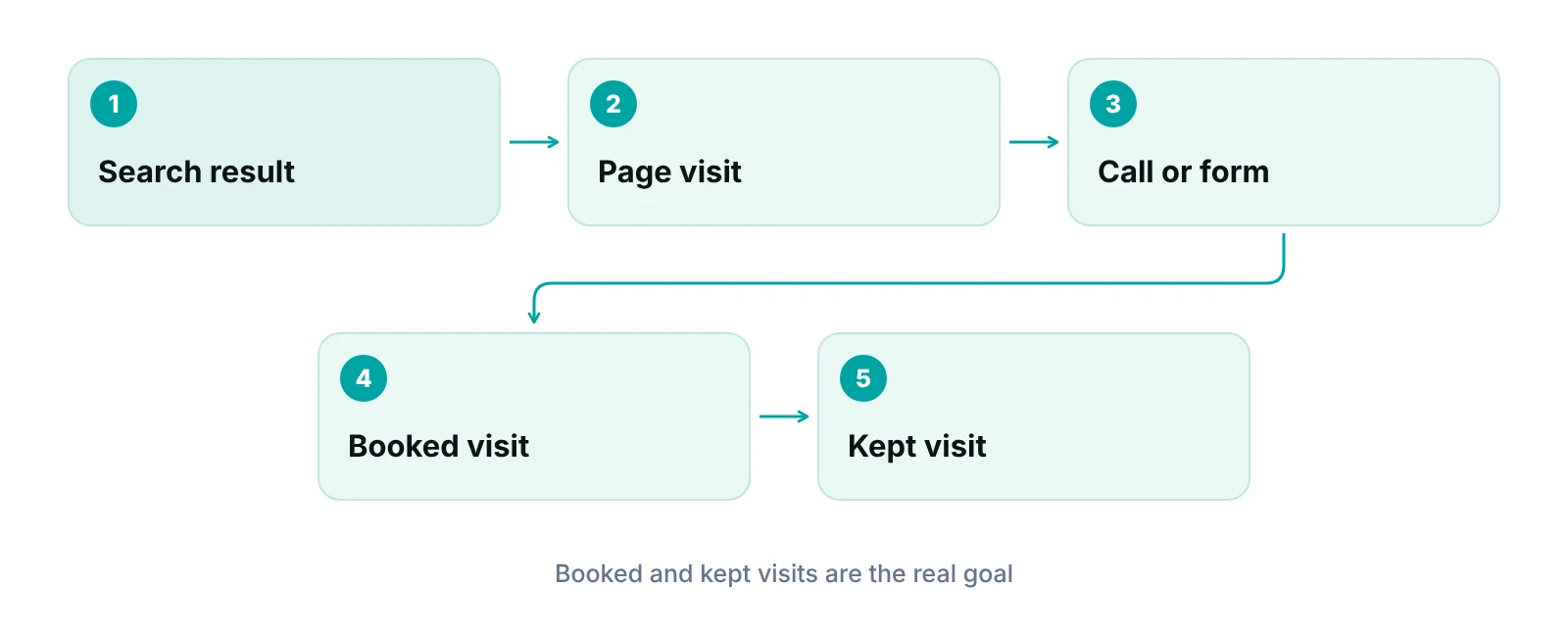
The measurement loop needs the front desk. A missed call after a good search result is a lost patient, and a virtual assistant covering overflow calls, intake and scheduling is one way to close that gap. The virtual medical assistant services and the post on front desk staff and revenue explain how.
Not sure what your skin practice is missing online?
Send the website and Google profile. A free practice audit reviews the pages, listing and intake path against the points above.
What is a sensible first 90 days?
Fix the foundation first, then build pages, then measure. The order matters because a new page on top of a wrong listing wastes the work.
- Verify the Google Business Profile for each location, correct the name and categories, and align hours and phone with the website.
- Write or rewrite the three service-line hubs and the five to ten condition and procedure pages that match real patient questions.
- Add provider pages with credentials checked against the state license record.
- Review every claim, photo and tracking tag with the privacy officer or counsel.
- Set up Search Console and a monthly report that ties queries to booked visits.
Organic search is slow and compounding, and it works best next to a clear plan for the rest of the funnel. The broader view of patient acquisition lives in the healthcare SEO guide and the healthcare digital marketing service page. Practices that bill insurance should also keep the revenue side in view through revenue cycle management, because new patients only help if visits convert to paid claims.
See how organic search fits your marketing mix
Review the healthcare digital marketing service for local search, Google Ads and reputation work.
Our recommendations
- Fix the listing before the website. Correct the Google Business Profile name, category, hours and phone for every location first. Errors there undo content work.
- Write one page per patient question. Give each condition, procedure and provider its own page. Open with the answer, then say when to call and how to book.
- Name a clinician reviewer. Put a clinician’s name and a review date on medical pages, and keep a log of who approved each page.
- Approve credentials and photos in writing. Check “board certified” wording against the state board and keep a signed HIPAA authorization on file for every patient image on the site.
- Tie search to booked visits. Ask every new patient how they found the practice and record it by service line. Report that number monthly beside Search Console data.
- Answer the phone. Search success ends at the front desk. Measure answered calls and time to callback for new-patient inquiries.
Bottom line
Dermatology SEO works when the listing is accurate, each patient question has a page, and every claim on those pages can be defended. Start with the Google profile, build the three kinds of pages, and measure booked visits. For help putting this into a plan, see the healthcare digital marketing service, then ask for a free practice audit. The related posts on service-line marketing and dermatology billing services and dermatology revenue cycle management cover what happens after the patient books.
Frequently asked questions
What is dermatology SEO?
Dermatology SEO is the practice of making a skin practice’s website and Google listing easy to find when patients search for a symptom, a treatment or a nearby dermatologist. It combines accurate local listings, clear condition and procedure pages, provider pages and trust signals, and it is measured by booked visits.
How is SEO for dermatologists different from other specialties?
Skin practices serve medical, surgical and cosmetic patients who search differently and pay differently. They also use before-and-after images and credential claims, which carry state advertising and HIPAA rules. Pages need to separate the service lines and keep every claim defensible.
Can a dermatology practice pay Google for a better local ranking?
No. Google states that there is no way to request or pay for a better local ranking. Local results depend on relevance, distance and prominence. Paid placement is a separate product, covered under Google Ads, and does not change organic map rankings.
Should the practice name include treatments like Botox?
No. Google’s guidelines say the profile name should be the real-world business name and that taglines and service descriptions do not belong in it. Adding treatments to the name risks a suspended profile. Put treatments on the website pages instead.
Is it safe to post before-and-after photos on a dermatology website?
Only with a valid HIPAA authorization from each patient, and within state advertising rules. The images must also accurately represent the results. Have counsel review the authorization form and the gallery wording before launch, because the rules differ by state.
How long does dermatology SEO take to work?
No reliable, sourced timeline exists. Results depend on competition, the starting state of the listing and the site, and how quickly pages are published. Judge progress by booked visits and answered calls over several months rather than by a promised date.
Get your free practice audit
Tell us about your practice. We will contact you using the details you give.
- A review of your recent claims, denials and A/R aging
- Where your front desk and prior authorizations slow payment
- A prioritized fix list you keep, whether or not you hire us
Pricing is quoted after the audit, based on your volume and the services you choose. Prefer to talk? Call +1 (302) 556-2288.
Sources
- Burden of skin disease — American Academy of Dermatology (2026)
- Creating helpful, reliable, people-first content — Google Search Central (2026)
- How to improve your local ranking on Google — Google Business Profile Help (2026)
- Guidelines for representing your business on Google — Google Business Profile Help (2026)
- Read and reply to reviews — Google Business Profile Help (2026)
- Local business structured data — Google Search Central (2026)
- California Business and Professions Code section 651 — California Business and Professions Code (2026)
- Complete P.T. resolution agreement — HHS Office for Civil Rights (2016)
- Use of Online Tracking Technologies by HIPAA Covered Entities and Business Associates — HHS Office for Civil Rights (2024)
- Trade Regulation Rule on the Use of Consumer Reviews and Testimonials — Federal Register (FTC) (2024)
- FTC announces final rule banning fake reviews and testimonials — Federal Trade Commission (2024)
Disclaimer: This article is educational and is not legal, coding, tax or compliance advice. CPT is a registered trademark of the American Medical Association, and its official descriptors are not reproduced here. Advertising, privacy and medical board rules differ by state and change, and payer rules vary, so confirm current requirements with your attorney, privacy officer, payers and Medicare contractor before acting.