
Dermatology marketing works best when medical, surgical and cosmetic care are treated as separate audiences with their own messages, payment expectations and appointment capacity. Plan each line on its own, route every inquiry to the right visit type, and check every claim, photo and review practice against FTC, HIPAA and state rules.
A dermatology practice is often three businesses under one roof. Medical dermatology treats conditions and is usually billed to insurance. Surgical dermatology, including skin cancer removal, depends on biopsies and referrals. Cosmetic dermatology is a consumer service where patients compare options and pay out of pocket. Each has a different buyer, a different calendar and a different set of advertising risks.
This guide is for owners and managers deciding where marketing effort goes. It covers how to split the lines, how to protect appointment capacity, which claims need approval, and what to measure. Organic search is covered in dermatology SEO, and ads, reviews and booking in dermatology digital marketing.
Key takeaways
- Medical, surgical and cosmetic care need separate messages because the patient, the payer and the decision are different.
- Marketing creates demand for a fixed number of slots. Decide which slots each line may fill before spending.
- Every inquiry should be routed by reason for visit, with cost and coverage said early for cosmetic requests.
- Photos, testimonials, reviews, credentials, prices and drug names each have a rule behind them. Approve them in writing.
- Measure each line with its own numbers. A blended “new patients” figure hides what is working.
Why does one marketing message not fit a dermatology practice?
Because the three service lines attract different people for different reasons. A patient with a changing mole wants speed and certainty. A patient referred for skin cancer surgery wants to know the surgeon is qualified and the process is clear. A cosmetic patient wants a consultation and a realistic picture of results and cost. A single “we treat your skin” message serves none of them well.
Demand for medical care is large. The American Academy of Dermatology reports 84.5 million Americans affected by skin disease in an analysis of 2013 claims data, with about one in three seen by a dermatologist (American Academy of Dermatology). That gap is an access problem as much as a marketing one, which makes the capacity question below important. Table 1 sets out how the lines differ.
| Service line | Typical patient | How care is usually paid | Marketing job | Lead measure |
|---|---|---|---|---|
| Medical | Rash, acne, eczema, psoriasis, a spot to check | Health plan, with copay or deductible | Make access easy; state plans accepted and what to bring | New-patient appointments filled and kept |
| Surgical | Referred or self-referred for a biopsy result or lesion removal | Health plan | Build trust with referring clinicians; explain the process | Referrals received by source |
| Cosmetic | Consumer comparing treatments | Usually self-pay; confirm per service | Educate, set expectations, book a consultation | Consultations booked and treatments started |
| Mixed | Medical patient who asks about cosmetic options | Both, on separate visits | Make cosmetic options visible without pressure | Cosmetic consults that begin from medical visits |
Coverage depends on the payer and on what the record documents, not on the label a practice gives the service. The details are in the dermatology insurance coverage guide. For marketing, the rule is simple: never imply coverage in an ad, and say early on cosmetic pages that the service is usually self-pay.
How do you protect appointment capacity while marketing both lines?
Decide in advance which slots each line may fill. Marketing that fills the week with cosmetic consultations can push a patient with a suspicious lesion out by weeks, and a long wait for medical care hurts the practice’s reputation faster than any ad can repair it.
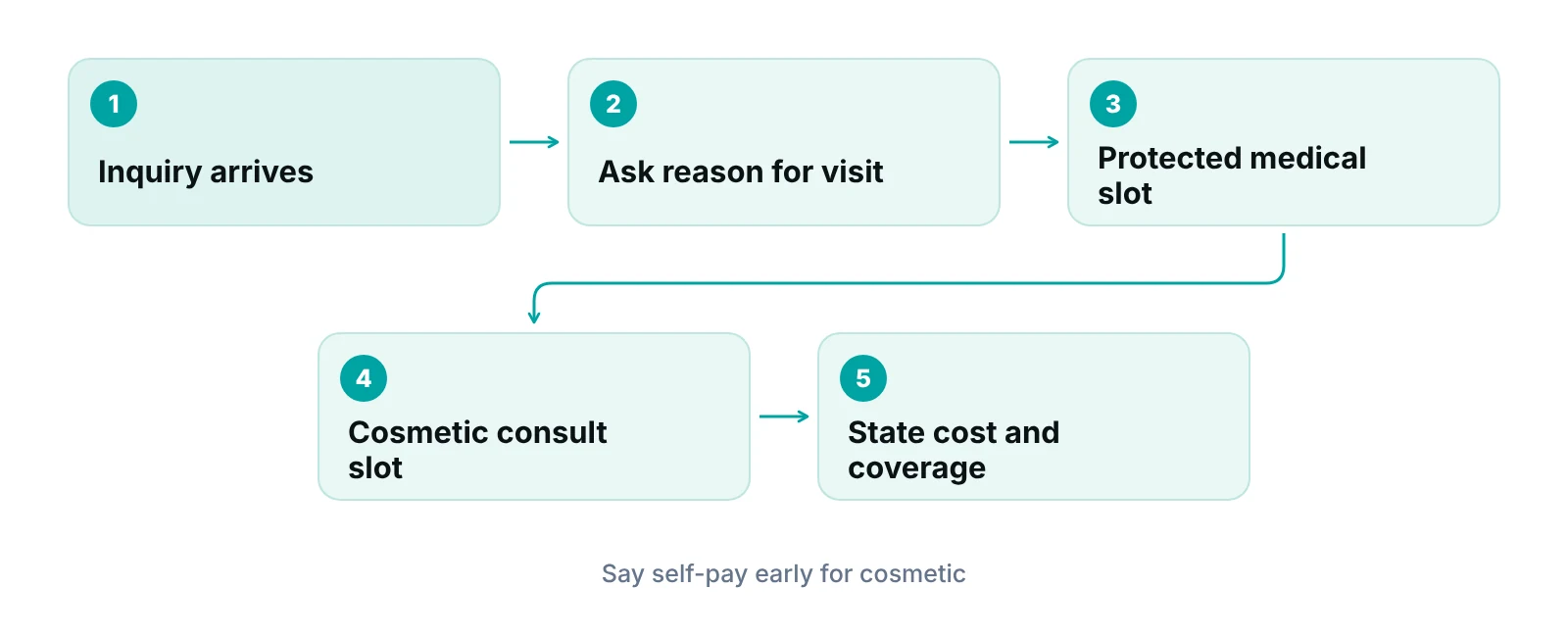
Most front desks solve this with a simple intake rule: ask the reason for the visit before offering a time. A reason that sounds medical or urgent goes to a protected medical slot. A cosmetic request goes to a consultation slot, and the caller hears the self-pay expectation before booking. The same script applies to web forms and chat.
Who answers the inquiry matters
The script only works if someone follows it every time, including after hours and at lunch. A virtual medical assistant can handle first contact, intake questions and scheduling inside the practice’s own rules, which keeps routing consistent when the front desk is busy. See the virtual medical assistant services and the post on how front desk staff affect revenue.
What should each service line say?
Medical dermatology
Lead with access and clarity: what the practice treats, which plans it accepts, how soon new patients can be seen and what to bring. Educational content on common conditions earns trust, as long as it says when to be seen and avoids diagnosing. Insurance acceptance should come from the front desk’s verified list, not from memory.
Surgical dermatology
Referring clinicians are the main audience. They need to know the surgeon’s training, how biopsy results are communicated and how quickly a patient can be scheduled. Patients arriving with a diagnosis need a plain explanation of the process. Keep any arrangement with referral sources reviewed by healthcare counsel before it starts.
Cosmetic dermatology
Lead with consultation and realistic outcomes. State pricing only if it can be exact: California’s advertising statute, used here as one state example, bars phrases such as “as low as” in price advertising and requires comparisons to rest on verifiable data (California Business and Professions Code section 651). The aesthetic practice marketing guide covers the cash-pay funnel in more detail.
How should surgical dermatology be marketed to referring clinicians?
Surgical dermatology is marketed through process, not slogans. A primary care clinician who finds a suspicious lesion wants to know three things: how to refer, how fast the patient will be seen, and how the result will come back. A practice that answers those questions in writing is easier to refer to than one with a general brochure.
- A referral path. A fax number, portal or form that a referring office can use in under a minute, plus a named contact for questions.
- A time commitment the practice can keep. State how soon a referred patient is scheduled only if the schedule supports it. Track days from referral to first visit.
- A closed loop. Send the referring clinician a short report after the visit and after biopsy or surgery. Referrers return to practices that keep them informed.
- Clear patient information. A plain-language page describing what happens after a biopsy result, so the patient arrives informed.
Referral relationships involve healthcare fraud and abuse rules, so any arrangement that involves value flowing between a practice and a referral source belongs in front of healthcare counsel. Informational lunches and educational material are common, but the line is the lawyer’s to draw, not marketing’s.
How should the brand and website be structured for three service lines?
Keep one practice brand and give each line its own section of the site. A single brand carries the trust earned by medical care. Separate sections let a cosmetic visitor reach treatment pages without wading through insurance information, and let a medical visitor skip the treatment menu.
The Google Business Profile needs more care than the site. Google’s guidelines call for one profile per location, a real-world business name, and note that co-located businesses need separate profiles with different names when they are genuinely different businesses (Google Business Profile Help). Whether a cosmetic arm of a dermatology practice counts as a separate business is a judgment call, so confirm it before creating a second listing. The mechanics of the profile and the page hierarchy are in the companion post on dermatology SEO.
Pages for cosmetic treatments should say what the visit is, what it may cost, that it is usually self-pay, and what a consultation involves. Pages for medical conditions should say which plans the practice accepts, when to call urgently, and how to bring records. The two page types should link to each other only where a patient would genuinely want to move between them.
Which marketing claims and assets need approval before they go live?
Photos, testimonials, reviews, credentials, prices and drug names each carry a rule. Table 2 pairs each asset with the source rule and the control a practice can use. State law varies, so treat California as an example and confirm your own state.
| Asset | Rule from a source | Control to put in place |
|---|---|---|
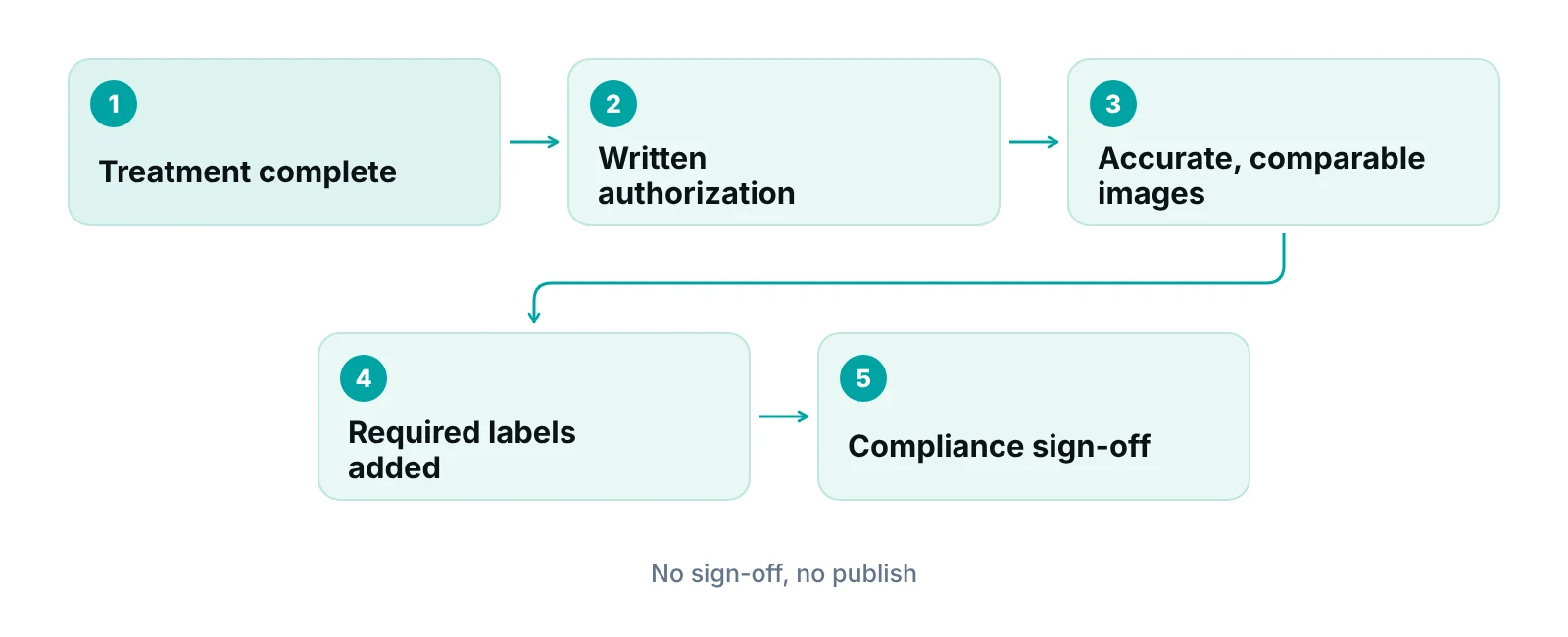
| Before-and-after photos | California requires images to accurately depict results, use comparable views, name the procedure and state that results may not occur for all patients. A HIPAA authorization is needed for patient images. | Signed authorization on file; a standard image protocol; a caption template |
| Patient testimonials | OCR settled for $25,000 in 2016 over testimonials with names and full-face photos posted without valid authorization. | No testimonial goes live without an authorization on file |
| Online reviews | The FTC rule effective October 21, 2024 bars fake reviews, buying reviews, undisclosed insider reviews and suppression through groundless legal threats. Google prohibits incentives for reviews. | One review request script for every patient; no gifts or discounts; staff reviews disclosed or excluded |
| Endorsements and influencers | The FTC’s updated Endorsement Guides (June 29, 2023) address incentivized reviews, reviews by employees and disclosure of material connections. | Written disclosure for any paid or free-treatment endorsement |
| Credentials | California allows “board certified” only for certification by a recognized board. | Check each claim against the state license and board record |
| Prescription drug names | FDA’s drug promotion office describes its scope as promotion by or on behalf of manufacturers, packers or distributors and does not address practitioner ads. Google Ads restricts prescription drug terms. | Counsel review of any ad naming a prescription product |
Sources: California BPC 651; HHS OCR (2016); Federal Register / FTC (2024); FTC (2023); Google Business Profile Help; FDA OPDP; Google Ads policy
The patient-image workflow is where most practices slip, because the photo is taken at a clinical visit and used later for marketing. Build the approval path into the chart.
The FTC and Federal Register material is the baseline for review practices, and the online reputation management guide shows how to run a review process inside those lines. Sources: HHS OCR, Federal Register, FTC and FTC Endorsement Guides announcement.
Drug names and Google Ads
Google’s healthcare policy prohibits speculative or experimental treatments and restricts prescription drug terms, and its policy page does not address cosmetic procedures (Google Advertising Policies Help). FDA’s promotion rules describe manufacturers, packers and distributors (FDA). Ask counsel how both apply before naming a prescription product in an ad.
How do medical patients become cosmetic patients without a privacy problem?
Many cosmetic patients first come through a medical visit. That is a useful path, but it needs rules. A conversation in the exam room, a brochure in the waiting room and a menu on the website are low-risk ways to make options visible. Pulling patient lists from the chart for a promotional campaign is a different matter, and the privacy officer should decide which lists may be used and with what consent.
Keep reminders for medical care separate from promotions for cosmetic services, in wording and in channel. Tracking tools on pages where visitors book or enter symptoms raise their own questions, which the HHS bulletin on online tracking technologies addresses (HHS OCR). The HIPAA compliance checklist is a good starting point for the review.
“The strongest dermatology brand is one where the medical side earns the trust and the cosmetic side never borrows it dishonestly.”
— Awais Afzal, Healthcare Operations & Data Analyst
What should each service line be measured on?
Each line gets its own scorecard, because a blended “new patients” number hides which line is working and which is crowding another out. Table 3 lists a lead, capacity and money measure for each.
| Line | Demand measure | Capacity measure | Money measure |
|---|---|---|---|
| Medical | New-patient requests by source | Days to the next new-patient visit; no-show rate | Visits billed and paid per new patient |
| Surgical | Referrals received by referrer | Days from biopsy result to surgery date | Procedures completed per referral |
| Cosmetic | Consultations booked by source | Consultation slots used | Treatments started per consultation; collected at visit |
| All lines | Calls answered and forms returned within a set time | Schedule fill by visit type | Revenue by line, reviewed monthly |
The money column needs clean billing data. Marketing spend that brings insured patients only pays off when visits turn into collected claims, which is why the revenue side matters. See the posts on dermatology billing services and dermatology revenue cycle management.
See how a marketing plan fits a mixed practice
Review the healthcare digital marketing service for local search, paid media and reputation work built around your service lines.
Are your medical and cosmetic lines competing for the same slots?
Send your scheduling templates and the way new inquiries are handled. A free practice audit shows where intake and marketing pull against each other.
Our recommendations
- Write a one-page service-line plan. List audience, payer, slots and one lead measure for medical, surgical and cosmetic care before any budget is set.
- Protect medical access first. Reserve new-patient and urgent slots for medical and surgical needs and cap the cosmetic consultation slots a campaign may fill.
- Script intake around the reason for the visit. Ask why before offering a time, and state self-pay expectations for cosmetic requests on the first call.
- Create an approval log for claims and images. Record who approved each photo, testimonial, credential line and price, with the authorization or source behind it.
- Run one review request process. Ask every patient the same way, never offer anything in exchange, and keep staff reviews disclosed or out.
- Give each line its own monthly scorecard. Report demand, capacity and money measures separately, and review them with the billing team.
Bottom line
Dermatology marketing succeeds when medical, surgical and cosmetic care are marketed as what they are: different decisions made by different patients, under different rules. Split the lines, protect capacity, approve every claim, and measure each line separately. To see how this fits a wider plan, review the healthcare digital marketing service, and read the companion posts on dermatology SEO and revenue cycle management. A free practice audit is the next step.
Frequently asked questions
How is dermatology marketing different from other specialties?
A dermatology practice serves insurance-based medical patients, referral-driven surgical patients and self-pay cosmetic patients at the same time. Each group needs its own message, intake path and measures, and before-and-after photos and credential claims add advertising and privacy rules.
Should medical and cosmetic services be marketed separately?
Yes, in messaging and measurement. They can share a brand and a website, but each line needs its own pages, intake questions and scorecard. Keeping them distinct also helps patients understand which services are billed to insurance and which are self-pay, which cuts down on billing surprises and awkward front desk conversations.
Can a practice use patient photos in marketing?
Only with a valid HIPAA authorization from the patient and within state advertising rules. California, for example, requires images to accurately depict results and comparable views. Have counsel review the authorization form and the gallery wording before publishing.
Are paid reviews or review incentives allowed?
No. Google prohibits incentives for reviews, and the FTC rule effective October 21, 2024 bars buying reviews and undisclosed insider reviews. Ask all patients the same way, reply to reviews, and never offer a discount or gift in return.
How do you stop cosmetic ads from crowding out medical patients?
Decide how many slots each line may fill, route every inquiry by reason for visit, and cap cosmetic consultation slots tied to a campaign. Track days to the next new-patient visit as a warning measure that spending is outrunning capacity, and pause a campaign when that number rises.
Where does a virtual assistant fit in dermatology marketing?
A virtual assistant can answer first contact, ask the intake questions and book into the right slot type under the practice’s rules, including outside office hours. That keeps routing consistent so campaigns convert into the right kind of visit. Pricing for the service is quoted after a free audit.
Get your free practice audit
Tell us about your practice. We will contact you using the details you give.
- A review of your recent claims, denials and A/R aging
- Where your front desk and prior authorizations slow payment
- A prioritized fix list you keep, whether or not you hire us
Pricing is quoted after the audit, based on your volume and the services you choose. Prefer to talk? Call +1 (302) 556-2288.
Sources
- Burden of skin disease — American Academy of Dermatology (2026)
- California Business and Professions Code section 651 — California Business and Professions Code (2026)
- Complete P.T. resolution agreement — HHS Office for Civil Rights (2016)
- Trade Regulation Rule on the Use of Consumer Reviews and Testimonials — Federal Register (FTC) (2024)
- FTC announces final rule banning fake reviews and testimonials — Federal Trade Commission (2024)
- FTC announces final updated Endorsement Guides — Federal Trade Commission (2023)
- Read and reply to reviews — Google Business Profile Help (2026)
- Prescription drug advertising and promotional labeling (Bad Ad program) — U.S. Food and Drug Administration (2026)
- Healthcare and medicines policy — Google Advertising Policies Help (2026)
- Use of Online Tracking Technologies by HIPAA Covered Entities and Business Associates — HHS Office for Civil Rights (2024)
- Guidelines for representing your business on Google — Google Business Profile Help (2026)
Disclaimer: This article is educational and is not legal, coding, tax or compliance advice. CPT is a registered trademark of the American Medical Association, and its official descriptors are not reproduced here. Advertising, privacy and medical board rules differ by state and change, and payer rules vary, so confirm current requirements with your attorney, privacy officer, payers and Medicare contractor before acting.
