
Dermatology digital marketing is paid search, paid social, review management and online booking working as one funnel inside the rules of Google, the FTC and HIPAA. Match each ad to a service page, limit targeting to what platform policy allows, ask every patient for a review the same way, and keep health details out of ad tags.
Paid ads, reviews and online booking are where a dermatology practice meets the most rules at once. A Google ad for a skin treatment touches advertising policy. A review request touches Google and FTC rules. A booking form touches HIPAA when the tracking tags on that page can see who is asking about what.
This guide is for owners and managers who run, or buy, these channels. It covers which paid channels fit, what Google restricts, how to handle reviews, and how to test a booking path. Organic search is in dermatology SEO, and the medical-versus-cosmetic strategy is in dermatology marketing.
Key takeaways
- Paid channels differ by service line: search suits people who already want a treatment or a provider, and policies restrict what can be said and who can be targeted.
- Google classes health as a sensitive category and bars advertiser-curated audiences such as customer match and lookalikes for it.
- Review requests must be the same for everyone. Google prohibits incentives, and the FTC rule bars fake, bought and suppressed reviews.
- Tracking tags on booking and symptom pages can raise HIPAA issues. Audit every tag with the privacy officer.
- The goal is a booked and kept visit, so measure the path from click to kept appointment.
Which paid channels fit a dermatology practice?
Search ads fit best, because they reach people who are already looking for a treatment or a provider. Other channels need more care. Table 1 sets out where each fits and what to check first. The policy statements come from Google’s published pages; paid social policies were not reviewed for this article, so read each platform’s current rules before launching there.
| Channel | Best use | Policy watch-outs | What to measure |
|---|---|---|---|
| Google Search ads | New-patient and treatment searches | Healthcare policy prohibits speculative or experimental treatments and restricts prescription drug terms; the page does not address cosmetic procedures | Booked visits by service line; calls answered |
| Display and video using Google’s predefined audiences | Awareness for a service or a new provider | Health is a sensitive interest category; advertiser-curated audiences are not allowed | Reach, then visits tied to the campaign |
| Paid social | Cosmetic education and consultation offers | Platform rules not reviewed here; before-and-after claims need state-law and authorization checks | Consultations booked |
| Local profile and reviews | Map visibility and trust | Google profile and review rules apply; see the SEO post | Calls, directions, review rate |
Sources: Google Advertising Policies Help: healthcare and medicines; personalized advertising (accessed 2026)
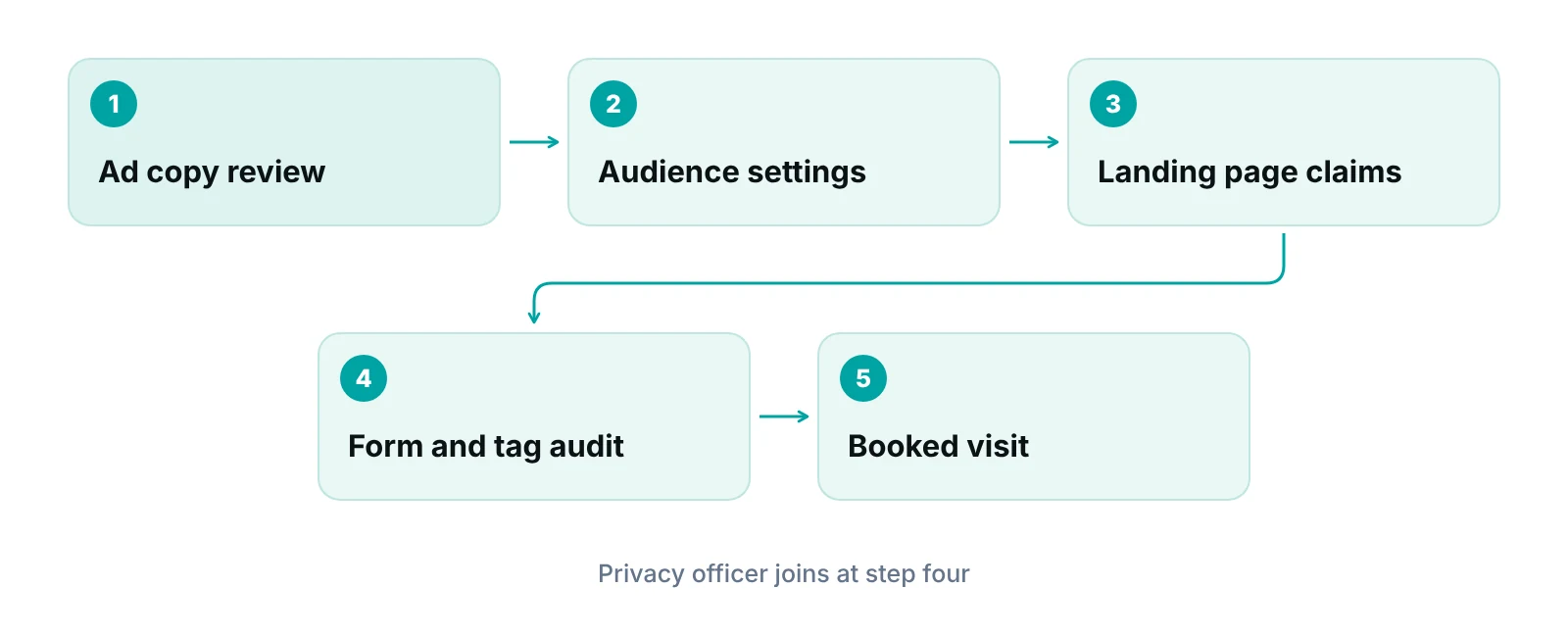
Ad copy should match the landing page exactly. An ad that promises a treatment the page does not describe wastes the click and, in some categories, draws a policy flag. Prices follow the same rule as other claims. California’s advertising statute, used here as one state example, bars phrases such as “as low as” in price advertising (California Business and Professions Code section 651). The wider claims rulebook is in the dermatology marketing post and the aesthetic practice marketing guide.
What do Google's policies restrict for a skin practice?
Google restricts the audiences a practice can build and the data it can send. Google’s personalized advertising policy lists health as a sensitive interest category. For those ads, advertiser-curated audiences such as customer match, “your data” segments, audience expansion and lookalikes are not allowed, while predefined Google audiences such as in-market and affinity segments, location and demographics are allowed. The policy also bars sending personally identifiable information to Google through data segment tags or feeds, and says users under 18 are not eligible for personalized advertising (Google Advertising Policies Help).
For a skin practice, that means no uploading a patient list to build an audience, and no remarketing list that targets people who visited a page about a specific condition. The healthcare and medicines policy adds that speculative or experimental treatments are prohibited and that prescription drug terms are restricted (Google Advertising Policies Help). That page does not address cosmetic procedures, so ask your account representative or check Google’s other policy pages before advertising a new treatment.
Tracking tags on booking and symptom pages
The HHS bulletin on online tracking technologies says tracking tools on pages where a visitor schedules an appointment or enters symptoms can involve protected health information, and that a vendor handling such data must sign a business associate agreement. A federal court vacated one part of the bulletin on June 20, 2024, and HHS says the bulletin does not carry the force of law (HHS OCR). The safe approach is to inventory every tag and let the privacy officer decide before launch.
How should campaigns be organized across service lines?
Keep medical, surgical and cosmetic campaigns apart. Separate campaigns mean separate budgets, separate messages and separate results. A blended campaign that sends a person looking for acne treatment to a cosmetic offer page wastes the click and confuses the patient.
- Medical campaigns point to condition pages and the new-patient booking path, and state accepted insurance plans where the front desk keeps the list current.
- Surgical campaigns are usually small and aimed at people who already have a biopsy result or a referral. Direct them to a page that explains the process and gives a phone number.
- Cosmetic campaigns point to treatment pages and a consultation booking step, and say the service is usually self-pay.
- Negative keywords keep each campaign out of the other’s searches, for example keeping medical-condition queries out of a cosmetic campaign.
Capacity matters here as in the marketing post: cap the daily budget of any campaign that fills a limited slot type, and pause it when the next available visit moves out beyond what the practice is willing to promise.
What does an ad landing page need to say?
It needs one answer to the searcher’s question, one next step, and nothing that the practice cannot support. Landing pages are where claims, photos and prices are most visible, so they carry the most review risk.
- State the service, who performs it and where, in the first screen.
- Give one clear action: call, or request a time.
- Show credentials that match the state license record.
- Use patient photos only with signed authorization and the labels your state requires.
- State insurance acceptance for medical services and self-pay terms for cosmetic ones.
- Link to a privacy notice and avoid free-text symptom boxes in tagged forms.
Test every landing page on a phone before the campaign goes live, and check that the call button and the form both work. For the page structure that supports organic search as well, see dermatology SEO.
How should a dermatology practice handle reviews?
Ask every patient the same way, reply to every review, and never give anything in return. Google lets businesses remind customers to review by sharing a link or QR code, and treats offering free or discounted goods or services for reviews as prohibited (Google Business Profile Help). The FTC’s rule, in effect since October 21, 2024, also prohibits buying reviews, undisclosed insider reviews, company-controlled sites that pose as independent, and review suppression through groundless legal threats or intimidation (Federal Register). The FTC says it can seek civil penalties against knowing violators (FTC).
| Practice | Rule from a source | Safer approach |
|---|---|---|
| Asking patients for reviews | Google allows reminders with a link or QR code | Send the same request to all patients after the visit |
| Offering a discount or gift for a review | Google treats incentives for reviews as prohibited; the FTC rule bars buying reviews | Offer nothing in return |
| Staff or owners posting reviews | The FTC rule covers insider reviews that do not disclose the relationship; the 2023 Endorsement Guides address employee reviews | Staff do not post; disclose any exception clearly |
| Threatening patients over a bad review | The FTC rule bars suppression through groundless legal threats or intimidation | Reply politely; use the platform’s flag tool for policy violations |
| Replying to a review | Google advises polite, personalized replies that protect privacy | Reply without confirming the person is a patient or giving any detail of care |
Sources: Google Business Profile Help; Federal Register / FTC (2024); FTC (2023)
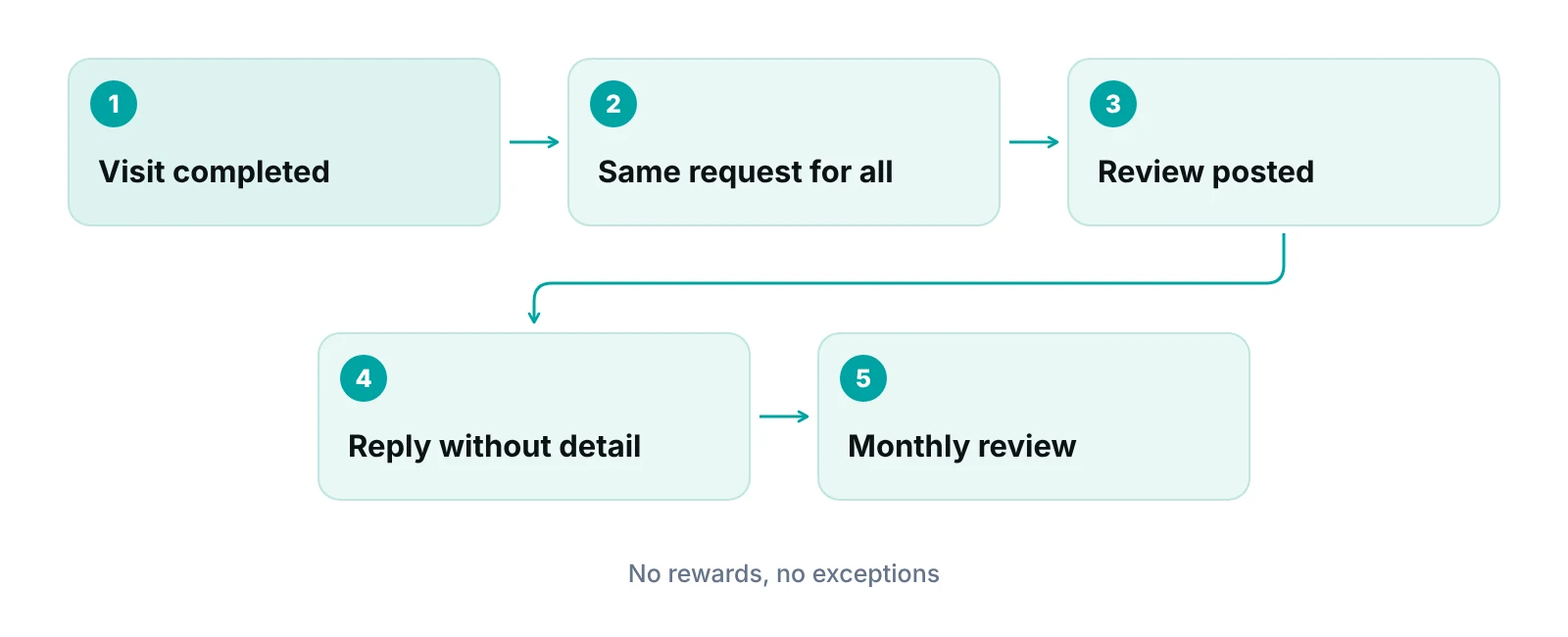
The last row deserves a rule of its own. A public reply that confirms someone was treated discloses information about them. OCR’s 2016 settlement for $25,000 with a physical therapy practice that posted testimonials without valid authorizations shows how OCR treats patient information used in public marketing (HHS OCR). Ask the privacy officer to approve reply templates. The wider reputation process is in the online reputation management guide.
What does a safe booking path look like?
A short form or a phone call that reaches a person quickly, with tags that never see health details. Booking is where marketing spend turns into visits, and where most of it is lost to delay. The HHS bulletin names scheduling an appointment and entering symptoms as moments when tracking can become a HIPAA matter, so the form should collect only what scheduling needs: name, phone, preferred time and visit type.
| Step | Common leak | Check | Measure |
|---|---|---|---|
| Landing page | Page does not match the ad | Same service, same claim, plain-language next step | Click-to-contact rate |
| Form or call | Slow reply; symptoms typed into a tagged form | Free-text symptom boxes removed or untracked; reply within a set time | Time to first reply |
| Confirmation | No message, or a message with health detail | Confirmation states visit type and time, not the condition | Confirmed bookings |
| Reminder | Patient forgets or cannot reschedule | Reminder with a simple way to change the time | No-show rate by source |
| Check-in | Insurance or self-pay terms unclear | Eligibility checked beforehand; cosmetic terms stated | Kept visits and collected balances |
Someone has to answer the form the same hour it arrives. A virtual medical assistant can take first contact, ask the intake questions and schedule into the practice’s own system, including outside office hours; see the virtual medical assistant services. The front-desk side is covered in front desk staff and revenue.
“A booking form that asks about symptoms for the ad platform's benefit is asking for trouble. Ask only what scheduling needs.”
— Awais Afzal, Healthcare Operations & Data Analyst
Is your booking path leaking patients or privacy?
Send the landing page, form and tag list. A free practice audit reviews the path from ad click to kept visit.
How should paid and reputation work be measured?
Measure booked and kept visits by service line, and cost per kept visit by channel. Clicks and impressions are early signals only. Because conversion tracking itself can raise HIPAA questions, send conversion events without health details and let the privacy officer approve the setup.
- By channel: spend, calls, forms, booked visits and kept visits.
- By service line: medical, surgical and cosmetic results kept apart, because they pay differently.
- Reputation: review count, average rating, reply rate and reply time.
- Front desk: calls answered, time to first reply and after-hours coverage.
Keep the monthly report to one page. It should show spend and kept visits by channel and service line, the next available new-patient date, review count and reply time, and one decision for the month: scale a campaign, pause one, or fix a step in the booking path. A report that ends with a decision gets used; a report that ends with a chart does not. Review it with the front desk, because the front desk controls the last two steps of the funnel.
Google says that local ranking depends on relevance, distance and prominence, and that prominence includes the number and rating of reviews, so reputation work feeds map visibility as well as trust (Google Business Profile Help). For the organic side, see the dermatology SEO guide and the healthcare SEO guide.
Visits only help when they turn into paid claims or collected balances. The revenue side is covered in dermatology billing services and dermatology revenue cycle management. The service-level view is on the healthcare digital marketing page, and a general checklist for privacy is in the HIPAA compliance checklist.
See how paid, reviews and booking fit one plan
Review the healthcare digital marketing service, which covers local SEO, Google Ads and reputation work.
Our recommendations
- Match every ad to one page. Keep a sheet that lists each ad group, its landing page and the claims on both, and review it before launch.
- Use platform audiences, not patient lists. Build audiences from Google’s predefined segments and keep patient lists out of any ad platform.
- Inventory every tag. List each pixel and script on booking and symptom pages, name its vendor and check whether a business associate agreement is in place.
- Write one review script. Use the same request for every patient, with no reward, and have the privacy officer approve reply templates.
- Keep the booking form short. Collect name, phone, time and visit type. Leave symptoms to the phone call or the portal behind login.
- Answer inside a set time. Choose a reply time, measure it weekly and cover after-hours inquiries.
Bottom line
Dermatology digital marketing works when the funnel is built inside the rules: ads that match their pages, audiences that Google allows, reviews asked for evenly, and a booking path that collects only what scheduling needs. Measure kept visits by service line and review the tags with the privacy officer. If you want a second view of your funnel, the healthcare digital marketing team can review it as part of a free practice audit.
Frequently asked questions
What is dermatology digital marketing?
It is the set of online channels a skin practice uses to attract and book patients: paid search and social ads, review management, online booking and the tracking that measures them. It works best as one funnel with clear service-line goals and checks for platform, FTC and HIPAA rules.
Can a dermatology practice use patient lists for Google Ads?
Not for health ads. Google’s personalized advertising policy lists health as a sensitive category and does not allow advertiser-curated audiences such as customer match, your data segments, audience expansion or lookalikes for it. Predefined Google audiences remain available.
Can a practice offer patients a discount for a review?
No. Google treats offering free or discounted goods or services in exchange for reviews as prohibited, and the FTC rule effective October 21, 2024 bars buying reviews. Ask every patient the same way and offer nothing in return.
Are tracking pixels allowed on a dermatology booking page?
It depends. HHS says tracking tools on pages where visitors schedule appointments or enter symptoms can involve protected health information and may require a business associate agreement. A court vacated part of the bulletin in June 2024. Have the privacy officer review every tag.
How should a practice reply to a negative review?
Reply politely and briefly, without confirming that the person was a patient or giving any detail of care. Google advises protecting privacy and avoiding personal attacks. Invite the person to call the practice, and have the privacy officer approve the template.
How do you measure dermatology digital marketing?
Track booked and kept visits by channel and service line, then cost per kept visit. Add calls answered, time to first reply and review rate. Clicks and impressions are early signals only, and conversion events should be set up without health details.
Get your free practice audit
Tell us about your practice. We will contact you using the details you give.
- A review of your recent claims, denials and A/R aging
- Where your front desk and prior authorizations slow payment
- A prioritized fix list you keep, whether or not you hire us
Pricing is quoted after the audit, based on your volume and the services you choose. Prefer to talk? Call +1 (302) 556-2288.
Sources
- Healthcare and medicines policy — Google Advertising Policies Help (2026)
- Personalized advertising policy — Google Advertising Policies Help (2026)
- Use of Online Tracking Technologies by HIPAA Covered Entities and Business Associates — HHS Office for Civil Rights (2024)
- Read and reply to reviews — Google Business Profile Help (2026)
- Trade Regulation Rule on the Use of Consumer Reviews and Testimonials — Federal Register (FTC) (2024)
- FTC announces final rule banning fake reviews and testimonials — Federal Trade Commission (2024)
- FTC announces final updated Endorsement Guides — Federal Trade Commission (2023)
- Complete P.T. resolution agreement — HHS Office for Civil Rights (2016)
- California Business and Professions Code section 651 — California Business and Professions Code (2026)
- How to improve your local ranking on Google — Google Business Profile Help (2026)
- Guidelines for representing your business on Google — Google Business Profile Help (2026)
- Burden of skin disease — American Academy of Dermatology (2026)
Disclaimer: This article is educational and is not legal, coding, tax or compliance advice. CPT is a registered trademark of the American Medical Association, and its official descriptors are not reproduced here. Advertising, privacy and medical board rules differ by state and change, and payer rules vary, so confirm current requirements with your attorney, privacy officer, payers and Medicare contractor before acting.