

Dermatology revenue cycle management is the control of every step between booking a patient and collecting the last balance, and skin practices lose revenue at predictable points: prior authorization for biologic drugs, lesion-level charge capture, modifier 25 visits, supervision rules for physician assistants and nurse practitioners, late filing and self-pay balances.
Most revenue loss in a dermatology practice is quiet. A lesion that was biopsied but never charged, a biologic request that sat in a fax queue, a physician assistant visit billed under the wrong rule, or a cosmetic balance that nobody followed up do not appear as denials. They appear as a month that is a little thin.
This guide maps those leaks, ties each to a source, and lists the controls that close them. The coding rules for biopsies, destruction and Mohs are in the companion post on dermatology billing services; this post stays on the cycle as a whole. For the marketing side that fills the schedule, see dermatology marketing.
Key takeaways
- Dermatology revenue leaks at the front (prior authorization), the middle (charge capture and modifiers) and the back (late filing and self-pay).
- Prior authorization for biologics is a documented burden: the AMA reports 39 requests and 13 hours per physician each week across specialties.
- Lesion-level charge capture misses are invisible in denial reports, so they need their own audit.
- Medicare incident-to billing generally requires direct supervision, and only the supervising practitioner may bill.
- Medicare claims received more than one calendar year after the date of service are denied as untimely, and apart from limited exceptions the denial cannot be appealed.
Where does revenue leak in a dermatology practice?
It leaks at the front end, in charge capture and modifiers, with supervised staff, and at the back end through late filing and self-pay balances. Table 1 maps each leak to the rule or evidence behind it and a control that closes it. Detail on the coding rules sits in the billing services post and is not repeated here.
| Stage | Leak | Rule or evidence | Control |
|---|---|---|---|
| Front end | Biologic and other drug requests stall or are denied | AMA 2024 survey: 39 prior authorizations and 13 hours per physician-week. In a 2009-2014 psoriasis chart review, step therapy was the most common denial reason | Named owner, tracker by payer, appeal letter library |
| Charge capture | Lesions or add-on lines never reach the claim | Biopsy, destruction and excision codes depend on method, site, number and size; add-on codes exist for further lesions | Lesion-level charge screen; weekly missed-charge audit |
| Coding | Modifier 25 omitted or unsupported | Needs a significant, separately identifiable E/M; not 99211 | Second reader on every modifier 25 claim |
| Documentation | Mohs and procedure claims denied on review | Medical necessity and insufficient documentation were common reasons in a 2024 Mohs review | Template with required fields; response owner for records requests |
| Supervision | PA or NP visits billed under the wrong rule | Incident-to: generally direct supervision; only the supervising practitioner bills | Written supervision rule per site and per service |
| Back end | Claims filed too late | Medicare: one calendar year; late-filing denial cannot be appealed as an initial determination | Aging report with a 90-day trigger |
| Patient balance | Self-pay and cosmetic balances uncollected | No external rule; depends on policy | Price in writing before treatment; collect at the visit |
Sources: AMA (2025); Dermatology Times (2016); CMS NCCI Policy Manual Ch. 3 (2026); First Coast (2024, 2026); 42 CFR 410.26; CMS Transmittal 12909 (2024); AAFP (2019)
The sources are the American Medical Association, First Coast Service Options and the AAFP, with the Medicare rules covered further below.
Why is prior authorization such a drain for dermatology?
Because modern skin treatments, especially biologics for psoriasis, atopic dermatitis and hidradenitis suppurativa, often need approval before the first dose, and approval rules differ by payer. The AMA’s 2024 physician survey of 1,000 physicians reported an average of 39 prior authorizations per physician per week, 13 hours of physician and staff time, and 40 percent of physicians with staff who work only on prior authorization (AMA). Those figures cover all specialties, so dermatology-specific data matter too.
| Source | What it measured | Result | Caveat |
|---|---|---|---|
| AMA physician survey, late 2024 | Prior authorizations per physician per week, all specialties | 39 requests; 13 hours; 40% have staff working only on them; 1,000 respondents | Not dermatology-specific |
| AAD member survey, 2020 (reported 2025) | Cost and staff time of prior authorization in dermatology practices | About $40,000 per practice per year; about 3.5 hours of staff time per day | Survey from 2020; self-reported |
| Dermatology Times report of a George Washington chart review (2016) | Biologic prior authorization in psoriasis, 2009 to 2014 | Share of biologic prescriptions needing prior authorization 16% to 75%; denial rate 0% to 19%; days to decision 3.7 to 6.7 | Single center; 864 psoriasis patients, 114 biologic candidates; a decade old |
| Biologic coordinator organization surveys (2024) | Reported effects among biologic coordinators | 96% reported delays in necessary care | The organization’s own surveys of members; not independent |
Sources: AMA (2025); Dermatology World, AAD (2025); Dermatology Times (2016, 2024)
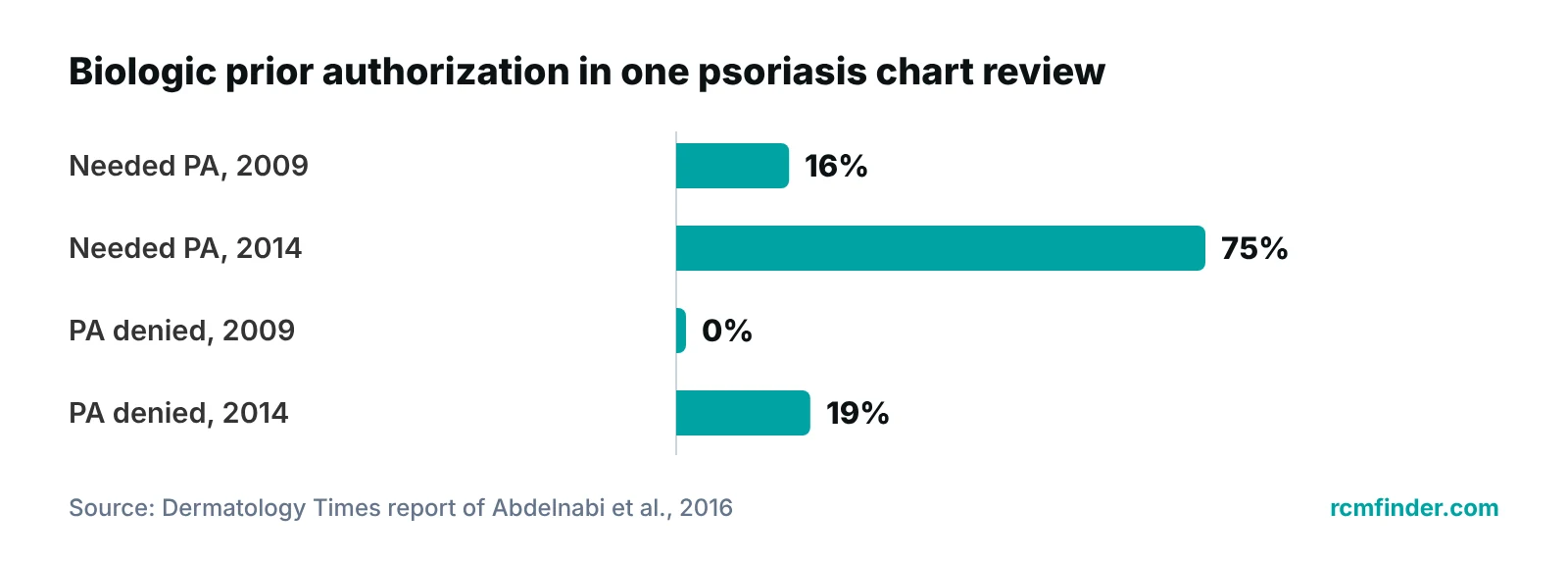
The study is old and small, so use it as a direction rather than a rate. The AAD survey is the nearest dermatology cost estimate: about $40,000 per practice per year and about 3.5 hours of staff time per day, from a 2020 member survey reported in Dermatology World in 2025 (Dermatology World). The same article describes the AAD’s appeal letter tool, with more than 70 customizable letters across 15 diagnoses.
What dermatology practices do about it
- Document the criteria at the visit. The 2016 Dermatology Times report advises recording body surface area and symptoms such as pain, difficulty walking and hand involvement clearly in notes and forms.
- Name an owner. Some practices employ a biologic coordinator who handles authorizations, appeals and patient assistance programs (Dermatology Times).
- Track every request. A shared tracker by payer, drug and date shows which requests are stuck.
The process steps are in the prior authorization guide and the guide to expediting medication prior authorization. A virtual medical assistant can take on intake, eligibility checks and prior authorization follow-up through the virtual medical assistant services, with the clinical decisions staying with the practice.
How do charge capture misses happen in a skin practice?
They happen because a single visit can hold many small services. A skin check may include a biopsy of one lesion, destruction of several others, a shave and a second problem. Each service needs a method, a site, a count and often a size, and the charge screen has to capture all of them.
The AAFP coding article describes why: destruction of premalignant lesions has a first-lesion code, an add-on for each additional lesion up to a count and a separate code for larger numbers, and benign lesion destruction has its own two-tier structure (American Academy of Family Physicians). If the note says “multiple AKs treated” without a number, the biller cannot choose the right line. The same is true for lesion size on shaves and excisions.
Modifier 25 is the other quiet leak. The E/M visit on a procedure day is payable only when significant and separately identifiable, and a Medicare contractor notes it does not apply with 99211 (First Coast Service Options). Too little use leaves payable visits unbilled; too much use invites review. Medicare’s NCCI manual adds a third risk: it says the biopsy of a lesion removed at the same encounter is not reported separately, so a biopsy line added to a removal claim is a bundling error (CMS). The full rule set for biopsy bundling and repair is in the billing services post.
“A revenue cycle review in dermatology should start with the exam room: if the note cannot support the charge, no downstream fix will hold.”
— Awais Afzal, Healthcare Operations & Data Analyst
What revenue risk comes with physician assistants and nurse practitioners?
Billing the wrong way for supervised staff is a compliance risk as well as a revenue risk. Under Medicare’s incident-to regulation, services must be furnished in a noninstitutional setting, be an integral part of the physician’s service, and generally be under direct supervision. Only the supervising physician or practitioner may bill Medicare for incident-to services (42 CFR 410.26).
In a busy practice with several providers, that rule creates practical questions: who was the supervising clinician on the day, was that person in the office, and was the service a continuation of a plan the physician started? Write the answers into a supervision policy and check a sample of claims against it. The details are in the Medicare incident-to billing guide. State law and commercial payer rules may differ, so confirm both.
Which back-end controls matter most?
Timely filing, denial follow-up and self-pay collection. Medicare’s general timely filing limit is one calendar year from the date of service (Medicaid.gov). CMS’s 2024 update to the claims processing manual states that a late-filing denial is not an initial determination and cannot be appealed, with limited exceptions such as administrative error by a Medicare contractor or retroactive entitlement (CMS Transmittal 12909). Commercial payers set their own limits, so keep a list for each payer.
Denials need a loop. Each denial should be coded to a reason, assigned an owner and reviewed monthly for patterns. If one provider’s modifier 25 claims draw repeated denials, that is a training question, not a billing one. The guide to denial management covers the working process, and the same discipline applies to accounts receivable.
Self-pay balances for cosmetic services are the third control. Quote the price before treatment, record it in writing and collect at the visit. A balance that leaves the building becomes a billing problem for months.
What belongs at the front end before the patient is seen?
Eligibility, visit type and the patient’s expected share, confirmed before the appointment. A dermatology schedule mixes medical visits, procedure visits and cosmetic consultations, and the right questions differ for each.
- Medical visits. Confirm active coverage, the referral or authorization requirement for the plan, and the patient’s copay or deductible position.
- Procedure visits. Many skin visits turn into procedures on the day. Tell the patient that a biopsy or lesion treatment may bring a separate charge, and that a lab fee may follow.
- Cosmetic consultations. State at booking that the service is usually self-pay and what the consultation costs, if anything.
- New patients. Collect insurance details and photo identification before the visit, so the first claim does not fail on a demographic error.
Telling patients early about cost avoids surprises at checkout. The process in detail is in the patient insurance verification guide. Remote eligibility checks are one of the tasks covered by virtual medical assistants, working in the practice’s own time zone.
Who should own each part of the cycle?
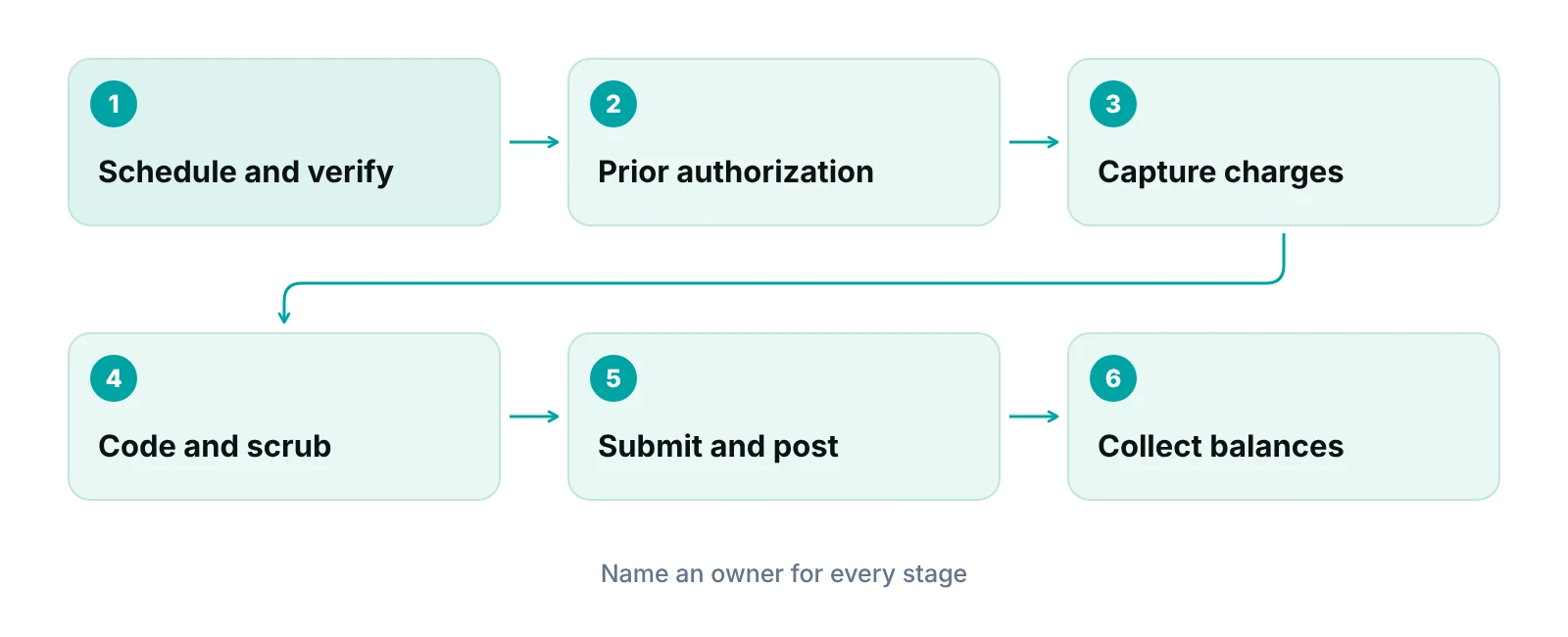
Ownership depends on staff depth. A small practice with one billing employee carries every risk in one person; a larger group can split roles. Whatever the size, each stage needs a named owner and a backup.
- In-house. Keeps control and context. The risk is dependence on a few people and no cover for absence.
- Outsourced. Adds specialty depth and coverage. It works when the practice answers documentation questions on time and receives stage-level reports.
- Hybrid. The practice handles scheduling, verification and patient contact, while a billing team handles coding review, denial follow-up and A/R.
The RCM Finder portal supports any of these models. It tracks claims by stage, applies specialty-aware billing logic per claim, checks claim data for completeness before submission, flags underpayments against expected amounts, and keeps role-based permissions and an audit log. The team works inside the practice’s existing EHR. Pricing is quoted after a free audit.
Estimate what leaks cost your practice
Enter your claim volume in the revenue calculator to estimate the effect of denied and delayed claims.
What should a dermatology practice measure?
Measure the stages, not only the total. A single collections figure hides which stage is leaking. Table 3 lists measures with a dermatology cut and a caution. No benchmark numbers are given because published benchmarks vary by source and mix of services, so set targets from your own baseline.
| Measure | What it shows | Dermatology cut | Caution |
|---|---|---|---|
| Prior authorization turnaround | How long requests take from submission to decision | By payer and by drug | Count appeals separately |
| Charge lag | Days from visit to charge entry | By provider and by procedure day | Late charges hide in the average |
| Denial rate by reason | Where claims fail and why | Modifier 25, documentation, authorization, eligibility | Rate by dollar value as well as by count |
| Days in A/R by payer | How long money takes to arrive | Medical versus procedure claims | Separate self-pay from payer A/R |
| Underpayment findings | Paid amounts below contracted or expected amounts | By top procedure codes | Needs a fee schedule on file |
| Self-pay collected at the visit | Share of cosmetic and patient-due amounts collected on the day | By provider | Track refunds and write-offs too |
For measure definitions, see the guide to revenue cycle KPIs. Reporting dashboards can show these by stage, and underpayment detection in the RCM Finder portal compares paid amounts against expected amounts. The service itself is described on the revenue cycle management page.
Where is your skin practice losing revenue?
Share a sample of denied, short-paid and aged claims. A free practice audit maps the leaks against the stages above and shows what to fix first.
Our recommendations
- Name an owner for each leak. Assign one person to prior authorization, one to charge capture, one to denials and one to self-pay, and review their lists weekly.
- Add body surface area and symptom fields to the note. Make the criteria payers ask for visible in the chart so authorization requests are built from the note, not from memory.
- Audit missed charges weekly. Compare a sample of notes with the charges posted. Count lesions, methods and sizes against the claim lines.
- Write a supervision policy. State who supervises each site and service, and check a monthly sample of supervised-staff claims against it.
- Set an aging trigger well before one year. Flag any unpaid claim at 90 days and escalate before it reaches a payer’s filing limit.
- Collect cosmetic balances at the visit. Put the price in writing before treatment and collect before the patient leaves.
Bottom line
Dermatology revenue cycle management is a set of small controls at predictable points: the authorization tracker, the lesion-level charge screen, the modifier 25 check, the supervision policy and the aging report. Start with the leak map, pick the worst stage, and measure it. If you want a second pair of eyes, the end-to-end revenue cycle management service starts with a free audit, and the posts on dermatology SEO and dermatology digital marketing cover the patients who fill the schedule.
Frequently asked questions
What is dermatology revenue cycle management?
It is the management of every step from scheduling and eligibility through authorization, charge capture, coding, claim submission, denials and patient balances. In dermatology, the weak points are biologic prior authorization, lesion-level charge capture, modifier 25 visits, supervised staff billing and late filing.
Why do dermatology claims get denied?
Common causes include missing or unsupported modifier 25, biopsy and removal billed for the same lesion, incomplete documentation of site, size or method, missing prior authorization and eligibility errors. Mohs claims are also reviewed for medical necessity and documentation under Medicare contractor policies.
How much does prior authorization cost a dermatology practice?
The most direct figure is from a 2020 AAD member survey, which reported about $40,000 per practice per year and about 3.5 hours of staff time per day. An AMA 2024 survey of all specialties reported 39 requests and 13 hours per physician each week.
What is the Medicare timely filing limit?
Medicare fee-for-service claims must generally be filed within one calendar year of the date of service. A late-filing denial is not an initial determination and cannot be appealed, apart from limited exceptions. Commercial payers set their own limits, which can be shorter.
Can a physician assistant's visit be billed under the physician in dermatology?
Under Medicare’s incident-to rule, services generally need direct supervision, and only the supervising practitioner can bill. Conditions apply to setting and the plan of care. State law and payer policies differ, so confirm the rules for each payer before billing.
Should a dermatology practice outsource its revenue cycle?
Many practices outsource part of it, such as coding review, denial follow-up and A/R work, and keep front-end tasks in house. The right choice depends on volume, staff depth and how quickly the practice can answer documentation questions. Start with a sample review.
Get your free practice audit
Tell us about your practice. We will contact you using the details you give.
- A review of your recent claims, denials and A/R aging
- Where your front desk and prior authorizations slow payment
- A prioritized fix list you keep, whether or not you hire us
Pricing is quoted after the audit, based on your volume and the services you choose. Prefer to talk? Call +1 (302) 556-2288.
Sources
- Fixing prior auth: Nearly 40 prior authorizations a week is way too many — American Medical Association (2025)
- Answers in practice (prior authorization appeal letter tool) — Dermatology World, American Academy of Dermatology (2025)
- Insurers make prescribing biologics difficult — Dermatology Times (2016)
- We are biologic coordinators of dermatology (BCoD) — Dermatology Times (2024)
- NCCI Policy Manual for Medicare Services, Chapter 3 (CPT 10000-19999) — CMS (2026)
- Modifier 25 fact sheet — First Coast Service Options (Medicare) (2026)
- Skin Deep: How to Properly Code for Biopsies and Lesion Removal — American Academy of Family Physicians (Family Practice Management) (2019)
- 42 CFR 410.26 Services and supplies incident to a physician or other practitioner — Legal Information Institute (eCFR text) (2026)
- What is Medicare's general timely filing period? — Medicaid.gov (CMS) (2020)
- Medicare Claims Processing Manual Chapter 1 timely filing update, Transmittal 12909 — CMS (2024)
- Targeted probe and educate round results: Mohs surgery (CPT 17311-17315) — First Coast Service Options (Medicare) (2024)
Disclaimer: This article is educational and is not legal, coding, tax or compliance advice. CPT is a registered trademark of the American Medical Association, and its official descriptors are not reproduced here. Advertising, privacy and medical board rules differ by state and change, and payer rules vary, so confirm current requirements with your attorney, privacy officer, payers and Medicare contractor before acting.
