

Dermatology billing services cover three streams of work: medical visits, in-office procedures and self-pay cosmetic care. A capable service codes each from the note, applies Medicare edits for biopsies, lesion removal and Mohs surgery, supports modifier 25 with documentation, and follows every claim to payment.
A dermatology claim is rarely just a visit. One appointment can include an exam, a biopsy of one lesion, destruction of another and a note about a new problem, and each piece follows a different rule. Add a cosmetic service that insurance does not pay for, and the billing office is working three workflows at once.
This guide describes what the work involves, states the headline Medicare rules for the procedures dermatology bills most, lists what the note must show, and gives a question table for choosing a billing service. For what insurance covers, read the dermatology insurance coverage guide. The revenue leak map is in dermatology revenue cycle management.
Key takeaways
- Dermatology billing is three workflows: medical visits, procedures and self-pay cosmetic care.
- Under Medicare edits, a biopsy of a lesion that is then removed at the same encounter is not reported separately.
- An E/M visit on the day of a procedure needs modifier 25 and a separately identifiable reason in the note.
- Mohs codes include the biopsy and excision of that stage. Repairs, flaps and grafts are reported separately.
- Ask any billing service who reviews procedure claims, how edits are applied and what it signs before it sees patient data.
What do dermatology billing services actually do?
They turn a visit note into a correct claim, send it, and follow it until it is paid, with different rules for each kind of work done in the visit. The three streams are medical visits, procedures, and cosmetic care paid by the patient. Table 1 shows what each involves.
| Stream | What is billed | What the billing task is | Where it usually goes wrong |
|---|---|---|---|
| Medical visits | Evaluation and management (E/M) visits for conditions and skin checks | Match the level to the note; tie diagnoses to the visit; verify eligibility | Visit level not supported by the note; diagnosis does not support the service |
| Procedures | Biopsies, destruction of lesions, excisions, repairs, Mohs surgery | Pick the procedure code from method, site and size; apply edits; add modifiers only when supported | Biopsy and removal of one lesion billed together; modifier 25 missing or unsupported |
| Cosmetic, self-pay | Treatments that are not billed to insurance | Keep them off insurance claims; quote, collect and record at the visit | Charge sent to a payer by mistake; no written price agreed before treatment |
| Mixed visits | A medical problem and a cosmetic request on the same day | Separate the charges: the medical service to the payer, the cosmetic service to the patient | One claim carries both; the patient is surprised by a balance |
Before any of that, the front end matters: eligibility checked before the visit and prior authorization where a plan requires it. The AMA’s 2024 physician survey reported an average of 39 prior authorizations per physician per week, taking about 13 hours of physician and staff time (American Medical Association). A billing service that does not handle these tasks leaves the heaviest work with the practice. The prior authorization guide explains the process.
Which procedure billing rules matter most in dermatology?
Five rules explain most of the confusion: biopsy bundling, modifier 25, repair bundling, destruction and biopsy on separate lesions, and Mohs. Table 2 states them in plain terms from Medicare’s 2026 NCCI policy manual (Chapter 3) and a Medicare contractor’s modifier 25 fact sheet. These are Medicare rules; commercial payers vary, so check each payer’s policy.
| Situation | What the source says | Practical meaning |
|---|---|---|
| Biopsy and removal of the same lesion, same encounter | The skin biopsy codes (11102-11107) are not reported separately when the biopsy is of the lesion being removed | Bill the removal code; the biopsy is included |
| Biopsy of a different lesion | A biopsy of a different lesion may be separately reportable with a removal code | Document each lesion separately, with site and method |
| Visit plus procedure on the same day | The E/M is reportable with modifier 25 only when significant and separately identifiable. It does not apply to 99211. | The note needs a reason for the visit beyond the usual pre-procedure work |
| Repair after lesion excision | Simple repairs are integral to lesion removal. Intermediate and complex repairs may be reported with excision of benign lesions. | Closure type and length must be documented |
| Biopsy and destruction on separate lesions | Modifier 59, XE or XS is appropriate only if the two procedures are on separate lesions or separate encounters | Do not use a modifier to bypass an edit on the same lesion |
| Mohs surgery (17311-17315) | The Mohs codes include skin biopsy and excision. Repairs, grafts and flaps are separately reportable. A pre-Mohs biopsy may be reported separately with modifier 59, XS, XU or 58. | Bill the repair on its own line; document the biopsy date and stage count |
| G2211 with a modifier 25 visit | For dates of service on or after January 1, 2025, G2211 is payable with a modifier 25 office visit only when a Part B preventive service, immunization administration or annual wellness visit is on the same date | Expect a denial of G2211 on routine procedure-day visits |
Sources: CMS NCCI Policy Manual, Chapter 3 (2026); First Coast Service Options modifier 25 fact sheet (2026)
These sources come from CMS and First Coast Service Options. For how modifiers 25 and 59 differ in general, read the guide to modifiers 25 and 59.
The code families in plain language
An AAFP coding article lists the families dermatology uses most: skin biopsy codes 11102 to 11107, split into tangential, punch and incisional methods with add-on codes for further lesions; destruction of premalignant lesions (17000, 17003 and 17004); destruction of benign lesions (17110 and 17111); shaves in the 11300 range; and excision of benign lesions in the 11400 range. It adds that simple closure is included in the biopsy codes (American Academy of Family Physicians). The article dates from 2019, so confirm descriptions against the current CPT book. Skin tag coding is covered in the skin tag ICD-10 guide, and skin substitute application in the skin substitute CPT codes guide.
What does the note have to show for a clean claim?
It has to show the method, the site, the size and the reason, lesion by lesion. The AAFP article says to record the biopsy method and number, to document the location and size of each shaved or excised lesion, and the lesion type for excisions. For malignant destruction, it says to select the code by lesion location and size, not by the size of the defect. It advises submitting excision claims after the pathology report is received.
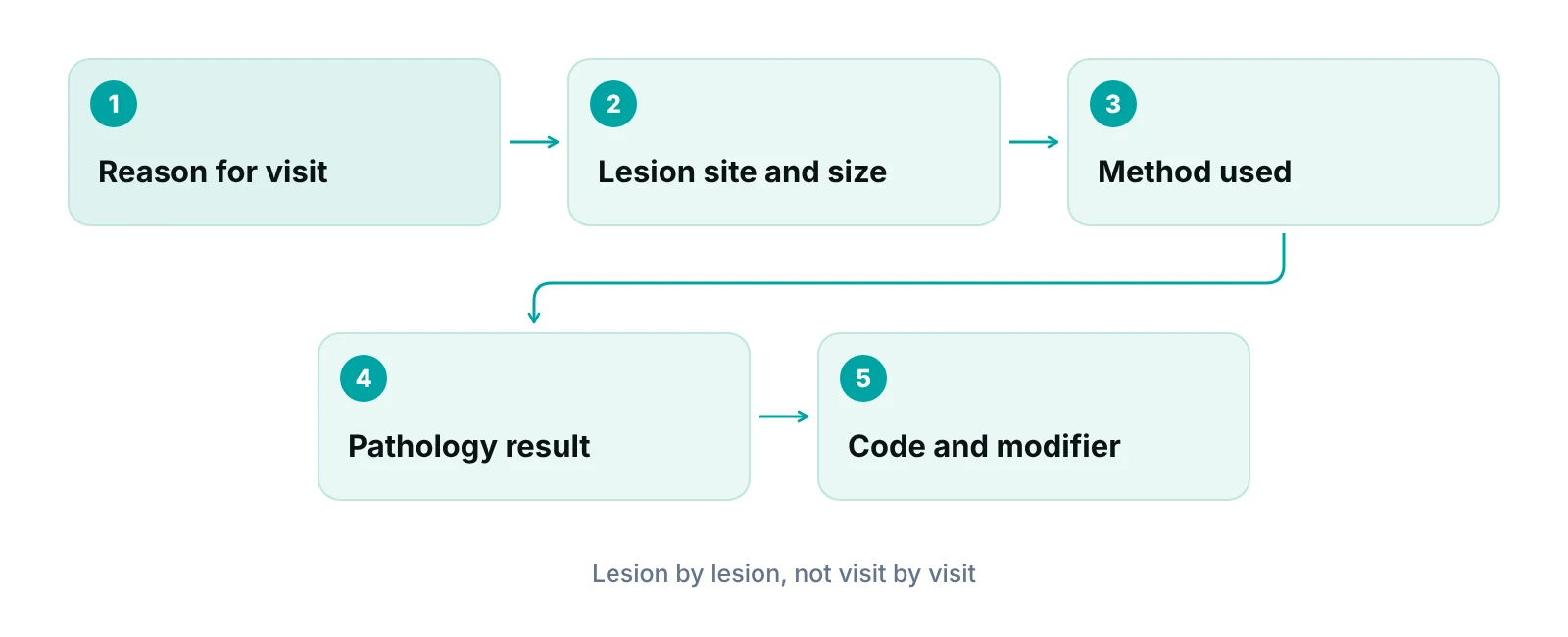
Mohs claims draw review attention. A First Coast Medicare review of Mohs surgery (17311-17315), dated September 9, 2024, listed medical necessity and insufficient documentation as common denial reasons, including records that lacked the evidence the coverage policy requires and providers who did not answer a records request (First Coast Service Options). A CGS Medicare notice from 2016 told providers that claims for Mohs on the trunk or extremities must carry qualifying terms from its coverage policy L34195 in the claim narrative (CGS Medicare). That notice is old, so check your own Medicare contractor’s current policy.
How are cosmetic and mixed visits billed?
Cosmetic services are quoted, agreed and collected by the practice rather than sent to a payer, and the billing office keeps them out of insurance claims. A medical problem and a cosmetic request on the same day become separate charges with separate payers.
The billing service’s role is to keep the line clear: a written price before treatment, payment recorded at the visit, and no cosmetic code on a payer claim. What counts as medically necessary instead of cosmetic depends on the note and the payer. The decision logic is set out in the coverage guide, and the common borderline case, skin tags, in the skin tag ICD-10 guide.
How do you choose a dermatology billing service?
Ask how procedure claims are reviewed, what the service signs, and what you will see each month. Cost is a fair question, but it comes after fit. Table 3 lists questions with the answer to look for and the warning sign.
| Question | A good answer | Warning sign |
|---|---|---|
| Who reviews procedure claims with modifiers? | A named reviewer with dermatology coding experience checks modifier 25 and 59 claims against the note | “Our software handles modifiers” |
| How are Medicare edits applied? | Edits are checked before submission and denials are fed back to the coders | Edits are only seen after the payer rejects the claim |
| What happens to a documentation gap? | The gap is sent back to the practice with a specific request | The claim is coded from the charge sheet alone |
| What agreement covers patient data? | A Business Associate Agreement before any access, plus role-based access and audit trails | No agreement, or shared logins |
| What do you report each month? | Claims by stage, denial reasons, A/R by age, with questions the practice must answer | A single collections figure |
| How is pricing set? | Quoted after a review of volume and workflow | A number quoted before anyone has seen a claim |
Source for the BAA row: HHS OCR online tracking bulletin (2024), which states that a vendor handling PHI for a covered function is a business associate that requires a BAA.
The business associate point comes from HHS (HHS OCR). Practices also decide between in-house, outsourced and hybrid models. In-house keeps control but depends on the skill and tenure of a few people. Outsourcing adds specialty depth and coverage, but only works with prompt answers to documentation questions. A hybrid keeps front-end tasks in the practice and sends coding and follow-up out.
“Ask to see how a billing service handles one messy procedure claim. The answer shows more than any brochure.”
— Awais Afzal, Healthcare Operations & Data Analyst
What should the handoff between the practice and the billing service look like?
The handoff should be a defined set of daily and weekly tasks with named owners. Billing errors in dermatology usually start in the exam room, so the practice and the service have to agree on what leaves the chart and when.
- Charges leave the chart the same day. A charge captured a week later invites missing lesions and forgotten add-on codes.
- Documentation queries have a deadline. The practice answers a question about site, size or method within a set window, so the claim does not age.
- Pathology results are tied to charges. Excision claims wait for the report, and someone owns the queue that tracks pending results.
- Denials come back with a reason. The service sends the denial code and a proposed fix, and the practice decides on the appeal.
- Patient statements follow one policy. Decide who sends them and who answers a patient’s question about a self-pay balance.
A weekly 20-minute review of denials and pending queries is usually enough to keep the loop moving. Claim edits belong before submission, not after the payer rejects the claim.
What does a sensible start look like when outsourcing dermatology billing?
Start with a sample review, not a switch. A short pilot lets both sides see how claims behave before everything moves.
- Pull a sample of recent claims with the notes, including paid, denied and short-paid ones, across medical visits and procedures.
- Review the sample for code, modifier and documentation causes, and agree on what the practice will change at the source.
- Write the payer rule sheet for the five largest payers: biopsy, destruction, modifier 25 and prior authorization rules.
- Set the reports: claims by stage, denial reasons by code, A/R by age, and a list of open questions for the practice.
- Move claims in stages, starting with the simplest, and review results weekly for the first month.
The whole sequence works only if the practice treats billing feedback as a clinical documentation tool. A coding audit gives that review a structure.
See what your denied claims have in common
Use the revenue calculator to estimate what denied and delayed claims cost, then bring the numbers to a free audit.
How does RCM Finder approach dermatology billing?
The team works inside the practice’s existing EHR and covers billing, coding support, claim scrubbing, denial management and A/R follow-up. The RCM Finder portal tracks claims by stage, applies specialty-aware billing logic to each claim rather than to the practice as a whole, checks claim data for completeness before submission, flags underpayments against expected amounts, and keeps role-based permissions and an audit log. Connections use HTTPS, and a Business Associate Agreement is put in place before patient data is accessed.
Pricing is quoted after a free audit. See the revenue cycle management service for the full scope, or the Virtual Medical Assistant service for eligibility checks, scheduling and prior authorization support. Denials are covered in the denial management guide.
Want a second look at your procedure claims?
Send a sample of denied or short-paid dermatology claims with their notes. A free practice audit shows whether the cause is the code, the modifier or the documentation.
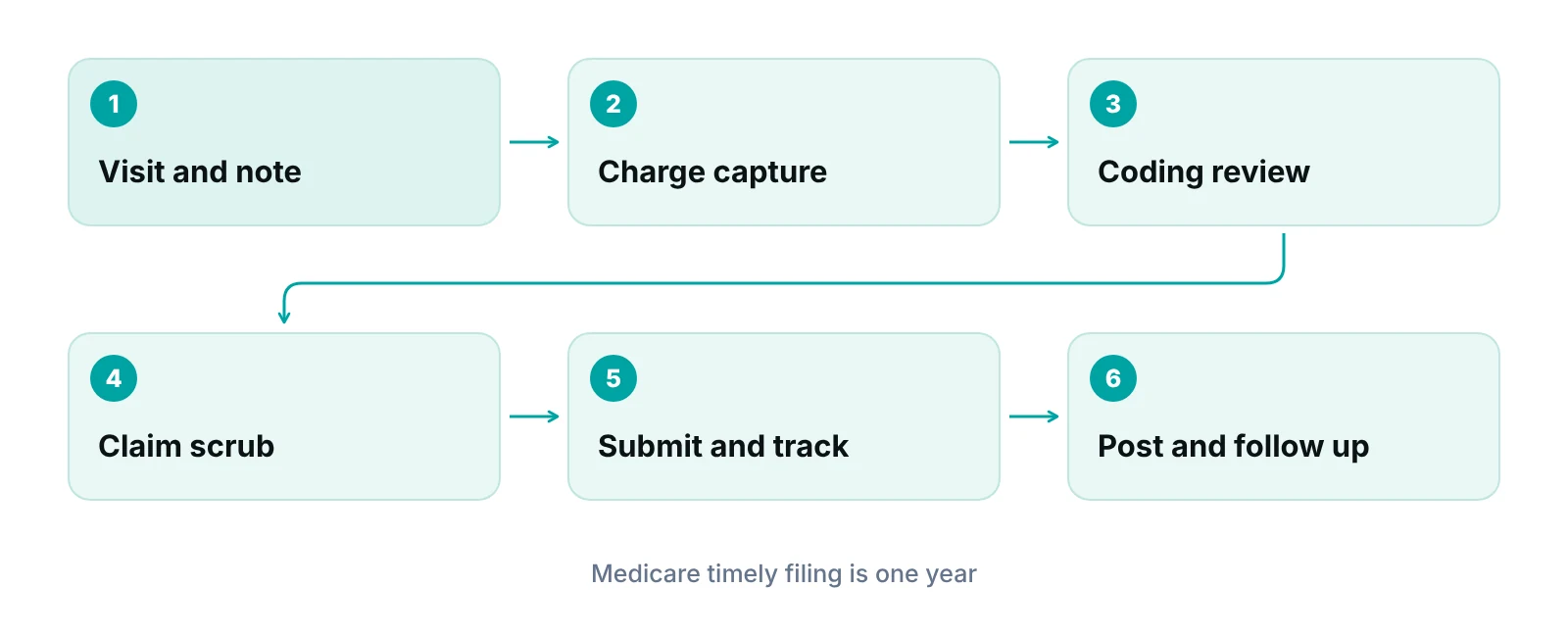
The last step has a clock on it. Medicare’s general limit is one calendar year from the date of service (Medicaid.gov), and CMS’s claims processing manual update of 2024 says a late-filing denial is not an initial determination and cannot be appealed (CMS Transmittal 12909). Physician assistants and nurse practitioners add another rule: Medicare incident-to billing generally requires direct supervision, and only the supervising physician or practitioner may bill for it (42 CFR 410.26). Those are covered in the companion post on dermatology revenue cycle management.
Our recommendations
- Map the three streams in writing. List what is billed to insurance, what is billed to the patient and who owns each step, so mixed visits have a rule.
- Make site, size and method required fields. A lesion note without all three cannot be coded correctly. Build them into the template for every procedure.
- Add a modifier 25 rule. Define what a separately identifiable visit looks like, and have a second reader check every claim that carries it.
- Hold excision claims for pathology. Route excision charges to a hold queue until the pathology report is in the chart.
- Keep a payer rule sheet. Medicare rules are the baseline. Record each commercial payer’s policy for biopsies, destruction and modifier 25 in one place.
- Ask for a monthly claims review. Review denial reasons by code with the coder every month so the same mistake stops recurring.
Bottom line
Dermatology billing services earn their keep in the details: the biopsy that is not billed twice, the modifier 25 that the note supports, the Mohs repair on its own line and the cosmetic charge that never reaches a payer. If your claims are returning for these reasons, the revenue cycle management team can review a sample, and the related posts on dermatology SEO, dermatology marketing and dermatology digital marketing cover how patients find the practice.
Frequently asked questions
What do dermatology billing services include?
They cover eligibility checks, charge capture, coding review, claim scrubbing and submission, payment posting, denial work and A/R follow-up for medical visits and procedures. They also keep self-pay cosmetic services off insurance claims and report on claims by stage each month.
When can modifier 25 be used in dermatology?
When the same clinician performs a significant, separately identifiable E/M visit on the day of a procedure. A Medicare contractor says it does not apply to 99211. The note must show a reason for the visit beyond the usual work of the procedure.
Can a biopsy be billed with the removal of the same lesion?
Not under Medicare’s NCCI rules. The 2026 policy manual says the skin biopsy codes are not reported separately when the biopsy is of the lesion being removed at the same encounter. A biopsy of a different lesion may be separately reportable.
How is Mohs surgery billed?
Mohs codes 17311 to 17315 include the skin biopsy and excision for that stage. Repairs, grafts and flaps are separately reportable, and a pre-Mohs biopsy may be reported separately with certain modifiers. Check your contractor’s policy and documentation requirements, because Mohs claims are a documented review target.
Are cosmetic dermatology services billed to insurance?
Generally not. Cosmetic services are quoted and collected from the patient. Whether a borderline service is cosmetic or medically necessary depends on the documentation and the payer, which is covered in the dermatology insurance coverage guide.
Should a dermatology practice outsource billing?
It depends on volume, staff depth and how fast the practice can answer documentation questions. Outsourcing adds specialty coverage, while in-house keeps control. Many practices use a hybrid. Ask any vendor for its Business Associate Agreement and a sample monthly report first, and ask who reviews procedure claims.
Get your free practice audit
Tell us about your practice. We will contact you using the details you give.
- A review of your recent claims, denials and A/R aging
- Where your front desk and prior authorizations slow payment
- A prioritized fix list you keep, whether or not you hire us
Pricing is quoted after the audit, based on your volume and the services you choose. Prefer to talk? Call +1 (302) 556-2288.
Sources
- NCCI Policy Manual for Medicare Services, Chapter 3 (CPT 10000-19999) — CMS (2026)
- Modifier 25 fact sheet — First Coast Service Options (Medicare) (2026)
- Skin Deep: How to Properly Code for Biopsies and Lesion Removal — American Academy of Family Physicians (Family Practice Management) (2019)
- Targeted probe and educate round results: Mohs surgery (CPT 17311-17315) — First Coast Service Options (Medicare) (2024)
- Mohs micrographic surgery claim reminder (LCD L34195) — CGS Medicare (2016)
- Use of Online Tracking Technologies by HIPAA Covered Entities and Business Associates — HHS Office for Civil Rights (2024)
- Fixing prior auth: Nearly 40 prior authorizations a week is way too many — American Medical Association (2025)
- What is Medicare's general timely filing period? — Medicaid.gov (CMS) (2020)
- Medicare Claims Processing Manual Chapter 1 timely filing update, Transmittal 12909 — CMS (2024)
- 42 CFR 410.26 Services and supplies incident to a physician or other practitioner — Legal Information Institute (eCFR text) (2026)
- Burden of skin disease — American Academy of Dermatology (2026)
Disclaimer: This article is educational and is not legal, coding, tax or compliance advice. CPT is a registered trademark of the American Medical Association, and its official descriptors are not reproduced here. Advertising, privacy and medical board rules differ by state and change, and payer rules vary, so confirm current requirements with your attorney, privacy officer, payers and Medicare contractor before acting.
