
Behavioral health digital marketing works best when each channel is chosen for intent and privacy risk, not popularity. Local search, a verified business profile and a clear website carry most inquiries. Paid ads and email need policy checks, and tracking tools on intake pages need the most care, because they can send visitor data to third parties.
A practice owner hears three pitches in one week: more ads, more email, a tracking tool to see who visits the booking page. Each promises inquiries. None mentions that mental health is a sensitive category for ad platforms, or that tracking code on an intake page can send visitor details to outside companies.
This guide compares the main channels for therapy, psychiatry and substance use practices and names the check each one needs. Claims, testimonials and referral payments are covered in behavioral health marketing, and local search in behavioral health SEO. The service view is on the behavioral health marketing services page.
Key takeaways
- Choose channels by intent and capacity. A person searching for a therapist near them is further along than a person who sees a social post.
- Mental health is a sensitive category on Google, which does not support advertiser-curated audiences such as customer match or lookalikes for it.
- Tracking tools on booking, symptom-checker and login pages can involve protected health information, and the FTC has acted against mental health companies for sharing data with advertising platforms.
- Marketing email must follow CAN-SPAM, and using client information for marketing generally needs HIPAA authorization.
- Measure inquiries at the practice’s own front desk, not with third-party tags on sensitive pages.
How should a therapy practice choose digital channels?
Pick channels by three tests: whether the reader wants help now, what privacy risk the channel adds, and whether the practice can answer every inquiry quickly. A channel that fails the third test wastes the money spent on the first two.
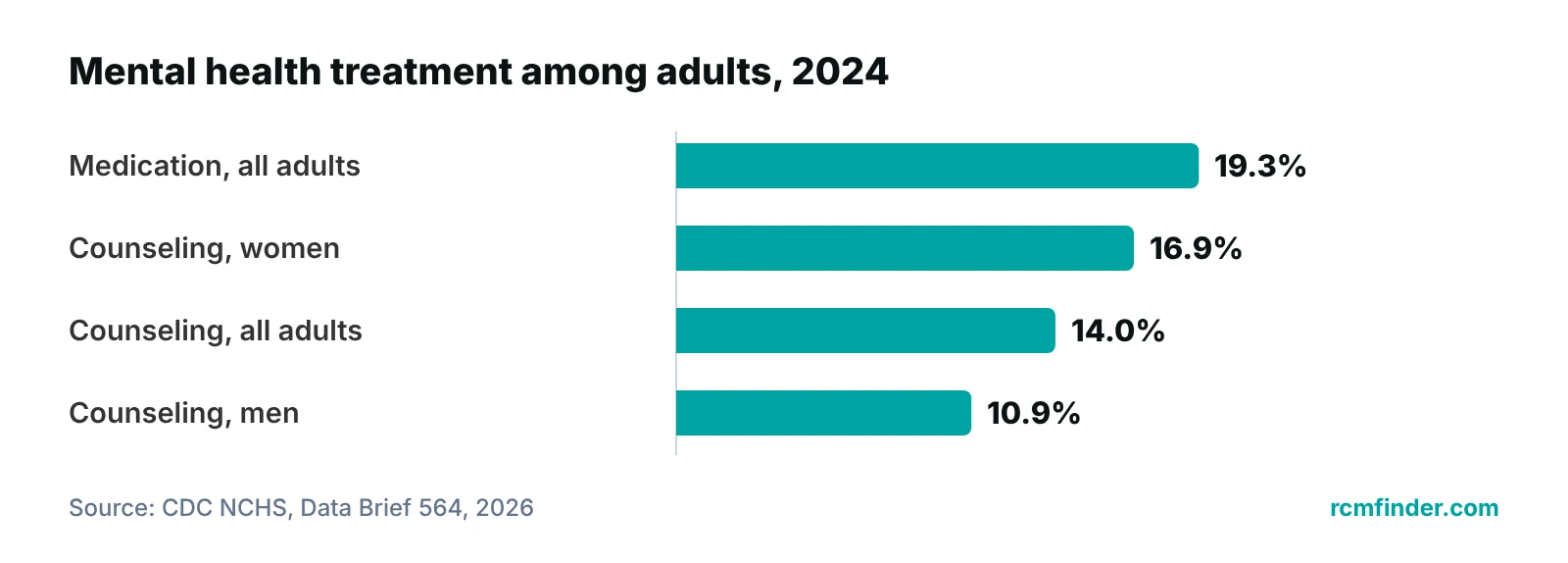
Demand is broad. A June 2026 CDC data brief found that in 2024, 19.3% of US adults took prescription medication for their mental health in the past 12 months and 14.0% received counseling or therapy from a mental health professional, with the two groups overlapping (CDC NCHS Data Brief 564, 2026). That is why a message has to name the service the practice actually offers, such as therapy, medication management or substance use treatment.
| Channel | Fits when | Check first | Basis |
|---|---|---|---|
| Local search and Business Profile | The reader wants a provider nearby now | Eligibility and naming rules; accurate hours and services | Google Business Profile guidelines |
| Paid search ads | The practice can answer inquiries the same day | Health ad policy; claims; certification for addiction services | Google Ads policy help |
| Social and display ads, retargeting | Awareness for a new program | Sensitive-category limits; no client lists; tracking tags | Google health policy; HHS OCR; FTC |
| Email to clients and referrers | Existing relationships need updates | CAN-SPAM; HIPAA authorization for marketing | FTC; HHS |
| Reviews and directories | Readers compare options | No incentives or gating; no client details in replies | Google; FTC; HHS OCR |
| Website content | The reader is researching | Named, credentialed authorship; accurate statements | Google Search Central |
Source: Google Business Profile and Ads policy help; FTC; HHS OCR; Google Search Central. Fit column is an RCM Finder summary.
What do search and paid ads require?
Local search is the base channel, and paid ads sit on top of it with extra rules. Google’s local results are mainly based on relevance, distance and prominence, and its help page states there is no way to request or pay for a better local ranking (Google Business Profile Help). Detailed setup is in the behavioral health SEO guide.
Ads carry their own limits. Google’s health policy treats mental health conditions and counseling for depression, anxiety and addiction as sensitive. It does not support advertiser-curated audiences, including customer match, your data segments and lookalike segments, for these categories, though predefined Google audiences, location targeting and in-market segments are supported (Google Ads policy help).
For addiction treatment, a 2018 Google announcement requires LegitScript certification and then Google certification for US advertisers (Google Ads policy help). Google also prohibits claims suggesting results that cannot be guaranteed (Google Ads policy help). The wording rules are covered in the marketing post linked above.
Which tracking tools put intake pages at risk?
Tools on pages where a visitor books, logs in or describes symptoms carry the highest risk. Public information pages carry less.
The HHS Office for Civil Rights issued a bulletin in November 2022 on cookies, tracking pixels, session replay scripts and similar tools. It says tracking on login and registration pages and on pages for scheduling appointments or checking symptoms can involve protected health information, that a tracking vendor receiving it for a regulated entity may be a business associate needing a BAA, and that a privacy policy or cookie banner does not authorize a disclosure. On June 20, 2024, a federal court in Texas vacated part of the bulletin, concerning the connection of an IP address to a visit to an unauthenticated public page about health conditions or providers (HHS OCR).
The FTC has acted outside HIPAA as well. It alleged that BetterHelp, an online counseling service, disclosed consumers’ email addresses, IP addresses and health questionnaire information to Facebook, Snapchat, Criteo and Pinterest for advertising after promising privacy. The final order of July 14, 2023 bans sharing health data for advertising and requires $7.8 million in payments (FTC). In April 2024 it proposed an order against Cerebral, alleging sensitive information on nearly 3.2 million consumers went to LinkedIn, Snapchat and TikTok through tracking tools (FTC).
| Page type | Example | Why it matters | Safer practice |
|---|---|---|---|
| Public information | Services, fees, clinician bios | OCR says it generally falls outside HIPAA when it cannot access PHI | Basic analytics; list tags in the privacy notice |
| Booking and intake forms | Appointment request, new-client form | Entered details can be identifiable health information | No ad pixels; practice-controlled forms |
| Symptom or screening tools | Self-check quiz | OCR names symptom checkers as an example | Avoid third-party tags; review with counsel |
| Login and portal pages | Client portal | Authenticated pages generally have access to PHI | Tracking only as the Privacy Rule permits, with a BAA |
| Thank-you pages | Confirmation after a request | URL or title can reveal the service sought | Neutral URLs and titles |
Source: HHS OCR, tracking technologies bulletin (2022; part vacated June 20, 2024). Last row is an RCM Finder suggestion.
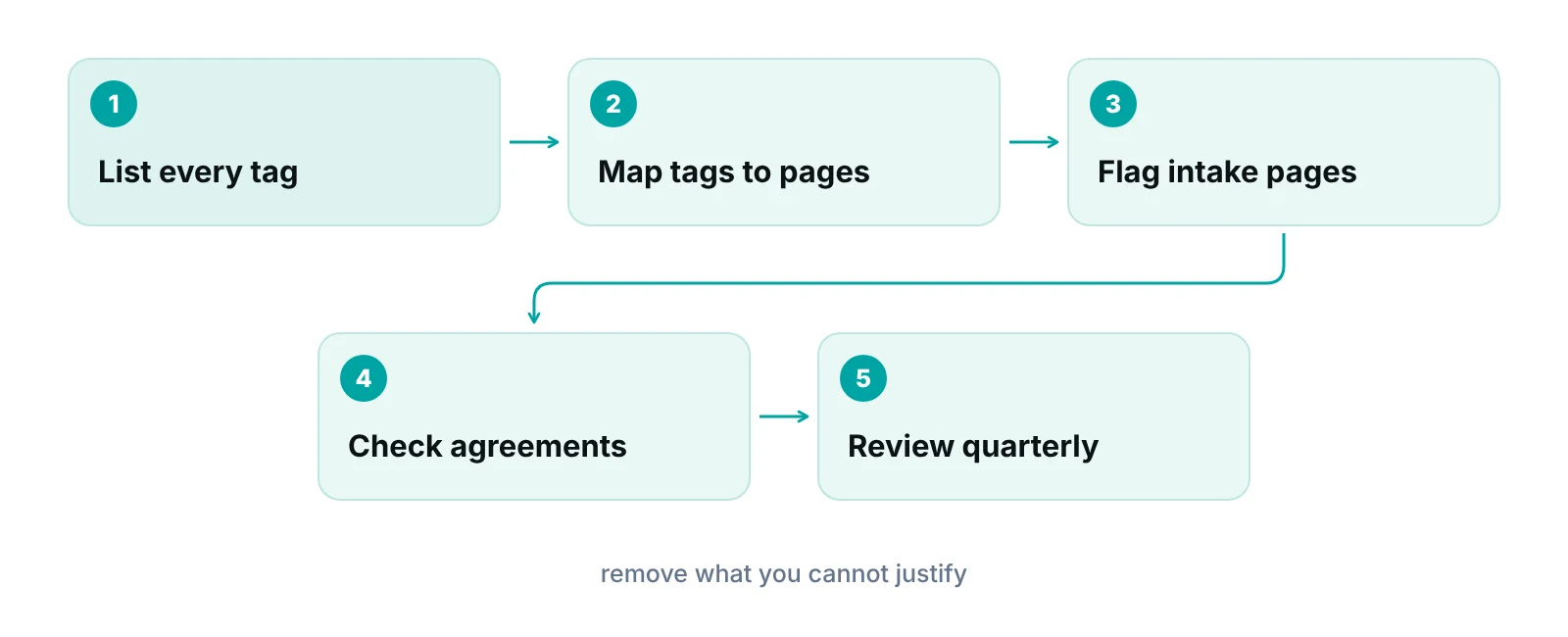
Ask any website vendor for the list of scripts installed. Software that hosts booking or portal pages is covered in behavioral health practice management software.
How should email and text be handled?
Marketing email must meet CAN-SPAM, and using client information for marketing generally needs a HIPAA authorization. Treatment-related messages are different from promotions.
The FTC’s compliance guide lists eight requirements, among them accurate headers, honest subject lines, a clear ad disclosure, a valid physical address, a working opt-out honored within 10 business days and oversight of any company sending on your behalf. Penalties reach $53,088 per email, and there is no exception for messages to existing customers other than transactional or relationship messages (FTC).
HHS says marketing a product or service generally needs written authorization, while treatment communications and care coordination fall outside the definition (HHS). Referral-partner newsletters, which go to professionals rather than clients, avoid the client-information question but still follow CAN-SPAM. Text message rules were not part of this research, so ask counsel before starting a texting program.
How do reviews, directories and content fit in?
They shape trust, and each has rules. Google bans incentives and review gating, and the FTC’s 2024 rule bans fake reviews and review suppression (Google review tips; FTC). Replies must never confirm a client’s care. The marketing rules post and the reputation management post cover this in detail.
For content, Google’s guidance says topics affecting health get extra weight for expertise and trust, recommends clear authorship with bylines that link to author information, and warns against fabricated creators or false credentials (Google Search Central). For a therapy practice, that means articles signed by a named, licensed clinician or reviewed by one, written for readers who are deciding whether to ask for help, and free of individual clinical advice.
“The channel is only a door. What the visitor finds behind it, and how fast someone answers, decides whether they step in.”
— Awais Afzal, Healthcare Operations & Data Analyst
Which channel mistakes are most common?
Most problems come from adding tools before the basics are in place. Five patterns show up often, and none needs special software to fix.
- Installing an ad pixel on the whole site, including the intake form, because the web vendor did so by default.
- Paying for ads while the Business Profile has wrong hours or an unverified listing.
- Sending one promotional email to the entire client list without checking the authorization and opt-out rules.
- Writing ad copy that promises recovery, then having the website say something more careful.
- Letting inquiries wait a day, so the person who reached out has already booked elsewhere.
The small practice marketing strategies post gives the general picture across specialties; this list is specific to therapy and psychiatry settings.
How can results be measured without leaking client data?
Count inquiries where the practice controls the data: its own phone system, its own forms and its own intake questions. Then compare channels. Google’s SEO guide notes that changes can show effects within hours or take months and suggests waiting a few weeks before judging results (Google Search Central).
| Measure | How to capture it | Care needed |
|---|---|---|
| Calls from each channel | Separate phone numbers per channel, logged by the practice | Disclose any call recording; keep logs private |
| Form requests | Count on the practice’s own server or form system | Do not copy form content to ad platforms |
| Source of new clients | Ask ‘how did you hear about us’ at intake and record the answer | Keep the answer in the client record, not in ad tools |
| Search visibility | Search Console and Business Profile insights | Aggregate data only |
| Cost per new client | Channel spend divided by new clients booked and attended | Include no-shows and unanswered inquiries |
Source: Google Search Central (measurement timing); the methods are an RCM Finder suggestion. Confirm any recording rules with counsel.
Inquiry handling is part of the channel. RCM Finder’s Virtual Medical Assistant service provides remote front-desk staff for scheduling, eligibility checks and intake, so inquiries do not sit unanswered. How the first call connects to payment is covered in behavioral health revenue cycle management.
Check your channels and your intake path
A free practice audit can review how inquiries become booked, verified and paid visits, and where tracking or follow-up gaps sit. Pricing is quoted after the audit.
Our recommendations
- List every tag on the website. Ask the web vendor for each script, its purpose and which pages load it. Remove what the practice cannot justify, especially on intake pages.
- Start with search, then add. Verify the Business Profile and fix the website before paying for ads. Add one paid channel at a time.
- Keep client lists out of ad platforms. Do not upload client or inquiry lists. Use contextual and location targeting that Google supports for sensitive categories.
- Use plain, accurate wording. Name the services offered and the states served. Avoid promises of outcomes.
- Write an email policy. Separate treatment messages from promotions, add a physical address and an opt-out, and get authorization before using client information for marketing.
- Track at the front desk. Record the source of every inquiry in the practice’s own system and review it monthly.
Bottom line
Behavioral health digital marketing is a set of channels with different intent and different risk. Local search and a clear website carry the most weight, ads and email need policy checks, and tracking tools on intake pages need the closest review. For help matching channels to a practice, see the behavioral health marketing services and the healthcare digital marketing pages, and the medical marketing ROI guide for measurement basics.
Frequently asked questions
What is behavioral health digital marketing?
It is online promotion of therapy, psychiatry and substance use services: local search, a website, paid ads, email, reviews and content. It differs from general healthcare marketing because mental health is a sensitive category for ad platforms and because intake pages can involve protected health information.
Which channel should a new therapy practice start with?
Start with a verified Google Business Profile and a clear website, since local searchers are looking for a nearby provider. Add one paid channel later if the practice can answer inquiries the same day. Avoid tracking tools on booking and intake pages.
Are tracking pixels allowed on a therapy practice website?
It depends on the page. HHS OCR says tracking on login, registration, scheduling and symptom-checker pages can involve protected health information, and part of its bulletin was vacated in June 2024. The FTC has also acted against mental health companies. Review each tag with counsel.
Can Google Ads target past clients of a mental health practice?
Google’s health policy does not support advertiser-curated audiences, such as customer match and lookalike segments, for sensitive categories that include mental health. Predefined Google audiences, location targeting and in-market segments are supported. HIPAA authorization rules also apply to client information.
Can a practice email its clients about a new program?
Marketing email must follow CAN-SPAM, including an opt-out, and HHS says using protected health information for marketing generally needs written authorization. Treatment communications are treated differently. Have a privacy officer or counsel classify each message before it is sent.
How long does digital marketing take to show results?
Google’s SEO guide says changes can show effects within hours or take months and suggests waiting a few weeks before judging. Paid ads can start quickly but depend on policy approval and a fast response to inquiries. Track the source of every call and request.
Get your free practice audit
Tell us about your practice. We will contact you using the details you give.
- A review of your recent claims, denials and A/R aging
- Where your front desk and prior authorizations slow payment
- A prioritized fix list you keep, whether or not you hire us
Pricing is quoted after the audit, based on your volume and the services you choose. Prefer to talk? Call +1 (302) 556-2288.
Sources
- Mental Health Treatment Among Adults: United States, 2024 (Data Brief 564) — CDC National Center for Health Statistics (2026)
- Use of Online Tracking Technologies by HIPAA Covered Entities and Business Associates — HHS Office for Civil Rights (2024)
- FTC gives final approval to order banning BetterHelp from sharing sensitive health data for advertising — Federal Trade Commission (2023)
- Proposed FTC order will prohibit telehealth firm Cerebral from using or disclosing sensitive data — Federal Trade Commission (2024)
- Health in personalized advertising — Google Ads Policy Help (2026)
- Healthcare: Addiction services (April 2018) — Google Ads Policy Help (2018)
- False, misleading, or unrealistic claims — Google Ads Policy Help (2026)
- How to improve your local ranking on Google — Google Business Profile Help (2026)
- Tips to get more reviews — Google Business Profile Help (2026)
- FTC announces final rule banning fake reviews and testimonials — Federal Trade Commission (2024)
- CAN-SPAM Act: A Compliance Guide for Business — Federal Trade Commission (2024)
- Marketing (HIPAA Privacy Rule guidance) — HHS (2003)
- Creating Helpful, Reliable, People-First Content — Google Search Central (2026)
- SEO Starter Guide: The Basics — Google Search Central (2026)
Disclaimer: This article is educational and is not legal, privacy or advertising advice. HIPAA, FTC rules and platform policies change and depend on facts, so confirm the current position with counsel, your privacy officer and each platform before you act. Nothing here promises search rankings, patient volume or results.