
Dermatology practice management is the work of running a skin practice's front desk, scheduling, intake, charge capture, billing, patient communication, marketing and software as one connected system. Its defining task is keeping medical visits, which bill insurance, and cosmetic visits, which are self-pay, on separate scheduling, consent, pricing and billing paths.
This guide is for owners and managers who run both sides of a skin practice. It orients you across every operating area and sends you to the deeper article for each, including the dermatology EHR checklist, the dermatology website design guide and the dermatology telehealth guide.
Key takeaways
- Run medical and cosmetic visits on separate paths for scheduling, consent, pricing and billing.
- Self-pay cosmetic patients generally must receive a written good faith estimate when a service is scheduled at least 3 days ahead.
- Same-day visit and procedure claims need a note that supports modifier 25; audit a few every week.
- Trace every denial to the front end and work A/R on a fixed schedule with one owner.
- Every vendor that sees patient information needs a business associate agreement.
What does dermatology practice management cover?
Dermatology practice management is the work of running a skin practice as one connected system: scheduling, front desk, intake and eligibility, charge capture, billing, denials and A/R, patient communication, marketing and software. The system has to serve two kinds of visits that follow different rules. Medical visits bill insurance. Cosmetic visits are paid by the patient.
Skin disease is common, which is why demand rarely is the problem. The American Academy of Dermatology reports that about 84.5 million Americans, roughly one in four, had skin disease in its 2016 Burden of Skin Disease report, which used 2013 claims data. The harder problem is capacity: the same providers, rooms and staff serve acne and skin-cancer checks in the morning and injectables in the afternoon.
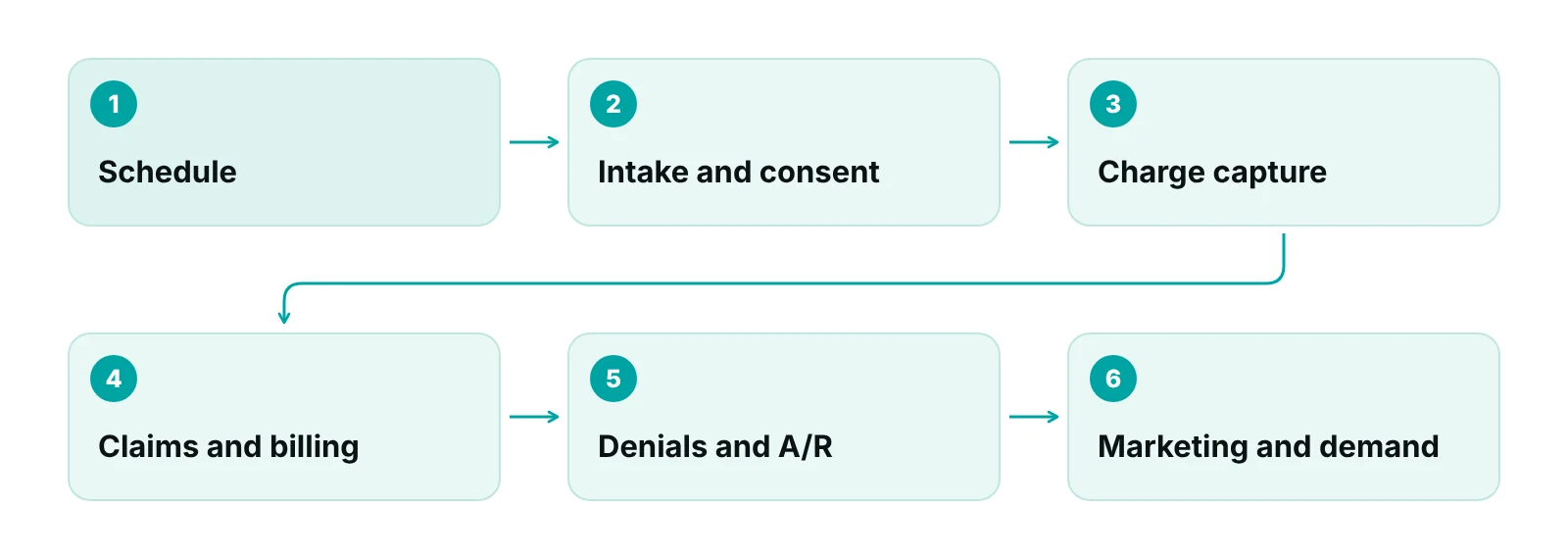
This guide is a map. Each section below answers the main question for one area, then sends you to the deeper article. Read it start to finish once, then use the routing table near the end as a monthly checklist.
How do medical and cosmetic visits differ in daily operations?
They differ in who pays, what the patient must be told before the visit, what the chart must show and how the money is collected. A practice that runs both on one workflow ends up billing insurance for things it should not, or giving away time that insurance would have paid for.
| Step | Medical visit (insurance) | Cosmetic visit (self-pay) |
|---|---|---|
| Scheduling | Visit type tied to a medical reason; urgent skin checks and cancer follow-ups protected | Longer, bookable blocks tied to a provider, room and device; consult and treatment may be separate slots |
| Before the visit | Eligibility, referral or prior authorization where the plan requires it | Written price estimate; no eligibility check needed for the service itself |
| Consent and notices | General consent, privacy notice, procedure consent; Medicare notice where a service may be denied | Procedure-specific informed consent, photo consent, cancellation and refund terms |
| Pricing | Fee schedule filed with each payer; patient owes copay, deductible or coinsurance | Practice-set price list, packages and memberships; shown to the patient before booking |
| Charge capture | CPT and ICD-10 coded from the note; modifiers where rules require | Price-list item entered in the self-pay ledger; no claim |
| Collection | Claim, remittance, denial work, patient statement | Payment at the time of service or a deposit; refunds and gift cards tracked |
| Reporting | Clean-claim rate, denials, days in A/R | Revenue by treatment, repeat rate, no-show and cancellation rate |
Source: RCM Finder operating framework. Payer and state requirements vary; confirm locally.
The mixed visit is the hard case. A patient comes for a medical rash and asks about a cosmetic treatment in the same slot. The medical part can be billed to insurance and the cosmetic part cannot. Decide in advance how those visits are scheduled, documented and billed, and see the dermatology billing services guide for the coding side.
Coverage questions at the front desk often come down to what insurance does and does not pay for. The guide to dermatology services and insurance coverage helps your team answer those without guessing.
How should the front desk and scheduling be set up?
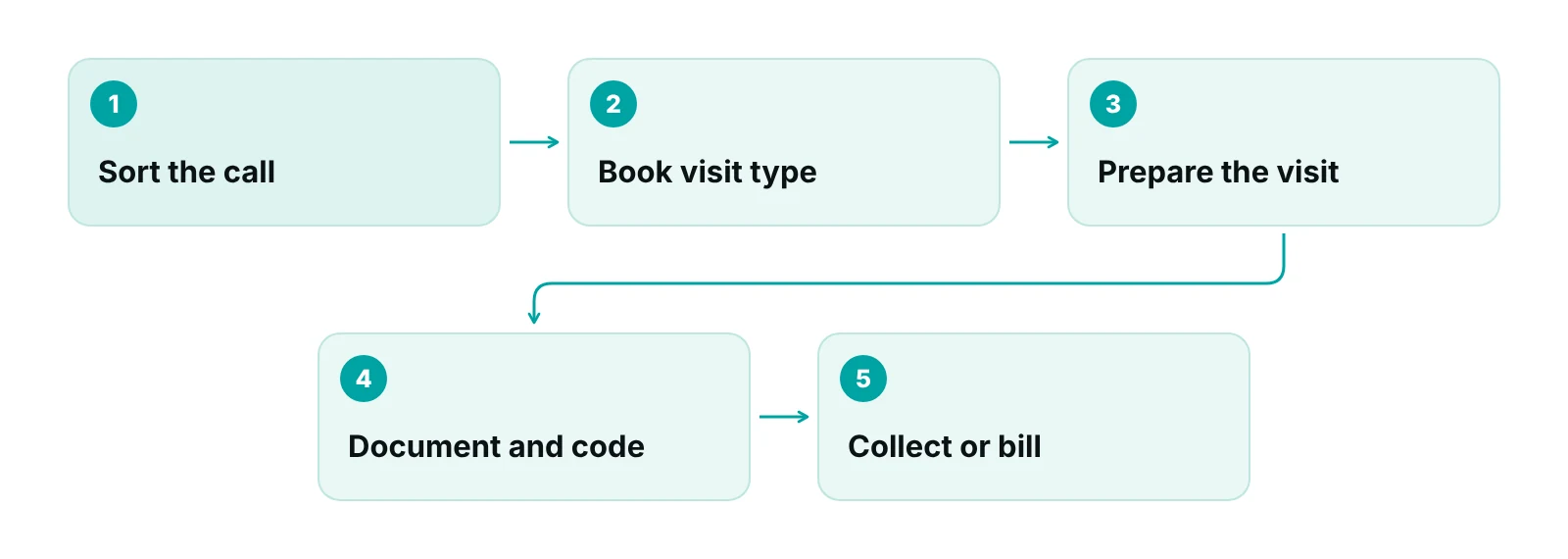
Build the schedule around visit types, not around provider preference. Each visit type needs a length, a room, a provider level and a rule for who may book it. Without that, the schedule fills with whatever call arrives first, and the visits that need the most time end up squeezed into the shortest slots.
- Medical access slots: hold a share of each provider’s week for new medical problems and skin-cancer concerns so those patients are not waiting behind cosmetic bookings.
- Procedure blocks: biopsies, destructions and excisions need room and instrument time. Book them in blocks the room can actually support.
- Cosmetic blocks: tie each treatment to a provider, a room and any device or product it needs. Add a consult slot where a plan of treatment must be agreed first.
- Surgical days: if the practice does Mohs or larger excisions, give those days their own template, pre-op checks and recovery time.
- Script for the phone: three questions sort a caller into the right visit type: what is the concern, is it new or a follow-up, and is it a medical or an appearance question.
Missed visits are a design problem as well as a patient problem. A 2026 scoping review in JAAD Reviews of 22 studies of U.S. adult dermatology clinics, reported by Healio, found that Medicaid patients missed 20.6% of visits without notice in one study, against 9.8% for privately insured patients, and that only 4 of the 22 studies tested ways to reduce no-shows. Two of those found video-based teledermatology linked to fewer no-shows. That is a reason to plan reminders and visit formats deliberately, not to make assumptions about any patient group.
The front desk is also where revenue is won or lost early. See how front-desk staff affect the revenue cycle for the habits that matter. Practices that cannot staff every phone and check in-house can use virtual medical assistants for scheduling, eligibility checks and intake, working in the practice’s own systems and time zone.
What belongs in intake, eligibility, authorization and consent?
Before the patient is seen, the practice should know who will pay, whether an authorization is needed and whether the patient has agreed to what is about to happen. For insured visits that means eligibility and authorization. For cosmetic visits it means an estimate and informed consent.
Medical visits. Verify coverage before the visit, not after the claim denies. The patient insurance verification guide sets out what to check. Prior authorization is the heavy part for treatments such as biologics. The American Medical Association’s 2024 physician survey, reported in its April 2025 article, found about 39 prior authorization requests per physician per week and about 13 hours of physician and staff time to complete them, and 40% of physicians said staff work only on prior authorizations. Decide who owns that work. The prior authorization guide covers the workflow.
Cosmetic visits. The price and the terms should be in writing before the patient arrives. Two federal items are worth knowing, shown in the table below. Neither replaces your state’s rules on consent, advertising and who may perform a treatment, which differ by state.
| Rule | What it says | What it means at the front desk |
|---|---|---|
| Good faith estimate (No Surprises Act) | Providers must give an uninsured or self-pay individual a written good faith estimate when the service is scheduled at least 3 days ahead or when the patient asks for one. Individuals covered by Medicare, Medicaid or other federal programs generally do not receive them. | Send an itemized written estimate to self-pay patients, keep a copy, and issue a new one if the scope changes. |
| Estimate dispute | A self-pay individual can start a dispute process if the billed charges are at least $400 above the estimate. | Quote with care and document why a final bill differs. |
| Medicare cosmetic exclusion | 42 CFR 411.15 excludes cosmetic surgery and related services, with exceptions for prompt repair of accidental injury and for improving the function of a malformed body part. | Do not bill Medicare for appearance-only treatment; document function when an exception may apply. |
| Advance Beneficiary Notice (form CMS-R-131) | An ABN must be written, signed and dated to be effective. It does not make a statutorily excluded service payable, and no ABN is needed for those services. A voluntary ABN for them uses modifier GX; modifier GY applies where none is issued. | Use the ABN for services Medicare may deny as not reasonable and necessary; use the correct modifier for excluded services. |
Sources: CMS Good Faith Estimate FAQ (2022 guidance); First Coast Service Options, CMS beneficiary notices; 42 CFR 411.15 (Cornell LII). Confirm current text before relying on it.
Consent has three layers. The first is the general consent and privacy notice for every patient. The second is procedure-specific informed consent, which for cosmetic work should cover risks, expected results, aftercare and cancellation or refund terms. The third is a separate written permission before any patient photo is used in marketing. Have counsel review the templates for your state.
How do charge capture and billing work in a skin practice?
Charge capture is where the note becomes a bill. In dermatology it fails in three places: procedures done but not coded, same-day visit and procedure coded wrongly, and cosmetic items entered as insurance claims or the reverse. A short daily check closes most of the gaps.
- Biopsy and removal: CMS’s NCCI policy manual states that a biopsy of the same lesion at the same encounter is bundled into the removal code, while a biopsy of a different lesion can be reported separately. See the manual’s Chapter 3.
- Same-day visit and procedure: the NCCI manual requires a significant and separately identifiable service unrelated to the decision to perform a minor procedure before a separate E/M is reported with modifier 25, and being a new patient alone does not justify it.
- Global periods: routine closure and post-op visits are part of the procedure’s package; unrelated visits can be reported with the proper modifier.
- Mixed visits: document the medical and cosmetic parts as separate problems with separate time and plans.
Modifier 25 is the most audited habit in the specialty. A First Coast Service Options fact sheet notes it applies to a significant, separately identifiable E/M on the same day as a 0- or 10-day global procedure, and that it should not be used where the note does not support it. The modifier 25 versus 59 explainer walks through the difference. For the full leak map, from prior authorization to physician assistant and nurse practitioner billing, read dermatology revenue cycle management.
Clean claims depend on a note that supports the code. The dermatology billing services guide lists what the note must show for biopsies, destructions, excisions and Mohs, and what to hand an outside billing team.
How should denials and accounts receivable be managed?
Treat denials as a feed of information about the front end, and work A/R on a schedule with a named owner. A denial that is only reworked, never traced to its cause, will come back next month.
Start by sorting denials by cause: eligibility, authorization, coding and documentation, and timely filing. Medicare fee-for-service claims generally must be filed within one calendar year of the date of service, as Medicaid.gov explains, and commercial payers set their own, often shorter, limits in the contract. A claim that misses the window is a write-off, so build a report that flags unbilled encounters weekly.
For a routine, review A/R by payer and age on a fixed day each week, set a time limit on each follow-up, and escalate only the claims over an agreed amount. The accounts receivable guide defines the measures. If the work competes with patient care for your staff’s time, an outsourced revenue cycle service is one option, and the billing services guide above explains how to evaluate one.
How should patient communication and telehealth be handled?
Patient communication should follow the same split as the schedule: reminders and recalls for medical patients, treatment-cycle prompts for cosmetic patients, and one HIPAA-safe path for anything that contains health information. Every vendor that touches patient information needs a business associate agreement.
HHS states that the HIPAA rules generally require a written contract with a business associate, covering permitted uses, safeguards, breach reporting and return or destruction of information, as its business associate contract guidance describes. That includes text-reminder tools, call recording and video platforms. If a vendor will not sign, do not send it patient information.
Telehealth suits some dermatology follow-ups and triage, and the Healio review above points to lower no-shows with video in two studies. The rules for licensure, payment and documentation change often, so they have their own guide: dermatology telehealth.
How do marketing and the website fit into operations?
Marketing should be limited by capacity and by privacy rules. The website, search presence and ads bring demand for both service lines, so decide first which line has open capacity. Then check the privacy rule for any tag or form before launch.
On privacy, HHS’s online tracking technologies bulletin says tracking tools on pages behind a login can involve PHI, and public pages that let users book appointments can too. A federal court vacated one part of the guidance on June 20, 2024, the part about IP addresses on public pages, so check current guidance before relying on either side. For reviews, the FTC’s final rule on reviews and testimonials bans fake reviews and compensation conditioned on a particular sentiment, so offering a discount for a five-star review is off the table.
Pick the guide that matches your question. For how patients search and what the pages and Google profile need, read the dermatology SEO guide. For splitting messages between medical and cosmetic patients, read dermatology marketing for cosmetic and medical patients. For paid search, reviews and booking, read dermatology digital marketing. For the site itself, read dermatology website design. If you want help, healthcare digital marketing services are available from RCM Finder.
What should software do for a dermatology practice?
Software should carry the visit from schedule to payment without rekeying: scheduling, charting with skin-specific templates, charge capture, claim submission, and reporting for both service lines. The right time to decide is before a contract, using a checklist, not a demo.
The EHR is the largest decision. Our dermatology EHR evaluation checklist lists the questions to ask about certification, data export, templates, the billing handoff, security and migration, without naming products. Practice management software is a separate decision, and the practice management system page describes what RCM Finder’s own portal does today. Appointment booking in the portal is in early access. The portal’s credentialing module and real-time eligibility are not live.
Whatever you buy, it should keep medical charges and cosmetic payments in separate ledgers, let you run reports for each, and give each staff role only the access it needs.
Who should own each area, and what should be measured?
Give each area one owner and one number. The table maps the sections of this guide to where to read next. Review it monthly with the manager and a physician in the room.
| Area | Owner | Number to watch | Read next |
|---|---|---|---|
| Scheduling and access | Front-desk lead | Days to next new-patient medical slot; no-show rate | Front desk and scheduling section above |
| Intake and authorization | Intake or prior-auth coordinator | Visits delayed or denied for authorization | Prior authorization guide |
| Charge capture and coding | Billing lead with provider | Encounters without a charge after 3 days | Dermatology billing services |
| Denials and A/R | Billing manager | Denials by cause; A/R over 90 days | Dermatology revenue cycle management |
| Patient communication | Practice manager | Reminders confirmed; opt-outs | Dermatology telehealth |
| Marketing and website | Owner or marketing lead | Booked new patients by source and service line | Dermatology digital marketing |
| Software and data | Owner or IT lead | Time spent rekeying; reports run on time | Dermatology EHR |
Source: RCM Finder operating framework. Thresholds are examples; set your own from your ledger.
See where your dermatology workflow leaks
A free practice audit looks at scheduling, benefit checks, charge capture and denials together, so you can see which area to fix first.
Our recommendations
- Write the visit-type list before changing anything else. List each medical, procedure, surgical and cosmetic visit with its length, room, provider and booking rule. Most scheduling problems trace back to this list.
- Protect medical access. Hold a fixed share of every provider’s week for new medical problems so cosmetic demand does not crowd out insurance-paid care.
- Put cosmetic prices and terms in writing before the visit. Send the estimate, consent and cancellation terms in advance, and keep a copy in the chart.
- Audit the note against the claim each week. Pull ten same-day visit-and-procedure claims and check that the note supports the modifier. It is a short task that prevents audits.
- Trace every denial to the front end. Tag each denial with eligibility, authorization, coding or timely filing. Fix the cause, not only the claim.
- Get a BAA for every tool that sees patient information. That includes reminders, video, call recording and forms. If a vendor will not sign, turn the feature off.
- Review the operations map monthly. Keep one owner and one number per area, and move on to the deeper guide for whichever number is slipping.
Bottom line
Dermatology practice management comes down to one design choice made well: two kinds of visits, each with its own path from schedule to payment. Use the operations map to give each area an owner and a number, and go to the deeper guides when a number slips. For practices that want one system for scheduling, claims and reporting, see RCM Finder’s practice management system for medical practices, or start with the dermatology revenue cycle guide.
Frequently asked questions
What is dermatology practice management?
It is the day-to-day running of a skin practice: scheduling, front desk, intake, billing, denials, patient communication, marketing and software. What makes it distinct is that medical visits bill insurance and cosmetic visits are self-pay, so each area needs two paths.
How should a dermatology practice schedule medical and cosmetic visits together?
Use separate visit types with their own lengths, rooms and booking rules, and hold a share of each provider’s week for new medical problems. Cosmetic blocks should be tied to the provider, room and device a treatment needs, so one line does not use up the other’s capacity.
Do cosmetic dermatology patients need a good faith estimate?
Federal guidance says providers must give a written good faith estimate to uninsured or self-pay individuals who schedule a service at least 3 days ahead or ask for one. Medicare and Medicaid patients generally do not receive one. State rules may add requirements, so confirm with counsel.
Can a dermatology practice bill insurance for a cosmetic treatment?
Not when the treatment is purely cosmetic. Medicare excludes cosmetic surgery and related services except for accidental injury repair or improving the function of a malformed body part, and many commercial plans follow similar policies. Document medical need accurately, and check each plan’s policy before billing.
Why does modifier 25 matter so much in dermatology?
Visits that include a biopsy, destruction or excision often also include a separate evaluation. Modifier 25 signals that the evaluation was significant and separately identifiable, and payers audit it. The note must show a distinct problem and work beyond the usual pre-procedure care.
When should a dermatology practice outsource billing or front-desk work?
Consider it when claims are delayed, denials repeat, or the front desk cannot cover phones, checks and authorizations. Start with an audit to find the weakest area, then outsource that task first. Make sure any vendor signs a business associate agreement before accessing patient data.
Get your free practice audit
Tell us about your practice. We will contact you using the details you give.
- A review of your recent claims, denials and A/R aging
- Where your front desk and prior authorizations slow payment
- A prioritized fix list you keep, whether or not you hire us
Pricing is quoted after the audit, based on your volume and the services you choose. Prefer to talk? Call +1 (302) 556-2288.
Sources
- Burden of skin disease — American Academy of Dermatology (2016)
- Guidance: Good Faith Estimates FAQ — CMS (CCIIO) (2022)
- CMS beneficiary notices — First Coast Service Options (Medicare) (2026)
- 42 CFR 411.15 Particular services excluded from coverage — Legal Information Institute (eCFR text) (2026)
- Business associate contracts — HHS Office for Civil Rights (2026)
- Patients facing greatest barriers to care most likely to be no-shows — Healio (reporting a JAAD Reviews 2026 scoping review) (2026)
- Modifier 25 fact sheet — First Coast Service Options (Medicare) (2026)
- Fixing prior auth: Nearly 40 prior authorizations a week is way too many — American Medical Association (2025)
- What is Medicare's general timely filing period? — Medicaid.gov (CMS) (2020)
- Use of Online Tracking Technologies by HIPAA Covered Entities and Business Associates — HHS Office for Civil Rights (2024)
- FTC announces final rule banning fake reviews and testimonials — Federal Trade Commission (2024)
- NCCI Policy Manual for Medicare Services, Chapter 3 (CPT 10000-19999) — CMS (2026)
Disclaimer: This article is educational and is not legal, coding, tax or compliance advice. Payer, Medicare and state rules differ and change, so confirm current requirements with your attorney, your state medical board and each payer before acting. CPT is a registered trademark of the American Medical Association; official code descriptors are not reproduced here.
