

Orthopedic billing services should cover more than claim submission: injections, fracture care and global periods, surgery with its facility split, DME, workers' comp and auto claims, and prior authorization, all followed to payment. Ask who owns each task, what the agreement says about patient data, and which reports you will see every month.
One orthopedic clinic day can include a joint injection, a cast check inside a global period, a brace, a workers’ comp visit and a surgery at an outside facility. Each follows its own rule and payer, and a partner that handles only the simple ones leaves the costly ones with you.
This buyer’s guide lists what a partner should handle, the Medicare facts that shape the work, and questions to ask before signing. For the full path from authorization to payment, read orthopedic revenue cycle management.
Key takeaways
- Ask for a written scope by service line: injections, fracture care, surgery, ASC cases, DME, workers’ comp, auto and authorization.
- Medicare counts a 90-day global period as 92 days, so someone must own the window.
- Medicare’s 2026 NCCI manual says fracture repair codes include casting.
- Billing braces as DME requires supplier enrollment, accreditation and a $50,000 surety bond per NPI.
- Any partner that sees patient data needs a signed Business Associate Agreement first.
What should orthopedic billing services handle?
Everything between the scheduled visit and the posted payment: eligibility, authorization, charge capture, coding review, submission, denial follow-up and patient balances, applied differently to each line of work. If a vendor’s scope ends at submitting claims, the hardest tasks stay with you. Table 1 shows the lines to ask about.
| Service line | The billing partner should | The practice keeps |
|---|---|---|
| Office visits and injections | Capture the visit, the procedure and the product injected as separate charges | Joint, side, guidance and product in the note |
| Fracture care and casting | Flag the global package at charge entry; keep included casting off the claim | A record of who applied the cast and who follows the patient |
| Surgery and global periods | Log the surgery date, count the window, review visits inside it | The decision for surgery documented; unrelated visits marked |
| ASC and hospital cases | Bill the surgeon’s fee and reconcile it to the facility’s claim | Agreement on who bills what before the case date |
| Bracing and DME | Bill only if the practice is enrolled as a supplier | Orders, fitting notes and proof of delivery |
| Workers’ comp, auto and injury | Identify the payer at scheduling; track claim numbers, adjusters and attorneys | Accident and employer details collected at intake |
| Prior authorization | Check requirements, submit, track and chase | Clinical notes and imaging reports, fast |
One boundary applies to every row: the practice owns the clinical record. A partner can catch a missing side or date but cannot create documentation. Ask how incomplete notes go back to providers.
How should injections and in-office procedures be billed?
Each part of the service gets its own line, within Medicare’s edits. Under the 2026 Medicare NCCI manual (Chapter 4), the unit of service for the joint injection and aspiration codes (20600 to 20611) is a joint and its surrounding bursae, and ultrasound guidance is covered within that family. Arthrocentesis is not reported separately with an open or arthroscopic procedure on the same joint, and local anesthesia for a musculoskeletal procedure is not separately reportable (CMS).
These are Medicare rules; commercial payers write their own. The practical risk is charge capture: ask how the partner matches injection charges to your supply records, since a product used but never charged appears on no denial report.
How do fracture care and global periods affect the billing work?
They turn a series of visits into one package, and the billing office must know when it starts and ends. Medicare’s global surgical package pays the procedure and its normal follow-up together. Table 2 states the headline rules from CMS’s global surgery booklet (December 2025) and the 2026 NCCI manual.
| Situation | What CMS says | Task for the partner |
|---|---|---|
| Window length | A 0-day code has no pre-op or post-op days. A 10-day code runs 11 days (surgery day plus 10). A 90-day code runs 92 days (1 day before, surgery day, 90 after). | Set the window from the code |
| Decision for major surgery | The visit that results in the first decision for major surgery is billed with modifier 57, the day before or day of surgery | Check the note shows the decision |
| Unrelated visit in the window | An unrelated E/M by the same provider in the post-op period uses modifier 24, with supporting documentation | Hold for review |
| Shared care | Splitting post-op care needs a written transfer of care in the record (modifiers 54, 55, 56); not for 0-day codes | Keep the agreement on file |
| Casting with a repair | Fracture and dislocation repair codes include casting, splinting and strapping, not reported separately | Block casting lines on repair claims |
| Initial cast only | If the physician applies the first cast with no other definitive treatment and expects to give initial care only, an E/M, a casting code and a supply code (Q4001 to Q4051) may be reported | Confirm no follow-up is managed |
| One repair per site | One fracture or dislocation repair code per anatomic site; a closed treatment converted to open at the same encounter reports only the open procedure | Review multi-line fracture claims |
Sources: CMS Global Surgery booklet MLN907166 (December 2025); CMS NCCI Policy Manual, Chapter 4 (2026)
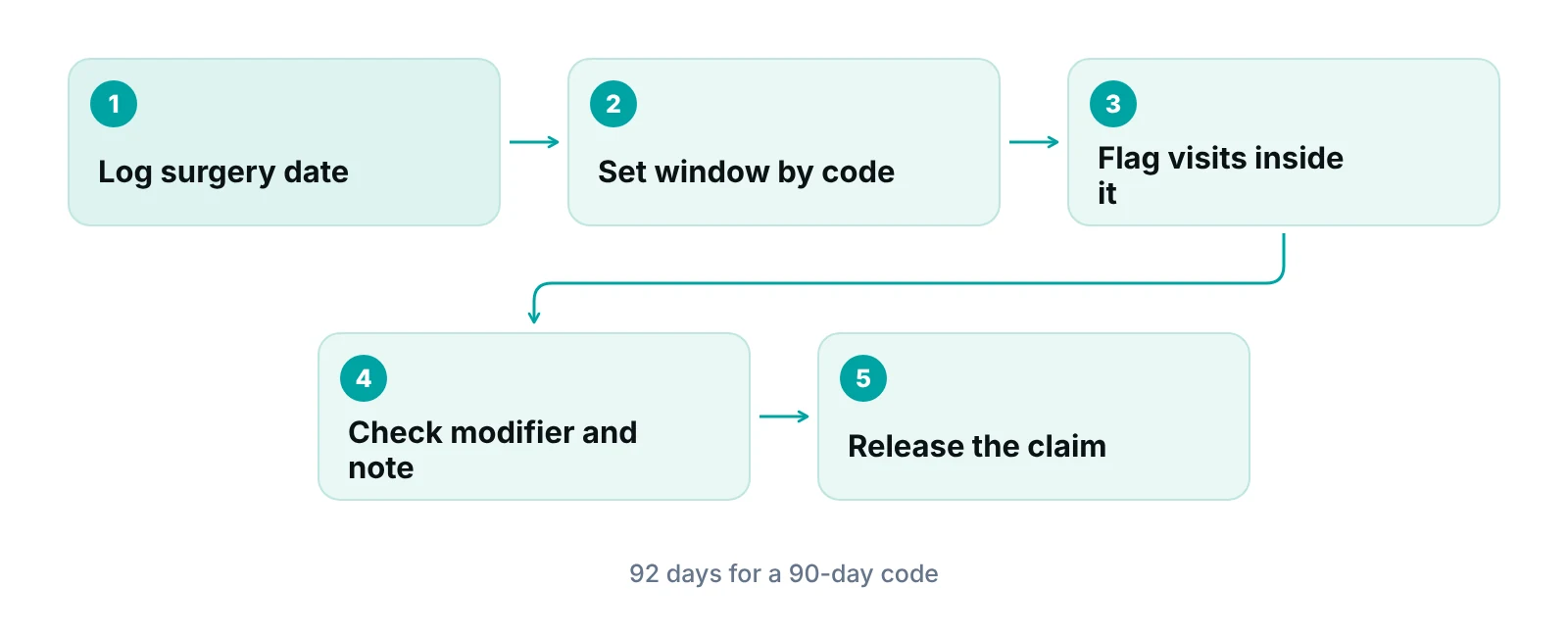
The booklet adds that providers in the same group and specialty must bill as a single physician, so the window is tracked by patient and procedure, not by surgeon. Modifier use and common errors are in the orthopedic coding guide; the 90-day package for hips, knees and shoulders is in the joint replacement billing guide. Sources: CMS and CMS NCCI Chapter 4.
How does the split between surgeon, ASC and hospital work?
The surgeon bills a professional fee, and the ASC or hospital outpatient department bills a facility fee under a different payment system. A partner must reconcile the two, even though the facility’s claim is not the practice’s to submit. The ASC vs HOPD billing guide explains the two systems.
Two facts show why the setting matters. CMS finalized a 2.6% ASC update for 2026 and began phasing out the inpatient-only list, removing 285 procedures it describes as mostly musculoskeletal (CMS). For 2027, a July 2, 2026 proposed rule would update ASC rates by 2.4%; it is a proposal, not final (CMS). CMS also finalized separate payment in both settings for 11 devices and five drugs that qualify as non-opioid pain relief, through December 31, 2027.
Settle implants in writing: ask which entity buys, bills and is paid for them in each setting you use. The answer depends on the setting and the contract, so do not accept a general reply.
Will a billing partner handle DME and bracing?
Only if your practice supplies DME. Per CMS, DMEPOS supplier enrollment requires accreditation from a CMS-approved organization, enrollment through PECOS or on paper, and a surety bond of $50,000 for each NPI (CMS, page modified June 3, 2026). The page says certain professionals may be exempt and points to the enrollment contractor, so confirm your status.
Before touching a brace claim, a partner should ask three things: is the practice enrolled, where are the order, fitting note and proof of delivery, and which payer’s rules apply. The 2026 NCCI manual also states that dressings and supplies are, with few exceptions, included in the surgical procedure payment. Modifier mechanics are in the DME billing modifiers guide.
How are workers' comp and auto or personal injury claims handled?
They go to the carrier or attorney named in the case, not the patient’s health plan, so the partner’s work starts at scheduling, when the payer is identified. State rules set forms, deadlines and fee schedules for workers’ comp, so ask which states the partner has billed. The workers’ comp billing guide covers the process.
A Medicare patient adds a layer. CMS says it relies on providers to ask Medicare patients about other primary coverage (CMS), and that settlement set-aside funds must be depleted before Medicare pays for related treatment (CMS). For auto and injury cases, ask how claim numbers, adjusters and attorney correspondence are tracked, and whether these accounts age on their own report line.
What should a partner do about prior authorization?
Check the requirement before the visit or case, submit with the right notes, track the decision and tell the schedule if it fails. The AMA’s late-2024 survey reported an average of 39 prior authorizations per physician per week, taking about 13 hours of physician and staff time, with 40% of physicians having staff who work only on them (American Medical Association, published April 2025).
Two federal changes touch this in 2026. CMS’s prior authorization rule applies to Medicare Advantage, Medicaid and CHIP and, for some provisions, exchange plan issuers. Covered payers must decide within 72 hours for expedited and seven calendar days for standard requests (exchange issuers excluded from that timeframe) and give a specific denial reason from 2026 (CMS). In traditional Medicare, the WISeR model, from January 1, 2026 in New Jersey, Ohio, Oklahoma, Texas, Arizona and Washington, lists knee arthroscopic lavage and debridement for osteoarthritis, epidural steroid injections, cervical fusion, vertebral augmentation and lumbar decompression for prior authorization, subject to change (CMS).
Ask who tracks these changes for your payer mix. The prior authorization guide covers the process, and our virtual medical assistant service supports eligibility checks, scheduling and prior authorization.
What should you ask before you sign?
Put the same questions to every vendor, in writing (Table 3).
| Topic | Ask | A usable answer includes |
|---|---|---|
| Scope | Which service lines are in and out? | A list by line, including DME, workers’ comp and authorization |
| Global periods | Who tracks windows and reviews visits inside them? | A named reviewer and a flag at charge entry |
| Documentation | How are incomplete notes returned to providers? | A queue, a turnaround time and a monthly repeat-issue list |
| Patient data | Will you sign a BAA before seeing patient data? Do you use subcontractors? | Yes, before access, and a BAA with each subcontractor |
| Access | Who sees patient records, and is access logged? | Role-based access and an audit log |
| Payer follow-up | Who works denials and underpayments? | A named owner and a written appeal process |
| Reports and exit | What do I see monthly, and what happens if we part? | A sample report set and data return terms |
Source for the BAA row: HHS Office for Civil Rights, business associate guidance
On the BAA row, HHS says a covered entity may disclose protected health information to a business associate only with satisfactory assurances in a written contract. The contract must describe permitted uses and disclosures, bar other uses, require Security Rule compliance and require reporting of security incidents, including breaches. HHS names claims processing and billing among the activities that can make a vendor a business associate, and a business associate needs its own agreement with any subcontractor.
What reporting should orthopedic billing services provide?
A monthly set, split by payer and service line:
- A/R aging by payer and age bucket, with workers’ comp and auto accounts shown separately.
- Denials by reason and service line, with the share worked.
- Global-period exceptions and how each was resolved.
- An authorization log: requested, approved, denied and expired.
- Facility reconciliation: surgeon claims matched to the ASC or hospital case.
- A timely filing watch list.
The watch list matters because Medicare Part B claims must be filed within one calendar year of the date of service, and a claim denied for timely filing cannot be appealed (Noridian Healthcare Solutions, Jurisdiction E; confirm with your own Medicare contractor). If you change partners, ask who owns older claims, since the clock keeps running during a handoff.
How does RCM Finder approach orthopedic billing?
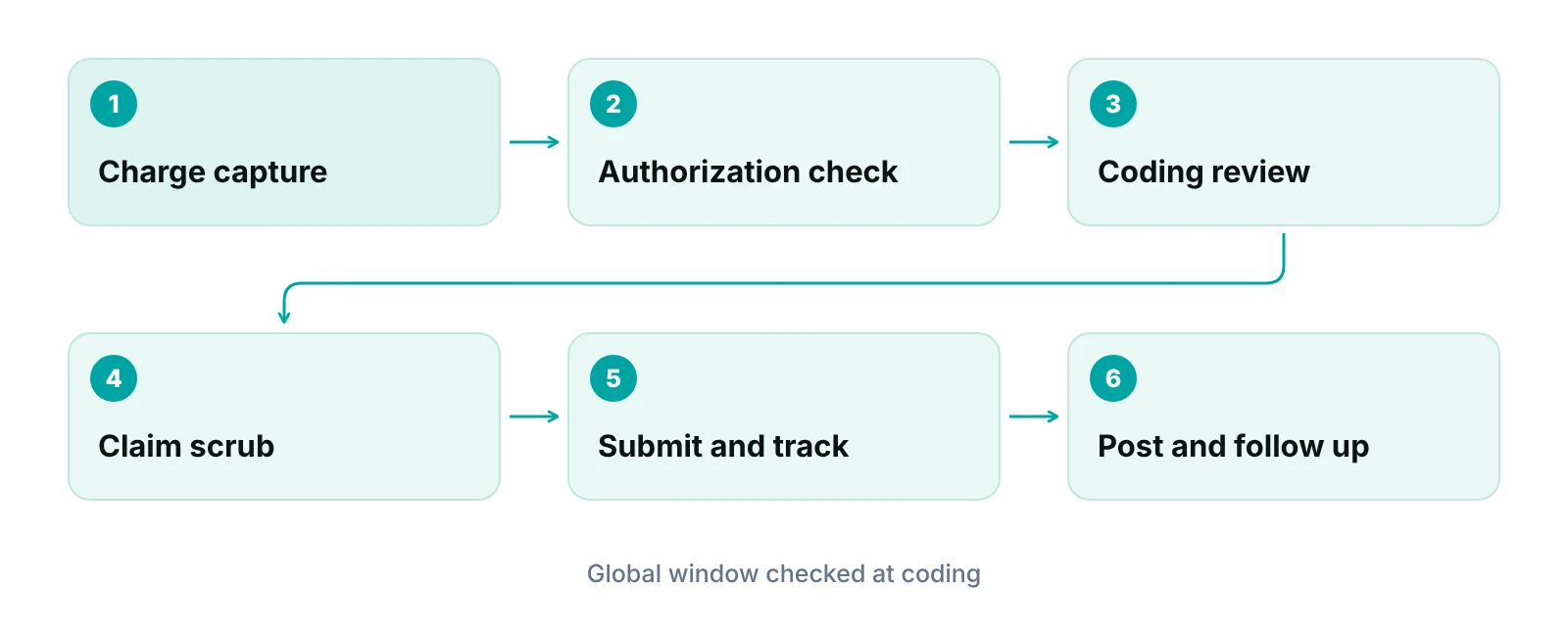
We begin with a free practice audit of a claim sample, and pricing is quoted after it. Our team works inside your existing EHR on your practice’s time zone, following the claim path below. Our billing portal tracks claims by stage, applies specialty-aware logic to each claim, checks data completeness before submission and flags possible underpayments. Access is role-based, activity is logged and connections use HTTPS.
We put a Business Associate Agreement in place before accessing patient data. Front desk and referral flow are covered in the orthopedic practice management guide.
Want a second look at your orthopedic claims?
Send a sample of denied or short-paid claims with notes. A free audit shows whether the cause is the code, the modifier, the authorization or the documentation.
Our recommendations
- Write the scope by service line. List what the partner does and what you keep. Unlisted work gets missed.
- Name the owner of the global window. One person owns the surgery date, the window and the review of visits inside it, with a second reader on modifier 24 and 57 claims.
- Confirm your DME status first. Check with your enrollment contractor whether your practice is enrolled before outsourcing brace billing.
- Settle the implant question in writing. For each facility you use, record who buys and bills implants and how it is reconciled.
- Separate payer types in every report. Workers’ comp, auto and injury accounts should age on their own line.
- Require the BAA and a sample report. Share no patient data until the agreement is signed, and compare vendors on a sample report set.
Bottom line
Good orthopedic billing services are judged on unglamorous work: the global window that is counted, the cast that is not billed twice, the authorization in hand before the case and the report that shows it. If your claims return for these reasons, our team at RCM Finder revenue cycle management can review a sample with you. For how patients and referral sources find the practice, see the orthopedic marketing plan.
Frequently asked questions
How much do orthopedic billing services cost?
Arrangements vary, so compare the same scope from each vendor. Ask what is included for authorization, DME, workers’ comp, denial follow-up and reporting, and get the fee basis in writing. Be wary of a quote given before anyone has looked at your claims. RCM Finder quotes pricing after a free practice audit of a claim sample.
Should the billing partner also do the coding?
Ask who reviews procedure claims before they go out. Orthopedic claims depend on global periods, casting rules and modifiers, so someone with specialty experience should check them against the note. If coding is a separate service, confirm who is accountable when a claim is denied for a code or modifier error.
Do we need separate help for ASC and hospital cases?
Not necessarily, but someone must reconcile the surgeon’s professional claim with the facility’s claim. Ask whether the partner does that reconciliation, who handles implant billing in each setting, and what it reports when the facility’s claim is unpaid.
Can an outside company bill DME for us?
Only if the practice itself is set up to supply DME. CMS lists accreditation, enrollment and a $50,000 surety bond per NPI for DMEPOS suppliers, with some professionals possibly exempt. Check your status with your enrollment contractor, then ask the vendor about its experience with your payers.
What must a Business Associate Agreement cover?
HHS says it must describe permitted uses and disclosures, bar other uses, require Security Rule compliance and require reporting of security incidents, including breaches. A vendor with subcontractors needs an agreement with each one that handles patient data. Have your own attorney review the document.
What happens to old claims when we switch partners?
Agree on it before you sign. Ask who works open claims from before the start date, how they are reported and how timely filing is monitored. Medicare Part B’s one-year limit keeps running, so unworked claims should not sit during a handoff, and the old and new partners should agree on a cutoff date.
Get your free practice audit
Tell us about your practice. We will contact you using the details you give.
- A review of your recent claims, denials and A/R aging
- Where your front desk and prior authorizations slow payment
- A prioritized fix list you keep, whether or not you hire us
Pricing is quoted after the audit, based on your volume and the services you choose. Prefer to talk? Call +1 (302) 556-2288.
Sources
- Global Surgery booklet (MLN907166) — CMS (2025)
- NCCI Policy Manual for Medicare Services, Chapter 4 (CPT 20000-29999) — CMS (2026)
- CMS Interoperability and Prior Authorization final rule (CMS-0057-F) fact sheet — CMS (2024)
- WISeR Model Request for Applications — CMS (2025)
- Fixing prior auth: nearly 40 prior authorizations a week — American Medical Association (2025)
- CY 2026 OPPS/ASC final rule fact sheet — CMS (2025)
- CY 2027 OPPS/ASC proposed rule fact sheet — CMS (2026)
- Enroll as a DMEPOS Supplier — CMS (2026)
- Workers' Compensation Medicare Set-Aside Arrangements — CMS (2026)
- Provider responsibilities for Medicare Secondary Payer — CMS (2026)
- Business Associates guidance — HHS Office for Civil Rights (2026)
- Medicare Part B timely filing — Noridian Healthcare Solutions (Medicare JE) (2026)
Disclaimer: This article is educational and is not legal, coding, tax or compliance advice. CPT is a registered trademark of the American Medical Association, and its official descriptors are not reproduced here. Medicare rules are summarized from the sources cited; Medicare contractors, commercial payers and state workers' compensation programs differ and change, so confirm current requirements with your payers, your Medicare contractor and your attorney before acting.
