
For hypotension icd 10 coding, I95.9 is the code only when no type is documented. Use I95.1 for orthostatic, I95.2 when a drug causes it, I95.3 during hemodialysis, I95.81 after a procedure, I95.0 for idiopathic and I95.89 for other types, such as chronic hypotension. A low reading with no diagnosis is not coded as hypotension.
Low blood pressure appears on visit notes, discharge summaries and dialysis records, and each setting writes it differently. The I95 category splits hypotension by cause and setting, which means the right code usually depends on one qualifier in the assessment. This guide gives you the codes, the rules that decide between them and the documentation that supports each. Code statuses were checked against the FY 2027 code set (effective 1 October 2026).
Key takeaways
- I95 is a category; the billable codes are I95.0, I95.1, I95.2, I95.3, I95.81, I95.89 and I95.9.
- I95.9 (unspecified) is for notes that name no type. If a type is documented, a more specific code exists.
- I95.1 and I95.2 exclude each other: orthostatic hypotension due to a drug goes to I95.2.
- A low reading without a diagnosis, cardiovascular collapse, maternal hypotension syndrome and neurogenic orthostatic hypotension all sit behind Excludes1 notes.
- Codes come from the provider’s documentation, not from a blood pressure value.
Which ICD-10 code do you use for hypotension?
Use I95.9 for hypotension with no type documented, and a more specific I95 code when the provider names one. The I95 category is not billable by itself. Per the FY 2027 listing of I95, the billable codes are I95.0 (idiopathic), I95.1 (orthostatic), I95.2 (due to drugs), I95.3 (of hemodialysis) and I95.9 (unspecified), and I95.8 is a header that breaks into I95.81 and I95.89.
Table 1 lists the codes with the situations they fit. Meanings are in our words, not the official descriptors, so read the full entry and its notes in the Tabular List before you finalize a template. The last two rows are not hypotension codes. They are the codes the I95 Excludes1 notes point to, and they are the source of most mistakes.
| Code | What it covers (our wording) | Use it when | Notes |
|---|---|---|---|
| I95.0 | Idiopathic hypotension | The provider documents low blood pressure with no identified cause | Billable |
| I95.1 | Orthostatic (postural) hypotension | The provider documents hypotension on standing; sitting and standing vitals should be in the record | Excludes1: neurogenic orthostatic hypotension (G90.3) and orthostatic hypotension due to drugs (I95.2) |
| I95.2 | Hypotension due to drugs | The provider links hypotension to a medication or chemical | A T36-T50 code can identify the drug, per AAPC |
| I95.3 | Hypotension of hemodialysis | Hypotension during hemodialysis, including intradialytic | Billable |
| I95.81 / I95.89 | Postprocedural hypotension / other hypotension | After anesthesia or surgery (I95.81); chronic or other specified hypotension (I95.89) | I95.8 alone is a header |
| I95.9 | Hypotension, unspecified | The note says hypotension and gives no type | Fallback, not default |
| R03.1 | Nonspecific low blood-pressure reading | A low reading with no diagnosis of hypotension | Named in the I95 Excludes1 note; confirm status |
| R57.9 | Shock, unspecified | Cardiovascular collapse or shock is documented, not hypotension | Named in the I95 Excludes1 note |
Source: NCHS/CDC ICD-10-CM FY 2027 files; code status and notes read on icd-10codes.com, 2minutemedicine.com and hccbuddy.com (FY 2027); AAPC Coding Alerts (2023).
The status and notes for I95.9, I95.81 and I95.1 were read on the I95.9, I95.81 and I95.1 lookup pages. All are secondary sources, so confirm each code in your encoder or the NCHS FY 2027 files.
How do you choose between the I95 codes?
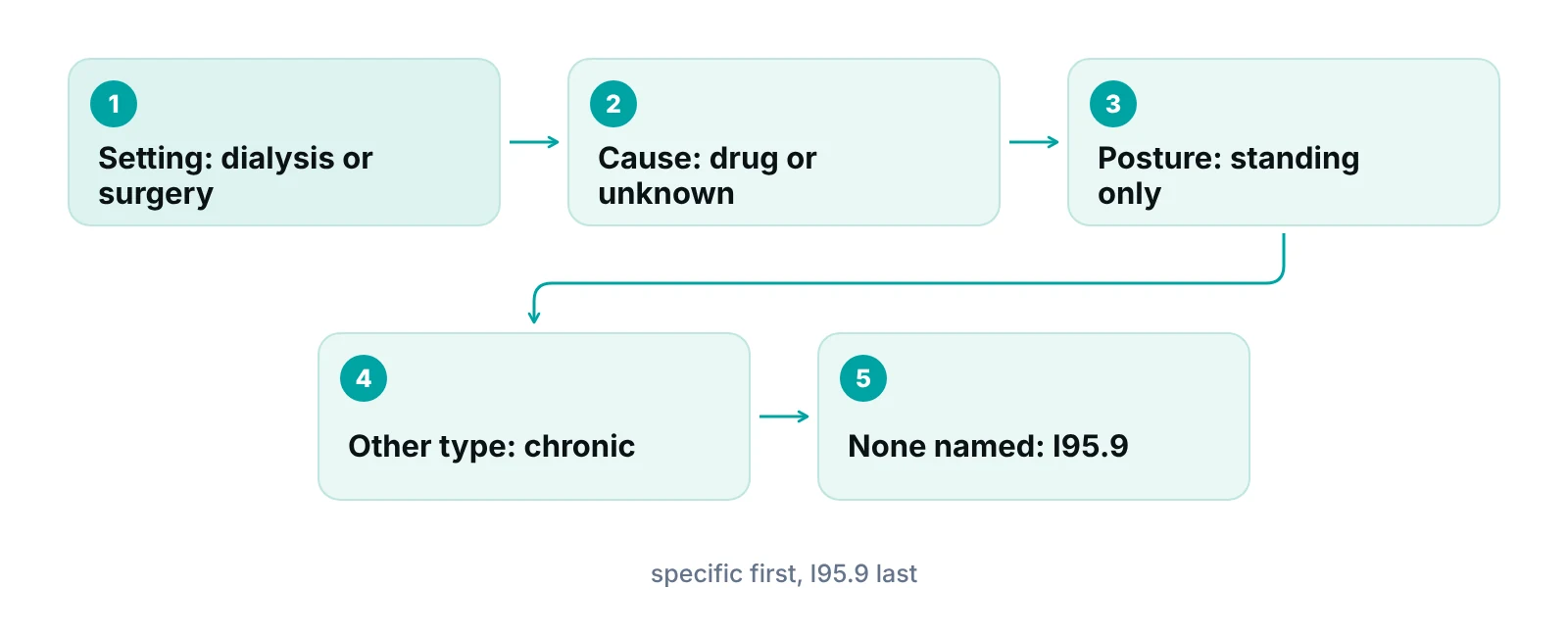
Choose by the qualifier the provider documents, in this order: setting (dialysis or after a procedure), cause (a drug or unknown), posture (orthostatic), and only then unspecified. The AAPC Coding Alert on hypotension advises that providers document the specific type or cause, because I95.9 is used when documentation gives no type, per the AAPC Coding Alert (April 2023).
Orthostatic versus drug-induced
I95.1 has an Excludes1 note for orthostatic hypotension due to drugs, which is reported as I95.2, according to the I95.1 lookup page. It also excludes neurogenic orthostatic hypotension (G90.3). So a note that says “orthostatic hypotension from the new blood pressure medication” is I95.2, not I95.1. Per AAPC, an I95.2 claim can add a code from T36 to T50 to identify the drug, if applicable, and the AAPC 2023 articles are the only source we read for that step. Confirm the adverse-effect rules in the Official Guidelines before you set a policy.
The AAPC alert also says an orthostatic diagnosis should rest on a record that has sitting and standing vitals. That is a documentation point for the provider, not a coding rule. A coder cannot add the diagnosis from the vitals, but a note that says “orthostatic” with no vitals is the kind of record an auditor will question.
After a procedure or on dialysis
Setting codes beat posture codes. I95.3 is for hypotension of hemodialysis, and AAPC says it includes intradialytic hypotension. I95.81 is postprocedural hypotension, and AAPC lists anesthesia and the first days after surgery as the setting, with possible causes such as infection, fever, respiratory distress, an anesthesia reaction or hypovolemia, per the AAPC Coding Alert (February 2023). Both are billable in FY 2027.
Chronic and other hypotension
I95.89 covers other specified hypotension, including chronic hypotension according to AAPC. It is a child of the I95.8 header, so I95.8 on its own is not a valid code. When a provider writes only “chronic low blood pressure” with no further qualifier, I95.89 is a reasonable path, and the Alphabetic Index in your encoder will confirm it.
Which Excludes1 notes do coders trip over?
The I95 category carries three Excludes1 notes: cardiovascular collapse (R57.9), maternal hypotension syndrome (O26.5-) and a nonspecific low blood pressure reading NOS (R03.1), according to the I95.9 lookup page. Excludes1 means the two are not coded together, with one exception when the conditions are unrelated. The FY 2027 Official Guidelines (Section I.A.12) say to query the provider when it is unclear whether they are related.
- A reading versus a diagnosis. A low reading with no diagnosis of hypotension does not go to I95.-. The Excludes1 note points to R03.1. If the provider later diagnoses hypotension, code the diagnosis.
- Shock and collapse. R57.9 is shock, unspecified, and the I95 note names cardiovascular collapse as the excluded condition. R57 has its own Excludes1 list, which includes postprocedural shock (T81.1-) and shock due to anesthesia (T88.2), per the R57.9 listing. Check it before you pick between I95.81 and a shock code.
- Pregnancy. Maternal hypotension syndrome sits in O26.5-, not I95.
- Neurogenic orthostatic hypotension. G90.3, not I95.1.
Chapter 9 has Excludes2 notes too, including symptoms and abnormal findings (R00-R94) and transient cerebral ischemic attacks (G45.-). Excludes2 means the conditions are separate and both can be reported when both are documented. A patient with transient neurological symptoms and low blood pressure may need two codes, which is why our TIA ICD-10 guide is worth reading next to this one.
What about dizziness, fainting and other symptoms?
Symptoms are coded only while no related definitive diagnosis exists. Per Sections I.B.4 and I.B.5 of the FY 2027 Official Guidelines, a symptom code is acceptable when the provider has not established a related diagnosis, and signs and symptoms that routinely accompany a disease are not coded separately. Once the note says orthostatic hypotension, the lightheadedness it causes is generally part of that diagnosis.
The AAPC alert lists symptoms that can accompany low blood pressure, such as dizziness, fatigue, blurred vision, confusion, nausea and fainting. We did not verify symptom codes for this article, so we do not list them. Two rules still help. First, if the cause of the symptom is not documented, the symptom is the reportable finding. Second, if the provider documents a symptom the diagnosis does not routinely explain, it can be coded in addition. When it is unclear, query the provider. Our guides to weakness ICD-10 codes and leg edema ICD-10 codes apply the same symptom-versus-diagnosis rule to other findings.
Unspecified is allowed, and it is a flag
Section I.B.18 of the CMS-hosted FY 2026 guidelines says unspecified codes are appropriate when they best reflect what is known at the encounter. I95.9 is therefore legal. It is also the code most likely to be reviewed, because a type usually exists in the record. Use it when the record is truly silent, and track how often it appears.
Does the care setting change how hypotension is coded?
The code does not change with the setting, but the likely type does, and so does the documentation you can expect. Knowing the pattern helps a coder see when a note is missing something.
- Primary care and specialty offices. Orthostatic and drug-related hypotension are common in medication reviews, so I95.1 and I95.2 matter most. The risk is a note that says only “low BP” and falls to I95.9 or R03.1.
- Dialysis units. The session record is the source for I95.3. If the same patient has hypotension on a non-dialysis day, the setting is gone and another type may apply.
- Surgical and procedure settings. I95.81 depends on the provider linking the hypotension to the procedure. A postoperative note with no link is closer to I95.9.
- Emergency and urgent care. Notes often record a reading and a plan before a diagnosis is reached. Watch for shock or collapse language, because the Excludes1 notes change the code.
Patients who take blood pressure medication sit on both sides of the scale. A patient whose therapy for high blood pressure is reduced because of dizziness may have hypertension and drug-induced hypotension in the same note. Both can be reported when both are documented, and our hypertension ICD-10 guide covers the hypertension side, including the combination codes. Check each code against its own Excludes notes rather than assuming one cancels the other.
What must the provider document to support the code?
The note has to name the type, the cause or setting, and the assessment. Without the type, you are left with I95.9, and without the cause, you cannot choose between I95.1 and I95.2. Ask providers to cover these points.
- The type. Orthostatic or postural, idiopathic, chronic, postprocedural, or hypotension during dialysis.
- The cause, if known. A medication or substance, a procedure or anesthesia, or the dialysis session. A linking word such as “due to” or “after” helps.
- The supporting findings. For orthostatic hypotension, sitting and standing vitals. For drug-related, the medication named.
- The assessment. What the provider did at that visit: reviewed the medication, adjusted therapy, ordered tests or referred. A diagnosis that was not assessed is hard to defend.
- Related conditions. If shock or collapse is part of the picture, say so, because the Excludes1 notes change the code.
AAPC repeats a basic point in its alerts: code from the provider’s documentation, and make sure the diagnosis supports the medical necessity of the service. Hypotension is a common reason for orders, so a code that does not match the note can put a test, a visit or a medication review at risk.
“Hypotension is a good example of a diagnosis where the qualifier is the code. If the note says orthostatic, drug-related or postprocedural, the code follows. If it says only low BP, the code is a flag.”
— Awais Afzal, Healthcare Operations & Data Analyst
What denial and edit reasons come up with hypotension codes?
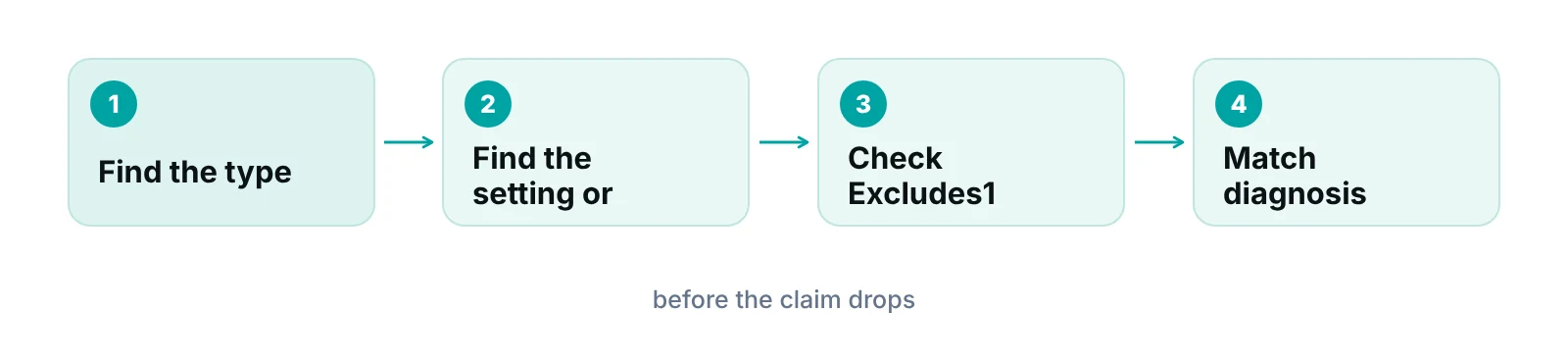
Most hypotension edits fall into three groups: an unspecified code where a type is documented, an Excludes1 pair, and a diagnosis that does not match the service. The table below lists the patterns we would add to a pre-bill check, in payer-neutral terms.
| Provider documents | Report | Check |
|---|---|---|
| Hypotension, no type | I95.9 | Query if a type is likely in the chart |
| Low BP when standing; postural | I95.1 | Sitting and standing vitals in the record |
| Orthostatic hypotension due to a medication | I95.2 | I95.1 is excluded; consider the drug code per Official Guidelines |
| Hypotension during dialysis | I95.3 | Setting documented |
| Hypotension after surgery or anesthesia | I95.81 | Link to the procedure documented |
| Chronic hypotension | I95.89 | I95.8 alone is not valid |
| Neurogenic orthostatic hypotension | G90.3 | I95.1 is excluded |
| Low reading, no diagnosis | R03.1 | I95.- is excluded; confirm R03.1 status |
Source: NCHS/CDC ICD-10-CM FY 2027 Official Guidelines (Sections I.A.12, I.B.4, I.B.5); Tabular List notes read on icd-10codes.com, 2minutemedicine.com and hccbuddy.com (FY 2027); AAPC Coding Alerts (2023).
| What the claim shows | Why it can stop or deny | What to do |
|---|---|---|
| I95.9 where the note names a type | Specificity edit; a more specific code exists | Code the type or query for an addendum |
| I95.1 and I95.2 on the same claim | I95.1 carries an Excludes1 note for drug-induced orthostatic hypotension | Report I95.2 if drug-related |
| I95.1 on a neurogenic note | I95.1 excludes G90.3 | Report G90.3 |
| I95.- with R03.1 | I95 carries an Excludes1 note for the nonspecific reading | Report the diagnosis only |
| I95.- with R57.9 | I95 carries an Excludes1 note for cardiovascular collapse | Review the note and query if both appear |
| I95.8 on its own | I95.8 is a header, not a valid code | Use I95.81 or I95.89 |
| Hypotension code on a service that needs another diagnosis | Diagnosis does not support the service line | Review the diagnosis pointer and the payer policy |
Source: Tabular List notes at I95, I95.1 and I95.8 read on icd-10codes.com, 2minutemedicine.com and hccbuddy.com (FY 2027). Payer edits vary.
These checks work best before the claim leaves the office. A claim scrubber or a spot check by a coder can hold a claim with an Excludes1 pair. Our guides to claim scrubbing and denial management show where that step fits, and our denial management services page explains how we review recurring patterns.
Are unspecified-diagnosis edits repeating on your claims?
Send a sample of returned claims with I95.9 or an Excludes1 pair. A free practice audit shows whether the cause is the note, the code choice or the payer edit.
What does a worked example look like?
Example (made-up, de-identified; not a real patient or claim). An established adult is seen for a medication review. The assessment reads: “Orthostatic hypotension, onset after the dose change. Sitting 128/78, standing 102/66. Reduce dose.” The provider linked the hypotension to a drug and documented postural vitals. The code to report is I95.2. I95.1 is excluded by its Excludes1 note, and the drug code from T36 to T50 can be added if your encoder and the Official Guidelines call for it.
Change the note to “Orthostatic hypotension, cause unclear. Sitting and standing vitals attached.” No drug is named, so I95.1 is the code. Change it again to “Low BP at triage, no diagnosis.” That is a reading, not a diagnosis, so the I95 Excludes1 note points you to R03.1, and you would query if the provider intended to diagnose hypotension.
Last, a dialysis unit note: “Hypotension during session, resolved with fluid.” This is I95.3. The same patient after a surgical procedure: “Hypotension on post-op day one, anesthesia-related.” This is I95.81. If the note said only “hypotension” in either case, I95.9 would be the fallback, and a query would be the better route.
Our recommendations
- Put Table 2 on the coder's desk. Show qualifier-to-code pairs so a note that says orthostatic, drug-related or postprocedural never ends at I95.9.
- Ask for the qualifier in the assessment. One word, orthostatic, chronic, postprocedural or dialysis-related, usually decides the code. Add a prompt to the note template.
- Add Excludes1 pairs to the pre-bill check. Flag I95.- with R03.1, R57.9 or G90.3, and I95.1 with I95.2, so a person sees the claim before the payer does.
- Report I95.9 use by provider. A short monthly count shows which providers need a template change and which settings generate the most unspecified codes.
- Write a query template. Keep a short script: ‘The note says hypotension. Please clarify the type and cause, if known.’ Keep the reply in the chart.
- Re-verify every 1 October. The ICD-10-CM code set changes each fiscal year. Re-check your templates and encoder against the new files before it takes effect.
Bottom line
Hypotension coding is a qualifier game: setting and cause first, posture next, unspecified last. Respect the Excludes1 notes for a low reading, shock, pregnancy and neurogenic hypotension, and make the provider’s note say which type it is. If these claims keep returning, a review of your revenue cycle management workflow or our medical billing services can show where, and you can ask for a free practice audit. For the other end of the scale, see our hypertension ICD-10 guide.
Frequently asked questions
What is the ICD-10 code for hypotension?
I95.9, hypotension unspecified, is used when the note names no type. If the provider documents a type, use the specific code: I95.0 idiopathic, I95.1 orthostatic, I95.2 drug-induced, I95.3 hemodialysis, I95.81 postprocedural or I95.89 other, including chronic.
What is the ICD-10 code for orthostatic hypotension?
I95.1. Its Excludes1 notes send drug-induced orthostatic hypotension to I95.2 and neurogenic orthostatic hypotension to G90.3. The record should hold sitting and standing vitals, according to AAPC.
Can I code hypotension from a low blood pressure reading?
No. A low reading without a diagnosis does not go to I95.-. The I95 Excludes1 note points to R03.1 for a nonspecific low reading. Code hypotension only when the provider diagnoses it, and query if it is unclear. The same applies to a triage or vitals entry copied into the assessment.
Is I95.8 a valid code?
No. I95.8 is a header. Use I95.81 for postprocedural hypotension or I95.89 for other specified hypotension, which AAPC says includes chronic hypotension. Confirm both in your encoder for the date of service. A pre-bill rule that rejects any code ending at I95.8 catches the error before the claim leaves.
Do I code the drug as well as I95.2?
AAPC says a code from T36 to T50 can identify the drug if applicable. The adverse-effect rules sit in the Official Guidelines, so follow them and your encoder prompts before you set a policy.
When is I95.9 acceptable?
When the note says hypotension and gives no type, cause or setting. Section I.B.18 allows unspecified codes when they reflect what is known at the encounter. If the type is likely in the chart, send a query first. Track how often I95.9 appears by provider and setting, because a high rate usually points to a note template that does not prompt for the type.
Get your free practice audit
Tell us about your practice. We will contact you using the details you give.
- A review of your recent claims, denials and A/R aging
- Where your front desk and prior authorizations slow payment
- A prioritized fix list you keep, whether or not you hire us
Pricing is quoted after the audit, based on your volume and the services you choose. Prefer to talk? Call +1 (302) 556-2288.
Sources
- ICD-10-CM FY 2027 file directory — NCHS/CDC (2026)
- Comprehensive listing of ICD-10-CM files — NCHS/CDC (2026)
- ICD-10-CM Official Guidelines for Coding and Reporting, FY 2027 — NCHS/CDC (2026)
- ICD-10-CM Official Guidelines, FY 2026 (CMS-hosted) — CMS (2025)
- I95 Hypotension — icd-10codes.com (2026)
- I95.9 Hypotension, unspecified — 2minutemedicine.com (2026)
- I95.81 Postprocedural hypotension — 2minutemedicine.com (2026)
- I95.1 Orthostatic hypotension — hccbuddy.com (2026)
- R57.9 Shock, unspecified — icd-10codes.com (2026)
- Condition spotlight: pocket these tips for coding hypotension correctly — AAPC ICD-10 Coding Alert (2023)
- ICD-10-CM: conquer different types of hypotension to submit clean claims — AAPC Cardiology Coding Alert (2023)
- R03.0 Elevated blood-pressure reading, without diagnosis of hypertension — icd-10codes.com (2026)
Disclaimer: This article is educational and is not legal, coding, billing, medical or compliance advice. ICD-10-CM and CPT code meanings, guidelines, Medicare contractor policies and payer rules change (the ICD-10-CM code set updates every 1 October) and vary by payer, contractor and state. Verify current requirements with the official ICD-10-CM Tabular List and Official Guidelines, your payers and your counsel before you act.
