
For leg edema icd 10 coding, use R60.0 when swelling is localized to the leg, R60.1 for generalized edema, and R60.9 only when the site is not documented. If the provider documents a cause, such as venous insufficiency (I87.2) or lymphedema (I89.0), report that diagnosis instead of the symptom code.
The word “edema” appears in thousands of visit notes, and the code you pick depends on three things the note may or may not say: where the fluid is, whether a cause is named, and whether the provider wrote “edema” or “swelling.” This guide gives you the codes, the rules that choose between them and the documentation that keeps the claim clean. All code statuses below were checked against the FY 2027 code set (effective 1 October 2026).
Key takeaways
- R60.0, R60.1 and R60.9 are the three billable edema codes; R60 alone is a category and needs a fifth character.
- R60 has no laterality, so right, left or both legs must be shown in the note, not in the code.
- When a definitive cause is documented, the cause code usually replaces the symptom code.
- “Edema” and “swelling” can lead to different code families (R60.- versus R22.4-), and their Excludes1 note stops you from reporting both.
- Unspecified R60.9 is a last resort when the site is known.
Which ICD-10 code do you use for leg edema?
Leg edema has no code of its own. The classification gives you R60.0 for localized edema, R60.1 for generalized edema and R60.9 for edema without a stated site, and the leg usually falls under R60.0. Per the FY 2027 listing of category R60, R60 itself is a non-billable category, so a claim that lists only R60 cannot be billed as written and needs a fifth character.
The table below lists the codes a coder is most likely to weigh against each other. Table 1 uses short, plain-language meanings, not the official descriptors. Always read the full descriptor and notes in the Tabular List before you finalize a code, because the instructional notes carry the rules that decide between neighbours.
| Code | What it covers (our wording) | Use it when | Billable in FY 2027? |
|---|---|---|---|
| R60.0 | Localized edema | Edema is limited to a region such as one or both legs, with no cause documented | Yes |
| R60.1 | Generalized edema | The provider documents whole-body or generalized edema | Yes |
| R60.9 | Edema, unspecified | Edema is documented but the site is not | Yes |
| R22.40 / R22.41 / R22.42 / R22.43 | Localized swelling, mass or lump of the lower limb: unspecified, right, left, bilateral | The note says swelling, mass or lump (not edema) of a leg; laterality is built into the code | Yes (R22.4 alone is a header) |
| I87.2 | Chronic venous insufficiency of the peripheral veins | The provider documents venous insufficiency as the diagnosis | Yes |
| I87.301 / I87.302 / I87.303 / I87.309 | Chronic venous hypertension without complications: right, left, bilateral, unspecified leg | The provider documents asymptomatic chronic venous hypertension | Yes (I87.30 alone is a header) |
| I89.0 | Lymphedema not elsewhere classified | The provider documents lymphedema from an acquired or non-specified cause | Yes |
| E87.70 | Fluid overload, unspecified | The provider documents fluid overload or retention as the diagnosis, not just edema | Needs confirmation in the Tabular List (see below) |
Source: NCHS/CDC ICD-10-CM FY 2027 files and Official Guidelines; code status cross-checked on icd-10codes.com and 2minutemedicine.com (FY 2027).
How we verified these codes
Code status for R60, R22.4-, I87.2, I87.30- and I89.0 was read on code-lookup sites that publish the FY 2027 files. The NCHS tabular PDF itself could not be read in full during research, and the CMS MS-DRG manual lists hypertension codes but not these. Treat Table 1 as a fast lookup and confirm each code in your encoder or the NCHS FY 2027 files before you publish a charge-master or template change.
How do you choose between R60.0, R60.1 and R60.9?
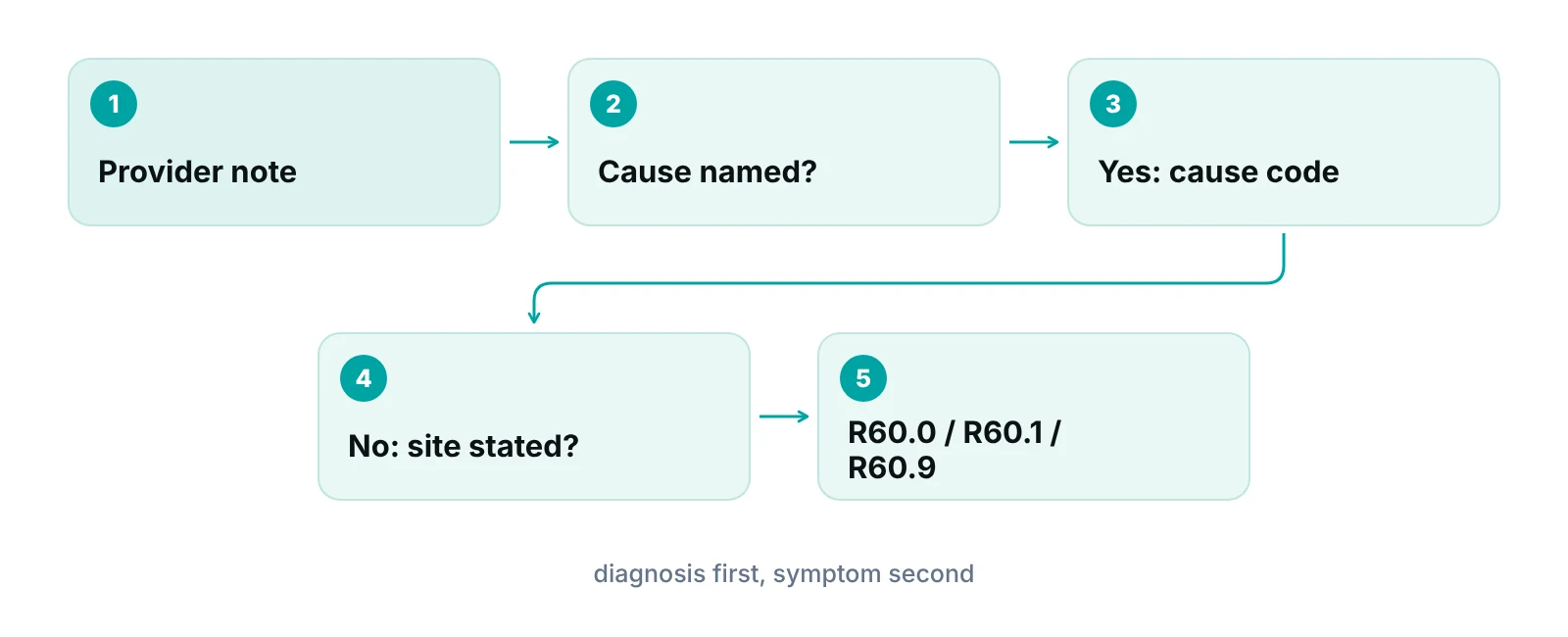
Choose by what the provider wrote about location. R60.0 fits edema confined to one area or limb, R60.1 fits edema described as generalized, and R60.9 is the fallback when the note says edema but not where. One lookup page for leg edema puts it plainly: there is no code that designates leg edema, so R60.0 is the closest fit, and R60.9 is for edema whose location is not known, per the Carepatron leg edema page (a secondary source).
R60 has no right or left character. A note that says “edema of both ankles” and a note that says “edema of the right ankle” both lead to R60.0. If a payer policy needs laterality, it has to come from the note and the claim narrative, not from the code. That is also why a vague note such as “LE edema” costs you time: your coder cannot tell whether to query for the cause, the side or both.
Why "unspecified" is not a safe default
The guidelines allow unspecified codes when they best reflect what is known at the encounter, according to the Section I.B.18 text in the CMS-hosted ICD-10-CM guidelines (FY 2026 edition). They do not allow you to skip detail that is already in the note. If the visit note says “bilateral lower leg edema,” R60.9 understates what the record shows, and a payer that audits specificity can treat it as under-coding. Use R60.9 when the site really is missing, and then send the note back for an addendum if your policy allows.
Edema or swelling?
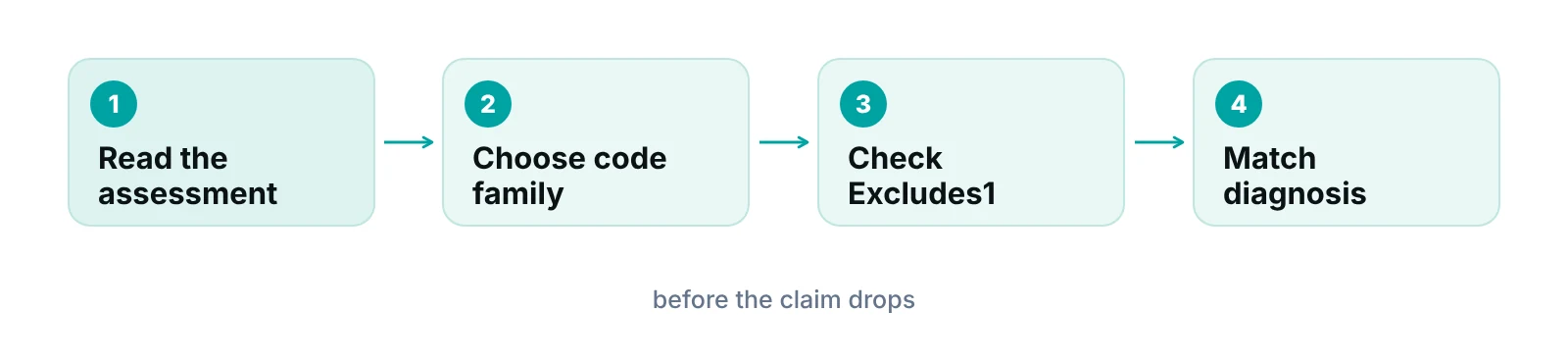
Category R22.4- is for localized swelling, mass or lump of the lower limb, and the category carries an Excludes1 note for edema (R60.-), according to the FY 2027 listing of R22.4. Excludes1 means the two are not reported together unless the conditions are unrelated. In practice, read the provider’s word. “Edema” points to R60.-, “swelling of the right leg” points to R22.41, and a note that uses both for the same finding needs a clarification before you code, not a guess.
Look at how Section I.A.12 of the FY 2027 Official Guidelines frames it: Excludes1 is a “NOT CODED HERE” note with one exception, when the two conditions are truly unrelated, and the guidelines tell you to query the provider if it is unclear. Excludes2 only means the conditions are not part of each other and can be reported together.
What changes when the provider documents a cause?
A documented cause moves you out of the symptom chapter. The Official Guidelines say symptom codes are acceptable when the provider has not established a related definitive diagnosis (Section I.B.4), and that signs and symptoms that routinely accompany a disease are not coded separately (Section I.B.5), per the FY 2027 guidelines. So once the note says venous insufficiency, lymphedema or fluid overload, the edema is part of that picture and the cause code leads.
| Provider documents | Code family | Rule to check | Common slip |
|---|---|---|---|
| Leg edema, cause not stated | R60.0 (or R60.9 if no site) | Symptom code allowed because no definitive diagnosis exists | Using R60.9 when the leg is named |
| Edema with chronic venous insufficiency | I87.2 | Excludes1 at I87.2 for stasis dermatitis with varicose veins (I83.1-, I83.2-) | Adding R60.0 for the same edema |
| Asymptomatic chronic venous hypertension, right, left or both legs | I87.301, I87.302, I87.303 or I87.309 | Excludes1 for venous hypertension due to deep vein thrombosis (I87.0-) and varicose veins (I83.-) | Picking the header I87.30 |
| Lymphedema, acquired or not otherwise specified | I89.0 | Excludes1 for hereditary lymphedema (Q82.0) and postmastectomy lymphedema (I97.2) | Using I89.0 for a hereditary or post-surgical form |
| Fluid overload or retention as the diagnosis | E87.70 (confirm billable) | Excludes1 at E87.7 for edema NOS (R60.9) and fluid retention (R60.9) | Reporting E87.70 and R60.9 together |
| Generalized edema, whole-body | R60.1 | Excludes1 at R60 for pulmonary edema (J81.-), ascites (R18.-), gestational edema (O12.0-) and others | Using R60.1 for fluid in the chest or abdomen |
Source: NCHS/CDC ICD-10-CM FY 2027 Official Guidelines (Sections I.A.12, I.B.4, I.B.5); code notes cross-checked on icd-10codes.com, 2minutemedicine.com and aapc.com (FY 2027).
The notes in Table 2 come from the lookup pages for each code: I87.2, I87.30-, I89.0 and E87.70. One more note on I87.2: its page also tells coders to report an associated hypertensive condition and, if there is an ulcer, an L97.- code for site and severity. That makes I87.2 a code that often travels with others, so check the full note, not only the code.
Do not trust a billable flag on its own
Lookup sites mark a code billable when it has no child codes. They do not tell you whether it is the right code for the note, whether a payer covers the service for that diagnosis, or whether the code can be a principal diagnosis. One of the sources we used says so directly. For E87.70 we could not confirm the FY 2027 status from a source that shows the notes, so leave it out of templates until your encoder confirms it.
Heart failure, kidney disease and medication effects can also explain leg edema. We left those codes out of Table 2 because they were not verified for this article, and because each has its own sequencing rules in the Official Guidelines. When the note links edema to one of them, code from that diagnosis and let your encoder show the required notes. Our posts on hypertension ICD-10 codes and chest pain ICD-10 codes cover how neighbouring circulatory and symptom codes behave.
What must the provider document to support the code?
The note has to answer four questions: where, which side, what cause and how it was assessed. Without them, your coder is left choosing between R60.0 and R60.9 on guesswork, and an auditor will do the same. Ask providers to add these items to the assessment, not only the exam.
- Site and side. “Bilateral lower leg edema” or “right ankle edema” beats “LE edema.”
- The word the provider means. Edema (pitting or non-pitting) is not the same finding as swelling, a mass or a lump.
- Cause, if known. Venous insufficiency, lymphedema, fluid overload or another diagnosis, stated as the provider’s assessment rather than as a symptom list.
- Evaluation or plan. What the provider did about it on that date: examined, ordered a test, advised compression, referred.
- Relationship to other conditions. If edema is part of a condition already on the problem list, say so; if it is a separate finding, say that too.
The CMS-hosted guideline text and the AAPC-hosted copy of the FY 2027 guidelines both stress that codes come from the provider’s documentation. A coder cannot assume a cause because it is common. When two readings of the note are possible, a short written query is faster than a denial and an appeal.
“Edema is one of the easiest findings to code wrong because the note often looks complete. The gap is usually one missing sentence: where, which side, or why.”
— Awais Afzal, Healthcare Operations & Data Analyst
What denial and edit reasons come up with edema codes?
Most edema problems are edit problems, not clinical ones. A claim fails because two codes cannot appear together, because a symptom code sits beside the diagnosis that explains it, or because the diagnosis on the line does not match the service. Use payer-neutral checks first, and then compare against each payer’s published edits.
| What the claim shows | Why it can stop or deny | What to do |
|---|---|---|
| R60.9 on a visit where the note names the leg | Specificity edit; a more specific code exists | Code R60.0 or query for an addendum |
| R60.0 with R22.41, R22.42 or R22.43 on the same line | R22.4 carries an Excludes1 note for edema (R60.-) | Pick the term the provider used; query if both appear |
| R60.9 with E87.70 | E87.7 carries an Excludes1 note for edema NOS and fluid retention | Report only the documented diagnosis |
| R60.0 with I87.2 for the same finding | Symptom code duplicates the diagnosis that explains it | Drop R60.0 unless the note shows a separate, unexplained edema |
| I89.0 on a hereditary or postmastectomy note | I89.0 carries Excludes1 notes for Q82.0 and I97.2 | Use the code the Excludes1 note points to |
| Edema code on a service that needs a different diagnosis | Diagnosis does not support the service on the line | Review the diagnosis pointer and the payer’s policy before appeal |
Source: NCHS/CDC ICD-10-CM FY 2027 Official Guidelines (Sections I.A.12, I.B.5); Excludes notes read on icd-10codes.com and 2minutemedicine.com (FY 2027). Payer edits vary.
These checks work best before the claim leaves your office. A claim scrubber or a pre-bill review step can hold a claim with an Excludes1 pair or an unspecified code when a more specific one is documented. Our guides on claim scrubbing and denial management show where that step fits in a larger workflow.
Are symptom-code denials repeating on your claims?
Send a sample of denied or returned claims with edema, swelling or fluid-overload diagnoses. A free practice audit shows whether the cause is the code choice, the note or the payer edit.
How do edema codes relate to other symptom and circulatory codes?
Edema rarely appears alone on a visit. It sits beside blood pressure readings, falls, weakness and chest complaints, and each of those has its own symptom-versus-diagnosis rule. The logic is the same every time: code the confirmed diagnosis when the provider states one, and use the symptom code only while the cause is open. Our posts on hypotension ICD-10 codes and weakness ICD-10 codes apply that rule to other findings, so a coder can use one habit across them.
Leg findings can also follow an injury. If swelling appears after a fracture or a fall, the injury code and its seventh character drive the claim, and the swelling is usually part of the injury picture. See our hip fracture ICD-10 guide for how the lower-limb injury codes are built. Do not add R60.0 just to show that the leg was swollen if the injury code already explains it.
Why the diagnosis pointer matters
Even a correct code can fail if it is attached to the wrong service line. Each line on the claim points to the diagnoses that support it, and a payer’s edit compares the two. If a visit addresses edema and hypertension, the pointer should lead with the diagnosis that best justifies the service. A mismatch is a common reason a claim stalls even when the codes are valid. If these denials are recurring, our denial management services page explains how we review the pattern, and the denial workflow in our denial management guide shows where to start in-house.
A last practical point: edema is often recorded in a template or a problem list that carries forward. A code that was right at one visit can be wrong at the next if the swelling resolved or a cause was found. Ask coders to code from the current note, not from the problem list, and to confirm the cause is still current before they repeat a diagnosis.
What does a worked example look like?
Example (made-up, de-identified; not a real patient or claim). An established adult is seen for a follow-up visit. The provider writes: “Bilateral lower leg pitting edema, 2+, chronic venous insufficiency. Compression stockings reviewed.” Here the provider named a cause in the assessment, so the diagnosis to report is I87.2. R60.0 would repeat the same finding, so we would not add it.
Now change the note: “Bilateral lower leg edema, cause under evaluation. Labs ordered.” No cause is documented, so the symptom code is acceptable. The site is the legs, so R60.0 is the better fit than R60.9. If the same provider wrote “swelling of the right leg” with no mention of edema, R22.41 would be the path, and a claim with both words for one finding would need a query first.
Last, suppose the note says only “edema.” You are left with R60.9. This is the case to send back for a clarification, because the visit almost certainly had a site. Keep the query, the reply and the date in the chart so an auditor can see how the code was reached.
Our recommendations
- Build a one-page edema cheat sheet. Put Table 1 and Table 2 in front of coders and front-desk leads, with the rule ’cause first, symptom second.’ Update it each October.
- Ask providers for one sentence. Request a line in the assessment that states site, side and cause. One added sentence in the assessment often does more for an edema claim than a longer code list.
- Turn Excludes1 pairs into scrubber rules. Add the pairs in Table 3 to your pre-bill edits so a claim with R60.0 and R22.4- or R60.9 and E87.70 stops for review.
- Track R60.9 use by provider. A short monthly report on how often R60.9 is used where the leg is named shows who needs a template change.
- Write a query script. Keep a short template: ‘The note says edema and swelling. Please clarify which finding you are treating, and the cause if known.’
- Re-check every 1 October. The ICD-10-CM code set changes each fiscal year. Re-verify the codes and notes in your templates before the new year starts.
Bottom line
Leg edema is coded from the provider’s words: a named cause leads, R60.0 fits a localized finding with no cause, R60.1 is for generalized edema and R60.9 is a last resort. Watch the Excludes1 pairs and keep the note specific. If edema claims keep returning, a review of your revenue cycle management workflow or our medical billing services can show where they break, and you can ask for a free practice audit.
Frequently asked questions
What is the ICD-10 code for leg edema?
There is no leg-specific code. R60.0 (localized edema) is the usual choice when edema is in the legs and no cause is documented. R60.1 is for generalized edema and R60.9 for edema with no stated site. R60 alone is only a category and cannot be billed. If a cause is documented, such as I87.2 or I89.0, report that diagnosis.
Can I report R60.0 and I87.2 together?
Usually not for the same finding. The Official Guidelines say signs that routinely accompany a disease are not coded separately. If the note shows a separate, unexplained edema, document that clearly or send a query.
Is there a right or left leg edema code?
No. R60.0, R60.1 and R60.9 have no laterality character, so side must be documented in the note. Swelling codes in R22.4- do carry right, left and bilateral options, but they apply to swelling, mass or lump, not edema.
When is R60.9 acceptable?
When edema is documented and the site is truly not stated. The guidelines allow unspecified codes when they reflect what is known. If the leg is named, R60.0 is more accurate. Track how often R60.9 appears by provider, because a high rate usually points to a note template that does not prompt for site.
What should I do when the note says both edema and swelling?
Query the provider before coding. Edema points to R60.- and swelling points to R22.4-, and an Excludes1 note stops the two from being reported together. A short query that asks which finding was treated is faster than a denial.
Does edema from heart failure or a medication get its own code here?
Those cases follow their own rules and were not verified for this article. Code the documented diagnosis, read its notes in the Tabular List, and ask the provider to link the cause in the note.
Get your free practice audit
Tell us about your practice. We will contact you using the details you give.
- A review of your recent claims, denials and A/R aging
- Where your front desk and prior authorizations slow payment
- A prioritized fix list you keep, whether or not you hire us
Pricing is quoted after the audit, based on your volume and the services you choose. Prefer to talk? Call +1 (302) 556-2288.
Sources
- ICD-10-CM FY 2027 file directory — NCHS/CDC (2026)
- Comprehensive listing of ICD-10-CM files — NCHS/CDC (2026)
- ICD-10-CM Official Guidelines for Coding and Reporting, FY 2027 — NCHS/CDC (2026)
- ICD-10-CM Official Guidelines, FY 2026 (CMS-hosted) — CMS (2025)
- ICD-10-CM Official Guidelines, FY 2027 (AAPC-hosted copy) — AAPC (2026)
- R60 Edema, not elsewhere classified — icd-10codes.com (2026)
- R60.0 Localized edema — icd-10codes.com (2026)
- R22.4 Localized swelling, mass and lump, lower limb — icd-10codes.com (2026)
- I87.2 Venous insufficiency (chronic) (peripheral) — icd-10codes.com (2026)
- I87.30 Chronic venous hypertension (idiopathic) without complications — 2minutemedicine.com (2026)
- I89.0 Lymphedema, not elsewhere classified — 2minutemedicine.com (2026)
- E87.70 Fluid overload, unspecified — AAPC Codify (2026)
- Leg Edema ICD-10-CM Codes — Carepatron (2023)
Disclaimer: This article is educational and is not legal, coding, billing, medical or compliance advice. ICD-10-CM and CPT code meanings, guidelines, Medicare contractor policies and payer rules change (the ICD-10-CM code set updates every 1 October) and vary by payer, contractor and state. Verify current requirements with the official ICD-10-CM Tabular List and Official Guidelines, your payers and your counsel before you act.
