
POS 21 is the place of service code for an inpatient hospital, defined as a non-psychiatric hospital where the patient is admitted. Professional claims use it for services performed on an admitted patient, and Medicare pays at the facility rate for it.
Place of service codes tell the payer where a service happened. Pick the wrong one and the payment can change by hundreds of dollars or the claim can deny outright. POS 21 is one of the most used codes in hospital-based practices, and it is also one of the easiest to confuse with POS 22 and POS 23.
This guide explains what POS 21 means, how it differs from the neighbouring codes, and how observation stays are reported. Payer rules differ, so confirm details with each payer before you change a workflow.
Key takeaways
- POS 21 is an inpatient hospital stay. POS 22 is an on-campus outpatient hospital department, and observation is usually reported there.
- Medicare pays professional services at the facility rate for POS 21, 22, 19 and 23, and at the non-facility rate for POS 11.
- If a patient moves from observation to inpatient on a later day, the observation visit keeps POS 22 and later inpatient days use POS 21.
- The professional claim uses the place of service. The hospital bills its own claim on a facility form.
What is POS 21?
POS 21 stands for Inpatient Hospital. The CMS place of service code set describes it as a non-psychiatric hospital that provides inpatient care, which means the patient has been admitted. Inpatient psychiatric stays use a different code, POS 51.
The code goes on the professional claim (CMS-1500 or 837P) for the physician or other practitioner. It does not replace the hospital’s own claim for the facility charges.
| POS | Name | Typical use |
|---|---|---|
| 21 | Inpatient Hospital | Services to an admitted inpatient |
| 22 | On Campus-Outpatient Hospital | Hospital outpatient department, often observation |
| 19 | Off Campus-Outpatient Hospital | Hospital outpatient department away from the main campus |
| 23 | Emergency Room – Hospital | ED services |
| 51 | Inpatient Psychiatric Facility | Admitted psychiatric stays |
Source: CMS place of service code set. Check the current file for new or retired codes.
How does POS 21 differ from POS 22, 23 and 11?
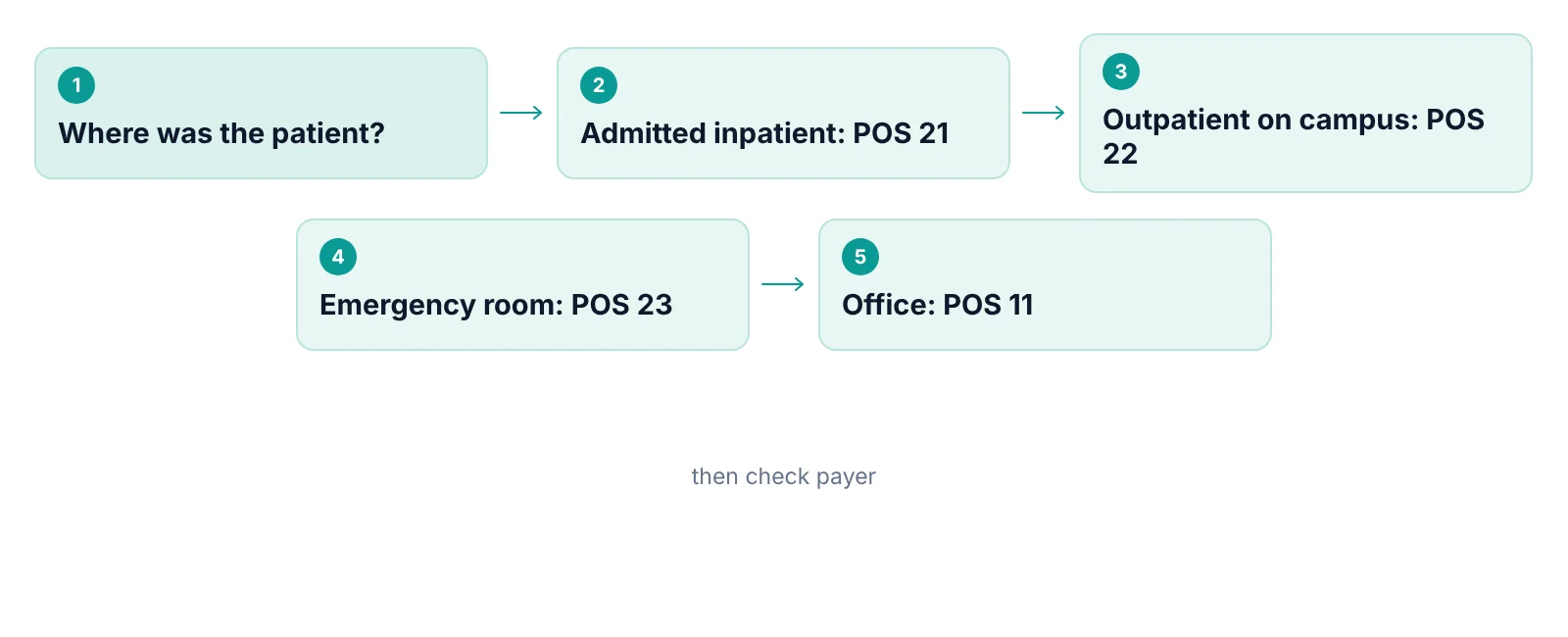
Think of it as three questions: Was the patient admitted? Was it the emergency department? Was it an office? Each answer points to a different code and a different payment rate.
| POS | Rate type | What changes |
|---|---|---|
| 21 Inpatient Hospital | Facility | Practice expenses are paid at the lower facility rate |
| 22 / 19 Outpatient Hospital | Facility | Same facility rate as POS 21 |
| 23 Emergency Room | Facility | Facility rate |
| 11 Office | Non-facility | Practice expense is paid at the higher non-facility rate |
Medicare contractor guidance lists POS 21, 22, 19 and 23 as facility settings and POS 11 as non-facility. See also the telehealth codes in our guide below.
If you are unsure how the broader code set works, start with our place of service codes guide and then POS 11 for the office setting.
How is observation reported?
Observation is an outpatient service, so the professional claim is typically POS 22. A patient is not an inpatient until the admission order is written. The two-midnight rule and status decisions are covered in our guide to inpatient vs observation.
- Same-day conversion: if the patient is admitted on the same date as observation began, one initial hospital visit code is reported with POS 21.
- Later conversion: the initial observation-day visit uses POS 22. Subsequent inpatient days use subsequent hospital visit codes with POS 21.
- Discharged from observation: everything stays POS 22.
These examples follow a Medicare contractor fact sheet on observation. Your payer may differ, and some commercial payers apply their own admission definitions.
How does POS 21 appear on the claim?
On the CMS-1500 the place of service code is in item 24B. The date range should fall within the admission. If a physician sees a patient in the hospital before the admission order, that earlier service may belong to POS 22 or POS 23.
Want a second pair of eyes on your claims?
Send us your recent denials and we will show where the same issue repeats. The audit is free and the fix list is yours to keep.
For the difference between the hospital and professional forms, see hospital vs professional billing and institutional vs professional claims.
What mistakes happen with POS 21?
| Error | Result | Fix |
|---|---|---|
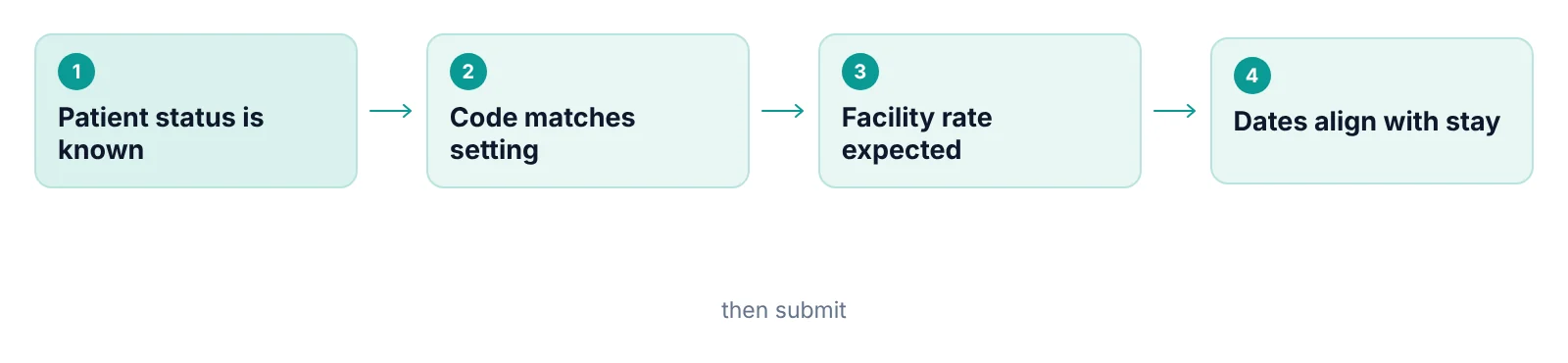
| Using POS 21 for an observation patient | Place of service does not match status; claim may deny or pay incorrectly | Use POS 22 until the admission order is written |
| Using POS 11 for hospital rounds | Overpayment risk because office rate is higher | Use the hospital code that matches status |
| Wrong date range | Services fall outside the stay | Match line dates to the admission and discharge |
| Telehealth visit to an inpatient | Wrong place of service for the patient’s location | Follow payer telehealth rules for POS, see the telehealth guide |
Always check payer policy; Medicare telehealth rules have changed several times.
Telehealth place of service rules are separate. See the telehealth POS 10 guide if a virtual visit is involved.
Where POS 21 sits in your billing workflow
Place of service is only one field on a claim. A clean claim also needs the right diagnoses, modifiers and demographic data, as laid out in our clean claims guide. For a practice that sees patients in several settings, our medical billing services page explains how we support multi-site coding.
Our recommendations
- Capture patient status at the point of charge. A single field for inpatient, observation, ED or office stops most POS errors.
- Pull the admit date from the hospital feed. Do not guess the date the status changed.
- Document the admission order time. It is the cleanest tie-breaker for observation versus inpatient.
- Test claims with a scrubber. A rule that compares POS and visit code catches mismatches. See claim scrubbing.
- Keep payer-specific POS rules in one sheet. Commercial payers may differ from Medicare.
- Review POS denials monthly. Look for patterns by provider and by facility.
Bottom line
POS 21 means an admitted inpatient. Keep observation in POS 22, match the code to where the patient actually was, and expect the facility rate. A small status check at charge entry prevents most of the errors in this guide.
Frequently asked questions
What does POS 21 mean?
POS 21 is the place of service code for an inpatient hospital. It tells the payer that the professional service was performed on a patient admitted to a hospital. The CMS code set describes it as a non-psychiatric hospital. A separate code, POS 51, covers inpatient psychiatric facilities.
Is observation POS 21 or POS 22?
Observation is generally an outpatient service, so professional claims usually use POS 22. If the patient is admitted on the same date, the initial hospital visit is reported with POS 21. If admission happens on a later date, the earlier observation visit keeps POS 22. Always check the payer’s policy.
Does POS 21 change payment?
Yes. Medicare pays physician services at the facility rate for POS 21, 22, 19 and 23, and at the higher non-facility rate for POS 11. Using the wrong code can create an overpayment or an underpayment. Many commercial payers follow the same approach, but contracts differ.
Which claim form uses POS 21?
Professional claims, the CMS-1500 or 837P, carry the place of service code. The hospital bills its own institutional claim for facility charges. The two claims describe different services, so the professional place of service does not have to match the hospital claim’s bill type, but the stay dates should agree.
What if the patient was in the ER before admission?
The ER visit belongs to POS 23, and professional services after the admission order belong to POS 21. Services between the two events depend on whether the patient has been admitted at that time. Use the admission order time as the dividing line, and check payer rules on same-day ED and admission services.
Can telehealth be billed with POS 21?
Telehealth place of service rules are separate and change over time. A physician seeing an inpatient by video must follow current payer rules for the correct place of service and modifier. Do not assume POS 21 is right. Check the current Medicare telehealth rules or your payer manual before billing.
Get your free practice audit
Tell us about your practice. We will contact you using the details you give.
- A review of your recent claims, denials and A/R aging
- Where your front desk and prior authorizations slow payment
- A prioritized fix list you keep, whether or not you hire us
Pricing is quoted after the audit, based on your volume and the services you choose. Prefer to talk? Call +1 (302) 556-2288.
Sources
- Place of Service Code Set — Centers for Medicare & Medicaid Services (2026)
- Medicare Claims Processing Manual, Chapter 26 (Completing and Processing the Form CMS-1500) — Centers for Medicare & Medicaid Services (2026)
- Medicare Physician Fee Schedule: facility and non-facility rates — Noridian Healthcare Solutions (2026)
- Observation services fact sheet — First Coast Service Options (2025)
- Medicare Benefit Policy Manual, Chapter 6 (Hospital Services Covered Under Part B) — Centers for Medicare & Medicaid Services (2026)
- Two-Midnight Rule overview — Centers for Medicare & Medicaid Services (2026)
Disclaimer: This article is educational and is not legal, coding, billing, medical or compliance advice. CPT codes and modifier descriptions are owned by the AMA, and code meanings, Medicare contractor policies and payer rules change and vary by payer, contractor and state. Verify current requirements with the official CPT manual, your payers and your counsel before you act.
