
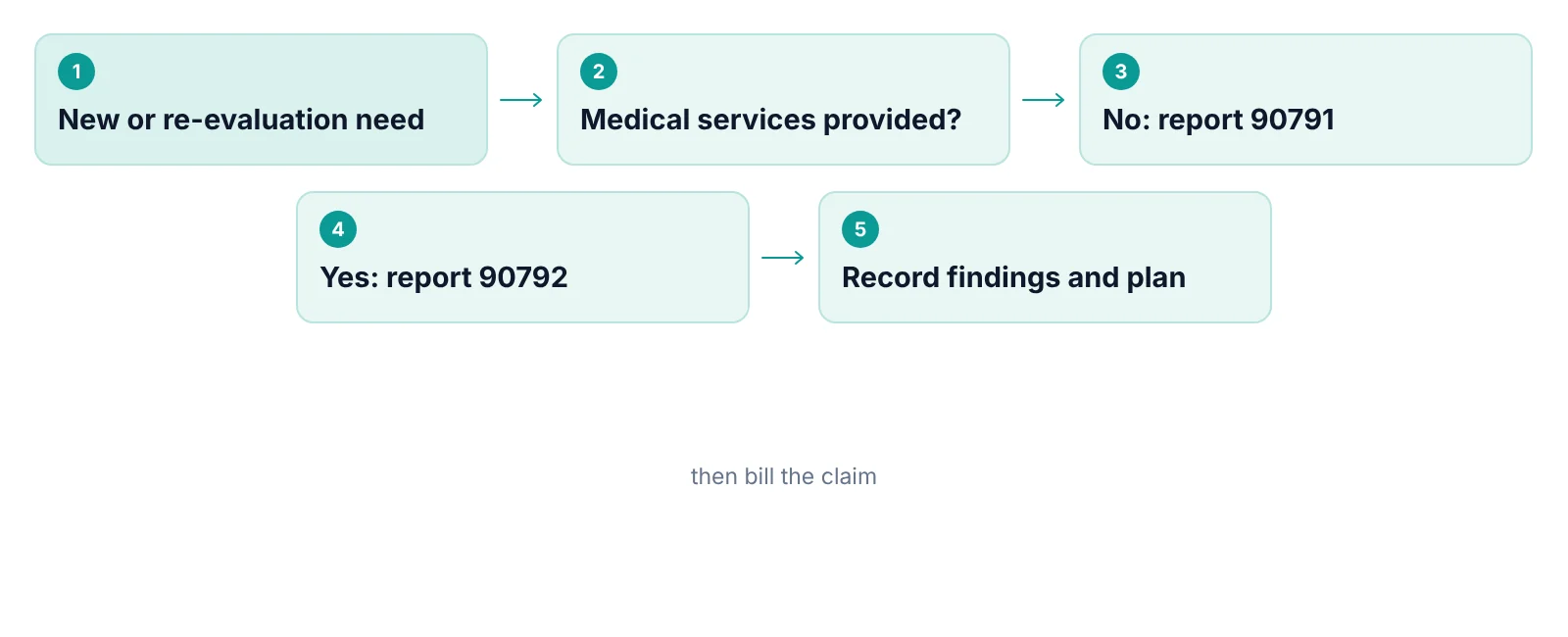
CPT 90791 is a psychiatric diagnostic evaluation that does not include medical services. It covers history, mental status and recommendations, and is used for the intake evaluation. When the clinician also provides medical services, such as a physical exam or prescribing assessment, the code is 90792 instead.
Every behavioral health patient starts with an evaluation, so 90791 is billed often and reviewed often. The questions that come up are the same. Which code applies, who can bill it, how many times, and what the note must contain.
This guide explains what 90791 covers, how it differs from 90792, and what makes a clean claim. Payer rules on frequency and provider type vary, so check each plan.
Key takeaways
- 90791 is a diagnostic evaluation without medical services. 90792 includes medical services.
- Both are used for intake and may be repeated when the patient needs a new evaluation, subject to payer rules.
- Psychologists, clinical social workers and other qualified clinicians typically bill 90791. Prescribers may bill either code.
- The note must include history, mental status and a diagnosis, not just a visit summary.
What is CPT 90791?
90791 is psychiatric diagnostic evaluation. It includes an integrated biopsychosocial assessment, such as history, mental status exam and recommendations, and it may include communication with family or other sources. It is not time-based in the CPT descriptor, so there is no minute threshold to meet.
| Feature | 90791 | 90792 |
|---|---|---|
| Medical services | No | Yes, such as physical exam or medical assessment |
| Typical billers | Psychologists, clinical social workers, counselors, prescribers | Physicians, psychiatric nurse practitioners and others who provide medical services |
| Use | Intake or re-evaluation | Intake or re-evaluation with medical component |
Differences described from the CPT code set. Confirm provider type rules with each payer.
Who can bill 90791?
Provider eligibility depends on licensure and the payer. Many clinicians who are licensed to diagnose and treat mental illness can bill 90791, including psychologists and licensed clinical social workers. Credentialing matters as much as licensure. A clinician who is not enrolled with a payer cannot bill that payer, whatever the license. See our guide to credentialing services for how enrollment works.
- Check scope of practice: state law sets what each license may do.
- Check payer enrollment: the clinician must be enrolled with the plan.
- Check supervision rules: trainees and associates may need supervisor billing.
For related psychotherapy codes, see our guides to 90834 and 90837.
How often can you report 90791?
It is usually reported once at intake. A re-evaluation may be reported when a patient returns after a long gap or when there is a significant change that needs a new evaluation. Payers set their own limits, and some restrict it to once a year or once per episode.
| Situation | Usually reportable? | Check |
|---|---|---|
| New patient intake | Yes | Payer visit limits |
| Patient returns after a long gap | Often | Payer definition of a new episode |
| Significant change needing new evaluation | Sometimes | Medical necessity in the note |
| Routine follow-up | No | Use a therapy code |
Rules vary by payer. Read the policy before you bill a repeat.
Want a second pair of eyes on your claims?
Send us your recent denials and we will show where the same issue repeats. The audit is free and the fix list is yours to keep.
What documentation supports 90791?
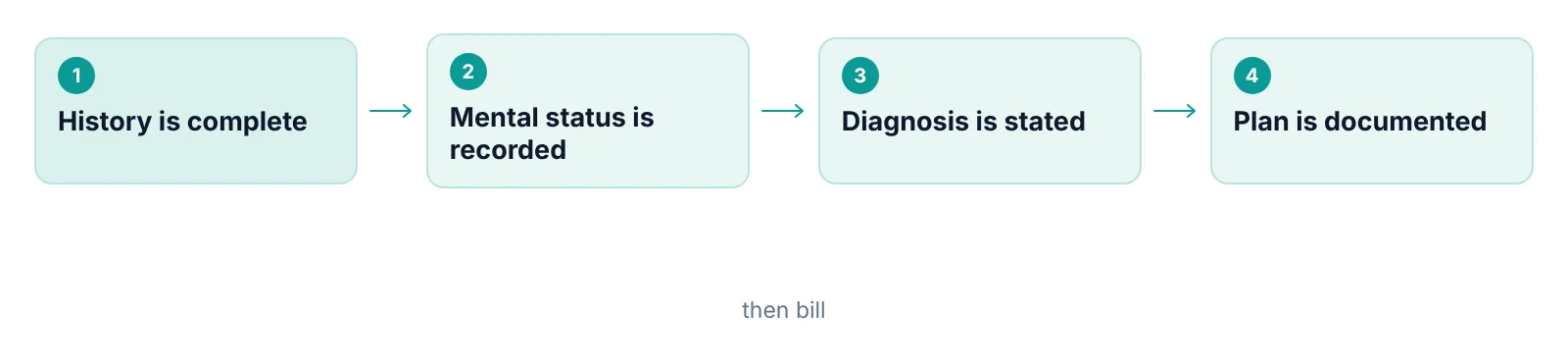
The note should show the reason for referral, history, mental status exam, risk assessment as relevant, a diagnosis and a treatment recommendation. If other sources were contacted, record who and why. A short intake form with no clinical findings is not enough.
| Element | What to record | Why |
|---|---|---|
| Presenting problem | Reason for the visit in the patient’s terms | Establishes need |
| History | Psychiatric, medical, social and family history as relevant | Supports the assessment |
| Mental status | Appearance, mood, thought process and risk | Shows the evaluation took place |
| Diagnosis and plan | Diagnosis and recommended treatment | Links the evaluation to care |
See behavioral health coding cheat sheet and CPT 96127 documentation for related coding.
What are the common 90791 billing mistakes?
| Mistake | Why it fails | Fix |
|---|---|---|
| Billing 90791 when medical services were given | Should be 90792 | Check what the clinician actually did |
| Repeating 90791 at every visit | Not an ongoing therapy code | Use a psychotherapy code for follow-up |
| Clinician not enrolled with the payer | Claim is denied | Confirm enrollment before scheduling |
| Thin note | Does not show an evaluation | Record history, mental status and diagnosis |
See behavioral health billing for the wider process.
Patterns in denials are easiest to find with a coding audit.
Related behavioral health guides
After the evaluation, treatment is usually billed with psychotherapy codes. See 90834, 90837 and mental health CPT codes. For the claims process, read coding and billing for mental health services.
Our recommendations
- Add a code choice prompt. Ask whether medical services were provided before choosing 90791 or 90792.
- Confirm enrollment first. Do not schedule intakes for unenrolled clinicians.
- Read frequency limits. Build the limits into scheduling.
- Use an intake template. Include history, mental status, diagnosis and plan.
- Train on follow-up codes. Switch to psychotherapy codes after the intake.
- Audit a sample. Check that notes show an evaluation.
Bottom line
90791 is the intake evaluation without medical services. Pick the right code, confirm enrollment and frequency limits, and write a note that shows the evaluation. For help with behavioral health claims, see our medical billing services.
Frequently asked questions
What is the difference between 90791 and 90792?
90791 is a psychiatric diagnostic evaluation without medical services. 90792 is the same evaluation with medical services, such as a physical exam or medical assessment, and is typically billed by clinicians who provide them. The deciding question is what the clinician actually did, not the clinician’s title alone.
Is 90791 a timed code?
The CPT descriptor does not set a time threshold for 90791. That differs from psychotherapy codes, which are chosen by time. Payers may still expect the note to show enough work to support an evaluation, so record the elements of the assessment, not only the length of the visit.
Who can bill CPT 90791?
Clinicians licensed to diagnose and treat mental illness can usually bill it, including psychologists and licensed clinical social workers, subject to state scope of practice and payer enrollment. Prescribers may bill 90791 or 90792 depending on whether they provide medical services. Always confirm the payer rules for the clinician.
How often can 90791 be billed?
It is usually billed once at intake, and again when the patient returns after a long gap or needs a new evaluation. Payers set limits, and some allow one per year or per episode. Check each payer’s policy before you schedule or bill a repeat evaluation.
Can 90791 be billed by telehealth?
Many payers allow diagnostic evaluations by telehealth with the right place of service and modifier, but rules change and differ by payer. Check the current telehealth policy for each plan, and see our telehealth modifier guides for how modifiers are used on virtual visits.
What diagnosis codes go with 90791?
The claim should carry the diagnosis the clinician documented, which may be a provisional diagnosis at intake. Use ICD-10-CM codes that match the note. Do not choose a code to fit coverage. If the diagnosis is not final, the clinician can document that and update it as care proceeds.
Get your free practice audit
Tell us about your practice. We will contact you using the details you give.
- A review of your recent claims, denials and A/R aging
- Where your front desk and prior authorizations slow payment
- A prioritized fix list you keep, whether or not you hire us
Pricing is quoted after the audit, based on your volume and the services you choose. Prefer to talk? Call +1 (302) 556-2288.
Sources
- Medicare Claims Processing Manual, Chapter 12 — Centers for Medicare & Medicaid Services (2026)
- Medicare Physician Fee Schedule — Centers for Medicare & Medicaid Services (2026)
- Medicare Benefit Policy Manual, Chapter 15 — Centers for Medicare & Medicaid Services (2026)
- Psychiatric diagnostic evaluation and psychotherapy coding — American Psychological Association Services (2025)
- Medicare Learning Network products — Centers for Medicare & Medicaid Services (2026)
- ICD-10-CM official guidelines for coding and reporting — CDC National Center for Health Statistics (2026)
Disclaimer: This article is educational and is not legal, coding, billing, medical or compliance advice. CPT codes and modifier descriptions are owned by the AMA, and code meanings, Medicare contractor policies and payer rules change and vary by payer, contractor and state. Verify current requirements with the official CPT manual, your payers and your counsel before you act.
