
The ICD-10-CM code for neck pain is M54.2, cervicalgia. Use it when the provider documents neck pain with no more specific cause. If the pain is due to a cervical disc disorder, report an M50 code instead, because M54.2 has an Excludes1 note for that cause. Current injuries use S codes with a 7th character.
A neck pain claim is easy to get slightly wrong: the code can say less than the note does, or something the note does not support. This guide covers which cervical codes to pick, how the Excludes1 and 7th-character rules work, and where the errors enter the revenue cycle. Code details below follow the CMS FY 2027 ICD-10 page and the FY 2027 ICD-10-CM Official Guidelines, which apply to encounters from October 1, 2026 through September 30, 2027.
Key takeaways
- M54.2 (cervicalgia) is for neck pain when the provider documents no more specific cause.
- M54.2 has an Excludes1 note for cervicalgia due to a cervical disc disorder, which is coded to M50.-.
- M50 codes need a region, and the mid-cervical region needs a level (C4-C5, C5-C6 or C6-C7).
- S13.4 and S16.1 injury codes are invalid without a 7th character (A, D or S).
- The FY 2027 code set applies to encounters from October 1, 2026 through September 30, 2027.
M54.2 is the code for neck pain with no documented cause
M54.2 is the ICD-10-CM code for cervicalgia, which means neck pain. It is a billable code in the FY 2027 tabular entry for M54.2. Use it when the provider records neck pain and has not linked it to a more specific cervical diagnosis.
The guidelines allow this. Under Section I.B.18 of the FY 2027 ICD-10-CM Official Guidelines, sign and symptom codes are acceptable when no definitive diagnosis has been established by the end of the encounter. A symptom code is a correct answer to an incomplete diagnosis. It is a wrong answer only when the note already names the cause.
Two limits on M54.2
First, M54.2 carries an Excludes1 note for cervicalgia due to an intervertebral cervical disc disorder, which is coded to M50.- (AAPC code reference). Second, the M50 to M54 block carries an Excludes1 note for current injury, which sends traumatic neck injuries to the injury chapter. Under Section I.A.12.a of the guidelines, an Excludes1 note means the two codes are not reported together unless the conditions are unrelated.
Section I.B.5 of the guidelines adds a related rule: signs and symptoms that routinely come with a disease process are not coded as extra diagnoses. In practice, once a provider documents a cervical diagnosis that explains the pain, the neck pain code usually drops off the claim. The category M50 even states that it includes cervicothoracic disc disorders with cervicalgia (tabular entry for M50), so the pain is already captured.
When a more specific code replaces M54.2
A more specific code replaces M54.2 when the provider documents the cause of the neck pain. Four documentation patterns cover most cases: a disc disorder, radiculopathy, spondylosis, or a current injury.
| What the provider documents | Code family | Example code | Watch for |
|---|---|---|---|
| Neck pain, no cause identified | M54.2 | M54.2 | Excludes1 with M50.- when a disc cause is documented |
| Cervical disc disorder (displacement, degeneration, other) | M50.2, M50.3, M50.8, M50.9 | M50.322 (disc degeneration at C5-C6) | Needs region or level in the 5th and 6th characters |
| Cervical disc disorder with radiculopathy or myelopathy | M50.1, M50.0 | M50.122 (C5-C6 level with radiculopathy) | M54.12 is excluded when the radiculopathy is with a cervical disc disorder |
| Radiculopathy not linked to a disc | M54.12 | M54.12 | M54.1 has Excludes1 notes for disc disorders (M50.1) and spondylosis (M47.2-) |
| Cervical spondylosis without myelopathy or radiculopathy | M47.812 | M47.812 | Spondylosis with radiculopathy is classified elsewhere in M47 |
| Cervical root disorder not classified elsewhere | G54.2 | G54.2 | G54 has Excludes1 notes for current traumatic nerve root disorders, disc disorders (M50-M51) and spondylosis (M47.-) |
| Current sprain or whiplash-type injury of the cervical spine | S13.4 | S13.4XXA (initial encounter) | Needs a 7th character: A, D or S |
Source: CMS and NCHS ICD-10-CM FY 2027 tabular content as published by AAPC, ICDlist and ICD10Codes.com (2026); CMS FY 2027 Official Guidelines.
If your practice delivers neck pain care, the diagnosis on the claim has to fit both the procedure and the note. The pain management billing specialty page shows how we approach diagnosis and procedure coding together.
Disc disorders and M50
Cervical disc disorders live in category M50. The category splits by effect: myelopathy (M50.0), radiculopathy (M50.1), other displacement (M50.2), other degeneration (M50.3), other disc disorders (M50.8) and unspecified (M50.9), per the FY 2027 list of M50 codes.
Radiculopathy and spondylosis
M54.12 means radiculopathy of the cervical region (AAPC code reference). Its parent M54.1 excludes radiculopathy with a cervical disc disorder (M50.1) and radiculopathy with spondylosis (M47.2-). M47.812 describes cervical spondylosis without myelopathy or radiculopathy (AAPC code reference). The right pick depends on how the provider ties the findings together, which is why the note matters more than the code lookup.
How M50 cervical disc codes are built
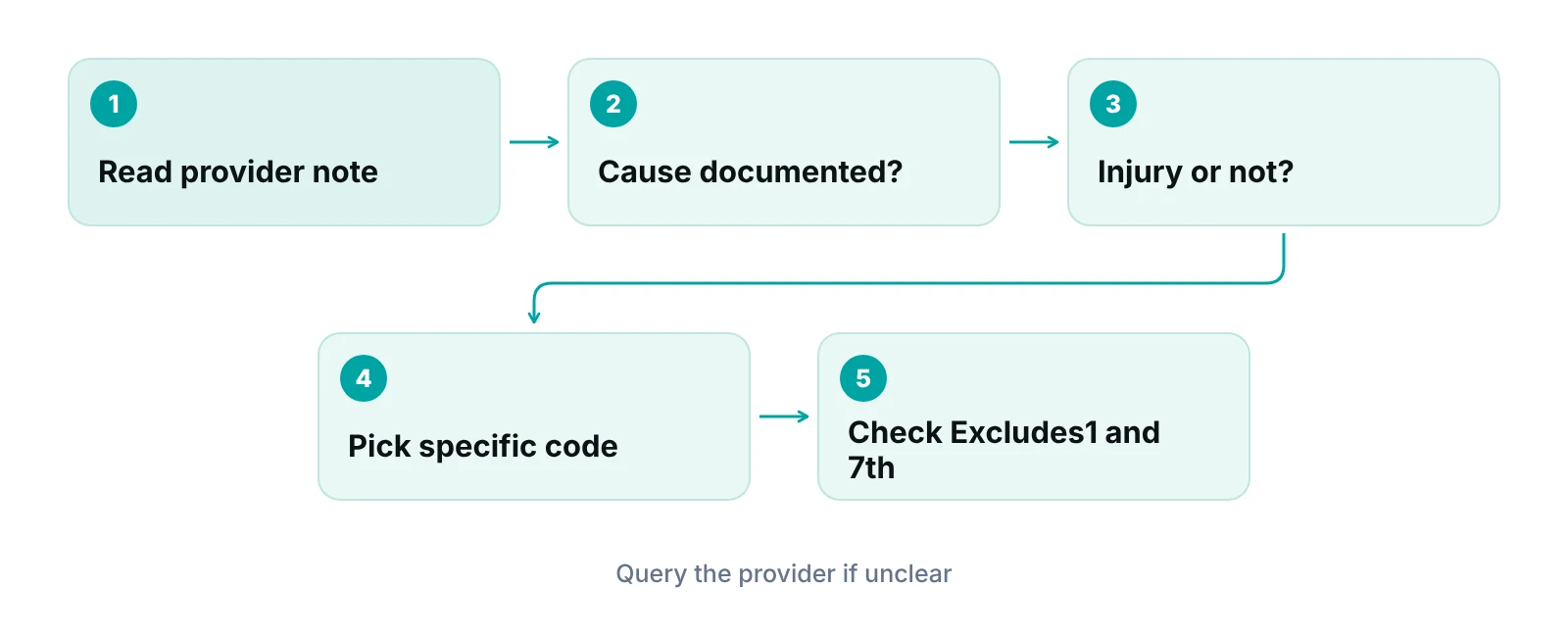
M50 codes need a region, and in the mid-cervical region a level. Section I.B.2 of the FY 2027 ICD-10-CM Official Guidelines says to report the highest number of characters and the highest specificity the record supports. For M50, that means the note needs to say where the disc problem is.
| Subcategory | Meaning | Region options | Example full code |
|---|---|---|---|
| M50.0- | Disc disorder with myelopathy | Unspecified, high cervical, mid-cervical (by level), cervicothoracic | M50.023 (C6-C7 level with myelopathy) |
| M50.1- | Disc disorder with radiculopathy | Same region options | M50.121 (C4-C5 level with radiculopathy) |
| M50.2- | Other cervical disc displacement | Same region options | M50.220 (mid-cervical, unspecified level) |
| M50.3- | Other cervical disc degeneration | Same region options | M50.322 (C5-C6 level) |
| M50.8- | Other cervical disc disorders | Same region options | M50.83 (cervicothoracic region) |
| M50.9- | Cervical disc disorder, unspecified | Same region options | M50.90 (unspecified cervical region) |
Source: CMS and NCHS ICD-10-CM FY 2027 tabular content as published by ICDlist (2026); mid-cervical level codes cover C4-C5, C5-C6 and C6-C7.
The levels in the mid-cervical group are C4-C5, C5-C6 and C6-C7. The cervicothoracic region is its own code. If the provider documents a cervical disc problem but not the region, an unspecified-region code such as M50.90 or M50.30 is the supported answer.
Do not hunt for specificity the record lacks. The guidelines call unspecified codes appropriate when they reflect what is known at the encounter, and they call choosing a more specific code without support inappropriate (Section I.B.18). If a code needs more detail, ask the provider. Do not guess.
The same logic applies to other body regions. Our guides to back pain ICD-10 codes and knee pain ICD-10 codes walk through the symptom-versus-diagnosis choice in those areas.
Excludes1 notes and 7th characters cause the most errors
Two rules from the FY 2027 ICD-10-CM Official Guidelines produce most neck pain code errors: Excludes1 conflicts and missing 7th characters. Both are easy to catch before a claim leaves the building.
Excludes1 versus Excludes2
An Excludes1 note means the codes should not be reported together, with one exception: the two conditions are unrelated (Section I.A.12.a). An Excludes2 note means the excluded condition is not part of the code, so both codes may be reported when both apply (Section I.A.12.b). If it is unclear whether two conditions are related, query the provider.
This is why M54.2 and M50.- do not belong together when the neck pain is due to the disc disorder. It is also why a second, unrelated condition may still be coded.
7th characters on injury codes
Cervical sprain codes in S13.4 are not complete without a 7th character. The valid values are A for initial encounter, D for subsequent encounter and S for sequela, giving S13.4XXA, S13.4XXD and S13.4XXS (FY 2027 tabular entry for S13.4). The X characters are placeholders. Under Sections I.A.4 and I.A.5, a code that needs a 7th character is invalid without it, and the 7th character always sits in the seventh position.
Muscle strains at the neck level are a separate category, S16.1, with the same 7th-character requirement (for example, S16.1XXA) (ICDlist S16 codes). S13 lists strain of muscle or tendon at neck level (S16.1) as an Excludes2 note, so a sprain and a strain can be reported together when both apply.
Code sets change every October
ICD-10-CM updates take effect each October 1, and CDC lists an additional April 1 update for FY 2026. The FY 2027 code set applies to encounters from October 1, 2026 through September 30, 2027, per CMS. Your billing system and encoder should carry the version that matches the date of service.
Where neck pain coding goes wrong in the revenue cycle
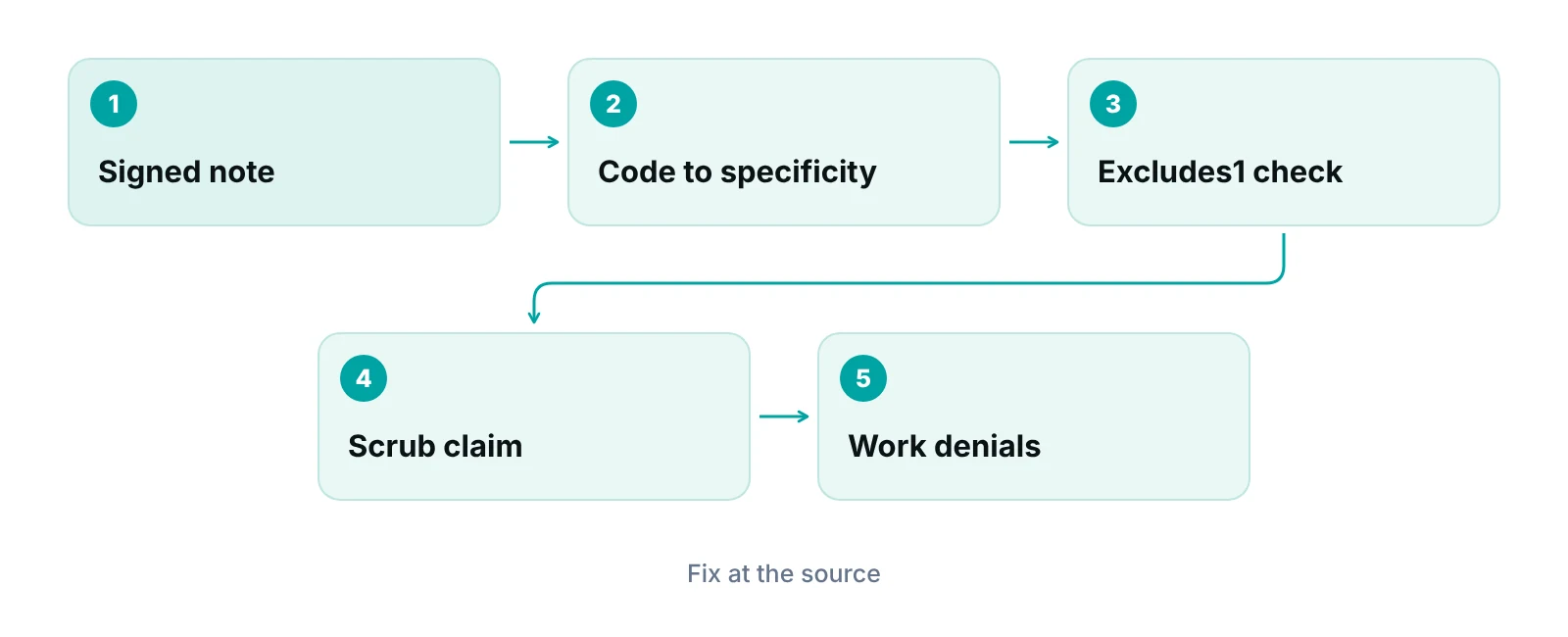
Diagnosis errors enter the revenue cycle at the note, the code pick and the claim edit. Each stage has a simple check that catches them before payers do.
| Stage | What goes wrong | Check to run |
|---|---|---|
| Provider note | Pain is documented but the cause is not tied to it, or the region and level are missing | Template prompts for cause, region and level; query the provider when unclear |
| Code selection | M54.2 and an M50 code both selected for the same pain | Review Excludes1 notes before finalizing the diagnosis list |
| Injury visits | S13.4 or S16.1 entered without a 7th character | Require a complete code before the charge can be saved |
| Claim scrub | Diagnosis does not support the procedure billed | Run diagnosis-to-procedure edits before submission |
| Denial follow-up | Denials worked as payment problems, not coding problems | Tag denials by cause and send coding fixes back to the provider and coder |
Source: ICD-10-CM Official Guidelines FY 2027 (Sections I.A.5, I.A.12, I.B.2, I.B.18) for the coding rules; the checks are RCM Finder’s workflow suggestions.
Two errors are common: a symptom code where a diagnosis exists, and two codes that exclude each other. A third, an injury code with no 7th character, is an invalid code under the guidelines. All three are cheaper to fix at the front than to appeal later.
Catching these early is the job of a clean-claims process. Our overview of CPT, ICD-10 and HCPCS codes shows how diagnosis codes pair with procedures. Our guides to claim scrubbing and clean claims cover the edits that sit between coding and submission, and medical coding audits show how to find recurring diagnosis patterns in what you already billed.
If your coders are stretched, medical billing and coding support can take the review step off your front desk and provider desks. We work inside your existing EHR, for example PrognoCIS, eClinicalWorks or athenahealth.
See where your diagnosis coding leaks revenue
Send us a sample of recent neck pain claims. We will review the diagnosis-to-claim flow and show you where the gaps are. The audit is free, and pricing is quoted afterward.
What the provider note should say for clean neck pain coding
The note should state what the provider concluded, not just what the patient reported. In our workflow the diagnosis comes from the provider’s documentation, and a coder does not upgrade neck pain to a disc disorder from a report alone.
- The diagnosis in the provider’s own words, and whether it is confirmed or still a symptom.
- The link between the pain and any cause, such as “neck pain due to cervical disc degeneration”.
- The region, and the level when the provider has identified one (for example C5-C6).
- Whether radiculopathy or myelopathy is present, if the provider diagnosed it.
- For injuries, whether this is the first visit for the problem, a follow-up during healing or a sequela.
- Any unrelated condition that is also being managed, so a coder can tell when an Excludes1 exception applies.
“A good diagnosis code is a faithful summary of the note. If the note is vague, the claim will be vague, and no coding tool fixes that.”
— Awais Afzal, Healthcare Operations & Data Analyst
These points are documentation habits, not clinical guidance. The provider decides the diagnosis. The billing team’s job is to make sure the note gives it a clear place to land.
Our recommendations
- Default to the symptom code only when the note stops at pain. We use M54.2 when the provider documents neck pain and nothing more specific. The moment a cause appears in the note, we re-code.
- Make Excludes1 a standing check. Run every cervical diagnosis list against M50.-, M54.1- and M47.- exclusion notes before the charge is finalized. It takes seconds and prevents mutually excluding pairs.
- Block incomplete injury codes at charge entry. Do not let S13.4 or S16.1 be saved without a 7th character. Fixing it at entry costs nothing.
- Ask the provider, never infer. If region, level or cause is missing, send a query. Our rule is simple: if it is not in the note, it is not on the claim.
- Update your code set every October. Check that your EHR and billing system load the new ICD-10-CM release on the effective date, and spot-check a few cervical codes after the update.
- Review denials for diagnosis patterns. Group denials by diagnosis and procedure pair. Repeating patterns point to a template or training fix, which is more useful than working each denial one at a time. Our guide to revenue cycle KPIs explains which numbers to track.
Bottom line
Neck pain coding is a small task with a long tail. M54.2 is right when the note stops at pain, M50 and its relatives are right when a disc disorder is documented, and S codes need their 7th characters. Get those three habits in place and most diagnosis-related rework disappears. If you want help building them into your workflow, our denial management services team can trace recurring diagnosis denials back to their source, and you can contact us or use the revenue calculator to see what rework costs your practice.
Frequently asked questions
What is the ICD-10 code for neck pain?
The ICD-10-CM code for neck pain is M54.2, cervicalgia. Use it when the provider documents neck pain without a more specific cause. If the pain is due to a cervical disc disorder, an M50 code is reported instead, and a current injury is coded from the injury chapter.
Can I report M54.2 and M50 together?
Not when the neck pain is due to the cervical disc disorder. M54.2 has an Excludes1 note for that cause, and under the official guidelines an Excludes1 pair is reported together only when the two conditions are unrelated. If you are unsure whether two conditions are related, query the provider and record the answer in the chart.
Is S13.4 a complete code for a neck sprain?
No. S13.4 needs a 7th character: A for initial encounter, D for subsequent encounter or S for sequela. The complete codes are S13.4XXA, S13.4XXD and S13.4XXS. The X characters are placeholders that fill the empty positions. Without the 7th character, the code is invalid.
Do cervical disc codes need a level?
They need a region, and the mid-cervical region adds a level: C4-C5, C5-C6 or C6-C7. When the note does not say, the unspecified-region or unspecified-level code is the supported answer. Do not choose a level the record does not support, and do not order extra tests only to find one.
How often do ICD-10-CM codes change?
The code set is updated each October 1, and CDC has also listed an April 1 update (for FY 2026). The FY 2027 version applies to encounters from October 1, 2026 through September 30, 2027, according to CMS. Check that your EHR and billing software load each new release on time, and spot-check a few cervical codes after each update.
Does RCM Finder code claims for pain management practices?
Our team supports coding review and billing for pain management and related practices, working inside your existing EHR. We start with a free practice audit of your claim flow, and pricing is quoted after that review. Providers remain responsible for the diagnosis documented in the note.
Get your free practice audit
Tell us about your practice. We will contact you using the details you give.
- A review of your recent claims, denials and A/R aging
- Where your front desk and prior authorizations slow payment
- A prioritized fix list you keep, whether or not you hire us
Pricing is quoted after the audit, based on your volume and the services you choose. Prefer to talk? Call +1 (302) 556-2288.
Sources
- ICD-10 Codes (FY 2027 files and effective dates) — CMS (2026)
- FY 2027 ICD-10-CM Official Guidelines for Coding and Reporting — CMS / NCHS (2026)
- ICD-10-CM files — CDC / NCHS (2026)
- ICD-10-CM FY 2027 file folder — CDC / NCHS (2026)
- M54.2 Cervicalgia (FY 2027) — ICDlist (2026)
- Cervical disc disorders M50 codes (FY 2027) — ICDlist (2026)
- M50 Cervical disc disorders (FY 2027) — ICD10Codes.com (2026)
- S13.4 Sprain of ligaments of cervical spine (FY 2027) — ICD10Codes.com (2026)
- S16 injury of muscle, fascia and tendon at neck level (FY 2027) — ICDlist (2026)
- Code reference M54.2 — AAPC (2026)
- Code reference M54.12 — AAPC (2026)
- Code reference M47.812 — AAPC (2026)
- Code reference G54.2 — AAPC (2026)
- ICD-10-CM Tabular List, Other dorsopathies (M50-M54) — Skyscape (ICD-10-CM tabular text) (2025)
Disclaimer: This article is general educational information for practice owners and managers. It is not legal, coding, compliance or medical advice. Code sets, guidelines and payer policies change; verify codes against the current ICD-10-CM release and your payers' rules before billing.
