
The ICD-10 codes for back pain start with M54 (dorsalgia). Use M54.9 when the note only says back pain, M54.50, M54.51 or M54.59 for low back pain, M54.30 to M54.32 for sciatica and M54.4- for lumbago with sciatica. Disc displacement and low back strain have their own codes and cannot be reported with low back pain.
Back pain is a routine diagnosis in primary care, pain management, orthopedics, neurology and rehabilitation. The codes look simple, but several have rules that are easy to miss. This guide explains the family, shows what to document, and replaces an older version of this article that contained errors.
Key takeaways
- Use M54.9 only when the note says back pain and nothing more specific.
- Low back pain is M54.50, M54.51 or M54.59, and it has no left or right version.
- Pick one family: low back pain, sciatica, or lumbago with sciatica, not two.
- Check Excludes1 notes for strain, disc disorders and psychogenic dorsalgia.
- Confirm your templates against the FY 2027 code set, effective October 1, 2026.
Which ICD-10 codes cover back pain?
Most back pain diagnoses sit in category M54, titled dorsalgia, in the musculoskeletal chapter. M54 itself is not reportable. You choose a subcategory that matches what the provider documented: the region of the spine, whether the pain travels down the leg, and whether a specific cause has been named. The table lists the codes practices use most often.
| Code | Plain-language title | Use it when the note says |
|---|---|---|
| M54.9 | Dorsalgia, unspecified (inclusion terms: backache NOS, back pain NOS) | Back pain, with no region or cause documented |
| M54.50 | Low back pain, unspecified (inclusion terms: loin pain, lumbago NOS) | Low back pain or lumbago, nothing more specific |
| M54.51 | Vertebrogenic low back pain | The provider documents the pain as vertebrogenic |
| M54.59 | Other low back pain | Low back pain with a named type that is not vertebrogenic |
| M54.30 to M54.32 | Sciatica: unspecified side, right side, left side | Sciatica, with or without a side stated |
| M54.4- | Lumbago with sciatica, by side (for example M54.40 unspecified side, M54.42 left side) | Low back pain and sciatica together |
| M54.6 | Pain in thoracic spine | Mid-back pain |
| M54.2 | Cervicalgia | Neck pain (see our neck pain guide) |
Source: AAPC code lookup (M54.50, M54.9), RapidClaims ICD-10-CM codebook (M54.5x), Kodex ICD-10-CM entry (M54.4-), Outsource Strategies (M54.2, M54.3x, M54.6). Titles checked against the FY2026 code set; see the FY 2027 note below.
The old code M54.5, plain “low back pain”, is now a header with three codes beneath it. Claims need the fifth character: 0, 1 or 9. A claim that still carries M54.5 alone will not pass a code-validity check. If your template or superbill still lists M54.5, that is the first thing to fix.
Two other points that trip people up. First, the patient’s complaint is not the code: “my back hurts” in a front-desk note is not a diagnosis, and the coder needs the provider’s wording. Second, this article covers the diagnosis side only. The procedure you bill, for example an injection or an evaluation visit, is coded separately with CPT, and the diagnosis must support it. Our guide to how CPT, ICD-10 and HCPCS codes fit together covers that link. For a different region, see our knee pain ICD-10 codes guide.
When is M54.9 correct, and when should you go further?
M54.9 is correct when the provider documented back pain and nothing else. It is not an error code. The FY 2027 ICD-10-CM Official Guidelines say unspecified codes are for use when the record does not hold enough information to assign a more specific one, and that they should be reported when they best reflect what is known at that encounter.
The same guidelines draw the other boundary. It is inappropriate to choose a more specific code than the record supports, and it is inappropriate to order tests only to reach a more specific code. So the fix for an overused M54.9 is better documentation at the visit, not a coder guessing a region or a cause after the fact.
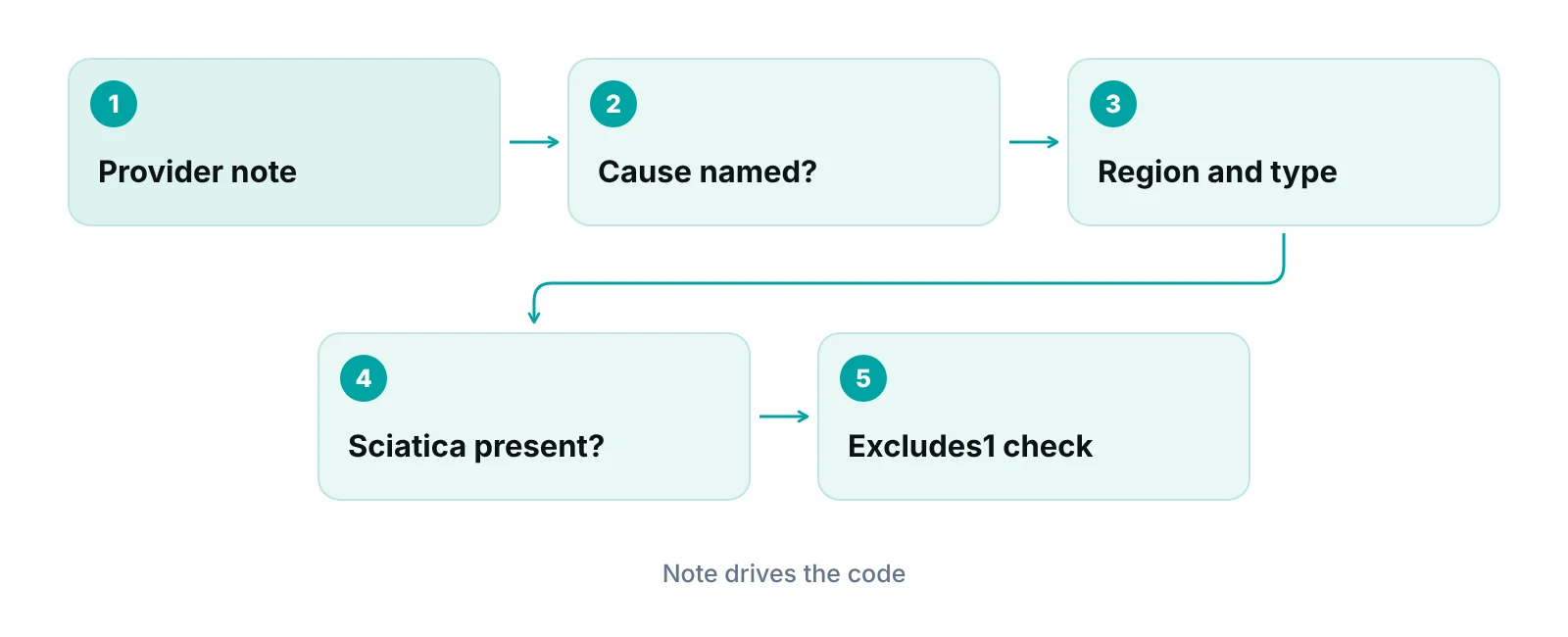
Symptom codes also have a place. The guidelines say codes for signs and symptoms, as opposed to diagnoses, are acceptable for reporting. When the provider has not established a related definitive diagnosis, a symptom code such as back pain is the honest code. Once a cause is established, the cause is usually reported instead.
A pain practice sees this every day
In pain management practices, a patient may be seen for low back pain at the first visit and for disc disease or radiculopathy after imaging. The diagnosis code should change as the clinical picture does. One thing to watch in any practice like that is a diagnosis carried forward from visit to visit after the note has moved on.
What is the difference between M54.50, M54.51 and M54.59?
M54.50 is low back pain with no further detail, M54.51 is vertebrogenic low back pain, and M54.59 is other low back pain. The three share the same parent, M54.5, and the choice depends on the words the provider used, not on how severe the pain is or which side it is on.
There is no left or right version of low back pain. Some older lists, including an earlier version of this article, showed side-specific low back pain codes. The code set does not work that way. Side only appears in the sciatica codes.
- M54.50 includes the terms loin pain and lumbago NOS. It is the right code for a note that says low back pain and stops there.
- M54.51 is titled vertebrogenic low back pain. Coding education sources say the provider must document that term or tie the pain to a vertebral source. Do not infer it from an imaging report or from the patient’s history.
- M54.59 is for low back pain the provider has described as another named type. If the provider writes a type that fits neither M54.51 nor M54.50, ask whether a more specific diagnosis exists elsewhere in the classification.
Check the Excludes1 list before you pick any M54.5x code
Several conditions are Excludes1 with low back pain, including low back strain, lumbago due to disc displacement and lumbago with sciatica. The next sections explain why that matters for the claim.
Which code is right for sciatica, and which for lumbago with sciatica?
Sciatica alone goes to M54.3-, and low back pain together with sciatica goes to M54.4-. Both are split by side, so the note should say right, left or, if the provider did not specify, the unspecified-side code is used.
- M54.30 to M54.32 is sciatica without documented low back pain: unspecified side, right side, left side. The sciatic nerve lesion code G57.0 and disc disorders M51.1 appear as related codes, so confirm the wording in the Tabular List.
- M54.40 to M54.42 is low back pain and sciatica documented together. Lumbago with sciatica due to a disc disorder (M51.1-) is not reported here.
- M54.5x is low back pain with no sciatica, and it is not reported with M54.4-.
The practical rule: pick one family. A patient with low back pain and sciatica is reported with M54.4-, not M54.5x plus M54.3-. The M54.5 Excludes1 note lists lumbago with sciatica, so reporting both gives you a claim that breaks the code set’s own rules.
If the provider documents a disc disorder as the cause of the leg pain, the picture changes again. The M54.4 Excludes1 note points lumbago with sciatica due to a disc disorder to M51.1-, and out of M54.4-. This is a provider documentation question first, which is why the section on queries below matters.
What does an Excludes1 note mean for back pain claims?
An Excludes1 note means the two codes are not reported together. The FY 2027 guidelines describe it as a pure excludes note and put it as “NOT CODED HERE.” The only exception is when the two conditions are unrelated to each other, and when it is unclear whether they are related, the guidelines tell you to query the provider.
Back pain codes carry several Excludes1 notes, which is why a claim that looks right can still fail a scrubber. The table shows the ones that matter most.
| If you report | Do not report it with | What to do instead |
|---|---|---|
| M54.5x (low back pain) | S39.012, low back strain | Code the strain from the injury chapter |
| M54.5x | M51.2-, lumbago due to disc displacement | Use the disc displacement code |
| M54.5x | M51.360 or M51.370, disc degeneration with discogenic back pain only | Use the disc degeneration code that matches the region |
| M54.5x | M54.4-, lumbago with sciatica | Use the sciatica family if both are documented |
| M54.4- | M51.362 or M51.372, disc degeneration with back and leg pain | Use the disc degeneration code |
| M54.4- | M51.1-, lumbago with sciatica due to a disc disorder | Use the disc disorder code |
| M54 (any code) | F45.41, psychogenic dorsalgia | Use F45.41 when that is the provider’s diagnosis |
Source: RapidClaims ICD-10-CM codebook (M54.5 and M54 Excludes1 lists); Kodex ICD-10-CM entry (M54.4 Excludes1 list); AAPC (M54 Excludes1 note); CDC FY 2027 Official Guidelines, Section I.A.12.a.
Notice the pattern. Each pair is a symptom code and a more specific explanation of the same symptom. Once the cause is known, the cause carries the diagnosis. The symptom code goes away.
How should back strain and injury codes be handled?
Low back strain has its own code, S39.012, in the injury chapter, and it is Excludes1 with M54.5x. Injury chapter codes also carry a seventh character that shows the stage of care, which the guidelines cover in Section I.C.19.a. Read that section and the FY 2027 Tabular List before you build a template for strain visits.
A caution about older lists. An earlier version of this article placed a code for an organ injury in a back pain table. It had nothing to do with the spine, and it shows why code tables copied from the web, including ours, need to be checked against the current Tabular List. The same goes for any lookup tool you use. Check it against the code set published for the date of service.
If the visit follows a lifting incident or an accident, make sure the note says so in the provider’s own words. The coder cannot add that context later, and it decides whether a strain code or a symptom code fits.
What should providers document so the code holds up?
The note should name the region, the type or cause if known, whether the pain travels, and the side if it does. Those four items are what separate M54.9 from M54.4-, and what keep a coder from guessing.
| What the note says | Code family to check | Query to send if unclear |
|---|---|---|
| Back pain, no region | M54.9 | Is a region of the spine documented anywhere else in the note? |
| Low back pain, no cause | M54.50 | Is the pain vertebrogenic or another named type? |
| Low back pain and leg pain | M54.4- or a disc code | Is a disc disorder or radiculopathy the cause? |
| Pain after a lifting incident | S39.012 (low back strain) | Is this a strain, and what is the stage of care? |
| Mid-back pain | M54.6 | Is the thoracic spine the documented site? |
| Psychological cause named | F45.41 | Is the provider diagnosing psychogenic dorsalgia? |
Source: RCM Finder summary of the code titles and Excludes1 notes in the tables above. Final code choice rests on the provider’s documentation and the current Tabular List.
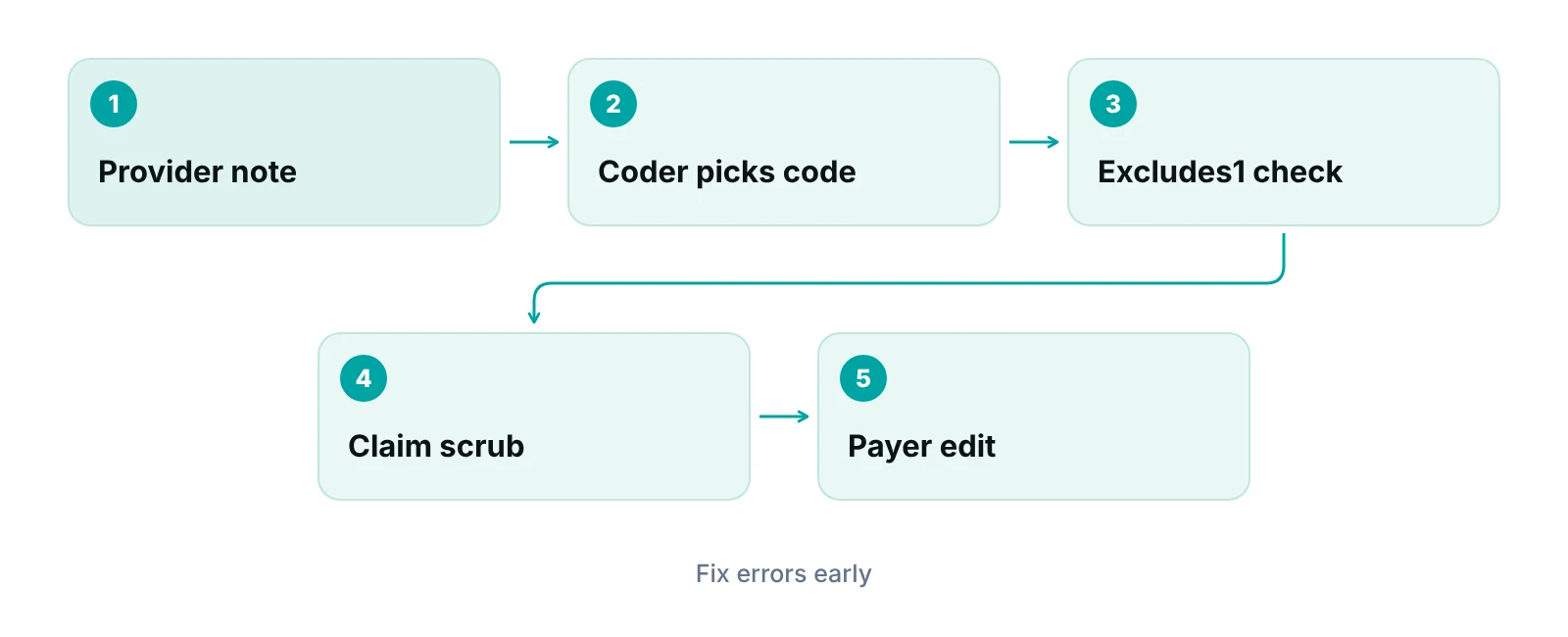
Write queries as yes/no or either/or questions, and never lead the provider toward a code that pays more. A good query names the options the record already supports and asks which one applies. Keep the reply in the chart, not in a side email.
How do back pain coding errors reach the revenue cycle?
Diagnosis errors usually show up as rejections at the front end or denials at the payer, and both cost staff time before any money moves. A rejection means the claim failed an edit before it was accepted. A denial means the payer accepted it and refused to pay.
A code-validity edit catches the old M54.5. An Excludes1 edit catches M54.5x with S39.012. A payer medical-necessity edit is different: it asks whether the diagnosis supports the service on the claim, and each payer sets its own list. Published policies from the payer or its Medicare contractor are the place to look, and we cannot give you a universal list.
If you want the front-end view, our claim scrubbing guide explains the edits that run before submission. For denials that have already come back, see our denial management guide.
See what coding gaps could cost you
Enter your own claim volume in the revenue calculator. It takes a few minutes and needs no account.
If you code back pain visits in-house and want a second look at how diagnoses are being chosen and checked, our medical billing services include coding support and claim review that work with the EHR you already use.
Do back pain codes change in the FY 2027 code set?
The FY 2027 ICD-10-CM update took effect on October 1, 2026, and it applies to encounters through September 30, 2027, according to CMS. The titles in this article were checked against published code lookups for the FY 2026 code set, and the FY 2027 files are the final authority.
Do this once a year. Download the new Tabular List and Addenda from the CDC’s ICD-10-CM files page, search for M54, M51 and S39, and confirm that the codes in your templates and superbills are still valid. Then update your EHR’s favorites list. A short, owned checklist for this is cheaper than finding out through rejections.
Our recommendations
- Remove M54.5 from every template. Search your EHR favorites, superbills and charge sheets for the three-character-plus-one version. Replace it with M54.50, M54.51 or M54.59 as your providers prefer.
- Teach the 'one family' rule. A back pain visit gets low back pain, sciatica, or lumbago with sciatica. It does not get two of them. Put the rule on a one-page reference at the coder’s desk.
- Build an Excludes1 check into review. Pull a sample of back pain claims each month and look for M54.5x paired with S39.012, M51.2- or M54.4-. A manual sample works even if your scrubber misses the pairs.
- Fix M54.9 at the note, not at the claim. If M54.9 is your most common back pain code, ask providers for region, type and side in the template. Do not ask coders to fill gaps.
- Review codes every October. Make the annual code-set check a calendar task with an owner, before the October 1 effective date, and keep the result.
Bottom line
Back pain coding comes down to reading the provider’s note, choosing one code family, and checking the Excludes1 list. If your claims for these visits are rejected or denied more than they should be, a review of diagnosis coding is a sensible first step. See how our denial management services handle diagnosis-related denials, or talk to our team about your own workflow.
Frequently asked questions
What is the ICD-10 code for back pain?
The code for back pain with no region or cause documented is M54.9, dorsalgia, unspecified. If the provider documents low back pain, use M54.50, M54.51 or M54.59 instead. If sciatica is also documented, M54.4- applies. Always follow the provider’s wording, and check the Excludes1 notes before you add a second back pain code to the same claim.
What is the ICD-10 code for low back pain?
M54.50 is low back pain, unspecified. M54.51 is vertebrogenic low back pain, and M54.59 is other low back pain. The older M54.5 is a header now, so claims need the fifth character. None of the three has a left or right version, so do not add one in your template.
What is the ICD-10 code for sciatica?
Sciatica alone is M54.3-, with M54.30 for the unspecified side, M54.31 for the right and M54.32 for the left. When low back pain and sciatica are both documented, use M54.4- instead of reporting both families. If the provider ties the leg pain to a disc disorder, the disc codes may apply instead.
Can I report M54.50 and M54.4- on the same claim?
Usually not. M54.5 has an Excludes1 note for lumbago with sciatica, so the two are not reported together unless the conditions are unrelated. If you are unsure whether they are related, query the provider.
Is M54.9 a bad code to use?
No. It is correct when the note only says back pain. It becomes a problem when it is used because the note was thin. Some payers may question it for certain services, so check the payer policy for the service you are billing. The better fix is a note that names the region and type of pain.
How often do back pain codes change?
The ICD-10-CM code set updates each October 1, with a possible mid-year update in April. Review your back pain codes against the new Tabular List each year, before the effective date. Check the new files for any change to M54, M51 and S39, then update superbills and EHR favorites so old codes do not linger.
Get your free practice audit
Tell us about your practice. We will contact you using the details you give.
- A review of your recent claims, denials and A/R aging
- Where your front desk and prior authorizations slow payment
- A prioritized fix list you keep, whether or not you hire us
Pricing is quoted after the audit, based on your volume and the services you choose. Prefer to talk? Call +1 (302) 556-2288.
Sources
- ICD-10-CM Official Guidelines for Coding and Reporting FY 2027 — CDC / NCHS (2026)
- ICD-10 codes (FY 2027 update) — CMS (2026)
- Comprehensive listing of ICD-10-CM files — CDC / NCHS (2026)
- ICD-10-CM M54.50, Low back pain, unspecified — AAPC (2026)
- ICD-10-CM M54.9, Dorsalgia, unspecified — AAPC (2026)
- M54.51 Vertebrogenic low back pain — RapidClaims ICD-10-CM codebook (2026)
- M54.42 Lumbago with sciatica, left side — Kodex ICD-10-CM (2026)
- Reporting Back Pain in ICD-10-CM — Outsource Strategies (2016)
- 2022 back pain ICD-10 coding guidelines — Coding Ahead (2022)
Disclaimer: This article is educational and is not legal, coding, billing or compliance advice. Code titles were checked against published code lookups for the FY 2026 code set and the FY 2027 guidelines. The FY 2027 Tabular List is the authority, and payer rules vary. Code choice depends on the provider's documentation.
