
DME coding means choosing the HCPCS Level II code for the equipment, adding the right modifiers for rental, purchase and policy status, and supporting the order with a documented diagnosis. Medicare DME MACs set the rules, so check the current code file and the supplier's coverage policy before you bill.
Most DME denials start before the claim is built: the wrong code family, a missing modifier, or a diagnosis the policy does not accept. This guide explains each part of a DME claim line in plain terms, uses hospital beds as a worked example, and shows where the live code list lives so you are not working from a stale table. It replaces an earlier version of this post that listed several codes with wrong descriptions. For the modifier detail, see our guide to DME billing modifiers, and for the wider compliance picture, DME billing best practices.
Key takeaways
- A DME claim line needs the HCPCS code, the right modifiers, a supported diagnosis and documentation that matches the supplier’s policy.
- HCPCS Level II codes are one letter followed by four digits, and CMS publishes updated files quarterly, so never code from an old list.
- Modifiers tell the payer whether the item is rented or bought, new or used, and whether policy requirements are met. Medicare claims carry up to four.
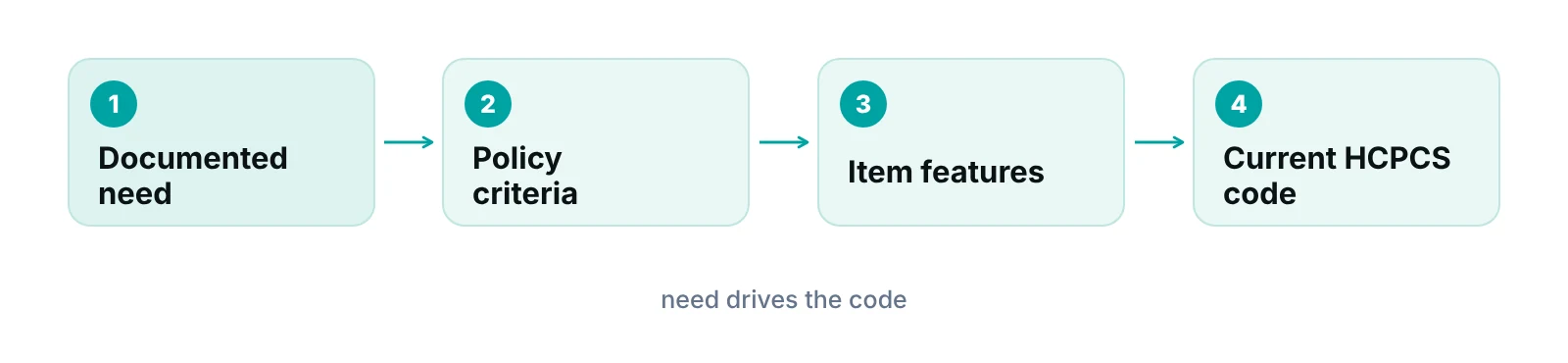
- Pick the code from the item’s features and the patient’s documented need, not from a price range or a general name.
- Diagnosis codes support medical necessity only if they match what the coverage policy accepts and what the chart documents.
What DME coding includes on a claim line
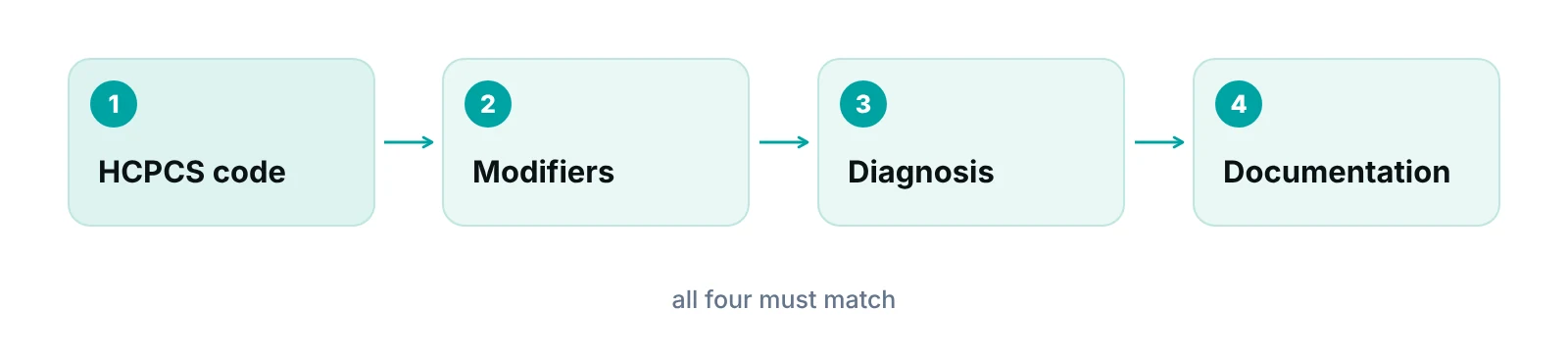
A DME claim line combines four things: the HCPCS code that names the item, the modifiers that describe how it was supplied, the diagnosis that supports the need, and the documentation that proves it. If one is missing or mismatched, the line is at risk even when the other three are correct.
This is different from coding a visit. Physician services use CPT codes from the AMA (Level I). Equipment, supplies and many non-physician items use HCPCS Level II. Our explainer on HCPCS versus CPT covers the split, and CPT, ICD-10 and HCPCS codes shows how all three sit on one claim.
- HCPCS code: identifies the exact item or item family.
- Modifiers: say whether the item is rented, bought new or used, and whether policy requirements are met.
- Diagnosis (ICD-10-CM): shows the condition that makes the item necessary.
- Documentation: the order, the clinical notes and any policy-specific forms that back the line.
The rest of this guide takes these in order, then ends with a checklist to run before a claim leaves your office.
How HCPCS Level II codes work for DME
HCPCS Level II codes are alphanumeric: a single letter followed by four digits. CMS says the national permanent Level II codes are maintained by its HCPCS Workgroup, while CPT codes (Level I) are maintained by the AMA (CMS, HCPCS Level II coding procedures).
The letter groups codes by purpose. For DME the letters you will meet most are E codes and K codes. CMS describes K codes as temporary codes created for the DME MACs when no existing permanent national code fits a needed medical review policy (CMS). A K code can later be replaced by a permanent code, which is one reason an old code list is risky.
The code list changes every quarter
CMS posts HCPCS updates as quarterly Alpha-Numeric files. For 2026 it lists files for January, April, July and October, the latest updated in September 2026 (CMS HCPCS quarterly update). A code can be added, revised or deleted at each update.
Two related rules help. First, a deleted code stays valid for dates of service on or before its deletion date (First Coast, DMEPOS HCPCS codes jurisdiction list). Second, CMS updates a jurisdiction list each year that shows which codes go to DME MACs and which go to Part B MACs (CMS, MLN Matters MM11596). If you bill both, route each code to the right contractor.
Where to get help choosing a code
CMS names the Pricing, Data Analysis and Coding (PDAC) contractor as the group that helps suppliers choose DMEPOS codes for Medicare billing (CMS). If a product does not clearly fit one code, a PDAC coding verification is a safer route than choosing the closest-sounding code.
Do not code from a price range or a nickname
An older version of this post paired codes with average prices and short names. Several of those descriptions were wrong. A code names a defined item with defined features. Match the item’s features to the current descriptor in the CMS file, and never code from a general name such as lightweight wheelchair or standard bed.
A worked example: choosing among hospital bed codes
Hospital beds show why the exact code matters. A DME MAC policy document groups the bed codes into families by features, and each family has its own coverage criteria (CGS Administrators, hospital beds policy summary, revised August 2024).
| Bed family | Codes in the family | Extra criterion in the policy summary |
|---|---|---|
| Fixed height | E0250, E0251, E0290, E0291, E0328 | Meets one of the base hospital bed criteria |
| Variable height | E0255, E0256, E0292, E0293 | Base criterion, plus a need for a bed height that differs from a fixed bed for transfers |
| Semi-electric | E0260, E0261, E0294, E0295, E0329 | Base criterion, plus a need for frequent or immediate position changes |
| Heavy duty, extra wide | E0301, E0303 | Base criterion, plus patient weight above 350 lb and up to 600 lb |
| Extra heavy duty | E0302, E0304 | Hospital bed criterion, plus patient weight above 600 lb |
Source: CGS Administrators, Hospital Beds policy summary (revised August 2024). Family labels are the contractor’s; check the current policy and CMS code file before billing.
Read the table from the patient backward. The policy summary lists the base reasons a patient may need a hospital bed, such as a condition that requires body positioning not possible in an ordinary bed, positioning to relieve pain, a need to keep the head elevated more than 30 degrees most of the time because of heart failure, chronic lung disease or aspiration problems, or traction that attaches only to a hospital bed. The family and then the code follow from those documented needs.
This is also where an old mistake shows. A semi-electric bed and an extra heavy duty bed are not interchangeable. If a note says only that the patient needs a hospital bed, the coder cannot pick between a fixed, variable-height or semi-electric family. The order and notes must say which features the patient needs and why.
DME modifiers: what they tell the payer
DME modifiers state how an item was supplied and whether policy conditions are met. The list below comes from a DME MAC’s modifier page (Noridian JA DME, modifiers). Our longer DME modifiers guide covers more of them.
| Modifier | What it states | Billing note |
|---|---|---|
| RR | Rental | Used when the equipment is rented |
| NU | New equipment purchase | Used when the item is bought new |
| UE | Used equipment purchase | Used when the item bought is used |
| KH / KI / KJ | Initial claim or first month rental; second or third month rental; capped rental months four to fifteen (and PEN pumps) | Track the rental month so the right one is sent |
| KX | Requirements in the medical policy have been met | Add only when the documentation really meets the policy |
| GA | Waiver of liability statement on file; a valid ABN was obtained | Do not use together with KX, GY or GZ on the same claim line |
| GY / GZ | GY: item statutorily excluded or not a Medicare benefit. GZ: item expected to be denied as not reasonable and necessary | GZ items are automatically denied without complex medical review |
Source: Noridian Healthcare Solutions, JA DME modifiers page (accessed 2026-10-14).
Order, number and purchase rules
- Number: the claim form carries up to four modifiers. If more are needed, modifier 99 goes in the fourth position and the rest go in the narrative field.
- Order: pricing modifiers such as RR, KH, KI, KJ and NU go first. Modifiers showing policy requirements are met, such as KX, go second.
- Purchases: CMS instructions say a claim must show whether equipment was rented or purchased, and purchased items must be marked new or used. For claims on or after October 1, 2018, KH is not needed with NU or UE purchase claims (CMS Transmittal R4052CP).
The KX modifier is the one that most often causes trouble. It is a statement by the supplier that the policy’s requirements are met, so it should come from a documentation check, not from habit. If you add KX to every line to avoid rejections, the claim may pay today and fail a later review.
“A modifier is a statement of fact about the claim. If the chart cannot back it up, leave it off.”
ICD-10 diagnosis codes and medical necessity
The diagnosis on a DME claim shows why the patient needs the item. It does not stand alone. Payers read it together with the order and the clinical notes, and DME MAC coverage policies set what they will accept for each item.
The hospital bed policy summary gives a clear example. A bed can be justified by a need for head elevation above 30 degrees caused by heart failure, chronic pulmonary disease or aspiration problems. A diagnosis in that range supports the line only if the chart also records the positioning need. A diagnosis code with no matching clinical note is a weak basis for a claim.
A practical way to pair diagnosis and item
- Open the current coverage policy and its policy article for the item. These are the contractor’s documents, not a blog or code lookup site.
- Find the diagnoses the policy lists, if it lists any, and the clinical criteria the notes must show.
- Confirm the chart supports the diagnosis you plan to report, at the level of detail the note gives.
- Report the diagnosis that best describes the condition driving the need for the item, and keep the order and notes consistent with it.
Why this post no longer lists sample ICD-10 pairs
An earlier version listed example diagnosis and equipment pairs, and at least one description was wrong. Diagnosis acceptance varies by item and by contractor policy, so a general sample table can mislead. Use the policy article for the item you supply.
Documentation is the other half. Our post on clear documentation in medical billing explains how to build notes that support a line, which matters even more for DME because the order, delivery and clinical notes must agree.
Common DME coding errors and what to check
Most DME coding errors are mismatches between pieces of the claim line. A checklist run before submission catches them cheaply, because a denial costs more time to fix than a check does to run.
| Check | What goes wrong | How to avoid it |
|---|---|---|
| Code against current file | Deleted or revised code used from an old list | Look up each code in the latest quarterly HCPCS file |
| Item features vs descriptor | Neighboring code chosen (for example a different bed family) | Match the ordered features to the descriptor, or ask PDAC |
| Rental or purchase | Missing RR, NU or UE, or wrong rental month modifier | Record the supply type at intake and the rental month on each claim |
| KX and waiver modifiers | KX added without documentation, or combined with GA, GY or GZ | Make KX depend on a documented policy check |
| Diagnosis and notes | Diagnosis not accepted by the policy or not in the chart | Pair the diagnosis with the policy article and the notes |
| Contractor routing | Claim sent to the wrong MAC for the code | Check the annual jurisdiction list |
Most of these are preventable at intake, and our guide to a clean claim in medical billing explains how to build checks like these into intake so errors are caught before billing.
Want a second reader on your DME claims?
Book a free practice audit and we will review how your coding, modifiers and documentation line up before claims go out.
Who should handle DME coding: in-house, specialist or outsourced
DME coding is specialized enough that a general coder may not know the policy details for every item you supply. Practices that also supply equipment, across the specialties we support, usually choose between three routes.
- In-house coder: best when volume is steady and one person can keep up with policy changes each quarter.
- Shared reviewer: a billing partner reviews claims for supply lines only, which suits low volume.
- Full outsourcing: fits when equipment is a large share of revenue. Our post on the pros and cons of outsourcing DME billing weighs it.
Whatever you choose, read our Medicare DMEPOS competitive bidding guide for the Medicare program context, and ask any billing vendor to sign a Business Associate Agreement before it sees patient data.
Our recommendations
- Code from the current quarterly file. Download the latest HCPCS file each quarter and make it the only source your team codes from. Retire any copied tables, including prices and nicknames.
- Write item features into the order. A request for a hospital bed or wheelchair is not enough to select a code. Ask for the features that decide the code family and record why the patient needs them.
- Tie KX to a documented policy check. Add KX only after someone confirms the notes meet the policy. Do not combine it with GA, GY or GZ.
- Track the rental month. For capped rentals, record the month so the right KH, KI or KJ modifier is sent.
- Pair diagnoses from the policy article. Use the contractor’s policy and policy article for the item, then confirm the chart supports the diagnosis you report.
- Use PDAC for unclear products. If a product does not clearly fit one code, seek a coding verification rather than choosing the nearest code.
- Review denials by cause. Group denied DME lines by code, modifier, diagnosis and documentation, then fix the intake step behind the most common cause.
Bottom line
DME coding is a set of four matching parts: a current HCPCS code, accurate modifiers, a diagnosis the policy accepts and notes that prove the need. If you want a second pair of eyes on those parts, see our medical billing services and denial management services, or start with a free practice audit. You can also contact us with questions.
Frequently asked questions
What are HCPCS codes for DME?
HCPCS Level II codes name equipment, supplies and other non-physician items. Each is one letter followed by four digits. DME items commonly use E codes, and K codes are temporary codes created for DME MACs. CMS publishes updated code files quarterly, so always check the latest file.
Which modifiers are used most often in DME billing?
RR marks a rental, NU a new purchase and UE a used purchase. KH, KI and KJ show the rental month. KX states that policy requirements are met, and GA, GY and GZ relate to waivers and expected denials. Medicare claims can carry up to four modifiers.
Can I use KX with GA on the same line?
No. A DME MAC states that GA, GZ or GY and KX must never be used together. KX says policy requirements are met, while GA, GY and GZ say the item may not be covered or that a waiver is on file. Pick the one the facts support.
Do I need an ICD-10 code on a DME claim?
Payers expect a diagnosis that supports why the item is needed, and DME MAC policies describe what they accept for each item. The diagnosis must also be supported by the clinical notes. Use the contractor’s policy and policy article for the exact requirements.
How often do HCPCS codes change?
CMS posts HCPCS updates quarterly, and its 2026 page lists January, April, July and October files. Codes can be added, revised or deleted. A deleted code remains valid for dates of service on or before its deletion date.
Where do I find the right code if a product does not fit?
Start with the current HCPCS file and the contractor’s coverage policy. For unclear products, CMS names the PDAC contractor as the group that helps suppliers choose DMEPOS codes for Medicare billing. Do not substitute a similar code.
Get your free practice audit
Tell us about your practice. We will contact you using the details you give.
- A review of your recent claims, denials and A/R aging
- Where your front desk and prior authorizations slow payment
- A prioritized fix list you keep, whether or not you hire us
Pricing is quoted after the audit, based on your volume and the services you choose. Prefer to talk? Call +1 (302) 556-2288.
Sources
- HCPCS Level II Coding Procedures — CMS (2015 document (accessed 2026-10-14))
- HCPCS Quarterly Update — CMS (2026 (accessed 2026-10-14))
- DME modifiers — Noridian Healthcare Solutions (JA DME MAC) (accessed 2026-10-14)
- Hospital Beds policy summary — CGS Administrators (DME MAC) (Revised August 2024)
- Transmittal R4052CP — CMS (2018)
- MLN Matters MM11596 — CMS (2020)
- DMEPOS HCPCS codes jurisdiction list — First Coast Service Options (accessed 2026-10-14)
Disclaimer: This article is educational and is not legal, coding, billing or compliance advice. CPT is a trademark of the American Medical Association. Payer and contractor rules vary and change, and the policy summaries cited here may have been updated. Check the current CMS code file and your DME MAC policy before you bill.
