
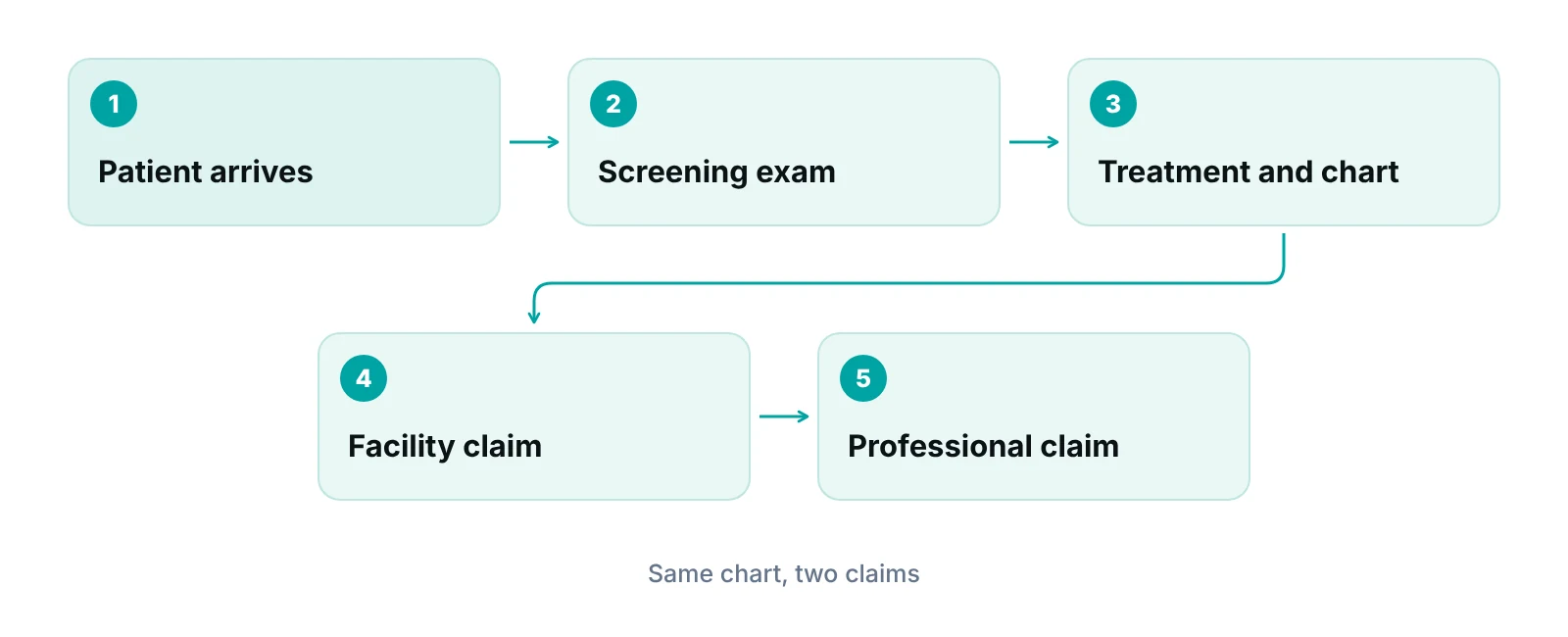
Emergency department billing usually means two claims for one visit: the hospital bills the facility and the emergency clinician bills the professional service. Since 2023, professional ED levels 99281 to 99285 are chosen by medical decision making alone, and EMTALA bars hospitals from delaying care to ask about payment.
Most ED billing trouble starts with treating the visit as one claim. It is two, built from the same chart, under different level logic. This guide is for practice and billing managers deciding how to run ED claims, and it uses only rules we could verify from primary sources.
We cover EMTALA, E/M level selection, critical care, facility versus professional claims and surprise-billing protections, then where claims fail and how to choose between in-house and outside help.
Key takeaways
- An ED visit usually produces a facility claim and a professional claim, leveled separately.
- EMTALA bars delaying screening or stabilizing care to ask about payment, insurance or authorization.
- From 2023, professional ED E/M levels use medical decision making only, not time, history or exam.
- Critical care codes 99291 and 99292 are time-based and were not changed by the 2023 ED guideline update.
- Document the decisions, not the volume: the level is only as strong as the chart.
What does emergency department billing cover?
Emergency department billing covers every claim that comes out of an unscheduled ED visit. In most hospitals that means two claims for one visit: a facility claim for the hospital’s resources and a professional claim for the emergency physician’s or other clinician’s service. Each is leveled, coded and paid on its own logic, and mixing them up is the root of many ED coding errors.
Unlike an office visit, nothing is scheduled. The patient is seen first, insurance is sorted out second, and the chart is the only record of what happened. That order is set by federal law, which is why the billing workflow has to be built around it. If your work also touches transport, see our guides to ambulance billing codes and to coding moderate sedation in the emergency department, which this post does not repeat.
Emergency medicine does not have its own page among our specialty billing pages, so start there if you want to see how we group related care settings. The rest of this guide stays on the rules that apply to ED claims in general.
What does EMTALA mean for ED billing?
EMTALA does not set billing codes, but it sets the order of work. A Medicare-participating hospital with an emergency department must give an appropriate medical screening examination to anyone who comes to the ED and asks for care, and it may not delay that exam or stabilizing treatment to ask about payment or insurance (42 CFR 489.24).
CMS describes the same rule for the public: the hospital may ask about insurance “as long as it doesn’t delay your exam or treatment,” and it must offer the screening even if the patient has no insurance (CMS, Emergency Room Rights). For a billing team the consequence is simple. Registration, insurance capture and authorization requests cannot be a gate in front of care.
| Requirement | What the regulation says | Billing-office takeaway |
|---|---|---|
| Screening exam | The hospital must provide an appropriate medical screening exam within the capability of its ED to determine whether an emergency medical condition exists (489.24(a)). | Screening comes first. Registration runs alongside it, not before it. |
| Payment questions | The hospital may not delay screening or stabilizing treatment to ask about method of payment or insurance status (489.24(d)(4)(i)). | Capture insurance without slowing the clinical team. |
| Authorization | The hospital may not seek insurer authorization until after screening and the start of any needed stabilizing treatment (489.24(d)(4)(ii)). | Prior authorization is not a front-door step in the ED. |
| Stabilize or transfer | If an emergency medical condition exists, the hospital must provide further exam and treatment within its capability to stabilize it, or transfer the patient under the transfer rules (489.24(d)(1)). | Admission, treatment and transfer paths change what is billed. Chart them clearly. |
| Refusal of treatment | The hospital meets the duty if it offers treatment, explains risks and benefits, and the patient declines. It must document the refusal and take reasonable steps to get a written informed refusal (489.24(d)(3)). | Keep the refusal documentation with the chart. |
Source: eCFR, 42 CFR 489.24 (current text; eCFR is authoritative but unofficial).
Registration scripts are a compliance risk
Front-desk scripts that open with “what insurance do you have?” before a patient is seen can collide with 489.24(d)(4). Review your ED registration flow with compliance counsel. This post is not legal advice.
The CFR also sets conditions for moving an unstabilized patient to another hospital, including a written request or a physician certification (489.24(e)). Those transfer records matter to billing because they explain why a patient left without an admission and why a visit ended where it did.
How are ED E/M levels 99281 to 99285 chosen?
Professional ED visit levels are chosen by medical decision making (MDM) only. ACEP reports that beginning in 2023 the ED E/M services are based only on MDM, and that time is not a descriptive element for choosing ED levels (ACEP). HFMA’s 2022 compliance article makes the same points and adds that there is no new versus established patient distinction in the ED (HFMA).
| Code | Level of MDM | Notes |
|---|---|---|
| 99281 | Not stated as an MDM level | The 2023 descriptor says the visit may not require a physician or other qualified professional to be present. |
| 99282 | Straightforward | Paired with a medically appropriate history and/or exam. |
| 99283 | Low | Paired with a medically appropriate history and/or exam. |
| 99284 | Moderate | Paired with a medically appropriate history and/or exam. |
| 99285 | High | Paired with a medically appropriate history and/or exam. |
| 99291 / 99292 | Not MDM-based (critical care) | Critical care codes were not affected by the 2023 ED documentation changes (ACEP). |
Source: ACEP (April 2023), summary of the 2023 AMA CPT ED E/M changes. Descriptors are paraphrased; CPT is owned by the AMA, so check the current CPT book.
HFMA adds that to reach a given level, two of the three MDM elements for that level must be met or exceeded, and that history and exam are no longer elements for level selection (HFMA). In plain terms, a long history and a full exam no longer buy a higher level. The documented decisions do.
What the chart has to show
HFMA recommends a clear assessment and plan that tells the diagnostic story and supports the MDM level (HFMA). Coders can only level what the physician wrote down. That includes the problems addressed, the data reviewed or ordered, and the risk of the management chosen.
“A visit level is only as strong as the decisions the chart records. Volume of documentation is not the same as complexity.”
Medicare’s Claims Processing Manual lists ED visits in section 30.6.11 and critical care in section 30.6.12 of Chapter 12. Because Medicare rules and local contractor policy can differ from CPT, confirm the current text and your MAC’s policy before you set internal rules.
When does critical care replace an ED visit code?
Critical care is reported with 99291 and 99292 instead of, or in addition to, an ED visit code depending on the course of the encounter. HFMA states that critical care and ED services may both be reported on the same day when the patient’s condition changes after the ED service and critical care is then provided (HFMA).
Critical care is time-based, so the chart needs a clear statement of critical care time and what the physician did during it. We do not give minute thresholds here because we could not confirm the current Medicare text from CMS for this post. Look them up in the current CPT book and your MAC’s guidance, and build a documentation template from them.
Procedures done in the ED have their own coding rules. For a worked example, see our guide to moderate sedation coding in the ED. When a visit and a procedure are both billed, your coders will also need to know how modifiers 25 and 59 differ.
How do facility and professional ED claims differ?
The facility claim reports the hospital’s resources and the professional claim reports the clinician’s work, and the two are leveled independently. A hospital can bill one ED level while the physician group bills another, and neither is wrong on its face because they measure different things.
A 2026 commercial payer policy (Regence, Optum Policy No. 110, effective January 1, 2026) says outpatient facility ED claims are billed at levels 1 to 5 with 99281-99285 or G0380-G0384, and that facility guidelines should be based on facility resources versus physician resources (Regence). The same policy says Type A EDs, open 24 hours a day, use 99281-99285, and Type B EDs, which are not open 24/7, use G0380-G0384.
| Item | Facility claim | Professional claim |
|---|---|---|
| Who bills | The hospital | The emergency physician or physician group, depending on the employment arrangement |
| Level logic | Hospital-written facility guidelines based on facility resources | Medical decision making, per the 2023 CPT rules |
| Codes for the ED visit | 99281-99285 (Type A) or G0380-G0384 (Type B), per the payer policy cited | 99281-99285, plus 99291-99292 for critical care |
| Other claim detail | Reported with an ED revenue code. One state Medicaid notice from 2012 maps revenue codes 0450, 0451 and 0456 to levels. | Reported under the clinician, with diagnoses and any procedure codes |
| Common failure point | Level not matched to hospital criteria; charges missed after discharge | Level not supported by documented MDM; critical care time missing |
Sources: Regence/Optum Policy No. 110 (effective 1/1/2026); Illinois HFS provider notice (2012); ACEP (2023); HFMA (2022). Payer rules vary.
Facility leveling is a hospital policy question as much as a coding one. The Regence policy notes that facilities are expected to follow CMS criteria for facility coding guidelines, including that the guidelines are written, consistent and clear (Regence). Review any leveling logic with your compliance lead, not only your coders.
If your professional claims go out on paper-style forms, our CMS-1500 claim form guide covers the fields. To keep both claims visible until they are paid, a practice management system that tracks claims by stage lets you give each claim an owner and see which ones are stuck.
Do surprise billing rules apply to ED claims?
Yes. CMS states that the No Surprises Act protects people from unexpected out-of-network medical bills for emergency room visits, and that it applies to most types of health insurance (CMS, Medical bill rights). Air ambulance services are listed among the protected services.
For a billing office, that changes how out-of-network ED claims are handled with patients. The CMS page we reviewed does not set out the rules on cost sharing, balance billing limits or payment disputes, so we do not describe them here. Get those from the current federal rule text or from counsel before you write a patient-billing policy.
Where do ED claims go wrong?
ED claims usually go wrong at the handoff points: chart to coder, coder to level, level to claim. The causes below follow from the rules above. We have no verified national denial rate for ED claims, so none is quoted.
- Level not supported by MDM. The code says high complexity but the note shows few decisions. Under the 2023 rules the physician’s reasoning is what gets leveled.
- Registration shortcuts. Missing or wrong insurance data because staff could not collect it up front, and no follow-up afterwards. EMTALA allows insurance questions that do not delay care, so build a back-end process.
- Charts finished late. Many hospitals track accounts that are discharged but not final billed. ED charts that stay open leave both claims waiting.
- Facility and professional levels treated as one. Staff try to force them to match instead of applying each logic.
- Critical care without time documentation. The code is time-based, so a missing time statement leaves the claim without support.
- Procedure billing gaps. Sedation, repairs and other ED procedures are coded separately from the visit.
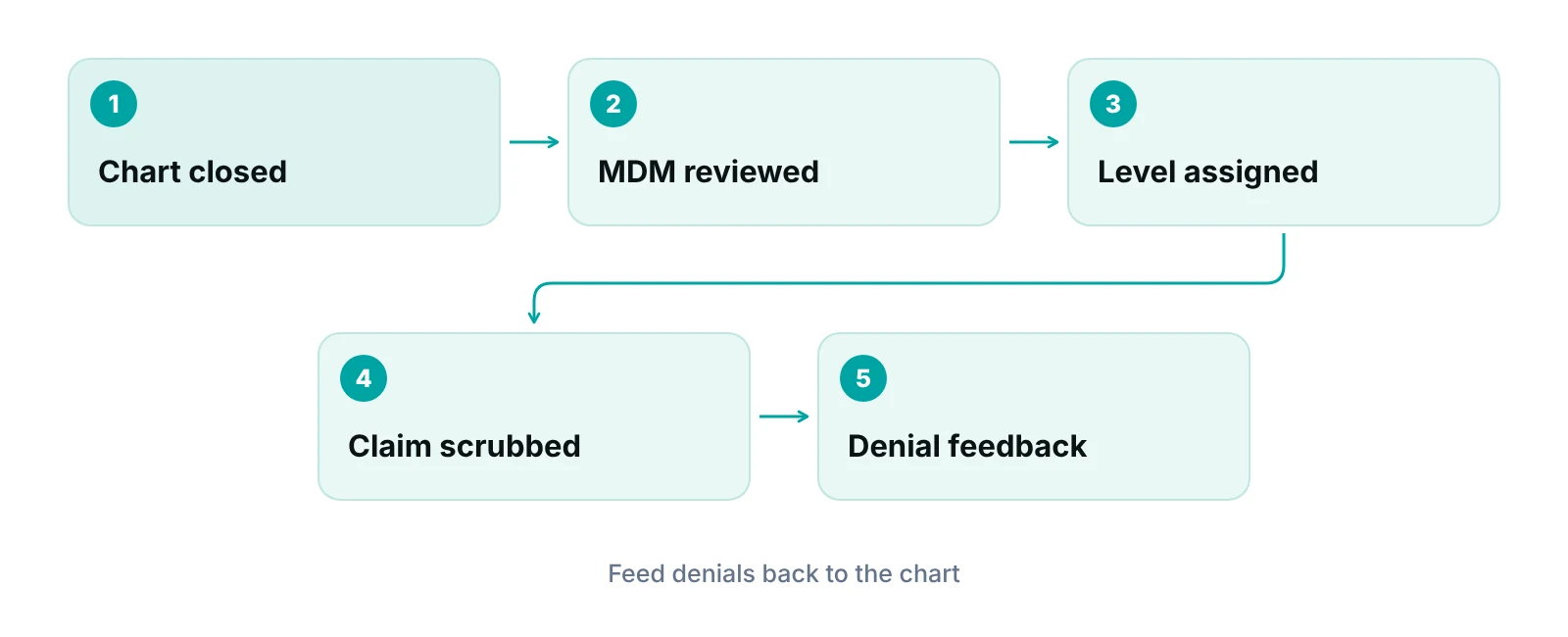
Pre-bill checks such as claim scrubbing catch missing data before the claim leaves, and a denial management process shows which of the causes above are costing you. Our ambulance billing workflow tips give a parallel example for the transport side of emergency care.
Should ED billing stay in-house or go to a partner?
Keep ED billing in-house if you have coders who know MDM-based ED leveling, a clear owner for each open chart, and a way to track claims through payment. Look at outside help if charts close late, if facility and professional claims are handled by different people with no shared view, or if denials are not being worked.
If you do compare partners, ask each one the same questions. Who levels the professional claim, and how do they check it against the documented MDM? How do they handle critical care time? How are facility level guidelines applied or checked? Will they sign a Business Associate Agreement before touching patient data? What reporting will you see, and how often?
Check how your ED claims are leveled and tracked
A free practice audit is a no-cost review of your claim workflow, so you can see where ED claims wait and who owns each step.
Our recommendations
- Separate the facility and professional workflows. We recommend giving each claim its own checklist, owner and level logic, with a shared view of the chart so neither team has to guess what the other billed.
- Build the ED registration script around EMTALA. We recommend having compliance review the front-desk script so no question about insurance, payment or authorization comes before the screening exam or delays treatment.
- Audit a sample of charts against MDM. We recommend pulling a small set of recent 99283 to 99285 charts and checking whether the documented decisions support the level billed, then sharing the findings with the physicians.
- Use a critical care time template. We recommend a short template that records critical care time and what was done, built from the current CPT guidance and your MAC’s policy.
- Close the loop on denials and late charts. We recommend a weekly review of denied ED claims and of charts that are still open after discharge, so the same causes are not repeated.
Track facility and professional ED claims in one place.
RCM Finder's portal is a claim-centred practice management system that tracks each claim by stage with an owner, runs data-completeness checks before submission and flags underpayments against expected amounts.
See how the RCM Finder portal works · Create a portal account
Disclosure: RCM Finder builds and sells this portal. It is a practice management system, not an EHR.
Bottom line
Bottom line: ED claims are won or lost at the chart. Keep care first and payment questions second as EMTALA requires, level the professional claim on documented decisions, apply hospital criteria to the facility claim, and track both until they are paid. If denials keep returning, denial management services and medical billing services can take on the follow-up, and you can reach us through our contact page.
Frequently asked questions
What is emergency department billing?
Emergency department billing is the coding and claim submission for care given in a hospital ED. A visit usually produces a facility claim for the hospital and a professional claim for the clinician, each leveled on its own rules. Documentation, coding and follow-up all run from the same chart, so late or thin charts delay both claims.
Does EMTALA affect billing?
Yes, indirectly. EMTALA requires a screening exam and stabilizing treatment and bars delaying either to ask about payment or insurance. Billing teams can collect insurance details, but only in ways that do not slow or discourage care. Authorization requests also wait until after screening and the start of stabilizing treatment.
How are ED E/M levels chosen in 2023 and later?
By medical decision making only. ACEP reports that time is not used for ED levels, and history and exam no longer drive the level. Levels 99282 to 99285 map to straightforward, low, moderate and high MDM.
Can critical care and an ED visit be billed on the same day?
HFMA states both may be reported when the patient’s condition changes after the ED service and critical care is then provided. Rules vary by payer, so check your MAC and contracts and document critical care time and the work done during it, so the second service is supported.
Do the facility and the physician use the same E/M level?
Not necessarily. Facility levels follow hospital guidelines based on facility resources, while professional levels follow documented decision making. Each claim should be defended by its own logic, not forced to match.
Does the No Surprises Act cover emergency room visits?
CMS says it protects people from unexpected out-of-network bills for ER visits under most types of health insurance. Check the current federal rule text for cost sharing and dispute details before writing patient-billing policy, and ask counsel to review your out-of-network ED patient letters.
Get your free practice audit
Tell us about your practice. We will contact you using the details you give.
- A review of your recent claims, denials and A/R aging
- Where your front desk and prior authorizations slow payment
- A prioritized fix list you keep, whether or not you hire us
Pricing is quoted after the audit, based on your volume and the services you choose. Prefer to talk? Call +1 (302) 556-2288.
Sources
- 42 CFR 489.24, Special responsibilities of Medicare hospitals in emergency cases — eCFR / U.S. Government (current)
- Emergency Room Rights — CMS (current)
- Medical bill rights (No Surprises Act) — CMS (current)
- 2023 AMA CPT documentation guideline changes for ED E/M codes 99281-99285 — ACEP (2023)
- Making sense of the madness: 2023 E/M changes (Compliance, Winter 2022) — HFMA (2022)
- Emergency Department Visits: Level of Service (Optum Policy No. 110) — Regence (2026)
- Provider notice: emergency department revenue codes — Illinois Department of Healthcare and Family Services (2012)
- Medicare Claims Processing Manual, Chapter 12 — CMS (current)
Disclaimer: This article is educational and is not legal, coding, compliance or medical advice. CPT is owned by the AMA. Payer and Medicare contractor rules vary and change, so confirm the current rules with your payers, MAC and counsel.