
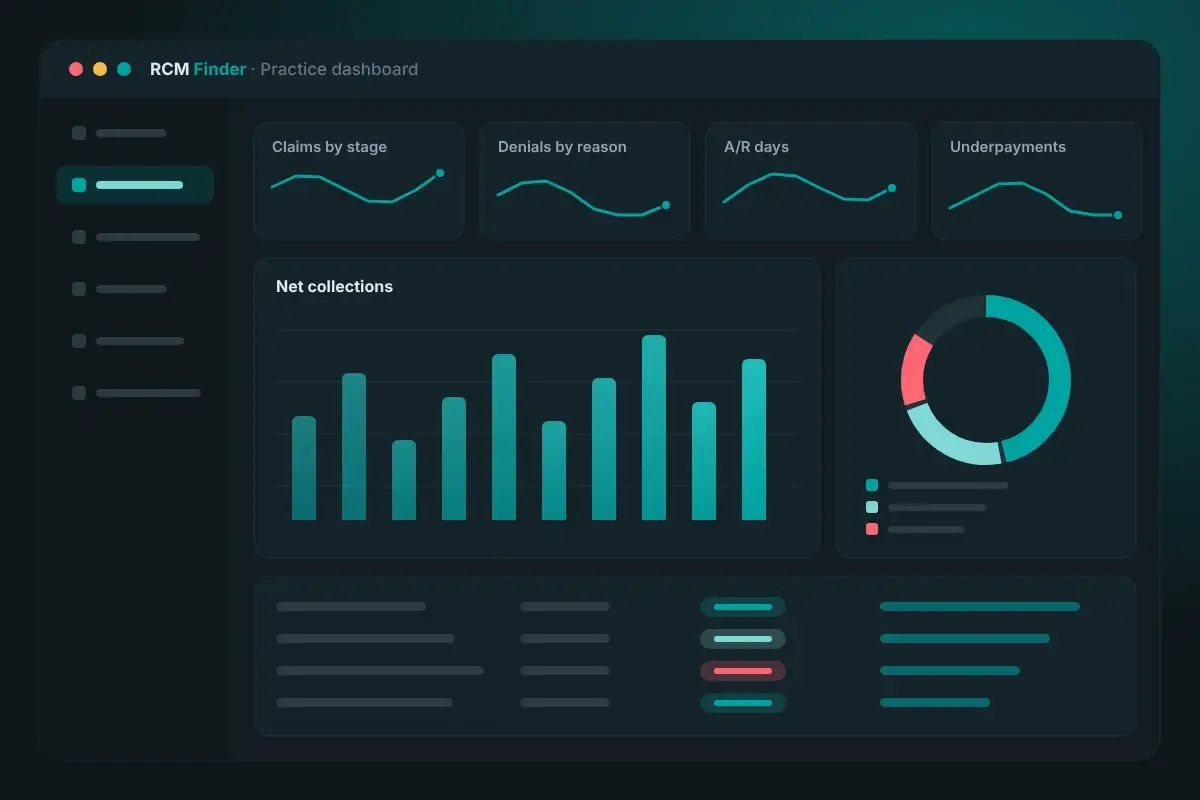
We run your revenue cycle inside the EHR you already use: eligibility, prior authorization, coding support, claims, payment posting, denials and A/R follow-up. You see every claim's stage and every KPI in one place.
By Awais Afzal | Healthcare Operations & Data Analyst
Published October 12, 2026 · Last reviewed October 12, 2026 · Next review April 12, 2027
Quick answer
Revenue cycle management services handle every financial step of a patient visit: registration, eligibility and benefits checks, prior authorization, charge capture and coding support, claim scrubbing and submission, payment posting, denial appeals, underpayment review, A/R follow-up and patient statements. End-to-end RCM runs all of these as one process, measured with standard KPIs.
On this page
Tell us about your practice. We will contact you using the details you give.
Pricing is quoted after the audit, based on your volume and the services you choose. Prefer to talk? Call +1 (302) 556-2288.
Tell us about your practice
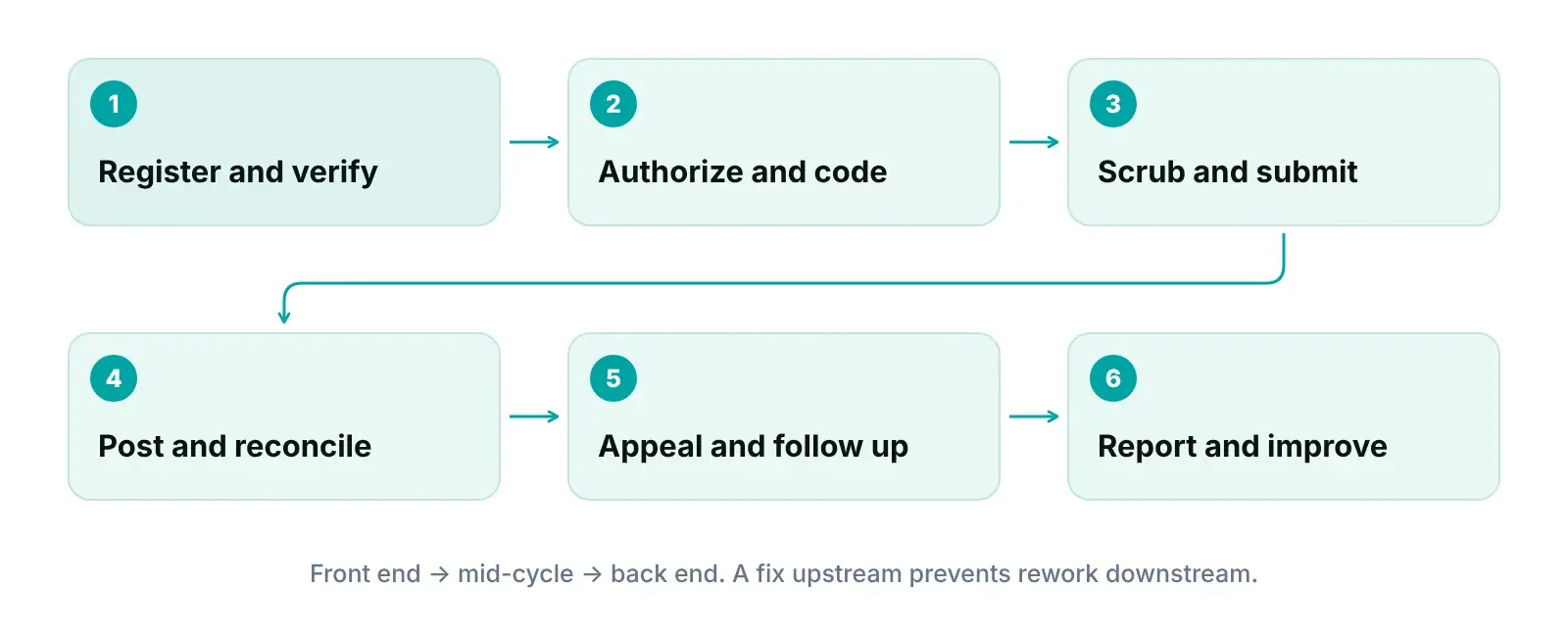
Revenue cycle management services cover everything from booking a patient to closing that patient's balance at zero. We own the front end, the mid-cycle and the back end, so nothing falls between two vendors. A denial found in week six often started with a registration typo on day one.
| Stage | What happens | Common failure | What we check |
|---|---|---|---|
| Scheduling & registration | Patient and insurance details entered | Wrong member ID, name or date of birth | Demographics against the insurance card |
| Eligibility & benefits | Coverage and cost share confirmed | Inactive plan or wrong payer billed | Active coverage, copay, deductible, referral rules |
| Prior authorization | Payer approval obtained where required | No approval, or approval does not match codes billed | Auth number, approved codes, units, date range |
| Charge capture & coding support | Documented services become codes | Missed charges; codes the note does not support | Note-to-charge match, modifiers, diagnosis links |
| Claim scrubbing & submission | Claim checked and sent | Missing fields; late filing (Medicare: 1 calendar year after service) | Completeness, payer rules, each payer's filing limit |
| Payment posting & ERA reconciliation | Payments and adjustments applied | Unposted ERAs; deposits that do not match | ERA lines against deposits and expected amounts |
| Denials, appeals & underpayments | Rejected or short-paid claims worked | Denials left unworked; underpayments written off | Reason code, root cause, appeal deadline |
| A/R follow-up & statements | Open balances collected | Claims age past deadlines | Aging by payer and owner of the next action |
Source for the Medicare filing limit: 42 CFR 424.44, eCFR (current as of October 2026; exceptions apply). Other cells describe common operating patterns, not statistics.
Find out where your claims are leaking
Our free audit reviews a sample of your claims, denials and A/R aging and shows which stage costs you most.
End-to-end RCM matters because a large share of claims are denied the first time, and every denial costs staff time to fix. Preventing errors upstream costs less than appealing them later.
In Premier's survey published in February 2025, hospitals and health systems reported an average denial rate of nearly 15% on their 2023 claims. The cost of fighting a denial rose from $43.84 per claim in 2022 to $57.23 in 2023, and about 70% of denials were eventually overturned and paid. Most of that money was payable; it just took extra rounds of work.
KFF's analysis of 2024 HealthCare.gov marketplace data, published in March 2026, found that insurers denied 19% of in-network claims, with rates from 3% to 36% by insurer. Fewer than 1% of denied claims were appealed.
The reasons matter more than the rate. Of in-network denial reasons in KFF's 2024 data, 25% were administrative and 9% were missing prior authorization or referral; 13% were excluded services, 5% medical necessity and 36% "other." Administrative and authorization problems are what a clean front end is built to catch.
We start with a free audit of your claims and workflow, then take over the cycle in stages inside your existing EHR. You keep your system, your payer contracts and your data.
We review a sample of recent claims, denials, remittances and A/R aging, plus how registration and eligibility work today. You get a written summary of where revenue slips and what to fix first. Pricing is quoted after the audit.
We put a Business Associate Agreement in place before accessing patient data, then set up role-based access limited to what each role needs.
We document your payer mix, the contracted rates you share and your specialty's billing patterns. The portal applies specialty-aware logic per claim, with 35 specialties grouped into shared billing-pattern archetypes.
Our team works inside your existing EHR (for example PrognoCIS, eClinicalWorks or athenahealth). Your practice's time zone governs every staff member, onshore or offshore.
Claims move through a tracked pipeline. Automation rules flag a claim for review, hold or advance a stage, or assign an owner.
You get weekly KPI reporting and a review of denial reasons, underpayments and aging. Each recurring problem gets an owner and an upstream fix.
We build our billing pipeline around how claims actually move through a practice: registration, charge entry, submission, payment and follow-up. For specialty rules, see our specialty RCM pages.
You see the same claim data we work from. The RCM Finder portal tracks each claim by stage, checks completeness before submission, flags underpayments against expected amounts and feeds KPI dashboards you can open at any time.
We build dashboards in our own practice management system for medical practices on your claims and remittance data: denials by payer and reason, days in A/R, aging and underpayments. Where your EHR allows, Python RPA and webhooks for medical billing take repetitive data entry off your staff.
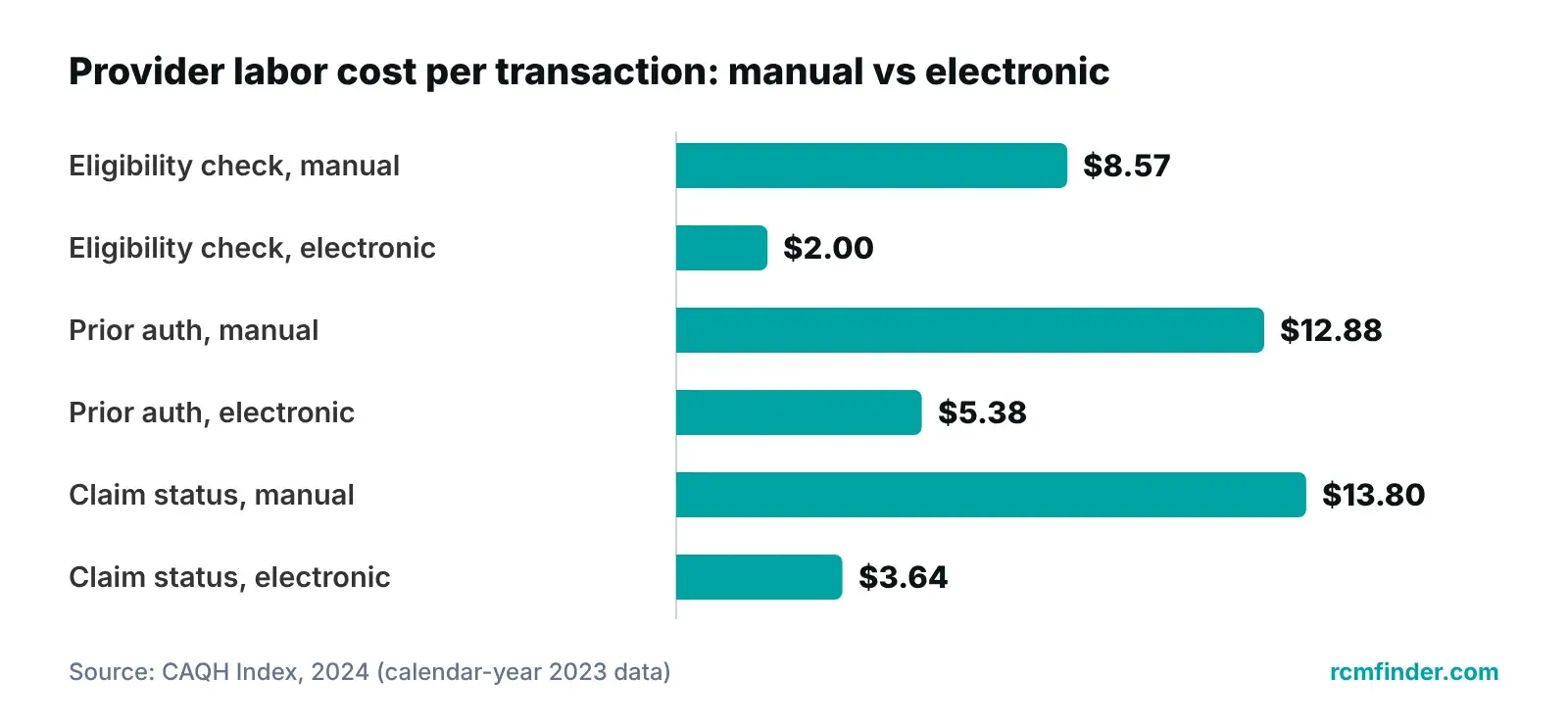
Manual work costs more. The 2024 CAQH Index (calendar-year 2023 data) put the provider labor cost of a manual eligibility check at $8.57 versus $2.00 electronically, and a manual claim status inquiry at $13.80 versus $3.64. The 2025 CAQH Index, released in February 2026, estimated a remaining $21 billion industry savings opportunity from full automation.
Track days in A/R, net collection rate, denial rate, clean claim rate and A/R aging. Use published definitions so the numbers mean the same thing every month and can be compared with peers.
HFMA's MAP Keys (2023 edition) apply to hospitals and health systems, ambulatory providers and physician organizations alike; MGMA's data definitions are built around medical groups. We state which standard each number uses.
| KPI | What it tells you | Formula (as published) | Source |
|---|---|---|---|
| Days in A/R | Days of charges sitting unpaid | Total A/R ÷ (adjusted FFS charges × 1/365) | MGMA data definitions |
| Net days in A/R | The same on a net revenue basis | Net A/R ÷ average daily net patient service revenue | HFMA MAP Keys, FM-1 |
| Net collection rate | Share of collectible charges collected | Net FFS revenue × 100 ÷ adjusted FFS charges | MGMA data definitions |
| Denial rate | How often payers deny claims | Claims denied ÷ claims remitted (remittance denial rate) | HFMA MAP Keys, AR-5 |
| Clean claim rate | Claims passing edits with no manual touch | Claims passing edits with no manual intervention ÷ claims accepted for billing | HFMA MAP Keys, CL-1 |
| Aged A/R | How much A/R is old and at risk | Billed A/R per aging bucket (0–30 … over 120 days) ÷ total billed A/R | HFMA MAP Keys, AR-1 |
Sources: MGMA Data Definitions (DataDive glossary, 2025); HFMA MAP Keys, 2023 edition. FFS = fee-for-service. Neither source sets universal target values.
For a longer walkthrough of each metric, read our guide to revenue cycle KPIs and our guide to clean claims.
Estimate what denials and slow A/R cost you
Enter your monthly claim volume and collections in our revenue calculator to size the gap before your audit.
Choose the model that can cover every stage, every day. In-house gives the most control, outsourced RCM adds depth and coverage, and a hybrid splits tasks between your office and a partner.
| Factor | In-house team | Outsourced RCM | Hybrid model |
|---|---|---|---|
| Day-to-day control | Highest | Shared, set by scope and reporting | Split by task |
| Coverage when staff are out | Gaps unless cross-trained | Vendor covers absences | Partner covers its stages |
| Depth in coding and appeals | Limited to who you can hire | Usually broader, across many payers | Partner fills gaps |
| Visibility | Your own reports | Vendor reporting; ask for claim-level access | Needs one shared dashboard |
| Cost structure | Salaries, benefits, software, training | Contract fee (ours quoted after a free audit) | A mix of both |
| Usually suits | Larger groups with stable billing staff | Practices short on staff or facing rising denials | Practices keeping the front desk local |
Decision guide based on common operating models; no sourced statistics.
A common hybrid: keep your front desk, add virtual medical assistants for eligibility and prior authorizations, and hand everything after the visit to an RCM team. Ask yourself: can your team work every denial before its appeal deadline, and who covers billing when your biller is out? More on staffing in our article on how front desk staff affect the revenue cycle.
Not sure which model fits?
Talk it through with our RCM team. If keeping billing in-house makes more sense for your practice, we will say so.
Revenue cycle results depend on what happens before and around billing. We run RCM as one of four connected services.
Marketing decides which patients and insurance plans reach your schedule. We aim local SEO, Google Ads and reputation work at the services and payers that pay you fairly.
Many avoidable denials start at registration. Our virtual medical assistants handle scheduling, eligibility, prior authorizations and intake.
Coding support, scrubbing, posting, appeals, underpayment review and A/R follow-up, run by one accountable team.
Our portal shows where every claim stands and who owns the next step, for practices and billing companies.
Any RCM vendor that handles your patient data is a HIPAA business associate and must sign a Business Associate Agreement. Beyond that, ask how the vendor limits access, logs activity, tracks filing deadlines and handles self-pay estimates.
HHS guidance lists claims processing, billing and practice management as business associate functions. The agreement must bar uses of patient data it does not permit and require safeguards, and business associates are directly liable for certain HIPAA provisions. The minimum necessary standard limits uses, disclosures and requests to what is needed, and the Security Rule's technical safeguards (45 CFR 164.312) include access control, audit controls and transmission security.
Under 42 CFR 424.44, a Medicare claim must be filed within 1 calendar year after the date of service, with limited exceptions. Other payers set their own limits, so we load each one into the work queue.
For uninsured or self-pay patients, 45 CFR 149.610 requires a good faith estimate within 1 business day of scheduling when a service is booked at least 3 business days ahead, and within 3 business days when booked at least 10 business days ahead or when the patient asks. CMS explains that a bill at least $400 above a provider's estimate can qualify for patient-provider dispute resolution.
Our own setup: role-based access, audit logging, encrypted HTTPS connections, and we put a Business Associate Agreement in place before accessing patient data. For your side, use our HIPAA compliance checklist.
We would rather tell you now than after you sign. Here is where we fit and where we do not.
A good fit if you are
Probably not a fit if you are
What we would do first if we were running your practice's revenue cycle tomorrow.
We check registration and eligibility first. In KFF's 2024 marketplace data, administrative reasons and missing authorization or referral made up about a third of in-network denial reasons.
We tag each denial with its reason code and the stage where it started, then review the top reasons weekly so the fix lands where the error began.
We sort open claims by the nearest filing or appeal deadline and by value, so recoverable money is worked before it expires.
Underpayments cannot be found without an expected amount. Share your fee schedules, and we use them as the baseline for underpayment checks.
We use HFMA and MGMA formulas and say which one each number follows, so trends stay honest month to month.
Good faith estimate deadlines are counted in business days from the day a self-pay visit is scheduled. We recommend making the estimate part of scheduling, not something left to memory.
Your claim data, dashboards and exports should stay yours. Put data-return terms in any RCM contract, including ours.
Medical billing is one part of revenue cycle management: creating claims, sending them and following up. RCM covers the whole path of a patient's money, from scheduling and eligibility through coding and claims to payment posting, denials, underpayments, A/R and patient statements. An RCM partner is accountable for the result across all of those steps, not only for submitting claims.
Pricing depends on claim volume, specialty, payer mix and how many stages you hand over. Billing companies price in different ways, so compare what each quote covers. We quote after a free practice audit, so the price reflects your actual workload. Ask any vendor exactly what is included, such as old A/R, patient statements and reporting.
No. Our team works inside your existing EHR, for example PrognoCIS, eClinicalWorks or athenahealth, using the access you grant. We add our portal alongside it for claim-stage tracking, underpayment checks and reporting. We do not claim official partnerships with EHR vendors; we work in your system the same way your own staff do.
Yes. During onboarding we review open A/R and recent denials, sort them by filing or appeal deadline and by dollar value, and work the recoverable claims first. Deadlines matter: Medicare's limit is generally 1 calendar year after the date of service, and commercial limits vary by contract, so some older claims may no longer be collectible.
HIPAA lets practices use billing vendors as business associates, provided a Business Associate Agreement is in place and the vendor safeguards the data. Before you share access, confirm the agreement is signed, access is limited by role, activity is logged and connections are encrypted. We put a Business Associate Agreement in place before accessing patient data. This is general information, not legal advice.
Start with days in A/R, net collection rate, denial rate, clean claim rate and the share of A/R over 90 or 120 days. Use a published definition, such as MGMA's or HFMA's, so the numbers stay comparable month to month. Watch the trend and the reasons behind it rather than any single month. We report these weekly and explain what changed.
About the author: Awais Afzal
Healthcare Operations & Data Analyst, RCM Finder
Awais has spent more than 16 years in healthcare digital marketing and clinical operations management. He builds data-driven revenue cycle blueprints for high-ticket medical practices and leads product development of the RCM Finder portal. More about our team.
How we write: every figure, code and rule on this page was checked against the primary source listed below and independently fact-checked before publishing. We re-review this page every six months. Last reviewed October 12, 2026; next review April 12, 2027.
We use cookies to understand how our site is used and to measure our advertising. You can accept or reject non-essential cookies. See our Privacy Policy.