
<strong>Denial management in medical billing is the process of logging every denied claim, reading its reason codes, fixing or appealing it before the deadline, and removing the cause so it does not return.</strong> It turns each denial from lost work into a tracked task with an owner, a due date and a root cause.
A denial is different from a rejection. In this guide, a rejection is a claim stopped before the payer adjudicates it, usually for a data error, and it is fixed and resent. A denial happens after adjudication and needs a corrected claim or an appeal. Tracking the two separately keeps your denial rate honest. If you want the basics of why claims fail first, read our guide to why claims get denied. This post is about the working process: how to run it week to week, which numbers to trust, and when to bring in help.
Key takeaways
- Denial management has five stages: capture, categorize, rework or appeal, reconcile, and prevent. Most teams stop at stage three.
- Published denial rates measure different things. Compare your practice with its own monthly trend before any national average.
- Every denial needs a reason code pair (CARC plus RARC), an owner and a last-day-to-appeal date.
- Original Medicare has five appeal levels with different windows. The first (redetermination) is 120 days from receipt of the notice under 42 CFR 405.942.
- Choose in-house, software or outsourced work by one test: how many denials age past 30 days unworked.
How common are claim denials, and which numbers can you trust?
Denial rates depend on who is measured and how. A Premier Inc. survey of 280 hospitals in 23 states found an initial denial rate of nearly 15 percent in 2023. KFF found that insurers on HealthCare.gov denied 19 percent of in-network claims in 2024. Neither is a physician-practice benchmark, so treat both as context, not a target.
| Metric | Figure | Who was measured | Source |
|---|---|---|---|
| Initial denial rate | Nearly 15% | 280 U.S. hospitals, 2023 claims | Premier, Feb. 2025 |
| Denials overturned | About 70% (methodology: 68.6% of claims ultimately paid) | Same hospital survey | Premier, Feb. 2025 |
| Cost of fighting denials, per claim | $57.23 in 2023 ($43.84 in 2022) | Same hospital survey | Premier, Feb. 2025 |
| Denied claims that had prior authorization | 10.4% in 2023 (3.2% in 2022) | Same hospital survey | Premier, Feb. 2025 |
| In-network claims denied | 19% | Insurers on HealthCare.gov, 2024 | KFF, Mar. 2026 |
| Denials appealed internally | Fewer than 1% | Insurers on HealthCare.gov, 2024 | KFF, Mar. 2026 |
| Appealed denials upheld | 66% | Insurers on HealthCare.gov, 2024 | KFF, Mar. 2026 |
| Denial rate, general provider guidance | Average 5% to 10%; under 5% optimal | Provider organizations; dollar-based | HFMA, 2023 (updated 2024) |
Sources: Premier Inc. (2025); KFF (2026); HFMA (2023, updated 2024). Premier describes the per-claim figure as the administrative cost of fighting denials in hospitals. These are not physician-practice benchmarks.
Two of these figures look like they disagree. Premier’s summary says about 70 percent of hospital denials were overturned, while KFF reports that insurers upheld 66 percent of appealed marketplace denials. They measure different populations, so the gap is expected. Both point the same way: few denials are appealed, and many of those that are appealed get paid.
HFMA defines denial rate in dollars: the total dollar amount of denied claims divided by the total dollar amount of claims submitted in the same period. HFMA also suggests resolving 85 percent of denials within 30 days (HFMA, 2023, updated 2024). Count denials by claim or by dollar, but pick one formula and keep it. For other revenue cycle measures, see our guide to revenue cycle KPIs.
Run the math on your own claims
Take last month’s submitted claims and denied claims. Multiply the denied count by the time your team spends per denial and its hourly cost. That is your rework cost, and it is more reliable than any hospital average. The revenue calculator can help you estimate what a lower denial rate would be worth.
What is the denial management process in medical billing?
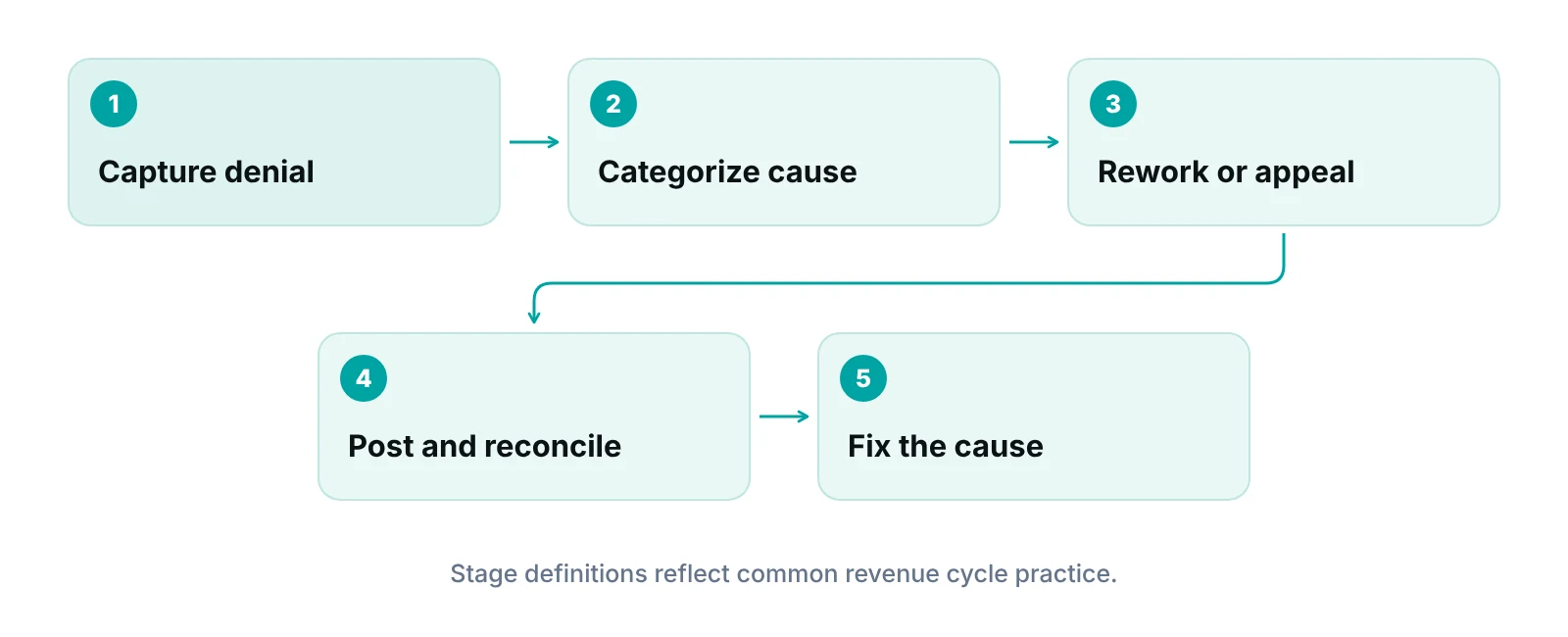
The process has five stages: capture every denial, categorize it by reason, rework or appeal it inside the deadline, post and reconcile the result, and fix the upstream cause. Most practices do the first three and skip the last two. That is why the same denials come back next month.
Stage 1 and 2: capture and categorize
Post the electronic remittance advice (ERA) the day it arrives. For each denial, log the payer, claim, dollar amount, reason codes and the last date you can appeal. Then sort by cause, because the cause decides who fixes it:
- Front end: eligibility, registration, prior authorization.
- Coding and charge capture: modifiers, code pairs, missing charges.
- Clinical: medical necessity and documentation requests.
- Timing: timely filing and late submission.
Stage 3 and 4: rework, appeal and reconcile
Correctable errors go back as corrected claims. Disputed decisions go to appeal with supporting documentation attached. Give every rework an owner and a due date. Then post every outcome, including write-offs, so you can see appeal results by payer at the end of each quarter.
Stage 5: prevent repeat denials
Prevention is where a denial program earns its keep. When one code keeps returning, fix it at the source: a front-desk eligibility check, a coder edit or an authorization step. Premier’s survey found that 10.4 percent of denied claims in 2023 had prior authorization, up from 3.2 percent in 2022. Even authorized services need a claim-level check against the authorization on file. Two controls catch most upstream problems: claim scrubbing before submission and an insurance verification step at scheduling.
See where your denials start
Our free practice audit reviews a sample of your recent claims and maps which denial causes cost you the most. It does not change your workflow.
Which denial reason codes should you track?
Track the claim adjustment reason code (CARC), the remark code (RARC) and the group code on every denial. X12 maintains these code lists. A CARC gives the reason for an adjustment, and a RARC adds detail or sends processing information (X12). The group code, such as CO (Contractual Obligation) or PR (Patient Responsibility), generally assigns responsibility for the adjustment amount (X12).
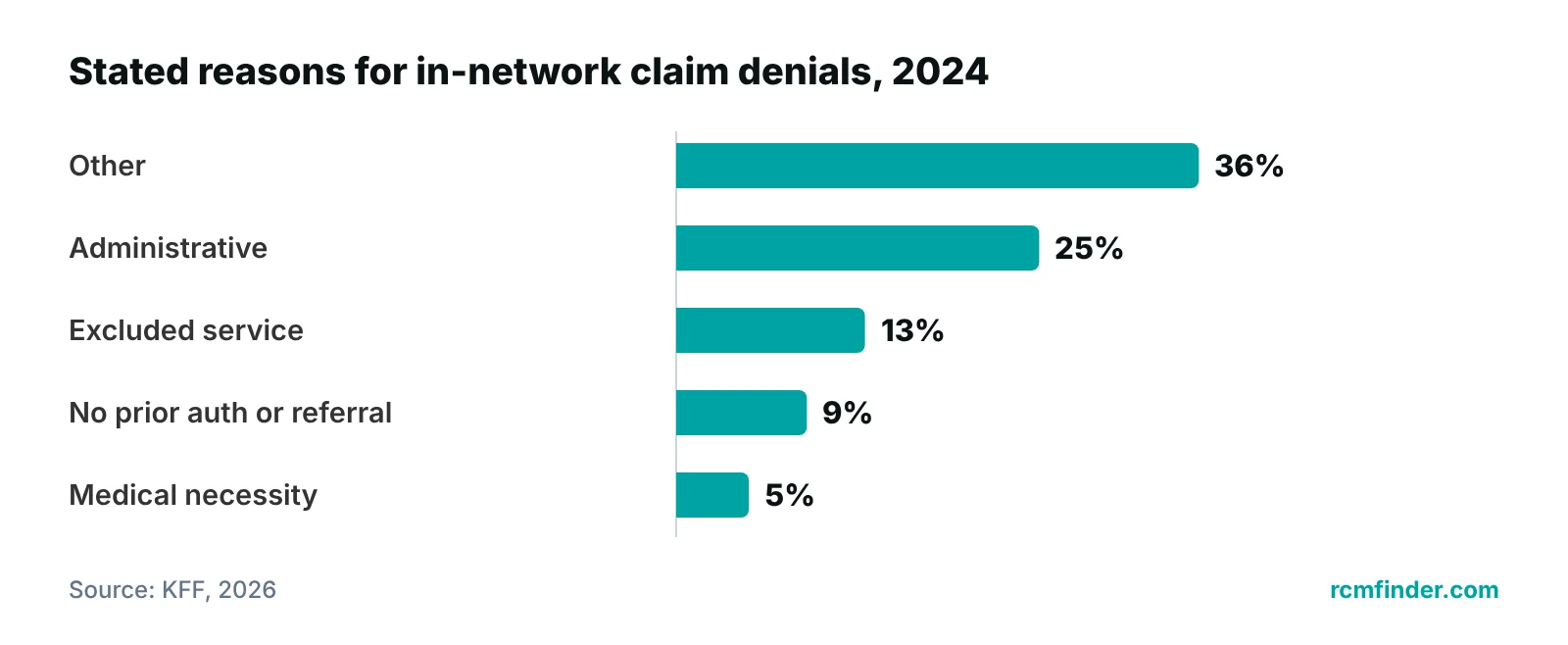
KFF’s 2024 data shows why your own code-level tracking matters. The largest bucket of marketplace denials, 36 percent, was labeled “other.” Administrative reasons were 25 percent, excluded services 13 percent, missing prior authorization or referral 9 percent, and medical necessity 5 percent.
| CARC | X12 description (wording as published) | Where to look first |
|---|---|---|
| 4 | The procedure code is inconsistent with the modifier used. | Modifier edits in your scrubber |
| 16 | Claim/service lacks information or has submission/billing error(s). | The remark code that comes with it; see our CO-16 guide |
| 22 | This care may be covered by another payer per coordination of benefits. | Coverage and payer order at the visit |
| 29 | The time limit for filing has expired. | Unsent charges by days since service |
| 50 | Non-covered services because this is not deemed a “medical necessity” by the payer. | Payer coverage policy and documentation |
| 97 | The benefit for this service is included in the payment/allowance for another service/procedure that has already been adjudicated. | Code pairs and modifiers, with a coder |
| 197 | Precertification/authorization/notification/pre-treatment absent. | Authorization record before the visit |
| 252 | An attachment/other documentation is required to adjudicate this claim/service. | What the paired remark code asks for |
Source: X12 Claim Adjustment Reason Codes (current list, checked Oct. 2026). The third column is RCM Finder guidance, not X12 text.
CARC 16 must be accompanied by at least one remark code under the X12 usage notes. For example, the X12 remark code MA130 says the claim has incomplete or invalid information, that no appeal rights are afforded because the claim is unprocessable, and that a new claim should be submitted with correct information. When you see that pairing, send a corrected claim instead of an appeal. Our CO-16 denial code guide walks through the remark codes. We also cover CO-197 and CO-22 in their own posts.
Code lists change
X12 updates its code lists on a regular schedule, and payers publish their own guidance on how they use each code. Check the current X12 list and your payer’s remittance guidance before you build rules around any code. Have a certified coder review denials that involve modifiers or bundling (CARC 4 and 97).
How do you appeal a denied claim before the deadline?
Work denials by dollars at risk and days left to appeal, not by the order they arrived. The deadline on the denial notice and in your payer contract controls. For Original Medicare, the first level of appeal is a redetermination by the Medicare Administrative Contractor (MAC).
Under 42 CFR 405.942, a redetermination request must be filed within 120 calendar days of receiving the notice of the initial determination. Receipt is presumed to be 5 days after the date of the notice unless there is evidence otherwise. A contractor may extend the period if you show good cause in writing. Medicare.gov lists the later levels:
| Level | Who decides | Filing deadline | Minimum amount |
|---|---|---|---|
| 1. Redetermination | Medicare Administrative Contractor (MAC) | 120 days from receipt of the initial determination notice | None |
| 2. Reconsideration | Qualified Independent Contractor (QIC) | 180 days after you get the MAC’s decision | None |
| 3. Hearing or on-the-record review | Office of Medicare Hearings and Appeals (OMHA) | 60 days from the date of the QIC’s decision (OMHA page: 60 days of receipt) | $200 for 2026 |
| 4. Appeals Council review | Medicare Appeals Council | 60 days after you get the ALJ’s decision | None |
| 5. Judicial review | Federal district court | 60 days after you get the Appeals Council’s decision | $1,960 for 2026 |
Sources: 42 CFR 405.942 (eCFR); Medicare.gov, Appeals in Original Medicare; CMS, Third Level of Appeal (OMHA). Medicare.gov says the MAC and QIC each decide within 60 days of receiving the appeal. Dollar thresholds are reset each calendar year.
Medicare Advantage plans and commercial payers set their own appeal windows, so read the denial notice and the provider contract for each. Appeal speed also depends on claim filing: Medicare requires a claim to reach the MAC within one calendar year of the date of service (Noridian, citing 42 CFR 424.44), so a corrected claim sent late can fail on timing alone.
A useful rule is to set your internal deadline at about half of the payer’s window. That leaves time to gather records and avoids last-week rushes. Because KFF found that fewer than 1 percent of denied marketplace claims were appealed, a team that appeals what it can document is already ahead of the pattern.
Do you know how much is sitting unworked?
The audit counts denials that have aged past your appeal windows and shows the most common causes. It is free, and you decide what happens next.
Should you handle denials in-house, with software or through a service?
Handle denials in-house when one trained biller can clear the queue inside every appeal window. Add software when volume outgrows spreadsheets. Bring in a service when denial follow-up competes with work your team cannot drop. The deciding measure is how many denials age past 30 days unworked.
In-house team
This works when volume is steady and your biller has time to call payers and write appeals. The risk is concentration: if the one person who knows the queue is out, appeal windows keep running.
Denial management software
Software tracks, categorizes and reports. It does not call payers, gather records or write appeal letters, so someone still owns the queue. A claim-tracking tool is most useful when it shows a stage and an owner for each claim. A practice management system that tracks claims by stage lets a manager see which denials are open, who holds them, and where claims stall. RCM Finder’s portal does this today with role-based permissions, an audit log and reporting dashboards. It is a claim-centered system, not an EHR.
Outsourced denial management
A service takes over the follow-up and appeals work. Our denial management services work inside your existing EHR (for example PrognoCIS, eClinicalWorks or athenahealth). Before you sign with any vendor, ask who owns each denial from receipt to resolution, how you will see appeal results by payer, which EHRs the team works in, and whether it will sign a Business Associate Agreement before it sees patient data. Our accounts receivable guide covers the follow-up side.
“A denial queue is a list of problems your practice already knew how to prevent. The work is deciding which three to fix first.”
— Awais Afzal, Healthcare Operations & Data Analyst
Specialty matters too, because modifiers, authorizations and documentation rules differ by specialty. See our specialty billing pages for how we approach each one.
Our recommendations
- Run a denial report by reason code every month. We recommend ranking your top five CARCs by dollars, not by count. A few high-dollar codes usually outweigh many small ones.
- Log the remark code with every CARC. Without the RARC you cannot see patterns. Add separate columns for the CARC, RARC and group code in your tracker.
- Set the appeal date on the day the denial posts. Record the payer’s deadline and an internal deadline at about half that window. Use the notice and contract dates, not a rule of thumb.
- Give each top code one owner. Front desk can own eligibility and authorization codes. A coder can own modifier and bundling codes. Clinical staff can own documentation requests. Review progress in a short monthly huddle.
- Follow up on unpaid claims weekly. Any claim without a payer response past your target window gets a status check the same week. HFMA’s guidance is to resolve 85 percent of denials within 30 days.
- Use appeal results in payer conversations. Track overturn rates by payer. If one payer keeps denying a well-documented service, bring that data to your next contract discussion.
Track every denied claim by stage, with a named owner.
The RCM Finder portal is a claim-centered practice management system, not an EHR. It tracks claims by stage with an owner, and it uses workflow rules, role-based permissions, an audit log and reporting dashboards so managers can see which denials are open and who holds them.
See how the RCM Finder portal works · Create a portal account
Disclosure: RCM Finder builds and sells this portal. It is a practice management system, not an EHR.
Bottom line
Denial management in medical billing pays off when someone owns the queue, tracks reason codes by dollar, and fixes causes at the source. Start by measuring your own denial rate and aging. If the queue is outgrowing your team, our denial management team can take over the follow-up, or you can talk to us about where to begin. Pricing is quoted after a free audit.
Frequently asked questions
What is the difference between a claim rejection and a denial?
A rejection is stopped before the payer adjudicates the claim, usually for a data or format error, and you fix and resend it. A denial comes after adjudication and needs a corrected claim or an appeal. Track them separately, because each has a different fix and a different effect on your denial rate.
What is a good denial rate for a medical practice?
HFMA’s general provider guidance puts the industry average between 5 and 10 percent, with under 5 percent as optimal, measured in dollars (HFMA, 2023, updated 2024). It is not specialty-specific. Calculate your own rate the same way every month and compare it with your own trend first.
How long do I have to appeal a Medicare denial?
For a Medicare redetermination, 120 calendar days from receiving the notice of initial determination, with receipt presumed 5 days after the notice date (42 CFR 405.942). Later levels have their own windows, shown in the table above. Medicare Advantage and commercial plans set their own deadlines, so read the denial notice.
Should I appeal a CO-16 denial?
Usually no. CARC 16 means the claim lacks information or has a billing error. When the paired remark code says the claim is unprocessable, such as MA130, no appeal rights apply and you submit a new claim with correct information. Check the remark code first.
Can a small practice manage denials in-house?
Yes, if one trained person can clear the queue inside every appeal window and the top reason codes are reviewed monthly. If denials regularly age past 30 days unworked, or follow-up competes with front-desk duties, software or an outsourced service is worth evaluating.
How does RCM Finder work with my EHR?
Our team works inside your existing EHR, for example PrognoCIS, eClinicalWorks or athenahealth. We do not claim an official partnership with any of them. Other systems are reviewed during the free audit. We put a Business Associate Agreement in place before accessing patient data.
Get your free practice audit
Tell us about your practice. We will contact you using the details you give.
- A review of your recent claims, denials and A/R aging
- Where your front desk and prior authorizations slow payment
- A prioritized fix list you keep, whether or not you hire us
Pricing is quoted after the audit, based on your volume and the services you choose. Prefer to talk? Call +1 (302) 556-2288.
Sources
- Claims adjudication costs providers $25.7 billion — Premier Inc. (2025)
- Claims Denials and Appeals in ACA Marketplace Plans in 2024 — KFF (2026)
- 7 KPIs providers should be tracking — HFMA (2024)
- Appeals in Original Medicare — Medicare.gov (2026)
- Third Level of Appeal: Decision by OMHA — CMS (2026)
- 42 CFR 405.942 Time for filing a request for a redetermination — eCFR (2026)
- Claim Adjustment Reason Codes — X12 (2026)
- Remittance Advice Remark Codes — X12 (2026)
- Claim Submission Timeliness — Noridian Medicare JF Part B (2026)
Disclaimer: This post is general educational information about revenue cycle operations. It is not legal, coding, billing-compliance or financial advice. Code definitions, payer rules, filing limits and appeal rights vary by payer and plan and change over time. Confirm requirements with the payer and qualified advisors before acting.
