
A good virtual assistant course for healthcare work teaches medical terminology, scheduling, insurance basics and HIPAA, and leaves you with work samples you can show an employer. Check accreditation yourself, treat income promises as a warning sign, and read the refund terms before paying anything.
Most advice on this topic ranks named programs and quotes prices. This guide does neither. Prices change, and a provider’s own page is the only fair place to read what it offers. What does last is a method: what a healthcare-focused virtual assistant needs to know, how to test any course against that list, and what a practice will look for when it reads your application. It is written mainly for people choosing training. Practice managers who hire remote staff will find a section near the end on what to ask. The work discussed here is non-clinical administrative work only.
Key takeaways
- A course is optional. The U.S. Bureau of Labor Statistics lists a high school diploma or equivalent as typical entry education for secretaries and administrative assistants, with most duties learned on the job.
- For healthcare work, the useful content is medical terminology, scheduling, insurance basics, EHR habits and privacy. Marketing a freelance business is a separate skill.
- Verify accreditation yourself in the U.S. Department of Education’s database, and walk away from income promises or pressure to buy now.
- A training certificate does not make you HIPAA compliant. The practice or agency you work for must still train you and, for outside vendors, sign a business associate agreement.
- Work samples beat certificates. Build three or four mock documents that show you can follow a process and write clearly.
What should a virtual assistant course teach for healthcare work?
A healthcare-focused course should cover medical terminology, appointment scheduling, insurance and benefits basics, how to work inside an electronic health record, written communication, and patient privacy. A generic course that stops at email and calendars will leave you short of what a medical office asks for.
The U.S. Bureau of Labor Statistics says medical secretaries need to be familiar with medical terminology and codes, and that they may train for several months as they learn industry-specific terminology and practices. The same page says the work includes processing insurance payments and taking simple medical histories. That is a useful checklist for reading any syllabus.
A practical syllabus checklist
- Medical terminology and basic anatomy words. Enough to read a referral or an order without guessing.
- Scheduling logic. Visit types, provider templates, double-booking risk, reminders and no-show handling.
- Insurance basics. Reading an insurance card, checking eligibility, copays, deductibles, referrals and the idea of prior authorization.
- Phone and written etiquette. Scripts for sensitive calls, short clear messages, accurate notes.
- EHR and software habits. Navigation, careful data entry and how to avoid editing the wrong chart. A course cannot teach every EHR, so ask how it handles this.
- Privacy. What counts as protected health information and what to do when you are unsure.
Each topic maps to real tasks. For instance, insurance verification and prior authorization are two of the jobs practices most often hand to remote staff, so a course that mentions neither is worth questioning.
Do you need a course at all?
No. A course can shorten your learning curve, but it is not a license, and most employers hiring for administrative roles care more about accuracy and reliability than about a certificate.
The Bureau of Labor Statistics lists a high school diploma or equivalent as the typical entry-level education for secretaries and administrative assistants and says workers usually learn their duties on the job over several weeks. For medical secretaries, BLS reported 979,000 jobs in 2025 and projected 5 percent growth from 2025 to 2035, attributed mainly to growth in the healthcare industry. Those figures cover the occupation as a whole, not remote work specifically, so treat them as a sign of steady demand rather than a forecast for virtual roles.
There is no single national credential required to work as a virtual assistant. Some training bodies award their own certificates, and their value depends on who recognizes them. Before paying for one, find three job postings you would like to apply for and read what they ask for. If none mention a certificate, spend the money on practice time instead.
Try a free test first
Spend a week on free material: a medical terminology list, a sample insurance card, a mock schedule. If you enjoy it and finish it, paid training is a lower risk. If you stall, you have learned that cheaply.
Which type of training fits your situation?
Four routes cover most options: a self-paced online course, a program from an accredited school, a freelance business program, or learning on the job with an employer or agency. The right one depends on whether you need a credential, structure or a job pipeline.
| Route | Good for | Watch for | Ask before you commit |
|---|---|---|---|
| Self-paced online course | Low-risk skill building, such as spreadsheets, scheduling tools or medical terminology | No feedback, no recognized credential, and quality varies widely | Can I see a sample lesson and the refund terms in writing? |
| Program at an accredited school | People who want a recognized credential or plan to continue studying | Curriculum may lag current workflows; may not cover freelancing | Is the school or program listed in the federal accreditation database, and by which agency? |
| Freelance business program | People who want to run their own client business | Often teaches sales more than healthcare work; may promise income | What exactly is taught about healthcare privacy? What proof supports any income statement? |
| On-the-job training at an agency or practice | Learning real workflows with supervision | Fewer portable credentials; training quality depends on the employer | Who trains me, on which systems, and who signs the HIPAA paperwork? |
Source: RCM Finder editorial comparison; no provider data used.
None of these is the best for everyone. A person who wants a steady remote job in a medical office may do better with a short skills course plus an agency or employer that provides on-the-job training than with an expensive business program built for freelancers.
How do you check a course before you pay?
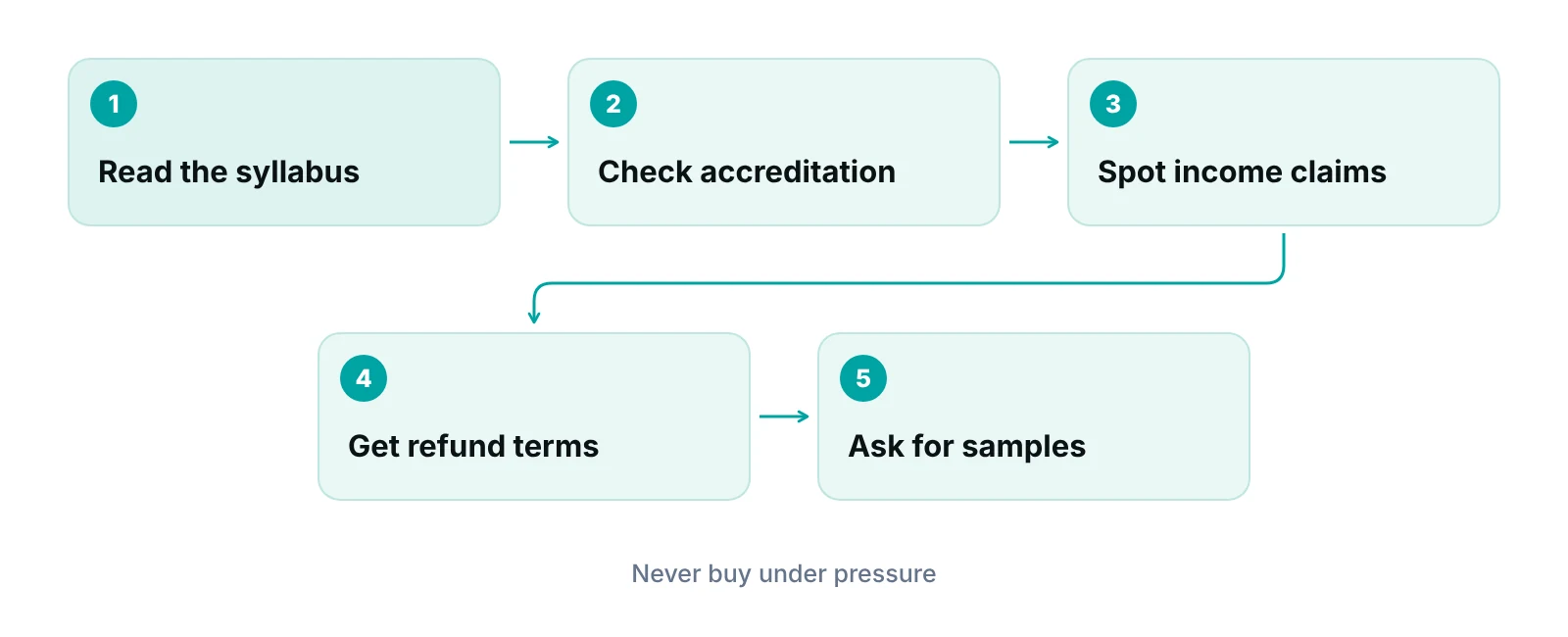
Check three things before paying: whether the school is accredited by a recognized agency, whether the sales page makes earnings promises, and whether you can get the refund terms in writing. Each takes a few minutes.
1. Look up accreditation yourself
The U.S. Department of Education says on its higher education FAQ that it does not accredit institutions or programs. Independent accrediting agencies do, and the Department publishes a list of agencies it recognizes. The same page points to the Department’s DAPIP database for confirming that a school or program is accredited, including online programs. Do not rely on a badge on the school’s own site. Search the database and note the agency named.
2. Treat earnings promises as a warning sign
A Federal Trade Commission consumer alert on deceptive money-making claims lists warning signs that fit course marketing closely. They include false or misleading earnings claims, claims that you do not need experience to earn income, claims that you must act immediately, and claims that buying is risk-free. The alert says any company that discourages you from taking time to study its offer is one to avoid.
3. Get the refund and delivery terms in writing
Ask for the refund policy as a document, not a chat reply. Note any conditions, such as finishing a number of lessons before you can ask for money back. Find out whether you keep access to the material, who answers questions, and whether the instructor has worked in a medical office. A course that avoids these questions has answered them.
Which skills do healthcare employers actually test?
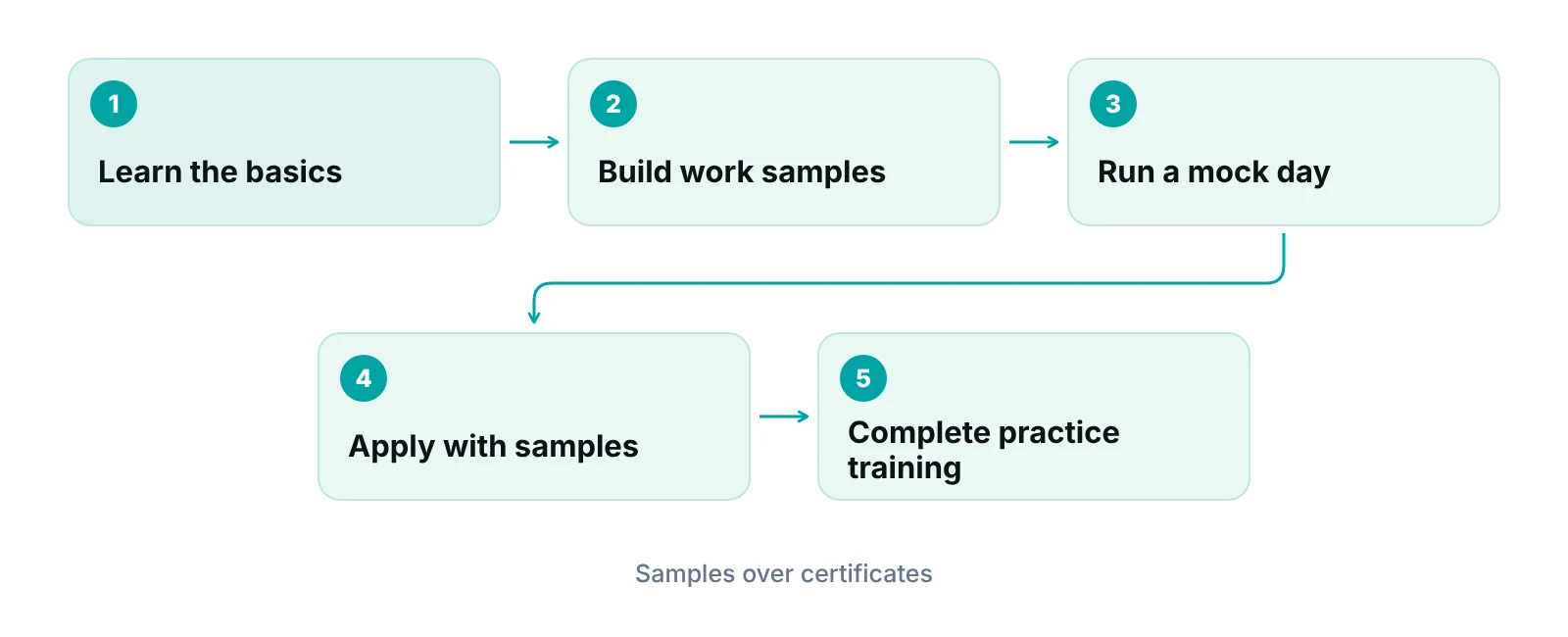
Employers test accuracy, clear writing and judgment about privacy more than software certificates. The fastest way to show these is a small set of work samples you create yourself, using made-up patients and made-up practices.
| Skill | Why a practice needs it | Work sample to build |
|---|---|---|
| Scheduling | A full, correctly booked day protects provider time and patient access | A mock weekly schedule with visit types, buffers and a note on how you would handle a no-show |
| Insurance basics | Wrong coverage details lead to claim problems later | A fictional benefits check note listing plan, deductible, copay, referral and authorization needs |
| Written communication | Patients and payers act on what you write | Three sample messages: a reminder, a rescheduling note and a records request |
| Prior authorization tracking | Missed deadlines delay care and payment | A tracker template with status, owner, due date and follow-up date |
| Privacy judgment | Mistakes with patient information can become reportable incidents | A one-page summary of what you would not put in email, text or a shared document |
Source: RCM Finder editorial guidance. Use fictional data in every sample.
Never use real patient information in a portfolio, even with names removed. Build samples from invented cases.
The traits a course cannot give you
- Self-checking. Re-read the date, the provider and the patient before saving.
- Anticipation. Notice a visit with no confirmation sent, or a referral with no matching order, and flag it.
- Calm with upset callers. Patients may be in pain or worried about cost. A steady script helps.
- Knowing when to ask. Staying inside your role and escalating clinical questions to a clinician.
“In a medical office, the assistant who checks twice and asks early saves more time than the one who works fastest.”
What does HIPAA require of someone trained as a virtual assistant?
A course certificate does not make you HIPAA compliant. HIPAA places the duty to train staff on the covered entity, meaning the practice, and requires a written business associate agreement when an outside party handles patient information on a practice’s behalf.
Under 45 CFR 164.530(b), as published in the Code of Federal Regulations, a covered entity must train all members of its workforce on its privacy policies and procedures as necessary for their functions. New workforce members must be trained within a reasonable time after joining, and the entity must document that training was provided. In practice, a general course helps, but the practice still has to train you on its own policies.
The HHS Office for Civil Rights explains that a covered entity may disclose protected health information to a business associate only after getting satisfactory assurances in writing, usually a business associate agreement. It lists billing and practice management among the activities a business associate may perform, and says subcontractors that handle the information for a business associate are covered too. If you plan to work as a freelancer, expect clients to ask for such an agreement. If you work through an agency, ask who signs it and what the agency requires of you.
Do not store patient data on personal accounts
Whatever your training says, follow the written rules of the practice or agency. Use only approved systems, and never move patient information to personal email, personal cloud storage or messaging apps. See our guides on the HIPAA guidelines for front desk staff and the HIPAA compliance checklist for practices.
Freelancer, agency worker or remote employee: what changes?
The arrangement you choose decides who trains you, who signs the privacy paperwork and who supplies equipment. Compare these before accepting any offer, because they matter as much as the course you took.
| Arrangement | Who typically handles HIPAA paperwork | Who sets the workflow | Question to ask |
|---|---|---|---|
| Freelancer with your own clients | You and each client; expect to be asked for a business associate agreement | The client, though you carry the business tasks | Do I have a contract that defines my tasks, systems and data handling? |
| Worker placed by an agency | The agency, with the practice; the agency may need subcontractor terms with you | The agency and the practice together | Who trains me and who signs what before I see a chart? |
| Remote employee of a practice | The practice, as part of its own workforce training | The practice | Which policies will I be trained on, and when? |
Source: RCM Finder editorial summary, based on HHS business associate guidance and 45 CFR 164.530(b). Contract and tax treatment vary; confirm with an adviser.
Tax treatment and contract terms differ by arrangement and by state. Ask an accountant or attorney before you sign, rather than relying on a course to tell you.
If you manage a practice: what should you ask a trained remote assistant?
Treat a course certificate as a conversation starter, not a clearance. Ask for a work sample, a short scheduling or insurance exercise, and a clear answer on how they handle patient information.
- Ask them to talk through a scheduling conflict and a benefits check, using a fictional case.
- Confirm you will sign a business associate agreement where required, and that your own training and access rules apply before they see any data.
- Start with one task, review output daily for the first weeks, and widen scope only after errors are rare.
- Keep clinical questions, patient advice and anything requiring a license with licensed staff.
If building a remote team is not a priority, an established service can take on defined tasks. Our virtual medical assistants cover scheduling, eligibility checks, prior authorizations and intake, working in your practice’s time zone and inside the EHR you already use. For role comparisons see our guides on a dental virtual assistant, virtual nursing assistants and choosing a virtual assistant service. Different specialties also place different demands on front-desk staff, as the specialties we support show. How a front desk affects collections is covered in front desk staff and the revenue cycle.
See how a remote front desk works
Our free practice audit looks at your phone, scheduling and verification workload and shows which tasks could move to remote staff. Pricing is quoted after the audit.
Our recommendations
- Test before you buy. We recommend a week of free material first. If you finish it and want more, paid training is lower risk.
- Match the course to the job. Read three real job postings and compare them with the syllabus. Buy only for gaps.
- Verify accreditation yourself. Search the federal database rather than trusting a badge, and note which agency accredits the program.
- Get refund terms in writing. Ask for the policy as a document before paying, and keep a copy.
- Build fictional work samples. Make three or four documents from invented cases: a schedule, a benefits note, a message set and a tracker.
- Expect the practice to train you. Ask any employer or agency about HIPAA training and the business associate agreement before accessing patient data.
- Stay non-clinical. Escalate any health question to a licensed clinician, and never offer medical advice.
Bottom line
The best virtual assistant course is the one that matches the job you want and passes your checks. Look for healthcare content, verify accreditation, ignore income promises and build work samples. For practices weighing remote help, see our virtual medical assistant services, or start with our appointment scheduling services if the schedule is the gap.
Frequently asked questions
Do I need a certificate to work as a virtual assistant?
Usually not. The Bureau of Labor Statistics lists a high school diploma or equivalent as typical entry education for secretaries and administrative assistants, with duties learned on the job. A certificate can help you stand out, but a reviewer will care more about accurate work samples. If you do buy a course, buy it for the skills, not the paper.
How do I know if a virtual assistant course is legitimate?
Look up the school or program in the U.S. Department of Education’s accreditation database, read the refund terms in writing, and be wary of income promises or pressure to buy now. The FTC lists those as warning signs. Ask for a sample lesson before you pay, and keep screenshots of the sales page so you can compare what was promised with what you receive.
Is there a virtual assistant course specifically for medical offices?
Some programs focus on medical administrative work, but quality and recognition vary. Judge any of them by its syllabus: medical terminology, scheduling, insurance basics, EHR habits and HIPAA. If it lacks these, it is a general course with a medical label. Also ask how it handles EHR practice, since a course cannot teach every system.
Does a HIPAA training certificate let me work with patient data?
No. HIPAA requires the covered entity to train its workforce on its own policies and to document it. An outside party handling patient information also generally needs a written business associate agreement. A course certificate can supplement this but cannot replace it.
How long does it take to become job-ready?
It depends on your starting point and the employer. BLS says medical secretaries may train for several months to learn industry terminology and practices, and many duties are learned over several weeks on the job. Judge readiness by whether you can complete a sample scheduling and benefits exercise accurately.
Should a practice hire a freelancer or use a service?
A freelancer can suit one defined task with close supervision. A service can suit teams that want continuity and coverage. Either way, put the privacy paperwork and access rules in writing first and start with one task, such as next-day benefit checks, so you can review the results before widening the scope.
Get your free practice audit
Tell us about your practice. We will contact you using the details you give.
- A review of your recent claims, denials and A/R aging
- Where your front desk and prior authorizations slow payment
- A prioritized fix list you keep, whether or not you hire us
Pricing is quoted after the audit, based on your volume and the services you choose. Prefer to talk? Call +1 (302) 556-2288.
Sources
- Medical Secretaries and Administrative Assistants (Occupational Outlook Handbook) — U.S. Bureau of Labor Statistics (2025)
- FTC puts over 1,100 businesses on notice about deceptive money-making claims — Federal Trade Commission (2023)
- Higher Education FAQ (accreditation and DAPIP) — U.S. Department of Education (2026)
- 45 CFR 164.530 Administrative requirements — Legal Information Institute, Cornell Law School (CFR text) (2026)
- Business Associates — HHS Office for Civil Rights (2026)
Disclaimer: This article is general educational information. It is not legal, HIPAA compliance, tax, employment or career advice. It does not rank or recommend any course provider. Course offerings, prices and accreditation change, so check each provider's own page and the accreditation database yourself. Have counsel review any business associate agreement or contract before you sign.