
Dental social media marketing works when posts show the team, the office and patient education without identifying any patient. Anything that does identify a patient needs a signed HIPAA authorization first. Add FTC disclosure for staff and incentive posts, check each platform's health ad rules, and measure booked patients rather than likes.
One photo with a patient in the background of a team picture can undo a month of good posts. This guide is for dentists, office managers and group owners who want a post plan that is safe to repeat. It sits under the dental practice management guide, which covers the whole practice.
The rules for every dental ad are in the dental marketing plan and are not repeated here. This post covers what is specific to social media: what to post, when a patient photo needs authorization, how FTC endorsement rules reach staff and incentives, platform health ad policies, a four-week calendar and what to count.
Key takeaways
- Post team, office, education and insurance basics; anything showing a patient needs written authorization.
- HHS enforcement has reached testimonials with patient names and photos ($25,000, 2016) and replies to online reviews ($30,000, 2023).
- The FTC expects disclosure of free care, family or employment ties; bare hashtags are generally inadequate.
- Health data in ad targeting or tracking pixels is the risky part of boosted posts.
- Count inquiries and booked new patients by source; reach and likes only diagnose content.
What can social media realistically do for a dental practice?
Social media shows patients who works in the practice and how care is explained, so someone who already found the office feels more sure about booking. It seldom replaces search, the Google profile or a well-handled phone call.
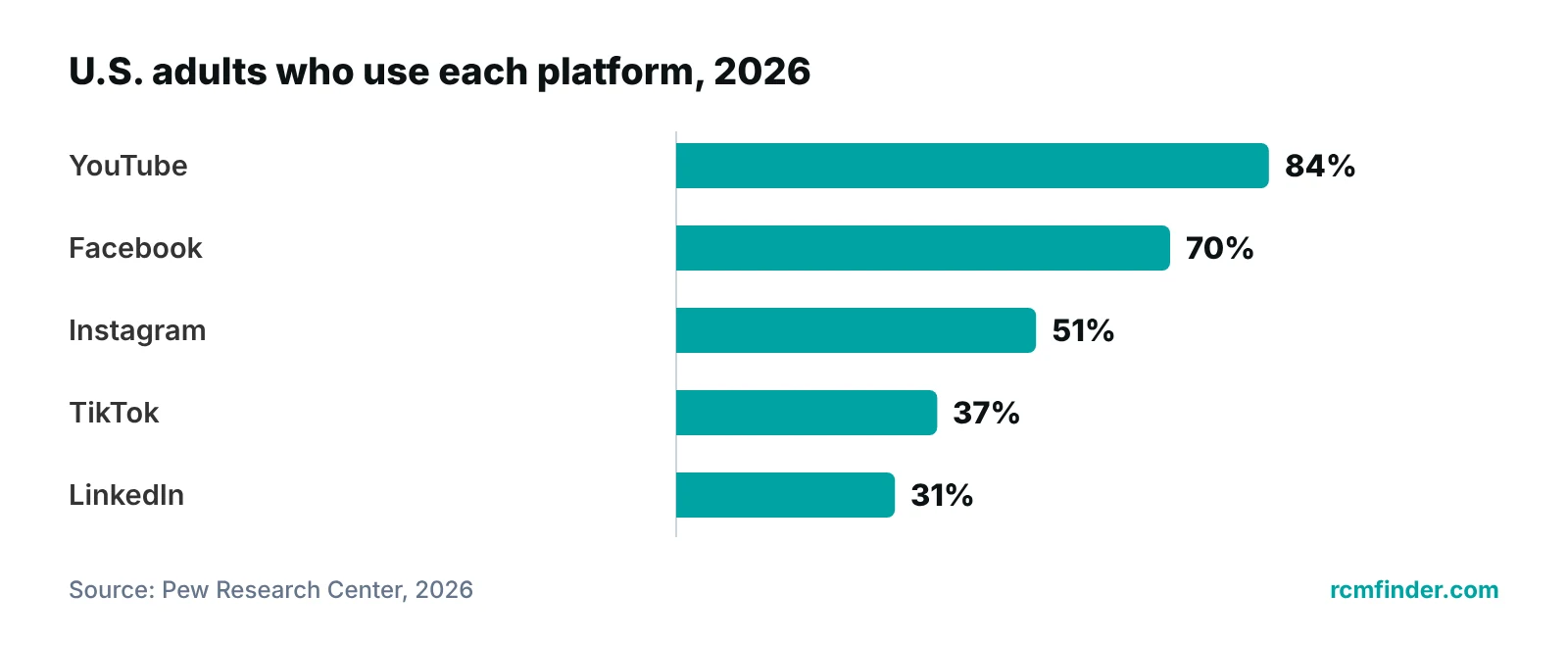
Patients are on the platforms. Pew Research Center’s 2026 survey of 5,511 U.S. adults, fielded from January 30 to June 18, 2026, found 84% use YouTube, 70% Facebook, 51% Instagram, 37% TikTok and 31% LinkedIn.
- Facebook: hours changes, community events and team news.
- Instagram: office and team photos and short explainer videos.
- YouTube: longer procedure explainers patients watch before a consult.
- TikTok: short educational clips, once the first platforms run without strain.
- LinkedIn: recruiting hygienists and assistants, and referring specialists.
These jobs are suggestions. Two platforms done steadily beat five done in bursts.
What should a dental practice post, and what should it avoid?
Post what helps a patient decide without identifying one: team introductions, office tours, aftercare and procedure explainers, insurance basics and community news. Content showing a real patient needs authorization.
Vendor calendar guides say patient stories and before-and-after content “need clear review” but name no rule (CloudCampaign). The table sorts post types by what must happen before they go live.
| Post type | Authorization or permission | Check before posting |
|---|---|---|
| Team introductions and staff tips | Staff agree in writing to appear | Staff disclose that they work there |
| Office tour or reception video | None if no patient is visible or audible | Screens, charts, schedule boards and X-rays in frame |
| Aftercare tips and procedure explainers | None | Clinician reviews wording; no guarantees or claims of superiority |
| Insurance and payment explainers | None | Plans named match current contracts |
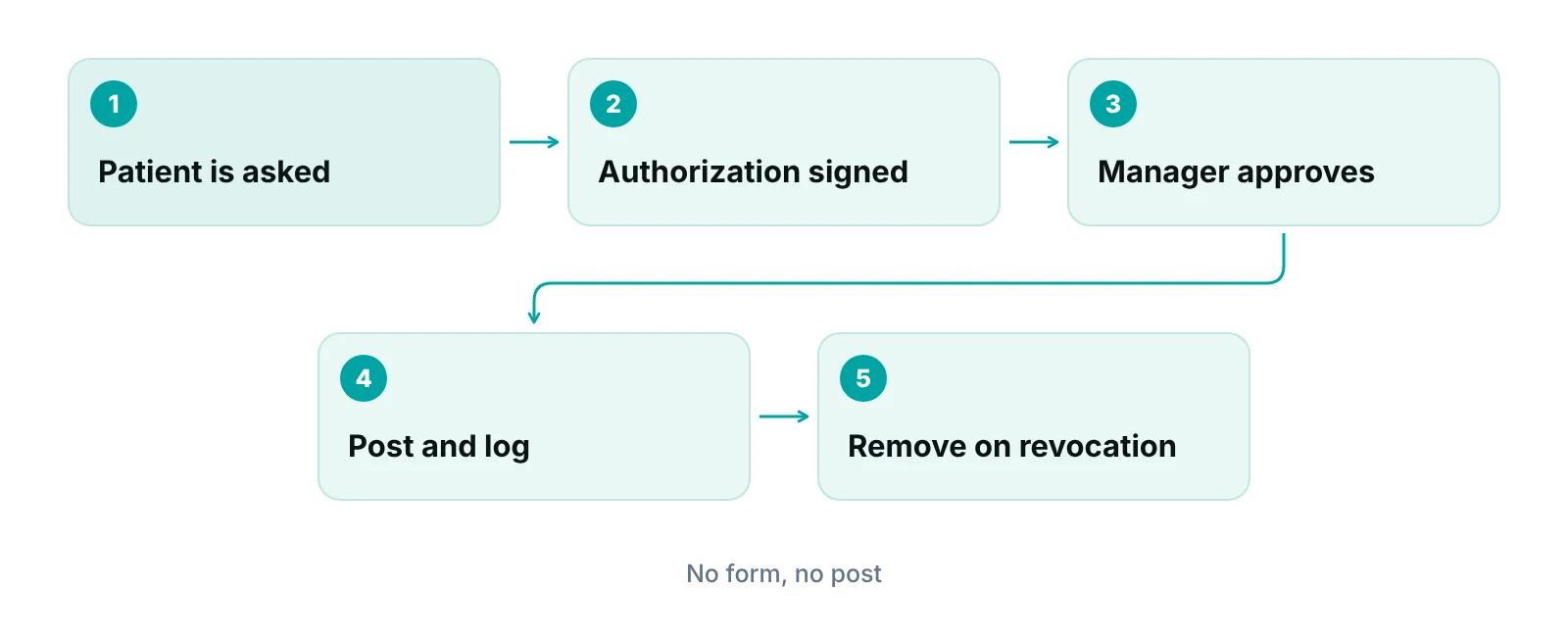
| Patient photo, video or smile before-and-after | Signed HIPAA authorization, specific to the post | State board image rules; remove on revocation |
| Patient story or testimonial, even without a name | Signed HIPAA authorization | Confirming someone is a patient can breach privacy |
| Reposting a patient’s own post or tag | Written permission before using it in practice marketing | A featured repost works as a testimonial |
| Replies to comments, reviews and direct messages | Not applicable | Do not confirm patient status; move details offline |
Source: ADA marketing and advertising page; HHS OCR Complete P.T. (2016) and Manasa Health Center (2023) resolution pages; FTC Endorsement Guides Q&A (page modified July 15, 2025). Staff and repost rows are practice recommendations.
Leave out guarantees, superiority and “painless” claims; the ADA page says some states prohibit them (ADA).
When do patient photos and stories need HIPAA authorization?
Treat any post that identifies a patient, or could lead someone to identify one, as needing a signed authorization before it goes live. HHS says marketing generally needs written authorization, and enforcement has reached testimonials and review replies.
HHS defines marketing as a communication that encourages people to buy or use a product or service. Marketing communications can occur only after the individual signs an authorization, with exceptions for face-to-face conversations and promotional gifts of nominal value (HHS Office for Civil Rights). The ADA tells dentists that a photo or video of a patient, “even just sitting in the waiting area,” may be protected health information (ADA).
Two cases show the pattern. Complete P.T., a physical therapy practice, posted patient testimonials with full names and full-face photographs without valid authorizations and paid $25,000 (published February 12, 2016; HHS OCR). Manasa Health Center in New Jersey answered negative reviews with patient details, exposing four patients’ information; it paid $30,000 and accepted two years of monitoring (HHS OCR, 2023). The 2019 Dallas dental case is in the dental marketing plan.
What a valid authorization contains
Under 45 CFR 164.508 an authorization needs (Cornell LII, 45 CFR 164.508):
- A specific description of the information, such as photographs of the patient’s smile taken on a set date.
- Who may use or disclose it, and who may receive it.
- Each purpose, such as posting on the practice’s Instagram and website.
- An expiration date or event.
- The patient’s signature and date, with a personal representative’s authority if one signs.
- Statements on revoking in writing, whether treatment depends on signing, and possible redisclosure.
The form must be in plain language and the patient gets a copy. A packet line saying “we may post photos” is unlikely to contain these elements. Treatment generally cannot depend on signing, and a release can be revoked in writing, so log where each item ran.
Have counsel review the form
This is a conservative reading of the sources, not a quoted rule that every photo needs a form. Have your attorney approve the wording. The HIPAA compliance checklist for medical practices covers the wider program.
Which FTC and ADA rules apply to posts, staff and incentives?
The FTC expects any paid, free or personal connection behind a post to be disclosed clearly, and holds the practice responsible for what others say for it. The ADA Code adds a standard for influencers.
- Material connections. The FTC says a payment, free goods, or a family or employment tie should be disclosed when it would affect how people weigh the endorsement, and that a disclosure in one post may be needed in every post (FTC Endorsement Guides Q&A).
- Staff posts. The FTC says employees who promote their employer should disclose it, and that listing the employer on a profile is not enough. Employers should remind staff of the policy periodically.
- Where the disclosure goes. Hashtags and “Disclosure” buttons are generally inadequate; put it at the start; on Stories, superimpose it on the image, and in video put it in the video itself (FTC Disclosures 101).
- Rewards for reviews. Conditioning a discount or reward on positive reviews is deceptive, and asking only satisfied customers can mislead (FTC Q&A). The FTC reviews rule, effective October 21, 2024, bars incentives that depend on a positive or negative opinion.
- Fake followers. Section 465.8 of the same rule bars buying fake indicators of influence, such as bot followers.
- Unusual results. If a post features exceptional results the practice cannot show are typical, the ad must clearly state generally expected results (FTC Q&A).
- Influencers and agencies. The FTC says advertisers need training, monitoring and pre-approval. The ADA’s 2025 update added advisory opinion 5.F.7 on social media, requires influencers to disclose paid partnerships, and treats paying an influencer a share of patient fees as fee splitting (ADA News, February 2025).
The ADA notes that many states regulate dental testimonials, with New York fines reaching $10,000 for each violation (ADA marketing page). The dental reputation management guide covers review requests and replies, and the guide to online reputation management for doctors the wider routine.
What do platform ad policies say about health content?
Boosted posts and ads follow health ad policies on top of community rules, and targeting or tracking built on health data is the part most likely to cause trouble. Policies change often, so read the current page before each campaign.
- Google. Google’s May 2025 update to its personalized advertising policy clarified that its “Health” sensitive interest category excludes content directed at healthcare professionals, and kept the existing ban on targeting people based on sensitive health conditions (Google Ads policy). Search ads are in the dental PPC and Google Ads guide.
- Meta. Meta’s policy page would not load for this review, so this rests on trade press. Search Engine Land reported in March 2025 that Meta restricts health advertisers that share health-related data, in tiers up to full loss of optimization, with triggers such as pixels on patient-portal pages and ad copy naming conditions (Search Engine Land). An agency guide adds that Meta bars ads implying knowledge of a person’s medical condition (Accelerated Digital Media). Confirm both on Meta’s current pages.
- TikTok. The Healthcare and Pharmaceuticals policy, last updated June 2026, is organized by country and has no dental section; cosmetic dentistry appears as an aesthetic treatment in several European markets (TikTok Ads). Read the U.S. entry before advertising.
- HIPAA and tracking. HHS says a tracking vendor handling protected health information needs a BAA, a cookie banner is not an authorization, and scheduling entries can be protected health information. A June 20, 2024 court ruling vacated part of the guidance (HHS OCR).
A boosted post is an ad
A boosted post carries the platform’s ad rules, the FTC’s and the state board’s. Do not target by health condition, keep tracking off booking and portal pages unless a BAA is in place, and see the tracking setup in the dental digital marketing guide.
What does a month of dental social posting look like?
A good calendar is one the practice can repeat. Start with three posts a week on one or two platforms, rotating four themes, and add volume only when the checks are routine. The cadence is a suggestion, not a benchmark.
| Week | Theme and posts | Check before posting |
|---|---|---|
| 1 | Team and office: a team introduction, an office tour, an hours notice | Staff consent on file; no patients, screens or schedule boards in frame |
| 2 | Education: an aftercare tip, a procedure FAQ, a short explainer | Clinician reviews wording; no guarantee or superiority claims |
| 3 | Access and coverage: insurance basics, the new-patient visit, a booking link | Plans listed match contracts; booking link sends no health data to ad platforms |
| 4 | Community and proof: a local event, team news, one authorized patient story | Signed authorization on file; no reward for reviews; staff disclose ties |
| Every week | Reply to comments and messages within one business day | Use a script that confirms nothing about care |
Source: RCM Finder suggested rhythm; the checks apply the HHS, FTC and ADA sources cited above.
Seasonal hooks, such as back-to-school checkups and a year-end benefits reminder, fit weeks 2 and 3. The dental patient retention guide covers recall and reactivation, which is where many of these posts should point.
What should a dental practice measure from social media?
Measure booked new patients by source, not likes. Reach and engagement show which topics to repeat; only appointments pay the practice.
| Number | Where it comes from | What it tells you |
|---|---|---|
| Reach and video views | Platform insights | Whether the content is being seen at all |
| Saves, shares and comments | Platform insights | Which topics patients find useful |
| Profile actions: calls, direction taps, website clicks | Platform insights, Google profile | Interest strong enough to act on |
| Inquiries by source | Call log and a “how did you hear about us?” field | Whether social media starts conversations |
| Booked new patients by source | Scheduling system, entered at booking | Whether inquiries turn into appointments |
| Patients who showed and accepted treatment | Scheduling and treatment records | Quality of the patients, not just the count |
| Comments and messages answered within a day | Inbox and comment log | Whether the front desk keeps up |
Source: RCM Finder suggested measurement set; funnel framework in the dental marketing plan.
Ask the source question on every first call and form, and record it in the scheduling system. The funnel from inquiry to paid patient is in the dental marketing plan. Keep analytics off pages that collect health details unless the vendor signs a BAA.
See what happens after a social media inquiry
A free practice audit reviews how inquiries, benefit checks and claims move through the practice, and what to fix first.
Who should post, approve and answer messages?
One named person should own the accounts, and a second should approve anything that shows a patient or makes a clinical or price claim. Write the rules down.
- Limit admin access to one or two people, and remove it when staff leave.
- Ban patient photos on personal phones; use an encrypted practice device.
- Check backgrounds for screens, charts, X-rays and appointment boards before every upload.
- Use a script for comments, reviews and messages that confirms nothing about care.
- Log each authorization, where the content ran and its expiry.
- If an agency posts for you, sign a business associate agreement before it sees patient information, and keep ad accounts in the practice’s name.
Offices short on front-desk coverage sometimes route messages to a remote assistant under the same script; see the dental virtual assistant guide. The posts also need a site behind them, covered in the dental website design guide.
Our recommendations
- Write a one-page social media policy before the next post. Name the account owner, the approver, what may be filmed and who answers messages. Train the whole team.
- Build the authorization form with counsel. Include every element of 45 CFR 164.508 and your state board’s image rules, and log each signed form.
- Lead with education and team content. It is safe, repeatable and builds trust. Use patient stories only with a signed form.
- Never confirm someone is a patient in public. Reply in general terms and move details to a phone call. We would rather leave a bad review unanswered for a day than answer it wrong.
- Disclose staff and incentive connections. Free care for a post, a staff member’s own review and a family tie each need a clear disclosure.
- Count booked patients, and ask the source question. Keep one source field in the scheduling system and review it monthly.
Bottom line
Dental social media marketing pays off when the content is safe to repeat and the booked patients are counted. Start with the policy and the authorization form, run the four-week rhythm for a quarter, and see how marketing fits the rest of the operation in the dental practice management guide. Practices that want help can start with RCM Finder’s healthcare digital marketing service.
Frequently asked questions
What should a dentist post on social media?
Post team introductions, office tours, aftercare tips, procedure explainers, insurance basics and community news. These help patients decide without identifying anyone. Keep patient photos, videos and stories for cases with a signed HIPAA authorization, and have a clinician review any wording about results.
Can a dental practice post patient photos or before-and-after images?
Only with the patient’s signed authorization that fits the post, and within your state board’s image rules. HHS settled with a physical therapy practice for $25,000 over testimonials with names and photos posted without valid authorizations. Even a patient in the background of a waiting-room photo can be an issue.
Can we reply to a negative review on Facebook or Google?
Yes, but without confirming the reviewer is a patient or giving any detail about care. HHS settled with a New Jersey practice for $30,000 after it answered reviews with patient information. Thank the person, say you want to look into it, and invite a phone call.
Do staff need to disclose when they promote the practice?
Yes. The FTC says employees who promote their employer on social media or review sites should disclose the relationship, and a profile that lists the employer is not enough. Put a short disclosure with the post itself, and remind staff of the policy from time to time.
Can we give a discount to patients who tag us or leave a review?
Be careful. The FTC says conditioning a reward on positive reviews is deceptive, and its reviews rule bars incentives that depend on a positive or negative opinion. Free or discounted care in return for a post is a material connection that must be disclosed. Check your state board’s rules too.
How often should a dental practice post?
Pick a number the team can keep up every month. Three posts a week on one or two platforms is a sensible starting point for many offices, then add more only when approvals and replies run smoothly. Consistency and safe content count for more than volume.
Get your free practice audit
Tell us about your practice. We will contact you using the details you give.
- A review of your recent claims, denials and A/R aging
- Where your front desk and prior authorizations slow payment
- A prioritized fix list you keep, whether or not you hire us
Pricing is quoted after the audit, based on your volume and the services you choose. Prefer to talk? Call +1 (302) 556-2288.
Sources
- Social Media Use in 2026 (fact sheet) — Pew Research Center (2026)
- FTC's Endorsement Guides: What People Are Asking — Federal Trade Commission (2025 (modified July 15, 2025))
- Disclosures 101 for Social Media Influencers — Federal Trade Commission (2019 (modified Dec 3, 2024))
- The Consumer Reviews and Testimonials Rule: Questions and Answers — Federal Trade Commission (2025)
- Marketing (HIPAA Privacy Rule) — HHS Office for Civil Rights (undated, read 2026)
- 45 CFR 164.508, Uses and disclosures for which an authorization is required — Cornell Legal Information Institute (amended 2013)
- Use of Online Tracking Technologies by HIPAA Covered Entities and Business Associates — HHS Office for Civil Rights (2024 (reviewed June 26, 2024))
- Marketing and advertising — American Dental Association (undated, read 2026)
- ADA Code updates address ethical concerns with social media influencers — ADA News (2025)
- Physical therapy provider settles violations it impermissibly disclosed patient information (Complete P.T.) — HHS Office for Civil Rights (2016)
- HHS OCR reaches agreement with New Jersey provider over PHI in responses to negative online reviews (Manasa Health Center) — HHS Office for Civil Rights (2023)
- Update to the Personalized advertising policy (May 2025) — Google Ads Policy Help (2025)
- Healthcare and Pharmaceuticals — TikTok Ads Help Center (2026 (last updated June 2026))
- How to prevent Meta Ads restrictions on health and wellness campaigns — Search Engine Land (2025)
- 2026 Health Advertising Policies on Social Media — Accelerated Digital Media (2026)
- Social Media for Dental Practices: What to Post, Where to Show Up, and How to Stay Consistent — CloudCampaign (undated, read 2026)
- Social Media HIPAA Compliance Risks for Dentists — AACD (2023)
Disclaimer: This article is educational and is not legal, coding, tax or compliance advice. Advertising, privacy and platform rules differ by state, by platform and over time, so confirm current requirements with your state dental board, your attorney and each platform before acting. CDT is a registered trademark of the American Dental Association; no code descriptors are reproduced here.