
Dental patient retention is the share of patients who keep recall visits, return after a lapse and finish recommended treatment. Rebook the next hygiene visit at checkout, work an overdue list and an unscheduled-treatment list every week, reactivate lapsed patients in tiers, and get consent before texting or emailing offers.
Most guides on this topic come from software vendors and treat texting as a tool, not a regulated channel. This one sets out the weekly routine, the consent rules for each channel and the numbers to track.
It is a companion to the dental practice management guide, which maps the whole office. New-patient marketing sits in the dental marketing plan; this guide covers the patients you already have.
Key takeaways
- Book the next hygiene visit before the patient leaves; use reminders as backup.
- Reactivate by months since last visit, newest lapses first.
- Follow up on diagnosed treatment weekly, with an owner and a recorded reason for each decline.
- Texts are calls under FCC rules; offers and balance messages fall outside the healthcare exemption.
- The FCC adopted new opt-out changes on September 30, 2026; check the effective date before building opt-out handling.
What does dental patient retention include?
Dental patient retention is the share of patients who keep their recall visits, return after a lapse and finish the treatment the dentist recommended. It has three jobs: keep the hygiene cycle running, bring lapsed patients back and close the gap between treatment diagnosed and treatment scheduled.
The starting point is thinner than many offices assume. The CDC’s Behavioral Risk Factor Surveillance System shows that 67.5% of US adults reported a dental visit in the past year in 2024, as reported by America’s Health Rankings. The ADA Health Policy Institute reported that about 2 in 5 working-age adults aged 19-64 had a dental care visit in 2022, with more than half of adults with private dental benefits visiting, less than one-quarter of adults with public benefits and 15% of adults with no dental coverage (ADA News, HPI Corner, December 2024).
Coverage changes are a retention risk, so capture plan changes at every visit. The rest is routine: rebook at checkout, work a list weekly and record why a patient said no.
How should a dental practice run recall and hygiene scheduling?
Book the next hygiene visit before the patient leaves, at the interval the dentist set, and treat the reminder as the backup. A patient with a date on the calendar needs one confirmation. A patient without one needs a campaign.
- Have the dentist or hygienist set the interval in the chart. It is a clinical decision based on the patient’s risk; the software only counts months.
- Rebook at checkout. Offer two specific dates. If the patient declines, record the reason: cost, schedule, insurance or other. That reason drives the follow-up.
- Confirm in layers. One reminder a week ahead and one close to the day lets the patient move the visit instead of missing it. Use the channel the patient chose.
- Check benefits before the visit, not at it. A patient surprised by a balance is less likely to rebook. The dental insurance verification guide covers what to confirm and when.
- Huddle on tomorrow’s schedule. Look for unconfirmed patients and open hygiene slots.
- Pull the overdue list weekly. List patients past due with no future appointment and work it in a fixed order.
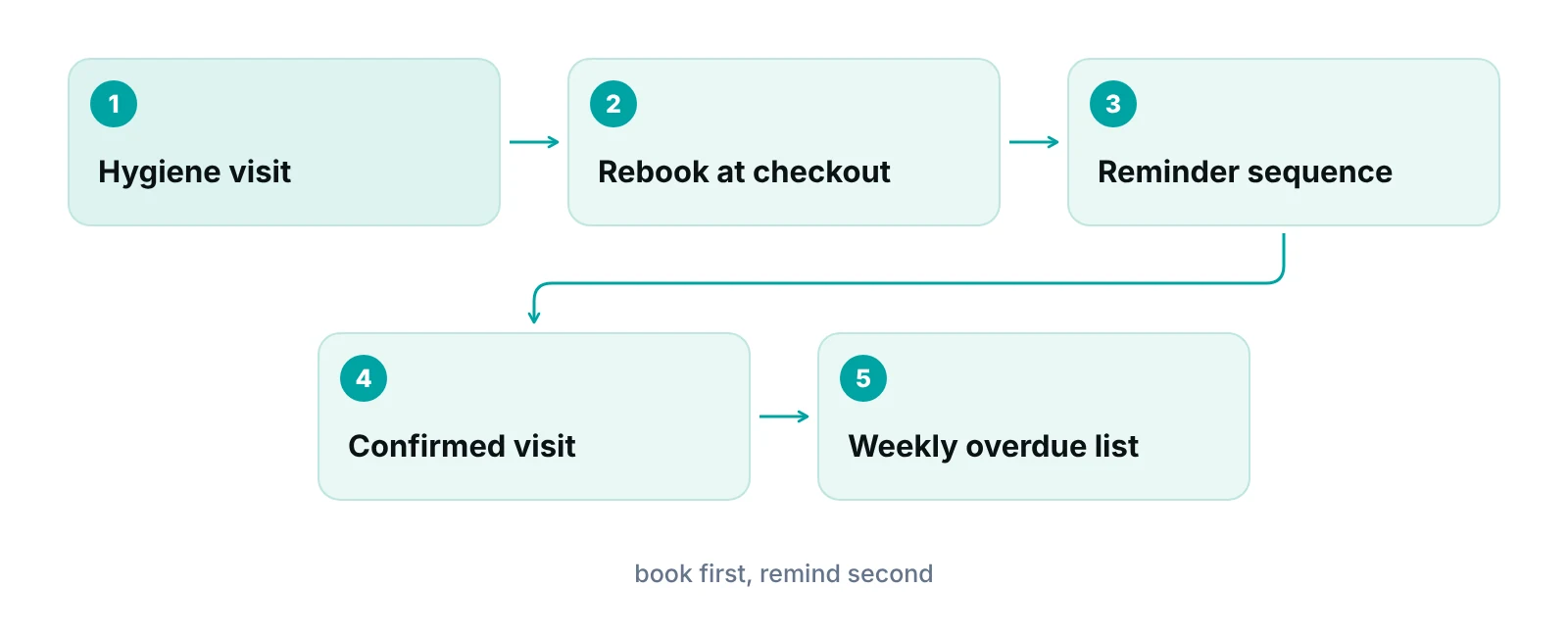
Call first, because a conversation settles cost and schedule questions that a message cannot. Try a second consented channel a few days later, then make a final attempt and note the chart. This work slips when one person also handles phones and check-in; the front desk staff guide explains why, and the dental practice management software guide lists what to test in a system’s recall tools.
How do you reactivate patients who have lapsed?
Split the inactive list by months since the last visit and by what the practice is allowed to send, then work the most recent lapses first.
Clean the list first: remove patients who have died, moved, transferred records or asked not to be contacted, and check phone numbers and addresses. The tiers below are working groups, not legal categories, except the 18-month point, which comes from FTC telemarketing guidance.
| Group | First action | Rule to check |
|---|---|---|
| Past due 1-5 months, no appointment | Staff call offering two dates; reminder by consented channel | Reminders about the patient’s own care are treatment-related; text needs consent |
| Missed or cancelled, never rebooked | Call within days; ask what got in the way | Record the reason; honor any opt-out |
| 6-17 months since last visit | Personal call, then text or email if the patient has consented | The FTC counts an established business relationship for 18 months from the last transaction; entity-specific do-not-call requests override it |
| 18-36 months since last visit | Letter or email welcoming the patient back; offer a comprehensive exam slot | Past 18 months, calling a number on the Do Not Call Registry for sales purposes is a risk; email ads must meet CAN-SPAM |
| Over 3 years, or no valid contact data | Verify address once; if no reply, move to an inactive archive | Keep the archive of opt-outs so the patient is not re-added |
| Diagnosed treatment never scheduled | Treatment follow-up (next section), not a general reactivation message | Message content stays about the patient’s own care |
Source: FTC, Q&A for Telemarketers and Sellers about DNC Provisions in the TSR; 47 CFR 64.1200; HHS; FTC CAN-SPAM guide. Tiers are an RCM Finder planning framework.
On HIPAA, HHS says a covered entity’s description of its own services, including discounts for existing patients, is not marketing (HHS FAQ 281). The line is crossed when someone else pays for the message: HHS says a covered entity may not sell protected health information to a third party for its own purposes, and promoting another party’s product generally needs written authorization (HHS marketing guidance). A texting or mailing vendor that receives the list is a business associate, so a Business Associate Agreement should be in place first.
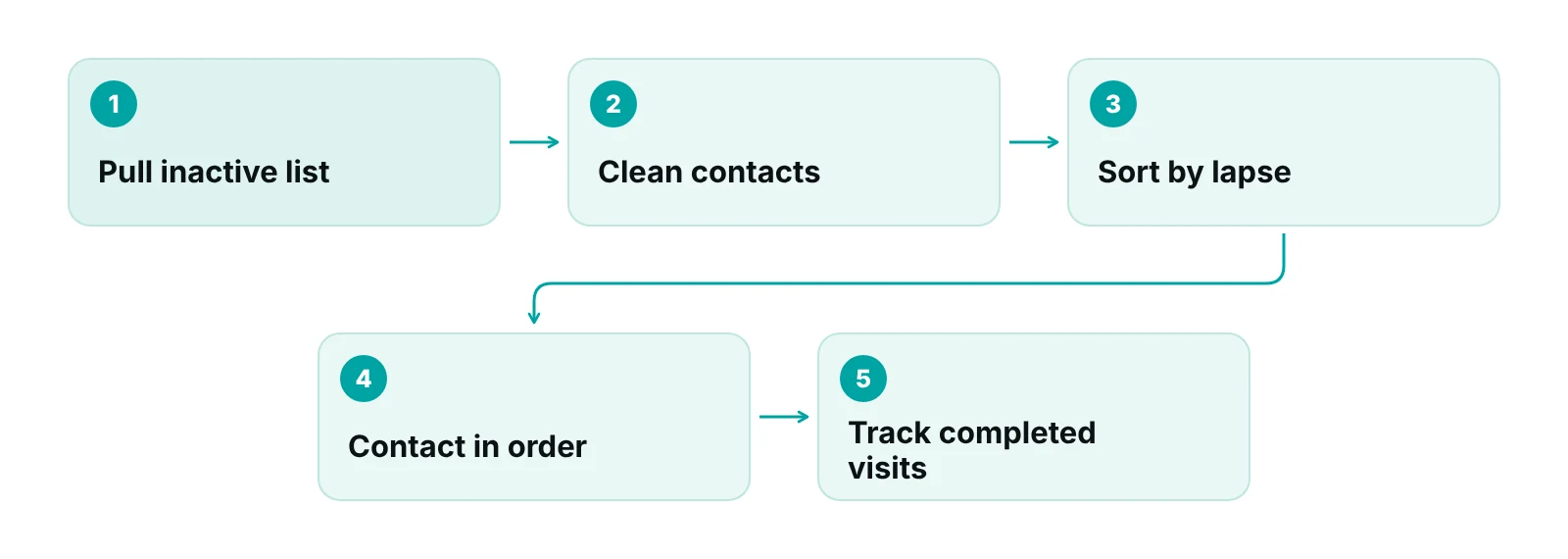
Run one tier at a time so the phones can absorb the replies, and count a patient as reactivated only when the visit is completed.
See where patients are slipping away
A free practice audit looks at how your front desk handles recall, reminders and open treatment, and shows which fixes are process changes and which need staff time.
How do you follow up on treatment that was accepted but not scheduled?
Run a weekly list of diagnosed treatment with no future appointment, give each line an owner and contact the patient about their own care. The barrier is rarely the recommendation. It is usually cost, timing or the insurance plan.
- Cost uncertainty. Verify benefits and give a written patient portion before the treatment conversation ends.
- Benefit timing. Plan limits and waiting periods differ; check the plan instead of assuming.
- Scheduling. Offer dates before the patient leaves the chair.
- Unclear need. The dentist or hygienist answers clinical questions, not the front desk.
- An old balance. Unpaid balances stop rebooking. The dental accounts receivable and collections guide covers handling them.
Work the oldest high-value lines first and record each attempt and answer. A pattern in the reasons points to a fix in the estimate process, not the follow-up script.
Ask for a review after treatment is complete; the dental reputation management guide covers the rules.
Which reminder channels can a dental practice use, and what consent is needed?
Use the channel the patient chose, record that choice and honor opt-outs quickly. Calls placed by staff are the lowest-risk channel. Automated calls and texts fall under the Telephone Consumer Protection Act (TCPA) rules, and marketing email under CAN-SPAM.
Under the FCC rule at 47 CFR 64.1200, autodialed calls and calls with an artificial or prerecorded voice to wireless numbers need the called party’s prior express consent, and texts are treated as calls (47 CFR 64.1200; FCC consumer guide). Calls or texts that include advertising or telemarketing need prior express written consent: a signed agreement, which can be electronic, that clearly authorizes such messages to a specific number and states that signing is not a condition of purchase. A narrow healthcare exemption covers messages to a patient’s wireless number for purposes such as appointment reminders, with no marketing, billing or debt-collection content, 160 characters or less, no more than one a day and three a week, an easy opt-out and no charge to the patient. A recall text with an offer, or a text about a balance, does not fit it.
Whether a platform counts as an autodialer, and whether a message is health care or advertising, are legal questions for counsel. Collect explicit text consent at registration either way.
| Channel | Rule to check | Record in the chart |
|---|---|---|
| Call by a staff member or automated call | Automated or prerecorded calls need consent, and written consent if they advertise; sales calls also fall under Do Not Call rules | Date, outcome, consent and any request to stop |
| Text reminder (appointment only) | Consent; healthcare exemption conditions; reply STOP honored | Consent source, date and opt-out |
| Text with an offer or promotion | Prior express written consent; an advertisement is outside the healthcare exemption | Signed marketing consent, kept separate from care consent |
| Email reminder | HHS: reasonable safeguards; limit the information; honor a patient’s request for another method | Patient’s chosen channel and email address |
| Email with an offer | CAN-SPAM: accurate headers, identify as an advertisement, postal address, opt-outs honored within 10 business days | Unsubscribe date, suppression list |
| Postcard or letter | HHS: honor a request for another address or method; keep detail minimal | Preferred mailing address |
Source: 47 CFR 64.1200; FCC consumer guide; FTC CAN-SPAM Act compliance guide; HHS FAQ 570. Summary of public rules, not legal advice.
On revocation, any reasonable method that clearly expresses a wish to stop counts. A reply of STOP is reasonable on its own, and the caller must honor the request within a reasonable time that does not exceed ten business days (47 CFR 64.1200(a)(10)). For email, HHS says providers may email patients about treatment with reasonable safeguards, that unencrypted email is not barred for that purpose, that the content should be limited, and that reasonable requests for another method, such as email instead of a postcard, should be honored (HHS FAQ 570). Marketing email must carry accurate headers, an ad label, a postal address and opt-outs honored within 10 business days (FTC). The dental digital marketing guide covers email as a channel, and the HIPAA voicemail guide covers voicemail content.
Opt-out rules are changing
A January 2026 FCC order moved the “revoke-all” compliance date to January 31, 2027 (Consumer Financial Services Law Monitor). The FCC then adopted an order on September 30, 2026 that lets callers designate an exclusive revocation method, such as a STOP reply, and limits an informational opt-out to that category. It takes effect 30 days after Federal Register publication, which had not happened by October 5 (Manatt). It also proposes shortening the ten-business-day limit (FCC fact sheet). Check the current rule before building opt-out handling.
Sales calls have a separate layer. The FTC says a business may call a registered number if the consumer made a transaction within 18 months or inquired within three months, unless the person asked to be on the company’s own do-not-call list. Registry lists must be synchronized at least every 31 days (FTC). That is why the reactivation table separates patients by months since the last visit.
How should a practice handle no-shows and late cancellations?
Treat each missed appointment as a retention event: contact the patient the same day, offer a new time and record why it happened. A fee is a last step, not a first one.
- Same-day call. Reach the patient within hours and offer two dates.
- One written policy. Give new patients the notice period and any fee in plain words at registration and keep a signed acknowledgment. Fee rules depend on state law and payer contracts, so confirm both.
- A short-notice list. Keep patients who want an earlier slot, with consent to be contacted.
- A pattern review. Set a threshold for repeat misses and look for causes such as work hours, transport or cost before discussing a fee.
- Care before discharge. Rules for ending a patient relationship vary by state; ask your attorney before dismissing a patient.
Apply the policy to every patient the same way; uneven waivers make it hard to defend.
Which numbers show whether retention is working?
Track a few ratios from the practice system each month, and define each once so the numbers stay comparable.
| Number | How to calculate it | Action when it slips |
|---|---|---|
| Recall rebooked at checkout | Hygiene patients with a future appointment when they left, divided by hygiene visits | Retrain checkout; offer two dates; record the decline reason |
| Overdue recall count | Patients past due with no future appointment, as of month end | Add calling time; check list quality |
| Reactivation rate by tier | Completed visits from a contacted tier, divided by patients contacted in that tier | Change the first action for that tier |
| Treatment scheduled | Diagnosed treatment value scheduled within the window you set, divided by treatment value diagnosed | Fix the estimate step; review the decline reasons |
| No-show and late-cancel rate | Missed or late-cancelled appointments divided by scheduled appointments | Review confirmations; use the short-notice list |
| Opt-outs and complaints | Opt-outs and complaints per 100 messages sent | Review message content and frequency |
Source: RCM Finder planning framework. Definitions are the practice’s to set.
Billing problems such as unresolved denials and patient balances show up later as retention problems, as the dental revenue cycle management guide explains. The wider plan is in the dental marketing plan.
If the front desk is full, a remote front-desk assistant can work the overdue list and confirmations in your practice’s time zone. The dental virtual assistant guide explains how that works. RCM Finder’s appointment booking is early access, so this guide assumes your current practice software runs recall and reminders.
Our recommendations
- Rebook before the patient leaves. Make a booked next visit the checkout standard and measure it monthly.
- Work one list per week with named owners. Assign the overdue and unscheduled-treatment lists to a person, with set call time.
- Capture consent at registration, by channel. Ask for text and email consent separately from care consent, store the date and source, and keep marketing consent on its own line.
- Put a business associate agreement in place before sharing patient lists. Any texting or mailing vendor that receives patient details needs one first. If it will not sign, do not send the list.
- Reactivate by tier, not all at once. Start with the most recent lapses, measure completed visits, then move to the next tier.
- Review decline reasons every quarter. Patterns of cost, timing or insurance answers point to fixes in estimates or verification.
Bottom line
Dental patient retention comes down to a few repeatable habits: rebook at checkout, work the overdue and unscheduled-treatment lists every week, reactivate in tiers, and keep texts and emails inside the consent rules. The dental practice management guide shows where retention fits with scheduling, billing and marketing. For practices that need more hands on the phones, RCM Finder’s virtual medical assistant service provides remote front-desk staff.
Frequently asked questions
What is dental patient retention?
It is the share of patients who keep their recall visits, return after a lapse and complete recommended treatment. Offices usually track it through rebooked hygiene visits, overdue recall counts, reactivation by tier and treatment scheduled, defined once and compared month to month.
How often should a dental practice contact overdue recall patients?
No rule sets a number. A workable pattern is a phone call first, a second attempt on another consented channel a few days later and a last attempt with a chart note. If relying on the FCC healthcare exemption, stay within one text a day and three a week.
Do dental practices need consent to text appointment reminders?
Plan on getting it. The FCC treats texts as calls, and autodialed messages to wireless numbers need prior express consent. A narrow healthcare exemption exists, but a text with an offer or a balance falls outside it. Collect explicit text consent at registration and ask counsel about your platform.
Is a reactivation message to old patients HIPAA marketing?
HHS says describing the practice’s own services, including discounts for existing patients, is not marketing. It becomes marketing when a third party pays for the message or the list is sold. A vendor that sends the message needs a Business Associate Agreement.
How long can a practice contact a lapsed patient by phone for sales purposes?
The FTC says an established business relationship lasts 18 months from the patient’s last transaction, and three months after an inquiry. A person’s request to be on the company’s own do-not-call list overrides it. After that, check the Do Not Call Registry. Whether a reactivation call counts as a sales call is a question for counsel.
Can a dental practice charge for no-shows?
Often yes, but state law and payer contracts set limits, so confirm both first. Give new patients a written policy at registration, keep their acknowledgment, apply it the same way to everyone, and call the patient the same day before any fee is discussed.
Get your free practice audit
Tell us about your practice. We will contact you using the details you give.
- A review of your recent claims, denials and A/R aging
- Where your front desk and prior authorizations slow payment
- A prioritized fix list you keep, whether or not you hire us
Pricing is quoted after the audit, based on your volume and the services you choose. Prefer to talk? Call +1 (302) 556-2288.
Sources
- Dental Visit, Adults (BRFSS, 2024) — America's Health Rankings (CDC BRFSS data) (2024)
- ADA News: HPI Corner — American Dental Association Health Policy Institute (2024)
- 47 CFR 64.1200 Delivery restrictions — Cornell LII (eCFR text) (2026)
- Consumer Guide: Robocalls — Federal Communications Commission (2016)
- FCC fact sheet and draft Report and Order, CG Docket 02-278 — Federal Communications Commission (2026)
- FCC Replaces Revoke All Rule and Permits Callers to Designate an Exclusive Revocation Method — Manatt, Phelps & Phillips (2026)
- FCC Further Extends Effective Date for TCPA Revoke-All Rule — Consumer Financial Services Law Monitor (Ballard Spahr) (2026)
- Q&A for Telemarketers and Sellers about DNC Provisions in the TSR — Federal Trade Commission (2026)
- CAN-SPAM Act: A Compliance Guide for Business — Federal Trade Commission (2026)
- Marketing (HIPAA Privacy Rule guidance) — US Department of Health and Human Services (2026)
- FAQ 281: Is it marketing to describe services provided by a covered entity? — US Department of Health and Human Services (2023)
- FAQ 570: Does HIPAA permit providers to use email to discuss health issues with patients? — US Department of Health and Human Services (2013)
Disclaimer: This article is educational and is not legal, coding, tax or compliance advice. Telephone, text, email, privacy, advertising and fee rules differ by state and by payer and change over time, so confirm current requirements with your attorney, your state dental board and each payer before acting. Consent and opt-out handling for texting in particular should be reviewed by counsel.
