
An insurance appeal letter should identify the claim, quote the denial reason, explain why the denial is wrong in a few specific sentences, list the enclosed proof and be sent before the deadline on the denial notice. For Original Medicare the first appeal level, redetermination, must be filed within 120 days of the notice.
Many denials are overturned when the practice answers the stated reason with proof. Many appeals fail because the letter is long, general and aimed at the wrong reason. A short, specific letter with the right attachments performs better than a long argument.
This guide gives a letter structure and a sample you can adapt, then covers the Medicare appeal levels. Commercial and employer plan deadlines vary, so always read the denial notice and the plan documents for the exact dates and address.
Key takeaways
- Answer the exact denial reason and attach the proof that answers it.
- The deadline and address are on the denial notice. Read them first.
- Original Medicare has five appeal levels; the first, redetermination, is due within 120 days of the notice.
- Keep a copy of everything you send and the proof of delivery.
What should you do before writing the letter?
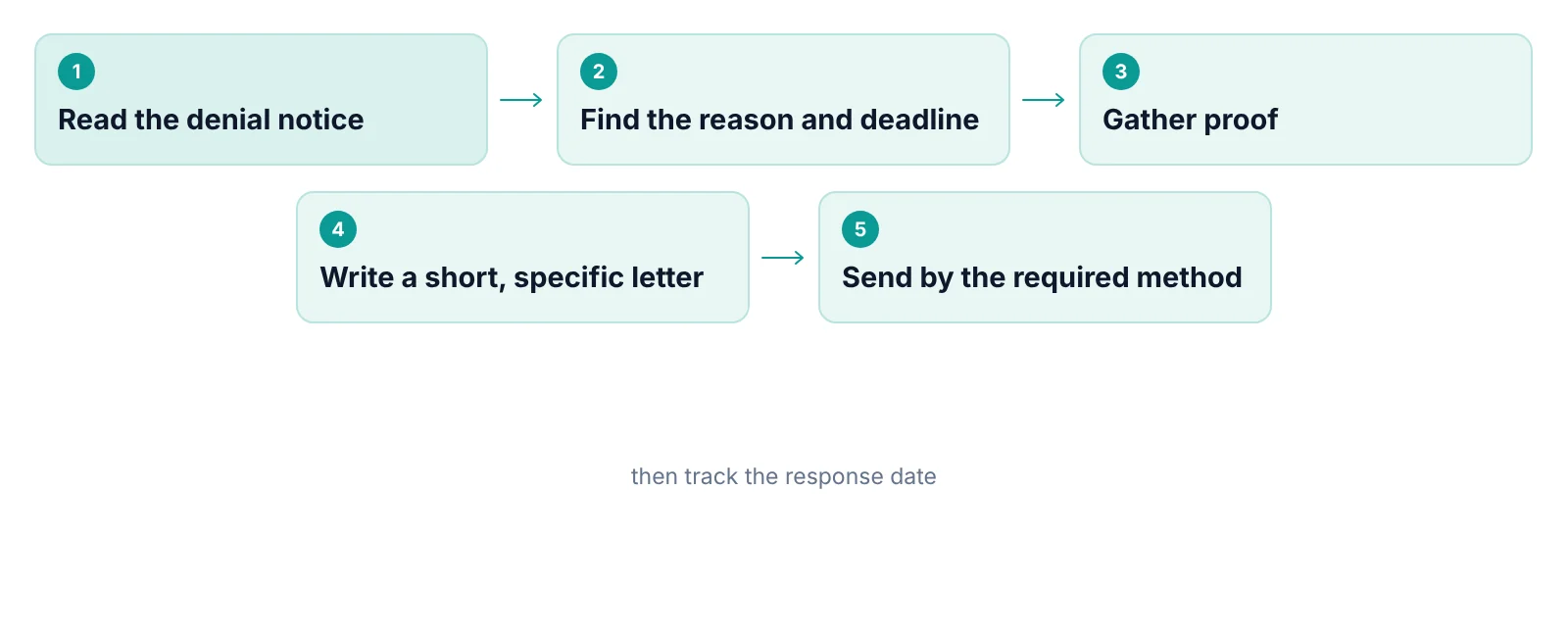
Read the denial notice, the remittance and any reason codes. If the denial came with a CARC and RARC pair on the ERA, look up both so you know which fact the payer relied on. See what an ERA is and how to read an EOB.
Then decide whether an appeal is the right tool. Some denials need a corrected claim, a records submission or a reconsideration request instead. Our guide to denial management sorts denials by fix.
What should the letter include?
| Part | What to write | Common mistake |
|---|---|---|
| Claim identifiers | Patient, member ID, claim number, dates, billed amount, denial date | Missing claim number |
| Denial reason | Quote or restate the reason from the notice | Arguing a different reason |
| Your position | One to three specific points, such as coverage criteria met or authorization obtained | General statements |
| Proof list | List each enclosure by name | Attachments not referenced |
| Request | State the outcome you want: overturn and reprocess | No clear request |
| Contact | Name, role, phone and email | No contact |
Adapt to the payer’s required form if it has one.
Sample appeal letter (adapt every bracket)
[Date]
[Payer name, Appeals Department, address or fax from the denial notice]
Re: Appeal of claim denial. Patient: [name]. Member ID: [ID]. Claim number: [number]. Date of service: [date]. Billed amount: [amount]. Denial date and reason: [as written on the notice].
To the Appeals Reviewer:
We request review of the denial above. The service was [brief description] and was provided on [date] because [clinical reason in one or two sentences]. The denial states [reason]. We disagree because [specific point: coverage criteria met, authorization obtained under number X, timely filing proven by date Y, or coding corrected].
Enclosed are: (1) the denial notice, (2) the relevant clinical records, (3) [authorization letter, corrected claim or proof of timely filing], and (4) [policy or criteria cited]. We ask that you overturn the denial and reprocess the claim for payment under the member’s plan.
Please contact [name, role, phone, email] with any questions.
Sincerely,
[Name, title, practice, NPI]
Keep it to one page when you can. Put detail in the attachments, not the letter.
What are the Medicare appeal levels?
Original Medicare Parts A and B have five levels. Each has its own deadline and form. Receipt of the notice is presumed five days after its date unless you show otherwise.
| Level | Who decides | Deadline to request | Form or note |
|---|---|---|---|
| 1 Redetermination | Medicare contractor | 120 days from the notice; decision generally within 60 days | CMS-20027 |
| 2 Reconsideration | Qualified Independent Contractor | 180 days from the redetermination notice | CMS-20033 |
| 3 Hearing | Office of Medicare Hearings and Appeals (OMHA) | 60 days; decision in 90 days; amount in controversy required | OMHA-100 |
| 4 Council review | Medicare Appeals Council | 60 days | DAB-101 |
| 5 Federal court | U.S. District Court | 60 days; amount in controversy required | Court filing |
Source: CMS Medicare Parts A and B Appeals Process booklet (MLN). Check the current booklet for thresholds and form updates.
Requests are in writing. The same booklet does not give a complete letter checklist, so build your own from the table above and the notice.
How do commercial and employer plan appeals differ?
Commercial and employer-sponsored plans set their own steps, often an internal appeal followed by an external review. The deadline and the address are in the denial notice and the plan documents. Do not assume Medicare’s dates apply.
- Find the appeal deadline on the denial notice before you do anything else.
- Ask whether the plan offers a peer-to-peer call and whether it must happen before a written appeal.
- If the denial is for medical necessity, ask for the criteria the plan used and answer them point by point.
Want a second pair of eyes on your claims?
Send us your recent denials and we will show where the same issue repeats. The audit is free and the fix list is yours to keep.
If the dispute is about a patient bill, see how to dispute medical bills and surprise medical bills.
What mistakes sink appeals?
| Mistake | Result | Fix |
|---|---|---|
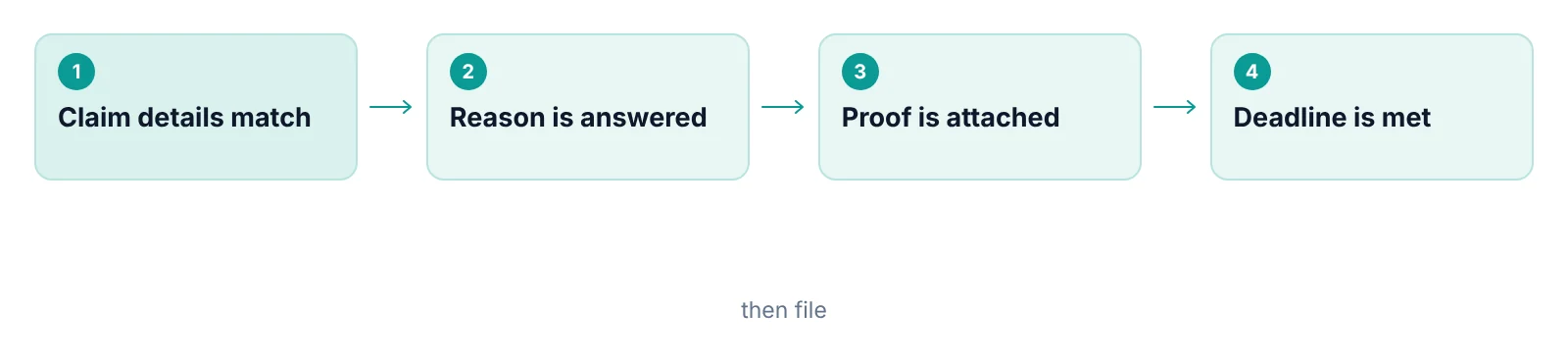
| Missing the deadline | Appeal rejected as untimely | Calendar the date when the notice arrives |
| Answering a different reason | Reviewer upholds the denial | Quote the reason and answer it |
| No supporting records | Nothing to review | Attach the records and name them in the letter |
| Long narrative | Key point is lost | Use short points and a proof list |
| No proof of delivery | Cannot prove timely filing | Use tracked delivery or portal receipts |
Timely filing and appeal deadlines are separate clocks.
Track which denials you win and lose. The method in denial root cause analysis shows where to fix the front end.
Where appeals fit in your denial workflow
An appeal is the last step in a longer workflow. For related denial codes see CO-197 and CO-226, and for broader tips see insurance denial tips.
Our recommendations
- Calendar every deadline on the day the notice arrives. Late appeals are lost appeals.
- Keep a letter template for each denial type. It saves time and keeps tone consistent.
- Answer the stated reason only. Do not add new arguments the payer did not raise.
- Attach and list every proof. Reviewers should not have to search.
- Use tracked delivery or the portal. Proof of delivery protects timely filing.
- Review overturn rates by payer. It shows where to spend effort.
Bottom line
A good appeal letter is short, specific and backed by proof. Read the notice, answer the stated reason, attach what proves it and send it on time. For Original Medicare, remember the 120-day first deadline; for everyone else, the notice sets the date. Our denial management services team can take over appeals that are piling up.
Frequently asked questions
What should an insurance appeal letter include?
Include the claim identifiers, the denial reason from the notice, a short explanation of why the denial is wrong, a list of the enclosed proof, the outcome you want and your contact details. Keep it to one page where possible and put detail in the attachments.
How long do I have to appeal a Medicare denial?
For Original Medicare Parts A and B, the first level, redetermination, must be requested within 120 days of the notice. Later levels have their own deadlines, such as 180 days for reconsideration and 60 days for the next steps. Receipt is presumed five days after the notice date.
Can I use the same letter for every denial?
Use a template for structure, but answer each denial reason specifically. A generic letter that does not address the stated reason is easy to uphold. Keep separate templates for common reasons, such as missing authorization, medical necessity or timely filing.
Do commercial plans use the same appeal levels as Medicare?
No. Commercial and employer plans set their own steps, usually an internal appeal followed by an external review. The denial notice and the plan documents show the deadlines and the address. Never assume Medicare’s timelines apply to a commercial claim.
What proof should I attach?
Attach what answers the denial reason: the denial notice, relevant clinical records, authorization letters, corrected claims, proof of timely filing and any policy or criteria you rely on. List each item in the letter so the reviewer can match them.
Should I send the appeal by mail, fax or portal?
Use the method the payer names on the notice. If several are allowed, choose one that gives proof of delivery, such as a portal receipt or tracked mail. Keep a copy of the full package and the confirmation in the account notes.
Get your free practice audit
Tell us about your practice. We will contact you using the details you give.
- A review of your recent claims, denials and A/R aging
- Where your front desk and prior authorizations slow payment
- A prioritized fix list you keep, whether or not you hire us
Pricing is quoted after the audit, based on your volume and the services you choose. Prefer to talk? Call +1 (302) 556-2288.
Sources
- Medicare Parts A and B Appeals Process (MLN006562) — Centers for Medicare & Medicaid Services (2025)
- Original Medicare (Fee-for-service) Appeals — Centers for Medicare & Medicaid Services (2026)
- Claim Adjustment Reason Codes — X12 (2026)
- Remittance Advice Remark Codes — X12 (2026)
- Appealing a health plan decision — Centers for Medicare & Medicaid Services, Healthcare.gov (2026)
- No Surprises Act overview — U.S. Department of Labor (2026)
Disclaimer: This article is educational and is not legal, coding, billing, medical or compliance advice. CPT codes and modifier descriptions are owned by the AMA, and code meanings, Medicare contractor policies and payer rules change and vary by payer, contractor and state. Verify current requirements with the official CPT manual, your payers and your counsel before you act.
