
Modifier 51 tells a payer that multiple procedures were performed by the same practitioner at the same session. Noridian says Medicare contractors do not want it appended manually, because the claims system applies the multiple-procedure rules itself, while many commercial payers expect it on the additional procedure codes.
Modifier 51 looks simple, and it is one of the most inconsistently handled modifiers in billing. One payer wants it on every additional procedure, and another says never to add it. The result is rejected claims, reduced payment where none was due, or claims that go through with the wrong reduction.
This guide explains what the modifier means, what Noridian says about its use on Medicare claims, which codes are exempt, and how to handle payers that differ. Policy is changing in some places, so confirm with each payer.
Key takeaways
- Modifier 51 identifies multiple procedures at one session by the same practitioner.
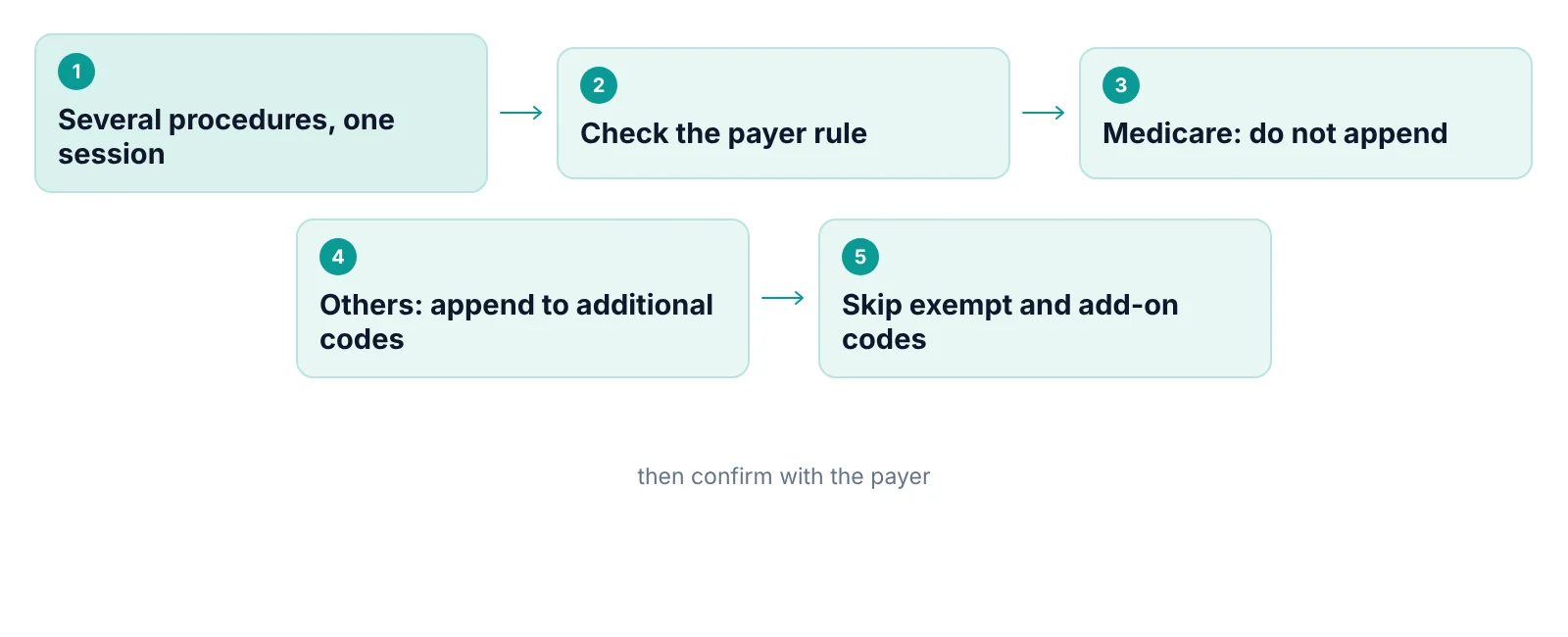
- Noridian says not to append it to the additional procedure on Medicare claims, because its system applies the rule automatically.
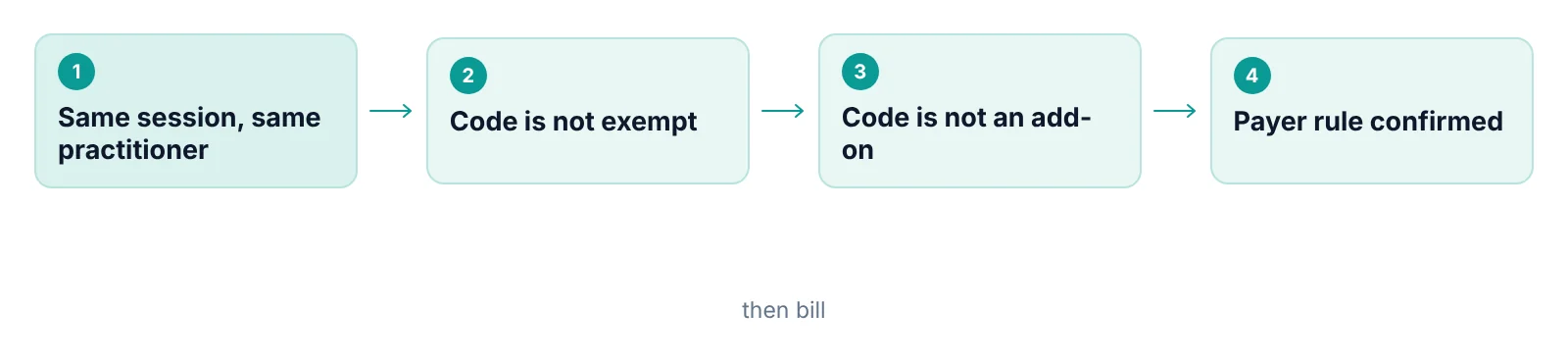
- Add-on codes and CPT modifier 51 exempt codes do not take the modifier.
- Many commercial payers still expect 51. Read each payer’s policy.
What does modifier 51 mean?
Modifier 51 is a CPT modifier for multiple procedures. When several procedures are done at the same session, payers generally pay the highest-valued procedure in full and reduce payment for the others. The modifier is the signal that the extra codes belong to a multiple-procedure session.
| Line | Typical treatment | Why |
|---|---|---|
| Primary procedure | Paid at the full allowed amount | Highest value |
| Additional procedures | Paid at a reduced percentage under the payer’s rule | Shared work and overhead |
| Add-on codes | Not reduced by this rule | Add-on codes are reported with a primary code |
Percentages vary by payer and are not listed here. Check your fee schedule or policy.
What do Medicare contractors say about modifier 51?
Noridian states: do not append modifier 51 to the additional procedure code, because its claims system applies the modifier to the correct line. Its page also says E/M services, physical medicine and rehabilitation services and supplies are outside the multiple procedure rule. Add-on codes, listed in CPT Appendix D, do not take modifier 51, and neither do codes CPT lists as modifier 51 exempt.
| Situation | Guidance | Source |
|---|---|---|
| Additional procedure code | Do not append 51 | Noridian |
| E/M, PM&R and supplies | Outside the multiple procedure rule | Noridian |
| Add-on codes | Do not take 51 | Noridian |
| CPT modifier 51 exempt codes | Do not take 51 | Noridian |
| Different physicians doing unrelated surgeries | Do not use 51 | Noridian |
Summarized from Noridian modifier 51 pages. The page’s later “Correct Use” wording appears to conflict with this, so confirm with your own contractor.
Want a second pair of eyes on your claims?
Send us your recent denials and we will show where the same issue repeats. The audit is free and the fix list is yours to keep.
How do other payers handle modifier 51?
Commercial and Medicaid payers differ. Some require 51 on additional procedures. Some apply the reduction without it. Some deny lines that carry it. The payer’s reimbursement policy is the authority.
| Question | Why it matters | Where to look |
|---|---|---|
| Is 51 required, optional or not allowed? | Wrong choice causes rejection or wrong reduction | Reimbursement policy |
| What reduction schedule applies? | Affects expected payment | Fee schedule or policy |
| How are bilateral procedures handled? | Different modifier | Payer policy |
Keep a one-page table by payer and update it yearly. See our claim scrubbing guide for how to add the rules.
How is modifier 51 different from 59, X modifiers and 50?
Modifier 51 says several procedures were done in one session and the payer should apply a reduction. Modifier 59 and the X modifiers say two services are distinct and should not be bundled. They answer different questions. A claim may need one, the other or neither.
| Modifier | Says | Effect |
|---|---|---|
| 51 | Multiple procedures | Reduction on additional procedures |
| 59 and X modifiers | Distinct service | Bypasses a bundling edit if allowed |
| 52 | Reduced service | Reduced payment for a partial service |
See X modifiers, modifier 59 and modifier 52.
What are the common modifier 51 mistakes?
| Mistake | Why it fails | Fix |
|---|---|---|
| Adding 51 on Medicare claims by habit | Contractor says not to | Remove it on Medicare lines |
| Adding 51 to an add-on code | Add-on codes do not take it | Remove it |
| Using 51 on an E/M | Outside the rule | Use modifier 25 where it applies |
| Omitting 51 for a payer that requires it | Payment may deny or reduce wrongly | Follow the payer policy |
Surgical and procedure billing audits find these. See billing audits.
If a denial cites bundling, see CO-97.
Related modifier guides
Other modifiers that appear in surgical billing include modifier 24, modifier 79 and modifier 91. For the E/M side, see modifiers 25 and 59.
Our recommendations
- Keep a payer table for 51. Required, optional or not allowed, by payer.
- Build the rule into the scrubber. Strip or add 51 by payer.
- Know your exempt codes. Keep the CPT exempt and add-on lists handy.
- Confirm with your contractor. Contractor pages can conflict.
- Audit multiple-procedure claims. Check reductions against the fee schedule.
- Train surgical coders. Explain what the modifier states.
Bottom line
Modifier 51 depends on the payer. For Medicare, follow your contractor’s page and do not append it by habit. For others, read the policy and build the rule into your scrubber. For billing support, see our medical billing services.
Frequently asked questions
What is modifier 51?
Modifier 51 is a CPT modifier for multiple procedures performed by the same practitioner at the same session. It signals that the additional procedures belong to a multiple-procedure session, so the payer can apply its reduction rules. Whether you append it depends on the payer, because some want it and some apply the rule themselves.
Should I append modifier 51 on Medicare claims?
Noridian says not to append modifier 51 to the additional procedure code, because its claims system applies the rule to the correct line. Contractors can word this differently, and Noridian’s own page has some conflicting text, so confirm with your own Medicare contractor before you change your billing.
Which codes do not take modifier 51?
Add-on codes, listed in CPT Appendix D, do not take modifier 51, and neither do codes CPT lists as modifier 51 exempt. E/M services, physical medicine and rehabilitation services and supplies are also outside the multiple procedure rule, according to Noridian.
Is modifier 51 the same as modifier 59?
No. Modifier 51 says multiple procedures were done at one session so a reduction applies. Modifier 59 and the X modifiers say two services are distinct and should not be bundled. A claim may need one, both or neither, depending on the codes and the payer’s edits.
Do commercial payers want modifier 51?
Many do, but policies vary. Some require it on additional procedures, some apply the reduction without it and some deny lines that carry it. Read the reimbursement policy of each payer, and build a payer table into your claim scrubber so that the rule is applied automatically.
How much is payment reduced for multiple procedures?
The reduction depends on the payer and the fee schedule, so we do not list percentages here. In general, the highest-valued procedure is paid in full and additional procedures are paid at a lower percentage. Check the payer’s policy and compare remittances to expected payment.
Get your free practice audit
Tell us about your practice. We will contact you using the details you give.
- A review of your recent claims, denials and A/R aging
- Where your front desk and prior authorizations slow payment
- A prioritized fix list you keep, whether or not you hire us
Pricing is quoted after the audit, based on your volume and the services you choose. Prefer to talk? Call +1 (302) 556-2288.
Sources
- Modifier 51 — Noridian Healthcare Solutions, JE Part B (2026)
- Modifier 51 — Noridian Healthcare Solutions, JF Part B (2026)
- Multiple surgeries — First Coast Service Options (2026)
- Medicare Claims Processing Manual, Chapter 12 — Centers for Medicare & Medicaid Services (2026)
- NCCI Policy Manual for Medicare Services — Centers for Medicare & Medicaid Services (2026)
- Modifier 51 Medicare Advantage policy — Regence (2025)
Disclaimer: This article is educational and is not legal, coding, billing, medical or compliance advice. CPT codes and modifier descriptions are owned by the AMA, and code meanings, Medicare contractor policies and payer rules change and vary by payer, contractor and state. Verify current requirements with the official CPT manual, your payers and your counsel before you act.
