

This telehealth billing guide comes down to four claim choices: the service code the payer covers, the place of service (02 or 10), any modifier the payer requires, and records that show how the visit was delivered. Medicare rules are public. Commercial and Medicaid rules differ by plan, so check each one.
Telehealth billing looks simple until a claim comes back denied. The reasons are usually small: a place of service that does not match where the patient was, a modifier one plan wants and another rejects, or a visit note that never says whether the call had video. This guide replaces an older post that listed several codes and modifiers incorrectly. It covers the basics for a practice office, flags what is Medicare-only, and sends you to the telehealth modifiers guide for modifier detail.
Key takeaways
- A telehealth visit is not a separate code family. You bill the service the payer covers and show how it was delivered through the place of service and, where required, a modifier.
- POS 02 means the patient was not at home. POS 10 means the patient was at home. Medicare pays POS 10 at the non-facility rate.
- Congress extended Medicare telehealth flexibilities, including home as a patient location and audio-only for some services, through December 31, 2027.
- Remote patient monitoring has its own codes and rules: consent, an FDA-defined device, and one billing practitioner per patient per 30 days.
- Commercial and Medicaid rules vary. Keep a short rule sheet per payer and review telehealth denials by payer.
What counts as telehealth, and is it different from telemedicine?
Telehealth means delivering care, or supporting it, through technology instead of an in-person visit. There is no single legal definition. The National Consortium of Telehealth Resource Centers notes that few definitions are universal and many terms are used interchangeably, so telehealth and telemedicine are used as near-synonyms. For billing, the label does not matter. The technology used and the payer’s policy for it do.
What changes the claim is the type of service. A live video visit, a phone visit, an image sent for later review and a blood pressure cuff that sends readings each day are billed under different rules.
| Type | What it is | Billing note |
|---|---|---|
| Synchronous (live) | A real-time interaction, such as a video call or an audio-only call | Needs the payer’s rule for video versus audio-only; place of service and modifier follow the payer |
| Asynchronous (store-and-forward) | Information such as images or results is stored and reviewed or answered later | Payer support is narrower; Medicare uses GQ only for a federal demonstration in Alaska and Hawaii |
| Remote patient monitoring (RPM) | Devices send a patient’s health data to the practice between visits | Has its own CPT codes and rules for consent, device and data days |
| mHealth | Phone apps used for monitoring, reminders or education between visits | Usually supports care but is not billed on its own unless a payer policy says so |
Source: National Consortium of Telehealth Resource Centers (2021); CMS MLN Telehealth & Remote Patient Monitoring booklet (January 2025).
What do you have to get right on a telehealth claim?
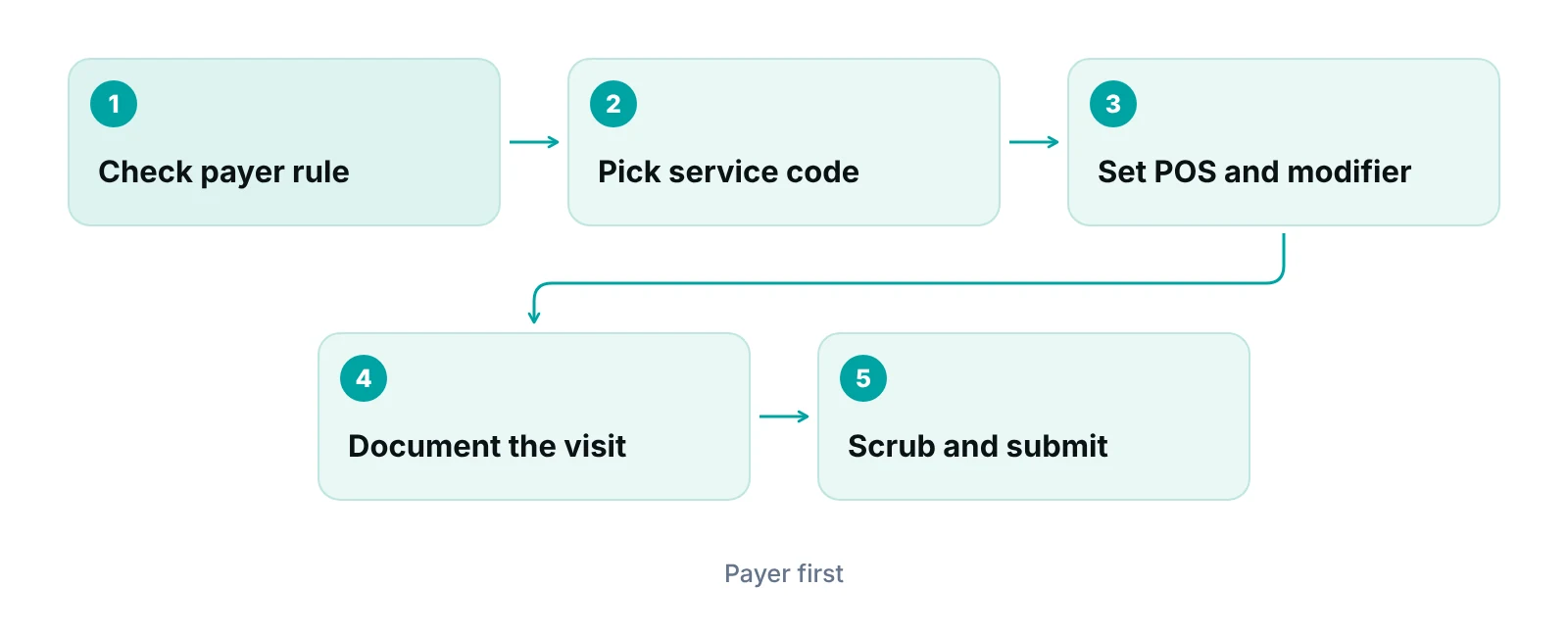
Four things decide most telehealth outcomes: the code, the place of service, the modifier and the record. Each one answers a different payer question.
- Service code. Use the code for the service that was actually delivered, from the list of services your payer allows by telehealth. Medicare publishes its own list; other payers publish theirs. A video visit is not a special code, and older advice that named one E/M level as “the video code” was wrong.
- Place of service (POS). POS 10 is telehealth in the patient’s home. POS 02 is telehealth when the patient is somewhere other than home. Pick the one that matches where the patient was.
- Modifier, if the payer requires one. Modifiers describe the technology, such as audio and video versus audio-only. Medicare and many plans treat them differently. See the telehealth modifiers guide for each modifier.
- Documentation. The note should say what technology was used, where the patient was, who took part and that consent was handled as the payer or state requires.
Place of service 02 versus 10
Since January 1, 2024, Medicare has used both codes. CMS’s MLN booklet says Medicare pays for telehealth furnished to patients at home at the non-facility Physician Fee Schedule rate (POS 10). A telehealth.org summary of the CMS manual update adds that POS 02 is paid at the facility rate and that modifiers 93 and 95 do not change the rate; only the POS does. Commercial plans may follow Medicare or set their own. For a closer look at the home code, read the POS 10 telehealth code guide or the overview of place of service codes.
| Claim element | What to confirm | Why it matters |
|---|---|---|
| POS 10 | Patient was at home during the visit | Medicare pays POS 10 at the non-facility rate |
| POS 02 | Patient was somewhere other than home | Medicare uses it when the patient is not at home |
| Modifier 95, 93 and others | The payer’s current rule for video and audio-only | Plans differ; see the modifiers guide for each one |
| GT | Used on institutional claims only for Critical Access Hospital Method II | Medicare’s booklet limits GT to that case |
| GQ | Alaska or Hawaii federal telemedicine demonstration only | Not a general modifier for asynchronous care |
| Q3014 | Originating site facility fee, if your site hosted the patient | Medicare pays 80% of the lesser of charge or $31.85 for CY 2026 |
Source: CMS MLN901705 (January 2025); CMS CY 2026 Physician Fee Schedule final rule summary (MM14315); telehealth.org (2024). Confirm POS 02 payment with your MAC.
Three errors in older telehealth guides
GT is not the modifier for telephone visits. There is no national modifier series called “U1 to UD” for visit length. And G0256 is not a remote patient monitoring code. If you use a cheat sheet that says any of these, retire it.
What does Medicare allow for telehealth in 2026 and 2027?
Medicare telehealth flexibilities now run through December 31, 2027. H.R. 7148, the Consolidated Appropriations Act signed on February 3, 2026, extended them, according to a legal analysis from Frier Levitt. The flexibilities include home as a patient location without geographic limits, and certain audio-only services for non-behavioral care. Physical, speech-language and occupational therapists can keep furnishing telehealth, and FQHCs and RHCs can keep acting as distant sites.
That is a temporary extension, not a permanent rule. Earlier extensions came in short steps, to December 31, 2024 and then March 31, 2025, so build your process to adapt. The CMS 2026 Physician Fee Schedule also made changes that are permanent.
| Change | Status | Date |
|---|---|---|
| Telehealth list: provisional and permanent categories removed; review asks if a service can be done by two-way audio-video | Permanent policy | Effective January 1, 2026 |
| Direct supervision through real-time audio and video (not audio-only) for services that require direct supervision | Permanent, with exclusions for 10-day and 90-day global services | Effective January 1, 2026 |
| Home as patient location, no geographic limits, and some audio-only services | Temporary, by statute | Through December 31, 2027 |
| Q3014 originating site facility fee: 80% of the lesser of charge or $31.85 | CY 2026 rate | Calendar year 2026 |
| New remote physiologic monitoring codes 99445 and 99470 for lower-volume monitoring | Added to the fee schedule | Effective January 1, 2026 |
Source: CMS MM14315 (December 2025); Frier Levitt (2026); Maryland Health Care Commission summary of the CY 2026 Physician Fee Schedule (2026).
Mental health is a special case. The CMS booklet describes no originating site or geographic restrictions for behavioral and mental telehealth, with the patient’s home allowed, and audio-only allowed when the patient is at home. Booklet details date from January 2025, so check your MAC for later changes. Practices that bill therapy and psychiatric visits can read more on our behavioral and mental health billing page and in the Medicare mental health therapy reimbursement guide.
“Rules that expire on a date should live in a dated rule sheet, not in staff memory. When the date changes, the sheet changes, and everyone sees it.”
How do Medicaid and commercial payers differ from Medicare?
They can differ on almost every telehealth element. Each state runs its own Medicaid program, and each commercial plan writes its own policy. The older version of this post carried tables for specific states and insurers. They were unsourced, so they are removed here. Use the payer’s current provider manual instead.
For each major payer, record the same six answers. Keep them on one page and add the date you last checked.
- Which services are covered by telehealth, and which are not.
- Whether audio-only is covered, and for which services.
- Which POS code the plan wants for home and for other locations.
- Which modifier, if any, is required for video and for audio-only.
- Whether the patient or provider must be in a particular state, and what licensure or enrollment applies.
- Prior authorization, consent and documentation requirements.
Do the same check at scheduling. A visit booked as telehealth for a plan that does not cover it is a denial you can prevent. Our guide to patient insurance verification shows the steps. For a telehealth visit, add one question to verification: does this plan cover the service by telehealth, and how should it be reported?
How is remote patient monitoring billed?
Remote patient monitoring (RPM) is billed with its own CPT codes, not with a video-visit code. The old post named HCPCS G0256 for RPM, which is wrong. The CMS MLN booklet lists these core codes, described here in plain words:
- 99453: setup of the monitoring and patient education on the device.
- 99454: the device supply and monthly data collection, with data on at least 16 of 30 days.
- 99457: the first 20 minutes of monthly interactive communication about the data.
- 99458: each additional 20 minutes of that communication.
The booklet also sets rules a biller should know. Patient consent is required when RPM services are provided. An established patient relationship is needed for remote physiologic monitoring. The device must meet the FDA’s definition of a medical device. Only one practitioner can bill RPM for a patient in a 30-day period. Only practitioners who can bill E/M services can bill RPM, and auxiliary staff can furnish it under general supervision.
For 2026, CMS added codes 99445 and 99470 for monitoring that falls below the older 16-day and 20-minute thresholds. Confirm the exact requirements for those codes in the final rule or with your MAC before you bill them. If your practice also manages chronic conditions, read the chronic care management billing guide so the same minutes are not counted twice.
Time tracking is the common failure
RPM claims depend on counting days of data and minutes of staff communication. If the logs are not kept as the work happens, the claim cannot be defended later.
How does telehealth change the revenue cycle?
It adds telehealth-specific checks at four points of the revenue cycle: scheduling, the visit, charge entry and denial review. The rest of the cycle works as it does for in-person care. Most telehealth denials trace to one of those four points.
Scheduling and registration
Capture the visit type, the patient’s location and the payer’s telehealth coverage at booking. If the patient plans to join from work or travel, the location changes the POS code and may change licensure rules. Front desk staff carry much of this work, as the front desk and revenue cycle post explains.
The visit
The clinician records the technology, the patient’s location and whether the visit stayed on video. If a video call falls back to audio-only, the claim may need a different modifier. Use a video platform your compliance lead has approved; see the guide to HIPAA-compliant video conferencing.
Charge entry and claim review
Coders should enter the POS and modifier from the visit note, not from a default. Claims that lack them are easier to catch before submission than after a rejection. A practice management system that runs checks before claims go out helps; a practice management system that tracks claims by stage can hold telehealth claims for a missing POS or modifier. Our clean claims guide covers the wider checklist.
Denial review
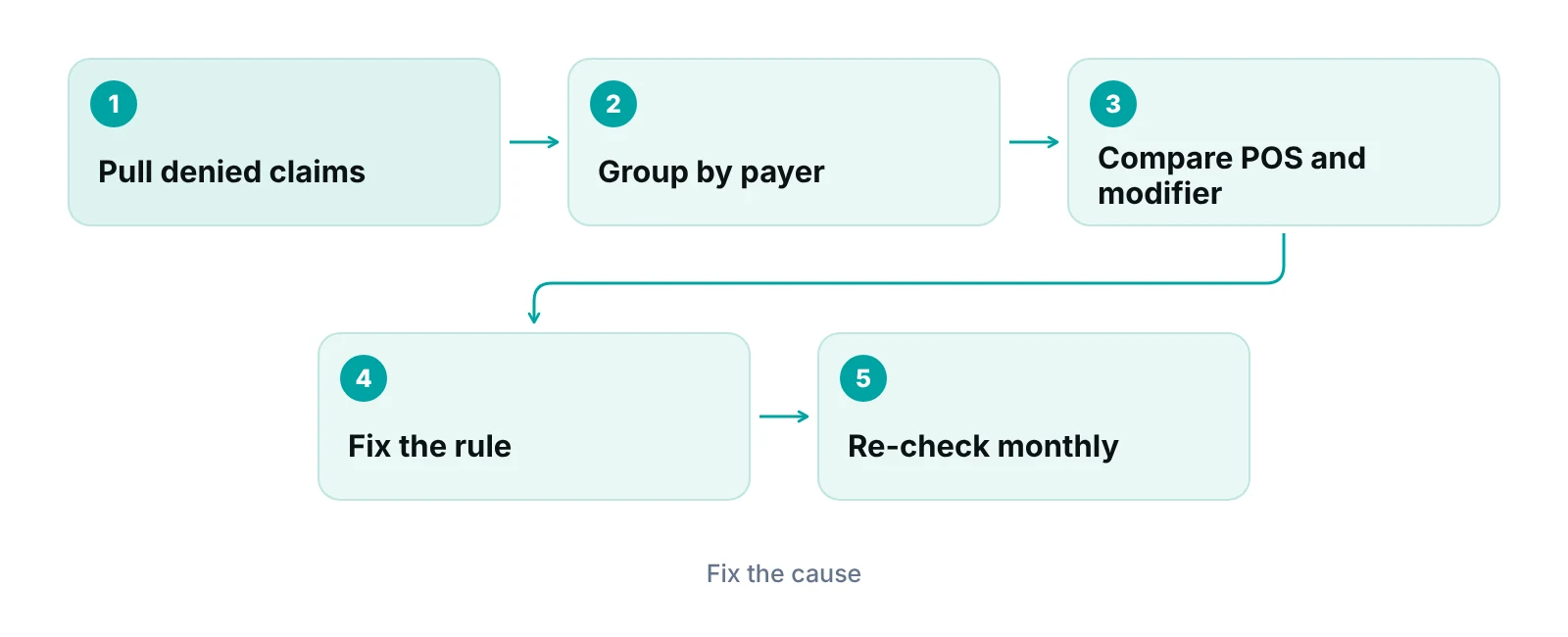
Review telehealth denials by payer, POS and modifier each month. Patterns show up quickly: one plan rejecting POS 10, or one location using the wrong code. Fixing the cause matters more than reworking each claim. If your team lacks time for this, medical billing services can take on claim submission and follow-up.
Want to see where your telehealth claims leak?
A free practice audit reviews a sample of recent telehealth claims, the POS and modifiers on them, and how payers responded.
What should a telehealth visit note include, and who needs training?
A defensible note shows how the visit happened, not only what was discussed. Payer and state rules decide the exact list, so treat this one as a starting point.
- Date, start time and length of the visit, if the code is time-based.
- The technology used: audio and video, or audio-only, and why audio-only was used if so.
- The patient’s location at the time, at least whether it was home.
- The provider’s location and that licensure fits the patient’s state, per payer and state rules.
- Consent, handled as your state and payer require.
- Participants, the clinical assessment and the plan.
Train three groups. Schedulers need to ask where the patient will be. Clinicians need to document the technology and location in the note. Billers need to read that record when they choose POS and modifier. Short, role-specific training beats a long general session.
Our recommendations
- Build a one-page rule sheet per payer. We recommend one page per major plan covering covered services, audio-only, POS, modifier and authorization rules, with the date last checked.
- Put end dates on your calendar. Medicare’s extended flexibilities run through December 31, 2027. Set a reminder six months before so billing changes do not arrive as a surprise.
- Capture location and technology at the visit. Add two required fields to the visit template: where the patient was and whether video was used. Billers can then pick POS and modifier from the record.
- Hold claims that lack POS or modifier. Run a check before submission that flags telehealth visits with no POS or with a modifier that does not fit the payer’s rule.
- Review telehealth denials monthly. Count claims sent, claims denied and the top three reasons per payer. Review them with the clinicians who deliver the visits.
- Log RPM days and minutes as they happen. Keep device data days and staff communication minutes in a log that is updated during the month, not rebuilt at month end.
Hold telehealth claims for a missing place of service or modifier before they go out.
RCM Finder's practice management portal tracks each claim by stage with an owner, runs data-completeness checks before submission and flags claims for review under workflow rules.
See how the RCM Finder portal works · Create a portal account
Disclosure: RCM Finder builds and sells this portal. It is a practice management system, not an EHR.
Bottom line
To bill telehealth correctly, match the service code to the payer’s list, set POS 02 or 10 from where the patient was, add the modifier the payer requires and document how the visit happened. Medicare flexibilities currently run through December 31, 2027, but other payers differ. If telehealth claims keep coming back, our denial management services team can review a sample, and you can talk to our team to start.
Frequently asked questions
What is the difference between telehealth and telemedicine?
The two terms are often used interchangeably. The National Consortium of Telehealth Resource Centers says few definitions are universal and many terms overlap. Some organizations use telemedicine for clinical visits and telehealth for the wider set of services. For billing, what matters is the technology used and the payer’s policy.
Is there a separate CPT code for a telehealth visit?
Not as a general rule. You bill the service that was delivered, from the list your payer allows by telehealth, and show the delivery method through the place of service and any required modifier. Check each payer’s list of covered codes.
Should I use POS 02 or POS 10?
Use POS 10 when the patient was at home and POS 02 when the patient was somewhere else. Medicare pays POS 10 at the non-facility rate. Some commercial plans have their own instructions, so confirm each payer.
Are Medicare telehealth flexibilities still in place?
Yes, for now. H.R. 7148, signed February 3, 2026, extended them through December 31, 2027, according to legal analysis from Frier Levitt. That covers home as a patient location without geographic limits and certain audio-only services. Check CMS and your MAC for later changes.
How do I bill remote patient monitoring?
RPM uses its own codes, including 99453, 99454, 99457 and 99458, with rules for consent, an FDA-defined device and one billing practitioner per patient per 30 days. CMS added 99445 and 99470 for 2026. Confirm each code’s current requirements with your MAC.
Why are telehealth claims denied, and what should a practice do?
Common causes are a POS that does not match the patient’s location, a missing or unwanted modifier, a service the plan does not cover by telehealth, and notes that do not show the delivery method. Keep a rule sheet per payer and review denials monthly by payer, POS and modifier.
Get your free practice audit
Tell us about your practice. We will contact you using the details you give.
- A review of your recent claims, denials and A/R aging
- Where your front desk and prior authorizations slow payment
- A prioritized fix list you keep, whether or not you hire us
Pricing is quoted after the audit, based on your volume and the services you choose. Prefer to talk? Call +1 (302) 556-2288.
Sources
- Telehealth & Remote Patient Monitoring MLN Booklet (MLN901705) — CMS (via HHS guidance portal) (2025)
- CY 2026 Physician Fee Schedule final rule summary (MM14315) — CMS (2025)
- Medicare Telehealth Flexibilities Extended Through 2027 — Frier Levitt (law firm) (2026)
- 2026 Medicare Physician Fee Schedule telehealth update — Maryland Health Care Commission (2026)
- What is Telehealth? fact sheet — National Consortium of Telehealth Resource Centers (2021)
- POS 10 Non-Facility Rate: Changes in CMS Manual — telehealth.org (2024)
Disclaimer: This article is educational. It is not legal, coding or compliance advice. CPT is owned by the AMA, and payer and state rules vary and change, so confirm each rule in your current code book, your MAC's guidance and each payer's policy before billing.
