
Urgent care telehealth works best as a defined service for low-acuity visits, staffed by clinicians licensed where the patient sits, charted and billed like any other encounter. Before launch, set visit rules, consent, a platform contract with a business associate agreement, payer checks and a clear hand-off to in-person care.
Most pages that rank for this term are written for patients who want a video visit. This one is written for the owner or manager of an existing walk-in clinic who is deciding whether to add one, and what has to be true before the first virtual visit is booked. It sits under the broader urgent care practice management guide and goes deeper on one question: how does a virtual visit fit a business built on unscheduled, in-person care?
Code-level billing detail lives in the telehealth billing guide, so this post stays on the decisions that come first.
Key takeaways
- Telehealth is now common in urgent care, so the question is how to run it safely, not whether to offer it.
- Licensure follows the patient’s location at the time of the visit, so capture it before every visit.
- Medicare telehealth rules, per CMS’s FAQ updated 9 October 2026, run through 31 December 2027 for most services, with the 2027 fee schedule rule still pending.
- A virtual visit needs its own consent, documentation fields, platform contract and queue rules.
- Advertise the service, not the outcome: no wait-time or results promises.
What does urgent care telehealth mean for a clinic?
For a clinic, urgent care telehealth means a clinician evaluating a patient over live audio and video, in place of a room visit, for conditions that do not need hands-on care. It uses the same chart, coding and duty to refer as any other visit.
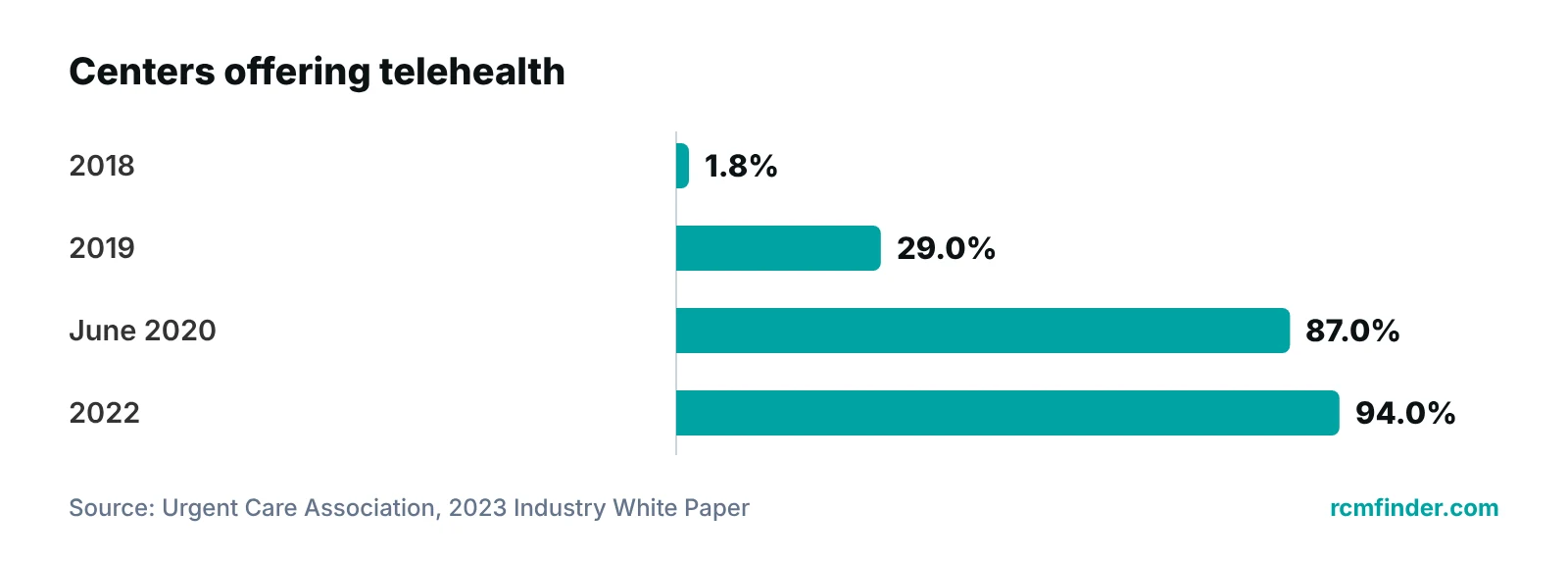
Adoption is no longer the open question. The Urgent Care Association white paper reports that 1.8% of surveyed centers offered telehealth in 2018, 29% in the 2019 benchmarking report, 87% by June 2020 and 94% in 2022. The same paper says centers offer it to meet patient expectations and stay competitive rather than because it is profitable, so model the economics before assuming a return.
Operators have done this for years: a 2017 Journal of Urgent Care Medicine item described remote providers serving self-pay and workers’ compensation patients. What has changed is the regulatory and payer picture.
Which visit types suit a virtual visit?
Visits suit video when a history and a visual check are enough to decide the next step. The medical director should set the list in writing so every desk and nurse applies it the same way.
| Group | Examples a clinic might include | Why | Rule to write down |
|---|---|---|---|
| Often suited to video | Mild cold or allergy symptoms, rash review, medication questions, results follow-up | History and a visual look can settle the plan | Clinician may convert to in-person at any point |
| Hybrid | Urinary symptoms, minor wound re-check, pink eye | May need a test or hands-on step | Book the in-person step before the call ends |
| Usually in-person | Injuries needing imaging, lacerations, chest pain, breathing difficulty, procedures, DOT or employer physicals | Needs hands-on care, testing or escalation | Screening script sends these to the door or emergency care |
| Occupational medicine | Follow-up of an open work-injury case | Payer or employer rules decide if video is accepted | Check the workers’ compensation payer first |
Source: RCM Finder editorial framework. It is not clinical guidance; each clinic’s medical director sets the final list.
A short red-flag script at booking sends unsuitable patients to in-person or emergency care. The same list should say what happens if the connection fails or the condition changes mid-visit.
“Write the exclusion list before the first booking. A virtual visit that should have been a walk-in costs the patient time and the clinic a second encounter.”
— Awais Afzal, Healthcare Operations & Data Analyst
Who can staff it, and where must they be licensed?
Clinicians generally need to be licensed or legally permitted in the state where the patient is located. The HHS telehealth site says providers must meet their own state’s rules and be licensed or permitted in the patient’s state, and HealthIT.gov advises establishing licensure where patients in other states are treated or prescribed for.
Near a state line or in a tourist area, that rule decides the schedule.
- Record the patient’s physical location at the start of every visit, not the billing address.
- Keep a roster of each clinician’s active licenses by state with renewal dates.
- Stop and redirect the visit if the clinician is not licensed where the patient is.
- Ask state boards and the malpractice carrier about scope of practice and supervision of nurse practitioners and physician assistants; the rules differ by state.
Controlled substances need a separate rule
Law-firm summaries report that DEA and HHS extended the telemedicine flexibilities for prescribing controlled substances through 31 December 2026 (Holland & Knight, January 2026), and a July 2026 policy summary says a final special registration rule had not been described as issued. Set a clinic policy on controlled substances with counsel and check the Federal Register before relying on this.
How does a virtual visit fit the walk-in queue?
A virtual visit fits when it is a visible lane in the same queue, with its own clinician time and one status board. As a side channel nobody watches, it leaves patients waiting and the walk-in room short-staffed.
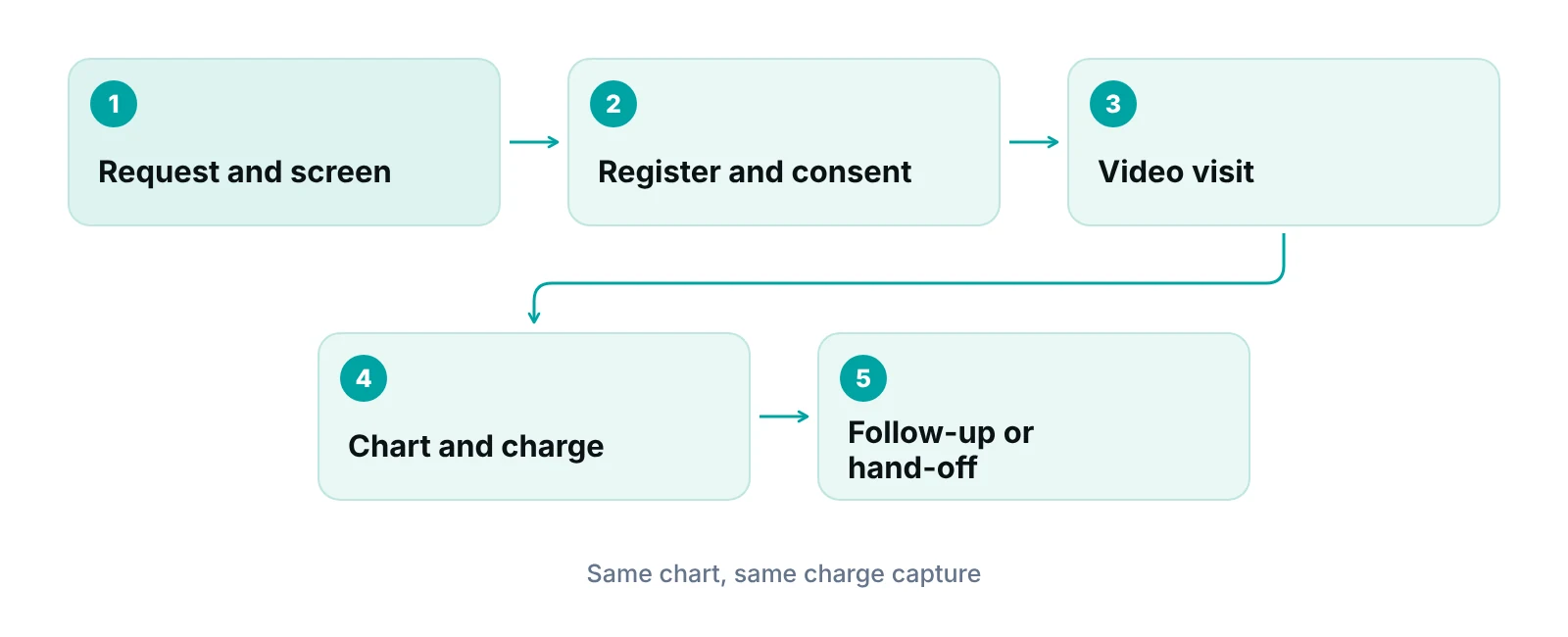
- One queue view. Virtual and in-person patients appear on one board, tagged by type, so the charge nurse can move clinician time.
- Same registration. Demographics, ID, insurance and eligibility come first, before the clinician joins.
- Pre-visit tech check. Send a link and test step before the clinician joins.
- Hand-off to the door. If the patient must come in, send the chart note to the front desk so they are not registered twice.
- Wait times. Show an estimate only if the clinic measures it.
Registration, eligibility and call-backs can be done by remote front-desk staff, such as RCM Finder’s Virtual Medical Assistant service, working inside the clinic’s systems. Appointment booking in the RCM Finder portal is early access, so do not plan the queue around it yet. To test whether your tools can hold a virtual lane, use the urgent care EHR guide and the practice management software guide.
How are virtual visits billed as of 22 October 2026?
Medicare’s telehealth flexibilities run through 31 December 2027 for most services, per the CMS Telehealth FAQ marked updated 9 October 2026. Commercial plans and Medicaid set their own terms, so each payer needs a written answer.
| Item | What CMS says | Why it matters to a clinic |
|---|---|---|
| Where the patient may be | Through 31 December 2027, anywhere in the US and territories. From 1 January 2028, generally a rural area and medical facility, except behavioral health. | Home-based visits for Medicare patients depend on the extension |
| Place of service | POS 02 is telehealth outside the home; POS 10 is in the home. Home visits paid at the non-facility rate since 1 January 2024. | Put the right POS on each claim |
| Audio-only | Allowed at home through 31 December 2027; from 1 January 2028 limited to behavioral health in defined cases. | Phone-only is time-limited |
| New modifiers | BB and BC required from 1 January 2027; CMS says no payment implications. | Ask whether the claim system can add them |
| Services list | CY2026 list published. Changes take effect 1 January via the fee schedule rule, final rule due by 1 November. | The 2027 list was pending when checked |
Source: CMS, Telehealth FAQ (updated 10/09/2026); CMS Telehealth page and List of Telehealth Services (CY2026); CMS Place of Service Code Set. Check the live pages before use.
The list is not final for 2027, so do not hard-code services. CMS’s Place of Service Code Set tells readers to check each payer’s policy; code detail is in the POS 10 guide.
The Center for Connected Health Policy separates service parity (must cover telehealth if covered in person, with no promise of the same rate) from payment parity (the same rate); state laws differ, some with sunset dates. Ask each major payer in writing: is video covered for the codes you bill, which POS and modifier, and at what rate? Add self-pay and workers’ compensation rules. Downstream steps are in the urgent care revenue cycle management guide.
What do consent and documentation need to show?
A virtual chart needs everything an in-person chart has, plus consent, patient location, identity checks, the technology used and what could not be assessed.
The Center for Connected Health Policy reports that most states have a telehealth-specific consent requirement, that some allow documented verbal consent while others require writing, and that content varies (risks and limits, identity, security, how to reach follow-up and emergency care). Its entries carry 2026 changes, so check your state.
| Field | What to capture | Owner |
|---|---|---|
| Consent | State-required wording, verbal or written, with date and who obtained it | Front desk or nurse |
| Patient location | State and address at the time of the visit | Front desk, confirmed by clinician |
| Identity | How identity was verified, and who else was present | Front desk or clinician |
| Technology | Platform used; audio-only or audio-video; any drop-out and the fallback used | Clinician |
| Clinical limits | What could not be examined remotely and why the plan is appropriate | Clinician |
| Escalation | Instruction given if symptoms worsen; in-person or emergency referral | Clinician |
| Billing data | Place of service, modifier required by payer, time or complexity basis | Coder or billing team |
Source: CCHP consent topic (2026 entries); HHS telehealth licensure page. The field list is an RCM Finder editorial checklist, not a legal standard.
Make these required template fields, so a visit cannot be closed without them.
What platform and privacy terms should be in place?
A video platform handling protected health information for the clinic is generally a business associate, so a signed agreement is needed first. HHS’s sample provisions say the HIPAA Rules generally require written contracts with business associates.
- Signed BAA before use. The HHS sample covers permitted uses, safeguards, breach reporting, individuals’ access rights, return or destruction of PHI at termination and flow-down to subcontractors. Sample language is optional, and state contract law may require more.
- Security controls. HHS’s technical safeguards paper lists access control, audit controls, integrity, authentication and transmission security. Ask the vendor to explain each, including encryption, and keep the answer with the clinic’s risk analysis.
- No consumer tools by default. HHS says the COVID-era enforcement discretion expired at 11:59 pm on 11 May 2023, with a transition period to 9 August 2023. See the video-call HIPAA question.
- Web pages and apps. HHS’s tracking technology guidance says tracking on authenticated pages can involve PHI and that scheduling or symptom-checker pages can too. Part of it was vacated by a Texas federal court on 20 June 2024, so ask counsel what applies to booking pages.
- Patient setup. Advise a private space and secure connection, and record that you did.
RCM Finder puts a Business Associate Agreement in place before accessing patient data, and its portal uses role-based access, audit logging and encrypted (HTTPS) connections.
How can the clinic market virtual visits without overpromising?
Describe what the service is, who it is for and how to start. Leave out promises about speed, cures or results.
- Google Ads. Google’s healthcare and medicines policy treats telemedicine as allowed with limitations and requires certification for prescription drug services, with LegitScript’s telemedicine certification applying in the United States. It prohibits promoting speculative treatments. See the urgent care digital marketing guide for campaign structure.
- Testimonials and reviews. The FTC’s endorsement guidance says advertisers must substantiate claims, that testimonials about exceptional results imply typical results, and that reviews must not be gated or suppressed. Do not publish results claims for virtual visits.
- Website. Put the virtual option beside the walk-in option, list eligible conditions and the red-flag warning, and keep booking forms free of unneeded trackers; the urgent care website design guide covers the page layout.
- Wait time. Quote none unless the clinic measures it and can stand behind it.
What should happen before and after launch?
Launch a small pilot with a short eligible-condition list, one platform contract and a weekly review, then widen.
Where RCM Finder can help, and what is not live
RCM Finder’s team can handle registration, eligibility and call-backs as remote front-desk staff, and its revenue cycle team can work virtual-visit claims inside the clinic’s EHR (for example PrognoCIS, eClinicalWorks or athenahealth), with no official partnership implied. The portal’s appointment booking is early access, and automated real-time eligibility inside the portal is not live. Pricing is quoted after a free audit.
Check the virtual-visit plan against your billing flow
Ask for a free practice audit and RCM Finder will review how virtual visits would move through registration, charge capture and claims at your clinic. The audit is free.
Our recommendations
- Write the eligible-condition list first. Have the medical director approve it, with red-flag screening and a hand-off rule.
- Map licenses to patient states. Keep a one-page roster and capture patient location every visit.
- Get payer answers in writing. Use Table 2 as a start and add a row per payer.
- Sign the platform contract first. No visit until the BAA is signed and security answers are in writing.
- Calendar the dates. Track 1 November 2026, 31 December 2026 (controlled substances) and 31 December 2027.
- Pilot, then measure. Track dropped calls, in-person conversions and denials by payer before widening.
Bottom line
Urgent care telehealth pays off as an operating discipline: a short list of eligible visits, clinicians licensed where the patient sits, consent and location charted every time, a signed platform contract and payer answers on paper. The wider operating picture is in the urgent care practice management guide, and RCM Finder’s practice management system page shows how intake, scheduling (in early access) and claim tracking fit together.
Frequently asked questions
Can an urgent care offer telehealth to patients in other states?
Only if the clinician is licensed or legally permitted where the patient is located at the time of the visit. HHS says providers must meet that state’s requirements, and HealthIT.gov advises establishing licensure for patients in other states. Capture the patient’s location every time and check with the state boards.
Does Medicare pay for urgent care telehealth visits in 2026?
Yes for services on the Medicare telehealth list, under flexibilities that CMS’s FAQ (updated 9 October 2026) says run through 31 December 2027. CMS’s 2027 list change is made through the fee schedule rule, due by 1 November. Check the CMS pages for the latest.
Do I need a BAA with a video platform?
Generally yes, if the vendor creates, receives, maintains or transmits protected health information for the clinic. HHS says the HIPAA Rules generally require written contracts with business associates. Have the BAA signed before the first visit and keep the vendor’s security answers on file.
What place of service goes on a virtual visit claim?
CMS defines POS 02 as telehealth when the patient is not at home and POS 10 as telehealth when the patient is at home. CMS tells readers to check each payer’s reimbursement rules. Medicare has paid home telehealth at the non-facility rate since 1 January 2024.
Which visits should not be done by video?
Anything that needs hands-on examination, imaging, procedures or immediate escalation, such as chest pain, breathing difficulty or injuries needing X-ray. The medical director sets the list, and screening at booking sends those patients to in-person or emergency care.
Can the clinic advertise virtual visits on Google?
Telemedicine is allowed with limitations under Google’s healthcare policy, and certification applies to prescription drug services. Avoid claims about results or guaranteed wait times. Confirm the current policy and your account’s status before running ads.
Get your free practice audit
Tell us about your practice. We will contact you using the details you give.
- A review of your recent claims, denials and A/R aging
- Where your front desk and prior authorizations slow payment
- A prioritized fix list you keep, whether or not you hire us
Pricing is quoted after the audit, based on your volume and the services you choose. Prefer to talk? Call +1 (302) 556-2288.
Sources
- Telehealth FAQ (updated 10/09/2026) — CMS (2026)
- Telehealth (Medicare coverage) — CMS (2026)
- List of Telehealth Services — CMS (2026)
- CMS Place of Service Code Set — HHS (CMS code set) (2024)
- 2023 Urgent Care Industry White Paper — Urgent Care Association (2023)
- Getting started: licensure — Telehealth.HHS.gov (2025)
- Are there state licensing issues related to telehealth? — HealthIT.gov (2024)
- HIPAA and telehealth — HHS OCR (2023)
- Sample Business Associate Agreement Provisions — HHS (2013)
- Security Standards: Technical Safeguards — HHS (2007)
- Use of Online Tracking Technologies by HIPAA Covered Entities and Business Associates — HHS OCR (2024)
- DEA and HHS extend telemedicine prescribing flexibilities through 2026 — Holland & Knight (2026)
- 2026 DEA Special Registration Rule: State of Play — Connect with Care (2026)
- Private payer parity — Center for Connected Health Policy (2026)
- Consent requirements: professional requirements — Center for Connected Health Policy (2026)
- Healthcare and medicines — Google Ads Policy Help (2026)
- The FTC's Endorsement Guides: What People Are Asking — FTC (2023)
- Telemedicine is Taking Root in Urgent Care — Journal of Urgent Care Medicine (2017)
Disclaimer: This article is educational and is not legal, coding, clinical or compliance advice. Telehealth rules vary by state, payer and profession and change often; Medicare, DEA and state dates in this article were read on 22 October 2026. Confirm current rules with your payers, state boards and qualified counsel before acting.
