
Urgent care practice management is the work of keeping a walk-in clinic staffed, paid and findable. It covers patient flow and wait times, staffing, front-desk intake and eligibility, coding and charge capture, payer mix, occupational medicine, denials and A/R, and patient communication. Measure each hand-off and give every number an owner.
Walk-in demand does not wait for a schedule, so small gaps in the day show up as lost patients and unpaid claims. This guide is for owners and managers who want one operating picture of the clinic, with a path to the deeper guide on each area.
It does not review products or promise results. Where numbers appear, they come from the cited sources and carry their year. Start with the urgent care revenue cycle management guide if billing is the pressing problem.
Key takeaways
- Define wait time once, measure it the same way daily and track patients who leave unseen.
- Eligibility checked before the patient is roomed is the cheapest denial prevention a clinic has.
- Close every chart the same day; code the visit from the note and capture the procedures and supplies.
- Run occupational medicine and workers’ compensation as a separate line with state-specific rules.
- Give every unpaid claim an owner, a reason and a deadline, and keep care, billing and marketing messages apart.
What does urgent care practice management cover?
Urgent care practice management is the work of keeping a walk-in clinic open, staffed, paid and findable. It covers the front door (flow and intake), the clinical day (staffing and coding), the money (payers, denials and A/R) and the way patients hear from you. This guide orients the owner and routes each area to a deeper read.
Urgent care differs from a scheduled office in one way that shapes everything else: demand arrives unannounced. The Urgent Care Association’s 2023 industry white paper counted about 14,000 centers at the end of 2022 and reported that more than 67% were open every day of the week (Urgent Care Association). A clinic open seven days with no appointment book cannot fix a bad hour by rescheduling it. It has to prevent the bad hour, or recover from it at the desk.
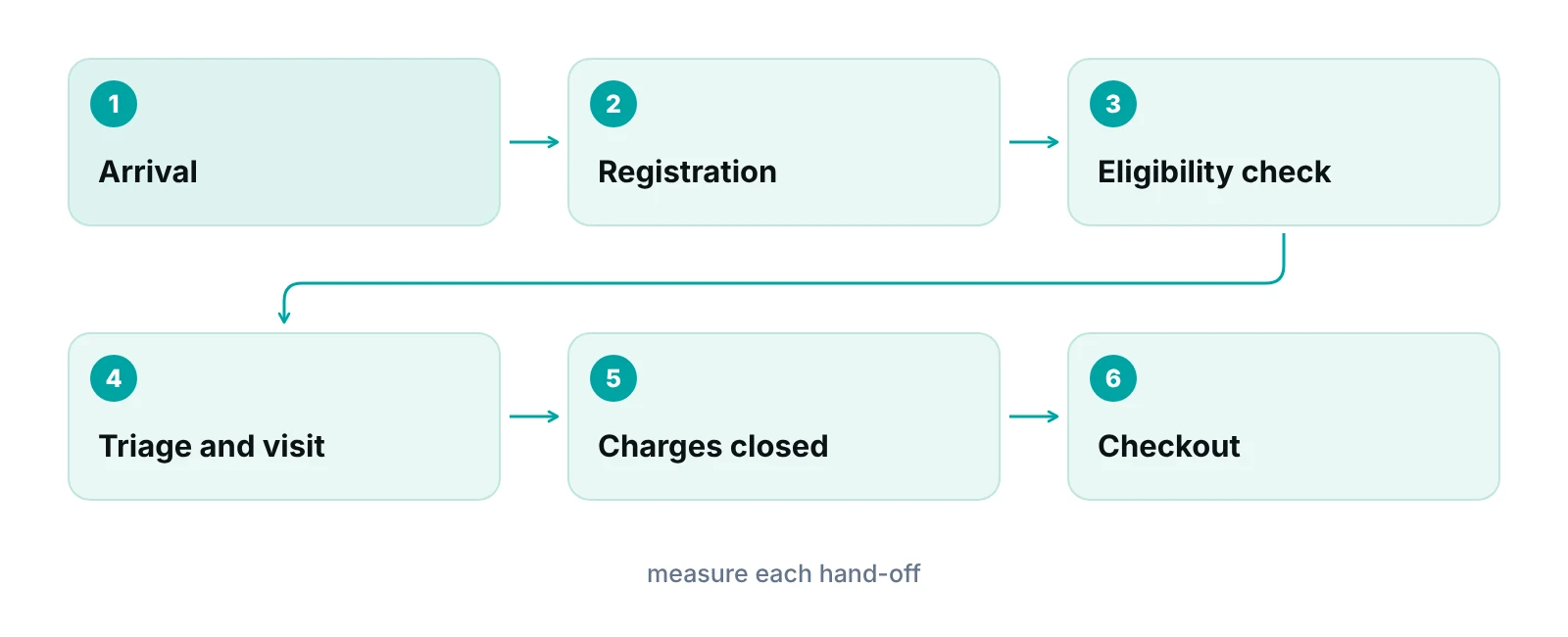
Most operating problems are hand-offs: a registration error that becomes a rejected claim, a procedure that never reaches the charge sheet, a text that raises a privacy question. The table maps the day.
| Stage | What must happen | What to watch |
|---|---|---|
| Arrival and check-in | Demographics, ID, insurance card, consent captured | Time from door to registration complete |
| Eligibility | Coverage confirmed before the visit | Share of visits checked before the patient is roomed |
| Visit | Provider sees the patient; orders, procedures, supplies recorded | Door-to-provider time; patients who leave unseen |
| Charge capture | Visit level, procedures and supplies coded and closed | Charts open at end of day |
| Claim and payment | Clean claim sent, payment posted | Days from visit to claim; rejections |
| Follow-up | Denials worked, patient balances collected | Unpaid claims by age and owner |
How do you manage walk-in flow and wait times?
Start by defining the wait, then measure it the same way every day. A 2019 Journal of Urgent Care Medicine commentary noted that “wait time” has no industry standard and that the American College of Emergency Physicians suggests measuring from the door to a qualified medical provider. Pick that or a similar definition, write it down and use it for staff, reports and any public posting.
Measurement alone changes behavior. A 2024 Journal of Urgent Care Medicine quality-improvement study at one co-located pediatric urgent care and emergency department tested a fast-track process for low-acuity patients. Mean urgent care door-to-provider time fell from 82.7 to 21.4 minutes and the share of patients who left without being seen fell from 5.9% to 3.5%. The study was one site, had no control group and involved children, so treat it as an example of what a measured process can do, not a benchmark for your clinic.
Four habits keep flow predictable.
- Count arrivals by hour for at least four weeks, by weekday. Staffing and opening-hour decisions should follow your own curve, not a rule of thumb.
- Set a trigger for surge mode. For example, when more than a set number of patients are waiting, a second person registers, a nurse starts standing orders and the manager checks the queue.
- Track patients who leave unseen and patients still waiting at closing. Both show where capacity ran out.
- Keep marketing tied to capacity. A promotion that fills a Saturday you cannot staff creates the walkouts you are measuring.
How should an urgent care plan staffing?
Plan staffing to the arrival curve, then protect the roles that cannot be covered by someone else: the licensed clinician, the person who can take an X-ray and the person at the door. The 2023 Urgent Care Association white paper reports that NP/PA-led models, with physicians not always on site, grew from 54.4% of centers in 2019 to 71.6% in 2022, while physician-only staffing was 0.3% (UCA).
The same paper reports that X-ray technicians are employed at 84.6% of centers and RNs at 46.1%. The support mix decides who can run imaging and complete intake while the provider sees the next patient.
Front-desk coverage is the role most clinics under-plan. A desk that is one person short on a Monday morning slows eligibility checks, and the cost shows up later as rejected claims. Options include cross-training, a split shift at peak hours, or remote front-desk help for eligibility and intake. RCM Finder’s Virtual Medical Assistant service provides remote front-desk staff who work on the practice’s own time zone.
A staffing check you can run this week
Chart four weeks of arrivals by hour, overlay scheduled staff and mark every hour where one role is a single point of failure.
What should the front desk capture at the door?
The front desk should leave every registration with a verified patient, active coverage, the correct payer on file and a payment conversation started. Errors here are the cheapest to fix at the desk and the most expensive to fix on a denied claim.
Eligibility is the main reason. The 2024 CAQH Index, which reports 2023 data, puts the industry labor cost of a manual eligibility and benefit verification at $12.95, against $2.04 when done electronically (CAQH). A walk-in clinic runs this check many times a day, so the gap is a daily number. The table shows the three transactions that matter most to a clinic.
| Transaction | Manual | Electronic | Why it matters at a walk-in clinic |
|---|---|---|---|
| Eligibility and benefit verification | $12.95 | $2.04 | Runs for most visits, usually while the patient waits |
| Claim submission | $7.35 | $3.15 | Paper or portal re-keying slows the claim |
| Claim status inquiry | $18.18 | $3.68 | Phone calls are the costliest way to chase an unpaid claim |
Source: CAQH, 2024 CAQH Index (calendar year 2023 data). Costs are industry labor costs and exclude system costs.
Build the intake checklist around what the claim will need:
- Photo ID and a scan of both sides of the insurance card at every visit, not only the first.
- Coverage check before the patient is roomed, with the plan, copay and any workers’ compensation or auto claim noted.
- Place of service 20 on the claim. The CMS code set describes it as a site separate from a hospital emergency room, an office or a clinic where walk-in patients receive prompt, unscheduled care (CMS Place of Service code set).
- A self-pay path. CMS guidance on good faith estimates covers uninsured and self-pay patients and says urgent or emergent care is generally not covered unless it is scheduled at least three days ahead (CMS FAQs). Your counsel should confirm how that applies to your clinic.
The deeper process is in the patient insurance verification guide. For the full path from check-in to payment, with the timing of each step, read the urgent care revenue cycle management guide.
How should visits and procedures be coded?
Code the visit from the documentation, add the procedures and supplies that were actually performed, and close the chart before the patient leaves or the same day. Most urgent care billing errors come from charges that were never captured or levels that the note does not support.
Visit level is the first decision. Since January 1, 2021, office and outpatient E/M codes 99202-99215 can be selected by medical decision making or by total time on the date of service, and 99201 was deleted. Level by decision making rests on two of three elements: problems addressed, data reviewed and risk. History and exam are required only as medically appropriate (AMA; JUCM). Time counts the practitioner’s work on that day, including non-face-to-face tasks, and excludes clinical staff time and procedure time. Time-based billing draws audit attention when high levels pair with minor diagnoses.
Procedures add a second question: can the visit be billed separately on the same day? Payers expect modifier 25 only when the evaluation was significant and separately identifiable from the usual work of the procedure. One payer policy, effective July 1, 2023, says an E/M is not separately paid unless the patient’s condition required care above and beyond that usual work (Regence reimbursement policy). Other payers differ, so keep a payer-specific cheat sheet. The modifier 25 vs 59 guide explains the pair.
Keep a charge sheet or EHR template current with the procedures and supplies you perform. The urgent care billing and coding guide and the guide to common urgent care billing mistakes give the coding detail this overview leaves out.
The EHR is where most of these controls live. The guide to EHR benefits for urgent care billing covers what the record should hand to billing, and the urgent care EHR evaluation checklist covers how to compare systems without brand names.
How does payer mix shape operations?
Payer mix decides which visits earn what, which need extra paperwork and which get chased the longest. Know the share of commercial, Medicare, Medicaid, workers’ compensation and self-pay visits by month before negotiating, staffing or adding services.
The 2023 white paper reports that 95% of surveyed centers receive Medicare fee schedule reimbursement, that commercial payers are the primary payers and that centers declining Medicaid cite fee schedules that do not cover costs and administrative burden. It also reports that the share of centers offering a cash-payment discount program fell from 67% in 2019 to 54.5% in 2022, and that medical supplies rose from 5.4% of expenses in 2018 to 15.2% in 2023 (UCA). The paper gives no percentage split by payer, so build your own from the practice system.
| Visit type | Median per day | Billing consequence |
|---|---|---|
| Provider visits | 40 | Commercial, Medicare, Medicaid or self-pay; eligibility every time |
| Occupational medicine | 5 | Employer billed; authorization and fee schedule rules |
| Workers’ compensation | 4 | State rules and a claim number; different forms and payers |
| Nurse visits | 4 | Often lower-level services; check what your payers allow |
| Digital health | 3 | Telehealth rules and consent; see telehealth section |
Source: Urgent Care Association, 2023 Industry White Paper, citing the 2022 UCA Operations Benchmarking Report (median of 56 patients per day). The paper elsewhere cites a median of 40 daily visits per center.
Review the mix quarterly. A shift toward self-pay or a slow-paying payer changes the cash plan even when visit volume is flat.
How does occupational medicine fit into the clinic?
Occupational medicine is a separate line of business inside the same building: the payer is usually an employer or a workers’ compensation carrier, the paperwork differs and the front-desk process should differ too.
The 2023 white paper reports a median of five occupational medicine visits and four workers’ compensation visits per day, and lists pre-placement physicals, drug screening, post-injury testing, annual employment physicals and DOT physicals among services. It also reports that very few centers have a separate entrance, waiting room or lab for these patients, and that about 2% have providers dedicated to them (UCA).
Three rules shape how to run the line:
- Workers’ compensation is state-run. The Department of Labor says workers at private companies and state or local agencies should contact their state workers’ compensation board (DOL). Fee schedules, forms and deadlines vary by state, so confirm them with your state board.
- DOT physicals need a registry-listed examiner. FMCSA announced in 2014 that new physicals for interstate commercial truck and bus drivers must be done by a health professional on the National Registry of Certified Medical Examiners (FMCSA). Check that the examiner is listed and current.
- Agree terms with the employer first: who orders, who pays and how results are reported.
Capture the employer, claim number, adjuster and date of injury at registration, and keep them out of the patient’s own insurance claim. The workers’ compensation revenue cycle guide covers the billing side.
How do you manage denials and accounts receivable?
Work every unpaid claim from a queue with an owner and an age. Denials come mainly from front-end data and coding, so fix the cause in the process and keep a short list of the top reasons by payer.
The most useful public denial data is not urgent care specific. KFF’s analysis of 2024 ACA marketplace plans found that insurers denied 19% of in-network claims (about 85 million of 451 million), with insurer rates ranging from 3% to 36%, and that fewer than 1% of denials were appealed (KFF). Marketplace plans are one slice of your payer mix, so the figures show the scale of the problem rather than your clinic’s rate. Track your own.
Timing matters as much as reason. Medicare requires a claim to be filed no later than the end of one calendar year after the date of service, with limited exceptions (42 CFR 424.44). Commercial payers set their own, often shorter, limits in contracts. Put those limits on the A/R worklist.
- Send clean claims within a day or two of the visit, using the completeness checks in your system.
- Work rejections the same day; they never reached the payer.
- Group denials by reason and payer; fix the intake or coding cause.
- Appeal with documentation before the payer deadline and log the result.
- Check claim status electronically before phoning; CAQH’s figures above show phone work costs more.
For the working method, read the medical billing denial management guide.
How should patients hear from the clinic?
Patient messages split into three groups with different rules: care messages (results, reminders, ready-to-be-seen texts), billing messages and marketing. Keep them separate in your tools and your policies.
HHS says marketing is a communication that encourages people to buy or use a product or service and generally needs written authorization, while communications for treatment and care coordination are excluded. It also exempts face-to-face communication (HHS Privacy Rule marketing guidance). Texting adds federal telephone-consent law. A law-firm summary of the FCC’s 2015 order says providing a phone number to a provider counts as consent for HIPAA-covered healthcare calls within the scope of that consent, and that the exemption for urgent health messages excludes billing and payment calls and requires an easy opt-out, including STOP for texts (Kutak Rock summary). Confirm the current rule with counsel.
Where the clinic’s website and tools collect information before the visit, review them with the same care. The urgent care website design guide covers booking, forms, accessibility and tracking-technology cautions.
The Urgent Care Association reports that 94% of surveyed centers offered telehealth in 2022, up from 1.8% in 2018 (UCA). Licensure, billing and consent rules differ, and Medicare flexibilities have changed repeatedly; the urgent care telehealth guide tracks them.
How do marketing and software tie in?
Marketing should send as many patients as the clinic can see, and software should carry their data from the first click to the final payment. Treat both as parts of the same flow.
- Local search: near-me searches depend on accurate hours and a verified profile. The urgent care SEO guide covers it.
- Promises: wait-time claims need a basis, and the word “emergency” can cause trouble. See the urgent care marketing guide.
- Paid and online channels: targeting and measurement rules are in the urgent care digital marketing guide.
- Software: what the practice system must carry is in the urgent care practice management software guide.
Any vendor that handles patient information for you needs a business associate agreement; HHS publishes sample provisions (HHS).
Where can RCM Finder help, and what is not live?
RCM Finder offers revenue cycle management (billing, coding support, claim scrubbing, denial management, A/R follow-up), Virtual Medical Assistants for eligibility checks, prior authorizations and intake, and a software portal for practices and billing companies. The team works inside the clinic’s existing EHR.
The portal today provides claim tracking by pipeline stage, data-completeness checks before submission, underpayment detection against expected amounts, workflow rules, role-based permissions, an audit log, a client portal and reporting dashboards. Connections use HTTPS, and RCM Finder puts a Business Associate Agreement in place before accessing patient data. See the practice management system page for the current list, and the revenue cycle management page for the billing service.
Early access and coming next
Appointment booking with a calendar view is in early access. A provider credentialing module and automated real-time eligibility verification inside the portal are not live. Do not plan around them yet.
What should the owner review each week?
Review a short scorecard weekly and a longer one monthly, with one owner per number and fixed definitions.
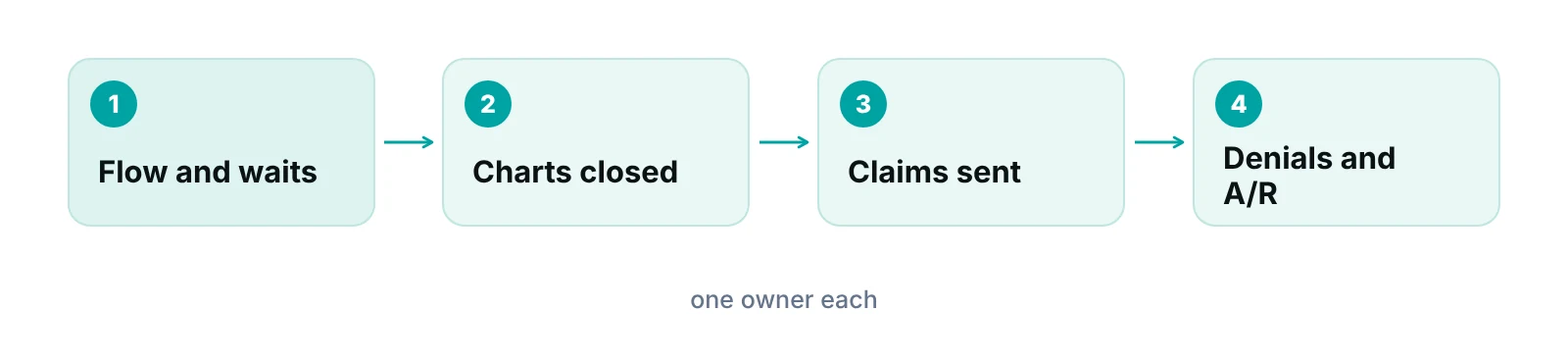
- Weekly: door-to-provider time, patients who left unseen, open charts, days to send claims, rejections.
- Monthly: payer mix, denials by reason and payer, A/R by age, occupational medicine volume and collections.
- Quarterly: staffing against the arrival curve, hours of operation, software and vendor review.
See where your walk-in day leaks
A free practice audit reviews how check-in data, charges and denials move through your current setup, so you can see which area to fix first.
Our recommendations
- Define the wait, then measure it. Choose one definition of wait time, such as door to qualified provider, and report it weekly with unseen patients.
- Staff to your own arrival curve. Use four weeks of hourly arrivals to find single points of failure.
- Verify coverage before the patient is roomed. Make eligibility a gate, and use electronic checks where possible.
- Close every chart the same day. Charges not captured today become write-offs later. Review open charts at close.
- Run occupational medicine as its own line. Give it its own intake fields, employer agreements and claim tracking.
- Own every unpaid claim. Each denial has an owner, a reason and a deadline.
- Separate care, billing and marketing messages. Write a rule for each, with counsel, before enabling texting.
Bottom line
Running an urgent care well means controlling the hand-offs: door to desk, desk to provider, provider to charge, charge to claim and claim to payment. Use the sibling guides above for each area, and if you want help with the desk, the claims and the reports, RCM Finder’s practice management system page lists what the portal does today and what is still early access.
Frequently asked questions
What is urgent care practice management?
It is the operating work of running a walk-in clinic: patient flow and wait times, staffing, front-desk intake and eligibility, coding and charge capture, payer mix, denials and A/R, and patient communication. It sits above any one software tool. A good system measures each hand-off and gives every number an owner.
What KPIs should an urgent care track weekly?
Start with door-to-provider time, patients who leave unseen, charts still open at closing, days from visit to claim, rejection count and the oldest unpaid claims by payer. Add payer mix, denials by reason and occupational medicine volume monthly. Define each measure in writing so staff count it the same way.
What place of service code does an urgent care use?
Place of service 20 is the CMS code for an urgent care facility, described as a site separate from a hospital emergency room, an office or a clinic that treats walk-in patients needing prompt, unscheduled care. Check each payer’s rules, since some contracts and plans have their own requirements.
How long does an urgent care have to file a Medicare claim?
Medicare requires the claim to be filed no later than the close of one calendar year after the date of service, with limited exceptions listed in 42 CFR 424.44. Commercial payers set their own limits by contract, which are often shorter, so put each payer’s deadline on the A/R worklist.
Should an urgent care run occupational medicine separately?
Usually yes. The payer is often an employer or a workers’ compensation carrier, rules are set by each state, and DOT physicals need a registry-listed examiner. Separate intake fields, employer agreements and claim tracking keep those visits from mixing with insurance claims and slowing the main flow.
Can an urgent care text patients about wait times?
Care and logistics messages are treated differently from marketing, but texting adds telephone-consent rules and HIPAA duties. A law-firm summary of the FCC’s 2015 order describes limits such as short messages, frequency caps and a STOP opt-out. Have counsel review your texting program and keep marketing out of care messages.
Get your free practice audit
Tell us about your practice. We will contact you using the details you give.
- A review of your recent claims, denials and A/R aging
- Where your front desk and prior authorizations slow payment
- A prioritized fix list you keep, whether or not you hire us
Pricing is quoted after the audit, based on your volume and the services you choose. Prefer to talk? Call +1 (302) 556-2288.
Sources
- 2023 Urgent Care Industry White Paper — Urgent Care Association (2023)
- 42 CFR 424.44 Time limits for filing claims — eCFR (2026)
- CMS Place of Service Code Set — HHS (CMS code set) (2024)
- 2024 CAQH Index — CAQH (2024)
- Already Looking Forward to 2021 and Smoother Sailing with E/M Coding — Journal of Urgent Care Medicine (2020)
- E/M health plan webinar — American Medical Association (2020)
- Good Faith Estimates for Uninsured or Self-Pay Individuals FAQs, Part 1 — CMS (2021)
- DOT Reminds Commercial Drivers Physicals Must Now Be Performed by Certified Medical Examiners — FMCSA (2014)
- Workers' Compensation — U.S. Department of Labor (2026)
- Claims Denials and Appeals in ACA Marketplace Plans in 2024 — KFF (2024)
- Modifier 25; Significant, Separately Identifiable Service — Regence (reimbursement policy) (2023)
- Marketing (HIPAA Privacy Rule guidance) — HHS Office for Civil Rights (2026)
- FCC clarifies TCPA robocall rules for health care — Kutak Rock LLP (law-firm summary of 2015 FCC order) (2015)
- Fast-track process for low-acuity pediatric patients (quality improvement study) — Journal of Urgent Care Medicine (2024)
- Advertised ED Wait Times Negatively Skew Patient Perceptions — Journal of Urgent Care Medicine (2019)
- Sample Business Associate Agreement Provisions — HHS Office for Civil Rights (2013)
Disclaimer: This article is educational and is not legal, coding, compliance or medical advice. Payer, state workers' compensation, telephone-consent and privacy rules differ and change over time, so confirm current requirements with your counsel, your state agencies and each payer. CPT is a registered trademark of the American Medical Association; official code descriptors are not reproduced here.
