
The 90834 CPT code reports individual psychotherapy of 38 to 52 minutes, billed as a stand-alone service. Count only face-to-face therapy minutes, record the time in the note, and report one unit. If the same clinician also performs a separate E/M visit that day, the add-on psychotherapy codes apply instead.
You finish a session and the clock says 45 minutes. The claim form needs one code, the note needs proof of the time, and the payer may ask for both months later. This guide is for practice owners, group-practice managers and billing staff who need to decide how 90834 is handled in their office. It covers the time band, how 90834 differs from 90832 and 90837, what the record must show, and where claims fail.
It stays on this one code. For the full code set, see our mental health CPT codes guide, and for the add-on used with a medical visit, see the 90836 CPT code post.
Key takeaways
- 90834 covers 38 to 52 minutes of individual psychotherapy. The 45-minute label is a name, not an exact-minutes rule.
- Below 38 minutes the session moves to 90832, and from 53 minutes it moves to 90837. Under 16 minutes no psychotherapy code applies.
- The note has to show how long the session lasted, plus signed, dated treatment details. Missing time is the first thing a reviewer looks for.
- When a prescriber adds therapy to an E/M visit, the add-on code (90836) is used, not 90834.
- Unit limits, diagnosis lists and telehealth rules differ by payer, so keep a short rule sheet for each one.
What does the 90834 CPT code report?
It reports an individual psychotherapy session of about 45 minutes, face to face with the patient. The American Psychiatric Association’s CPT overview lists the code as psychotherapy, 45 minutes, usable for sessions of 38 to 52 minutes (American Psychiatric Association). The AMA owns the official CPT wording, so the code is described here in plain terms.
The patient must be present for all or some of the service, and the time counts only the psychotherapy itself (CMS Medicare Coverage Database, Article A57520). The same overview says the time can be spent with the patient and/or a family member.
A Medicare Part B contractor states that codes 90832, 90834 and 90837 describe psychotherapy without medical management (Palmetto GBA, Article A59723, effective January 1, 2026, a draft article). If the visit includes a separate medical evaluation by the same clinician, the add-on codes come into play, which a later section explains. Behavioral health practices make this choice on most therapy claims; our behavioral and mental health RCM operations page shows how billing support is organized for that setting.
A name is not a rule
The descriptor says 45 minutes, but the claim is supported by a band, not by an exact length. A 38-minute session and a 52-minute session both fit 90834 if the note shows the time.
What is the 90834 time band, and how does it compare with 90832 and 90837?
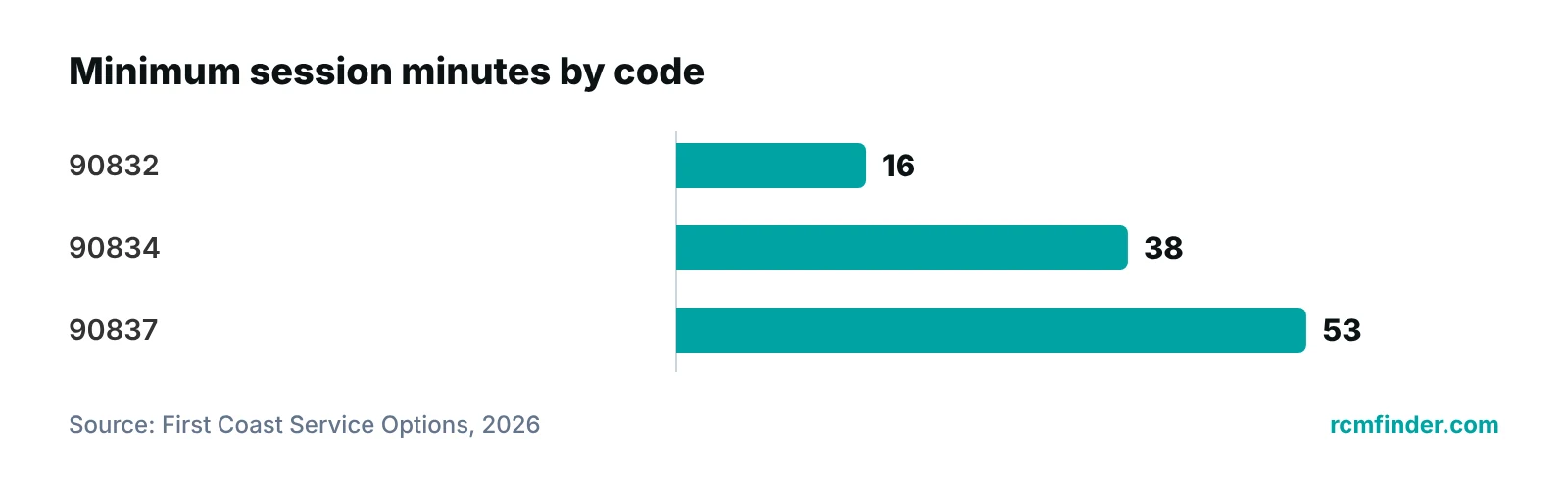
The band is 38 to 52 minutes. A Medicare contractor lists 90832 at 16 to 37 minutes, 90834 at 38 to 52 minutes and 90837 at 53 minutes or longer, and says not to report psychotherapy codes for any session under 16 minutes (First Coast Service Options, page dated August 6, 2026, psychotherapy services).
| Code | Session length | How it is reported |
|---|---|---|
| 90832 | 16 to 37 minutes | Stand-alone individual psychotherapy |
| 90834 | 38 to 52 minutes | Stand-alone individual psychotherapy |
| 90837 | 53 minutes or longer | Stand-alone individual psychotherapy |
| 90833 | 16 to 37 minutes | Add-on to a qualifying E/M visit |
| 90836 | 38 to 52 minutes | Add-on to a qualifying E/M visit |
| 90838 | 53 minutes or longer | Add-on to a qualifying E/M visit |
Source: First Coast Service Options, Psychotherapy services (page dated August 6, 2026); American Psychiatric Association, CPT overview.
90834 vs 90832
The only difference is time. A session that ends at 37 minutes supports 90832 and a session that reaches 38 minutes supports 90834. Our 90832 CPT code guide covers the short-session code and the 16-minute floor in detail.
90834 vs 90837
Again the difference is time. A session of 53 minutes or longer supports 90837. Whichever code is billed, the note must prove the minutes, and defaulting to 90834 for sessions that run past 53 minutes leaves supported work unbilled.
How do you pick between the codes when the clock is close?
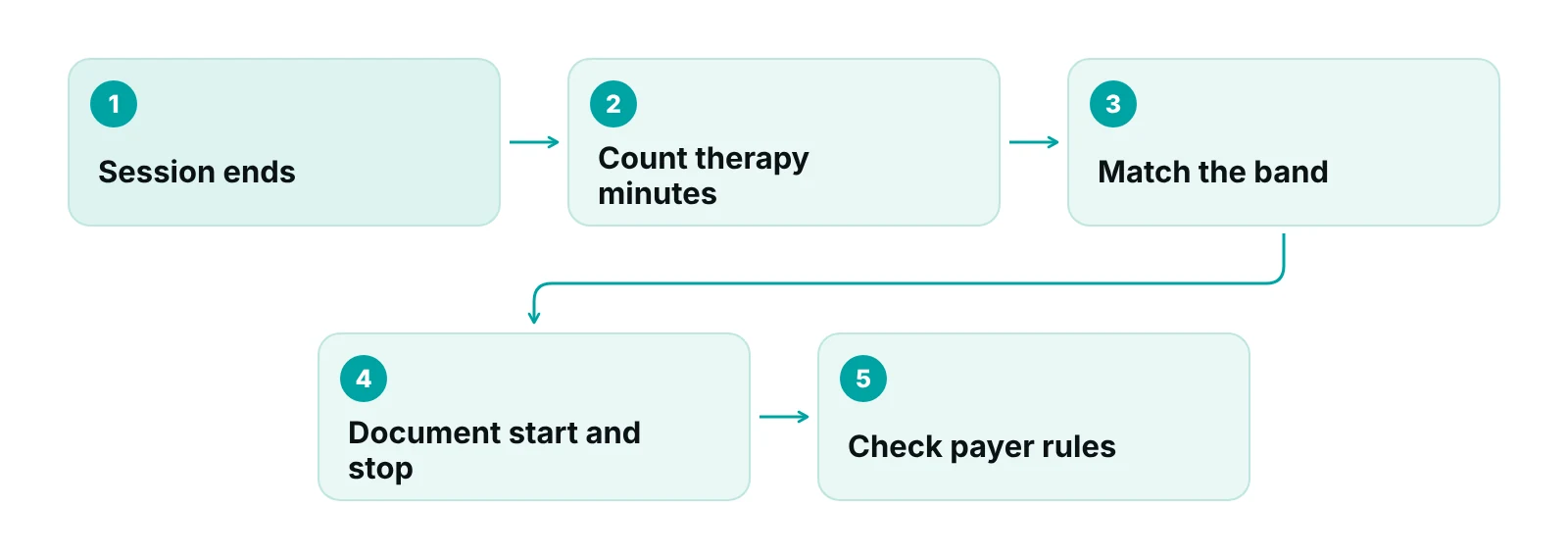
Use the actual documented minutes and match them to the band, never the appointment slot. A contractor article tells billers to choose the code closest to the actual time and requires start and stop times or total time in the record (CMS Medicare Coverage Database, Article A57520, revision effective January 1, 2025, a draft article).
| Scenario | Likely code | What to check |
|---|---|---|
| Thirty-seven-minute session | 90832 | Do not round up to the next code |
| Thirty-eight-minute session | 90834 | Time moved into the next band; start and stop times in the note |
| Fifty-two-minute session | 90834 | Still inside the band; confirm no break or paperwork time was counted |
| Fifty-three-minute session | 90837 | Check that every minute was therapy, not scheduling or note writing |
| Fifteen-minute check-in | No psychotherapy code | Below the 16-minute floor; ask the payer if another service fits |
| Prescriber adds therapy to a medical visit | Add-on code with an E/M | 90834 is not the right code; see the E/M section |
Source: First Coast Service Options (August 2026) and CMS Medicare Coverage Database Article A57520 for the bands and the 16-minute floor; scenario column is an RCM Finder summary.
Edge mistakes usually come from counting the scheduled slot instead of the clock, counting waiting or paperwork time, or letting the system default to the last visit’s code.
A contractor also notes that when interactive complexity (90785) is billed with a time-based code, the time spent on it must be documented, and that it should not be billed if the patient cannot communicate by any means (Article A57520). Noridian lists 90785 as reportable with 90834 (Noridian JE Part B, updated June 8, 2026).
When is 90834 the wrong code?
It is the wrong code when the same clinician delivers a separate E/M service in the same visit. In that case the psychotherapy is reported with an add-on code, 90833, 90836 or 90838, and the add-on time must not include the E/M time (Article A57520, CMS Medicare Coverage Database). The APA overview makes the same point: when psychotherapy is done in the same encounter as an E/M service, timed add-on codes are used.
Noridian adds that to report psychotherapy and E/M on the same day, both must be significant and separately identifiable, and the psychotherapy and E/M time cannot overlap (Noridian). If you are weighing the add-on version, the 90836 CPT code post covers the pairing rules.
Other cases to separate
- Family therapy. First Coast says family psychotherapy (90846, 90847) focused on patient-family interaction may be reported with an individual code only if it is a distinct service in a separate time interval (First Coast). See the 90846 time range post.
- Diagnostic evaluation. Noridian states 90791 and 90792 are never used with an E/M on the same day (Noridian).
- Therapy method. The method does not change the code; a cognitive behavioral session is still billed by time (see the CBT billing guide).
What must the note show to support 90834?
The note must show the length of the session and enough clinical detail to prove the service was delivered and needed. First Coast says the medical record must indicate the length of time spent in the psychotherapy encounter (First Coast, psychotherapy services). A CMS article lists start and stop times or total time as acceptable (Article A57520).
When a Medicare contractor announced post-payment review of 90832, 90834 and 90837 in April 2021, it said reviewers check medical necessity, required components and signatures, proof the service was delivered, and correct coding (CGS Administrators).
| Element | What it proves | Where it appears |
|---|---|---|
| Date of service and patient name | The note belongs to the claim | CGS review notice (2021) |
| Session time (start and stop, or total) | The band billed matches the minutes delivered | First Coast (2026); Article A57520 |
| Individualized treatment plan with goals, frequency and duration | The service is part of a plan, not open-ended contact | CGS review notice (2021) |
| Interventions used and patient response | The session was therapy, not a general check-in | Noridian (June 2026); CGS (2021) |
| Diagnosis, mental status and progress | Medical necessity and clinical direction | CGS (2021); Noridian (2026) |
| Signature and credentials; late entries initialed and dated | The record is authentic and attributable | CGS review notice (2021) |
Source: CGS Administrators (April 26, 2021); First Coast Service Options (August 2026); Noridian JE Part B (June 2026); CMS Medicare Coverage Database Article A57520.
Palmetto GBA’s article adds that treatment plans should be updated generally every three months and that a periodic summary of goals and progress belongs in the record (Article A59723).
“The code is only as strong as the minute count in the note. Build the time into the template so a session cannot be signed without it.”
— Awais Afzal, Healthcare Operations & Data Analyst
Who can bill 90834, and does telehealth change the code?
The code is used by clinicians who are enrolled with the payer for psychotherapy. Noridian lists physicians, psychologists and several nonphysician practitioners, including nurse practitioners, physician assistants, clinical social workers and marriage and family therapists, as able to bill independently subject to specialty and enrollment rules. It also says counselors, qualified mental health professionals, RNs and LPNs cannot bill directly (Noridian JE Part B, updated June 8, 2026).
Telehealth does not change the code. The HHS telehealth resource center lists 90834 with permanent Medicare coverage for telehealth (page last updated July 29, 2025, telehealth.hhs.gov). What changes is place of service. CMS says that as of January 1, 2024, POS 02 means telehealth other than in the patient’s home and POS 10 means telehealth in the patient’s home (CMS MLN901705, December 2025).
The same booklet says the home is a permitted originating site for mental health diagnosis and treatment, with an in-person visit required within 6 months of the first telehealth visit and annually after, subject to an exception. Telehealth rules change, so confirm them first; see our telehealth billing guide for the wider picture.
What payer limits apply to 90834?
Payers add their own limits on units, visits and diagnoses. Medicare contractors are the most explicit. First Coast says codes 90832 to 90834 and 90836 to 90838 are generally limited to one unit, with multiple units allowed only in partial hospitalization (POS 52), and that since July 1, 2022 claims with more than one unit outside POS 52 are denied (First Coast).
State Medicaid programs differ. The Texas Medicaid provider manual (July 2024) limits psychotherapy codes, including 90834, to 30 visits per calendar year, requires prior authorization beyond that, and restricts the codes to a specific list of diagnoses (Texas Medicaid Provider Procedures Manual). It also requires modifier 95 for audiovisual telehealth and FQ for audio-only. These are one state’s rules.
The First Coast article lists 582 ICD-10-CM codes that support medical necessity for the group including 90834 and says to code to the highest specificity (Article A57520). Check each payer’s diagnosis list before the first claim goes out.
A one-page rule sheet per payer saves time; our behavioral health coding cheat sheet shows one layout.
Why do 90834 claims get denied, and how do you fix them?
Denials usually trace to the few causes below. The contractor documents name the related items as requirements but do not rank them, so treat the list as a checklist, not a statistic.
- No time in the note. Add a required start and stop field before the note can be signed.
- Wrong band. Compare the billed code with the documented minutes before release, especially at 37/38 and 52/53.
- More than one unit. Cap the unit field at one for non-hospital settings, since Medicare contractors deny the rest.
- Diagnosis not covered. Match the primary diagnosis to the payer’s list and code to full specificity.
- Unsigned or late entries. CGS says late entries must be identified, initialed and dated by the author.
If a claim does deny, the response clock matters. CGS’s 2021 notice says a documentation request must be answered within 45 days, a failure to respond results in denial for non-response and recoupment, and a redetermination request is due within 120 days of the demand letter (CGS Administrators). Check the letter you receive, since deadlines vary.
Not sure your 90834 claims would hold up in a review?
Send us your psychotherapy workflow and we will review how time, codes and notes line up. The audit is free.
Should you manage 90834 billing in-house or get help?
Keep it in-house if one person knows the rules and reviews the claims. Get help when volume, payer variety or turnover makes the rules hard to keep current.
- Who checks the time in the note before a claim is released?
- Who owns the payer rule sheet, and when was it last updated?
- Who works denials, and how soon after they arrive?
If the honest answer to several of these is nobody, a partner can help. Look for one that works inside the EHR you already use. RCM Finder offers medical billing services and denial management services, and the behavioral health billing partner guide explains what to ask a vendor.
Check the cost of denied therapy claims
Enter your claim volume to see what delays and denials may cost your practice.
Our recommendations
- Make start and stop times a required field. Build time into the note template so a psychotherapy note cannot be signed without it. It is the cheapest control against a time denial.
- Train staff on all three bands. Review sessions at 37/38 and 52/53 minutes first, since most errors happen at the edges.
- Cap units at one. Set 90834 to one unit per date of service by default and flag any exception for review, except in settings such as partial hospitalization.
- Keep a one-page rule sheet per payer. Record unit limits, visit caps, diagnosis lists, telehealth rules and authorization steps. Date it and review it quarterly.
- Audit a small sample monthly. Compare the minutes, plan and signature in a few notes per clinician with what was billed.
Bottom line
The 90834 CPT code comes down to a 38 to 52 minute band, one unit, and a note that proves both. Match the code to the documented minutes, use the add-on codes when a medical visit is part of the session, and keep a rule sheet for each payer. If you want a second set of eyes on your psychotherapy claims, our medical billing services and denial management services teams can review them, and the behavioral and mental health RCM operations page explains how we support therapy practices. For the full code set, see the mental health CPT codes guide.
Frequently asked questions
What is the time range for the 90834 CPT code?
The 90834 time range is 38 to 52 minutes of individual psychotherapy. At 53 minutes the session moves to 90837, and at 37 minutes or less it falls to 90832. A Medicare contractor says not to report any psychotherapy code for a session under 16 minutes. Record the minutes in the note.
Is 90834 the same as a 45-minute session?
Not exactly. The code is named for a 45-minute session, but it is supported by any documented session from 38 to 52 minutes. A 40-minute and a 50-minute session both fit. What matters is that the note shows start and stop times or total time, because the record has to prove the band.
What is the difference between 90834 and 90837?
The difference is time. 90834 covers 38 to 52 minutes and 90837 covers 53 minutes or longer. Both are stand-alone psychotherapy codes. Because 90837 is the longer service, payers often review it more closely, so make sure every counted minute was therapy and the note shows it.
Can 90834 be billed with an E/M visit on the same day?
Not as 90834. When the same clinician performs a separate E/M service and psychotherapy, the add-on psychotherapy codes (90833, 90836 or 90838) are reported with the E/M code, and the therapy time cannot include the E/M time. Both services must be significant and separately identifiable.
Can 90834 be billed for telehealth sessions?
Yes, the code itself does not change. HHS lists 90834 as having permanent Medicare telehealth coverage, and CMS uses POS 02 or POS 10 for telehealth claims. Modifiers, audio-only rules and in-person visit requirements vary by payer and have changed over time, so confirm the current rule first.
Why was a 90834 claim denied?
Common causes include missing session time, a band that does not match the documented minutes, more than one unit, a diagnosis outside the payer’s list, an unsigned or late entry, or a medical visit on the same day that needed an add-on code. Read the remark code on the remittance and check the note against it.
Get your free practice audit
Tell us about your practice. We will contact you using the details you give.
- A review of your recent claims, denials and A/R aging
- Where your front desk and prior authorizations slow payment
- A prioritized fix list you keep, whether or not you hire us
Pricing is quoted after the audit, based on your volume and the services you choose. Prefer to talk? Call +1 (302) 556-2288.
Sources
- Psychotherapy services — First Coast Service Options (Medicare) (2026)
- Billing and Coding: Psychiatric Diagnostic Evaluation and Psychotherapy Services (A57520) — CMS Medicare Coverage Database / First Coast (2025)
- Mental Health – JE Part B — Noridian Healthcare Solutions (Medicare) (2026)
- Notification of Service Specific Post Payment Review for Psychotherapy: Codes 90832, 90834, 90837 — CGS Administrators (Medicare) (2021)
- Billing and Coding: Outpatient Psychotherapy (A59723) — CMS Medicare Coverage Database / Palmetto GBA (2026)
- CPT overview for psychiatrists — American Psychiatric Association (2013)
- Billing for telebehavioral health — HHS Telehealth.HHS.gov (2025)
- Telehealth & Remote Monitoring (MLN901705) — CMS Medicare Learning Network (2025)
- Texas Medicaid Provider Procedures Manual, Behavioral Health and Case Management Services Handbook — Texas Medicaid & Healthcare Partnership (2024)
Disclaimer: This article is educational and is not legal, coding or compliance advice. CPT is a registered trademark of the American Medical Association, and its official descriptors are not reproduced here. Payer rules and Medicare contractor policies differ and change, so confirm the current rule with your payer, your Medicare contractor and the current CPT book before you bill.