
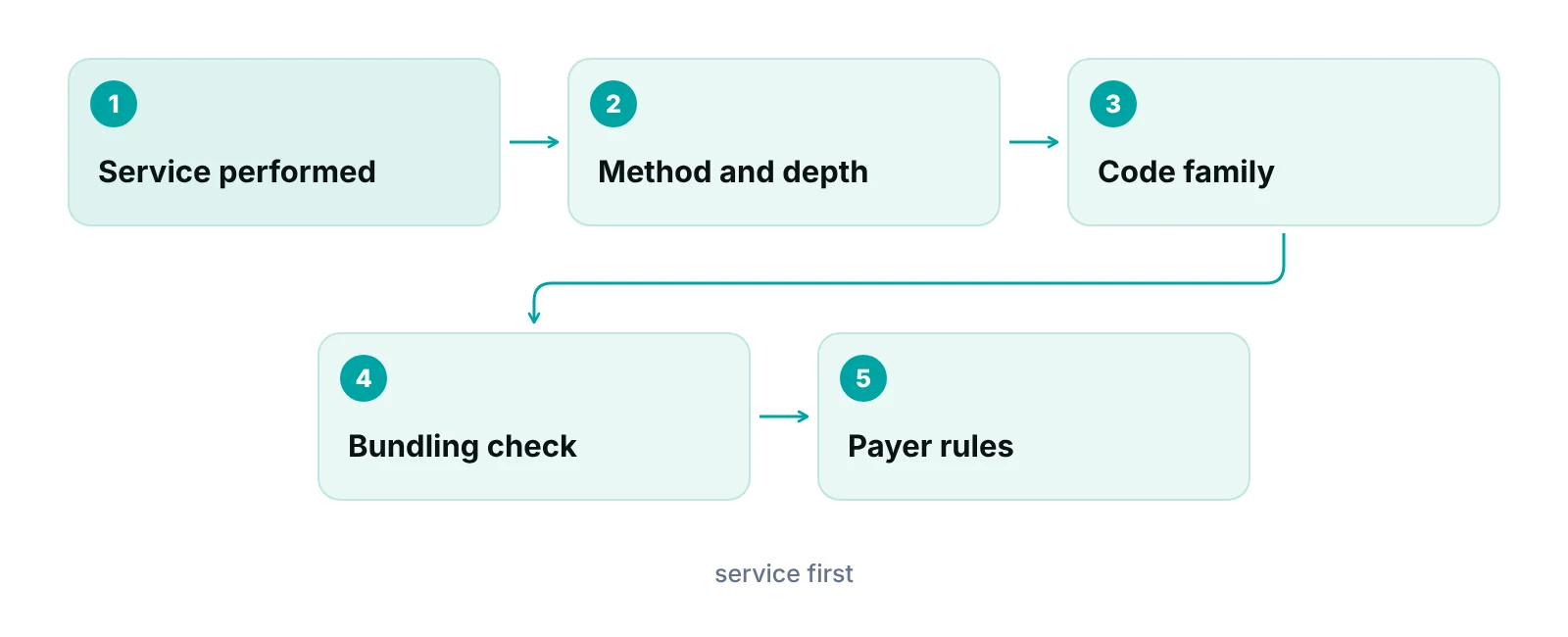
Wound care CPT codes sort into families by service, not by wound: selective debridement (97597, 97598), surgical debridement (11042-11047), negative pressure wound therapy (97605-97608), compression (29580, 29581), repair (12001-13160) and E/M. Pick the family from what was done and documented, then check bundling and payer rules.
A wound care visit can involve cleaning, debridement, a dressing, a compression wrap, a pump and an office visit, and each piece has its own billing rule. Most denials come from mixing the pieces up.
This guide is the umbrella map for practice owners, wound clinic managers and billers. It points each service to its code family, shows what is bundled, covers modifier 25 and the diagnosis codes, and links out for debridement and skin substitute detail. Every rule below is tied to a Medicare, CMS or state source, and the dates matter: several contractor policies are years old.
Key takeaways
- Wound care CPT codes are chosen by the service performed, not by the wound type.
- Selective (97597) and surgical (11042-11047) debridement are mutually exclusive on the same wound.
- Dressing changes, local anesthesia, Unna boot supplies and routine wound checks are generally bundled under Medicare sources.
- An E/M on the same day needs a separately identifiable reason and modifier 25.
- Measurements, tissue level and a plan support the code, the diagnosis and medical necessity together.
What are the wound care CPT codes, and how do they group?
Wound care CPT codes fall into service families, and the family is chosen by what was done to the wound, not by the wound type. A pressure ulcer, a diabetic foot ulcer and a venous leg ulcer can all be billed with the same debridement code if the same service was performed. Table 1 maps each service to its code family. Descriptions are in our own words, because the AMA owns the official CPT descriptors.
| Service | Codes | What decides the code | Where to read more |
|---|---|---|---|
| Selective debridement | 97597, add-on 97598 | Removal of dead tissue only; total wound area in 20 sq cm steps | Debridement guide |
| Surgical debridement | 11042-11047 | Deepest tissue removed, then area at that depth | Debridement guide |
| Non-selective debridement | 97602 | Method (for example wet-to-moist or enzymatic), per session | Debridement guide |
| Negative pressure wound therapy | 97605-97608 | Pump type (durable or disposable) and wound size | Section below |
| Compression or strapping | 29580, 29581 | Type of wrap or compression system applied | Section below |
| Wound repair (closure) | 12001-13160 | Simple, intermediate or complex repair | Section below |
| Skin substitute application | 15271-15278 | Body site and total wound area | Skin substitute guide |
| Hyperbaric oxygen attendance | 99183 (physician); G0277 (facility) | Session or 30-minute interval | Section below |
Source: First Coast L33566 and Medicare contractor article L34587 (debridement codes); TrailBlazer Article 4S-150AB R8 (2011); Palmetto A53781 (97607, 97608); Noridian JE Part A (29580, hyperbaric codes); Noridian JE Part A HBO page (June 2026); NCCI Policy Manual Chapter III (2026). Codes described in our own words.
Two codes sit outside the table. Burn dressings and debridement use 16020, 16025 and 16030, according to TrailBlazer Article 4S-150AB. Evaluation and management (E/M) visits are covered further down, because the question is not which E/M to pick but whether one is billable at all on the same day.
Scope of this guide
This is the map. For tissue depth, area counting and place-of-service limits, read the CPT codes for debridement guide. For application codes for skin substitutes and the 2026 Medicare payment change, read the skin substitute CPT codes guide. Neither is repeated here.
Which debridement code family fits the service?
The family follows the method and the tissue removed. Selective debridement (97597 and add-on 97598) removes only devitalized tissue and is typically billed for recurrent debridements, according to Medicare contractor article L34587. Surgical debridement (11042-11047) is reported by the deepest tissue level removed and the wound surface area. The same article says not to report 11042-11047 together with 97597-97602 for the same wound.
Cleansing alone is not debridement. L34587 states that removing secretions does not meet the definition, and TrailBlazer Article 4S-150AB says removing fibrin, crusts or biofilm that are not integrated into tissue does not qualify. If the note describes irrigation and a dressing, there is no debridement code to report.
Two payer details change the outcome. First, 97602 carries a status B on the Medicare fee schedule, so Medicare treats it as bundled, per both L34587 and First Coast L33566. Second, L34587 limits the deep codes 11043, 11044, 11046 and 11047 to inpatient hospital, outpatient hospital or ambulatory surgical center settings. Both documents are contractor-specific and several are years old, so check the policy your own contractor publishes today.
How is negative pressure wound therapy coded?
Negative pressure wound therapy (NPWT) has two billing lanes: the clinician’s session code (97605-97608) and the pump and supplies billed by a supplier. The two pairs split by equipment type and wound size. 97605 and 97606 are for NPWT with durable medical equipment, 97605 for a total wound surface area of 50 sq cm or less and 97606 for more than 50 (UnitedHealthcare policy CSNCT0594.07, effective June 1, 2026; Solventum 2025 coding sheet). 97607 and 97608 are for disposable, non-durable equipment with the same 50 sq cm split, per the same UnitedHealthcare policy and Palmetto article A53781. The Solventum sheet says not to use 97605 or 97606 for disposable NPWT. CMS Transmittal 805 (2006) addresses 97605 and 97606 as the NPWT codes. Always confirm the descriptors in the current AMA CPT code book.
For a home pump, the supplier bills the equipment. CMS Medicare Learning Network compliance tips (page last modified February 11, 2026) uses E2402 (a HCPCS code, not a CPT code; see our guide to HCPCS versus CPT) as its example and says the treating practitioner who orders and supervises NPWT is affected as well. Medicare covers NPWT in the home and inpatient settings for chronic stage 3 or 4 pressure ulcers, neuropathic ulcers, venous or arterial insufficiency ulcers, and chronic mixed-etiology ulcers. A wound therapy program must have been tried or ruled out first.
NPWT is a documentation audit target
The same CMS page reports a 17 percent improper payment rate for NPWT in the 2024 reporting period, a projected $12.1 million. Its example claim failed because the record lacked evidence of a diabetic management program, pressure-reducing measures and a nutrition evaluation. Medicare also expects measurements at least monthly: length, width, depth and the amount of drainage.
If a visit includes NPWT and something more, E/M is limited. A53781 says an E/M with modifier 25 is billable only for a separately identifiable service beyond the NPWT, and that a simple check of the wound does not justify one. Therapists add a therapy modifier when the service is part of a therapy plan of care, per Transmittal 805.
What about compression, strapping and Unna boots?
Compression wraps are reported with 29580 for an Unna boot and 29581 for a multi-layer compression system, but payment depends on context. Noridian JE Part A states that all supplies are included in the payment for 29580, so the boot itself is not billed separately.
- With vein procedures. First Coast article A58250 (effective January 1, 2026) says application of a compression dressing is included and 29581 shall not be reported separately with those procedures.
- For lymphedema. Noridian article A52959 says Medicare does not cover unskilled lymphedema compression bandage application and that 29581 should not be billed for it. The article is marked superseded and dates from 2018, so confirm the current version.
- By therapists. Transmittal 805 says services in the 29000-29590 strapping range need the therapy modifier when a therapist furnishes them or they are part of a therapy plan of care.
- As a prerequisite. For venous insufficiency ulcers, CMS lists consistent compression bandages or garments among the steps that must be tried before NPWT, per the NPWT compliance page.
Notes for the biller: the sources reviewed do not set a same-day E/M rule for 29580 or 29581 specifically. Until your payer’s policy says otherwise, treat the wrap like any minor procedure and apply the E/M test in the section on modifier 25 below.
When is it wound repair rather than wound care?
Repair codes 12001-13160 report closure of a wound, and the CPT book groups them as simple, intermediate or complex, according to the Medicare NCCI Policy Manual, Chapter III (revision date January 1, 2026). Chronic wound care is different: the work is cleaning, debridement, dressing and monitoring over many visits, not closing an edge.
The same chapter limits when repair can be billed with other work:
- Simple repairs (12001-12021) are integral to lesion removal codes, and dressings or strip closure with a lesion removal are not separately reportable (Section E.6).
- Wound repair codes 12001-13153 are not reported for closure of surgical incisions under procedures with a 000, 010, 090 or MMM global period (Section L.9).
- Debridement of non-viable tissue needed to complete a procedure is not separately reportable (Section E.7).
- Debridement of a skin wound (11000, 11042-11047, 97597, 97598) before a graft or skin substitute is included in that graft procedure (Section I.2).
If a traumatic wound is closed in the same encounter as it is cleaned, the note has to show the closure level separately from the cleaning. Intermediate and complex repair levels depend on definitions in the CPT book, which this guide does not reproduce.
What is bundled, and when can an E/M be billed with modifier 25?
Most small wound items are bundled into the procedure, and an E/M on the same day needs a separately identifiable reason. The NCCI manual (Section B) says the decision to perform a minor procedure is included in the procedure, while a significant, separately identifiable E/M unrelated to that decision is reportable with modifier 25. For debridement, First Coast L33566 adds that the code includes the assessment before, the debridement and the instructions after, and that an E/M is not usually billed with it. Table 2 lists the items that most often cause confusion.
| Item | How the sources treat it | Source |
|---|---|---|
| Dressing change alone | Not separately reported and included in the E/M; Medicare does not separately reimburse it | First Coast L33566; Noridian JE Part A |
| Local anesthesia or digital block with debridement | Included in the payment | Article L34587 |
| Non-selective debridement (97602) | Status B on the Medicare fee schedule; bundled | Article L34587; L33566 |
| Whirlpool before selective debridement | Not separately reimbursable; do not add modifier 59 | Noridian JE Part A |
| Unna boot supplies (29580) | Included in the payment for the code | Noridian JE Part A |
| Compression dressing with vein procedures | Included; 29581 not reported separately | First Coast A58250 |
| Debridement before a graft or skin substitute | Included in the graft procedure | NCCI Manual, Chapter III (2026) |
| Routine wound check with NPWT | Does not justify an added E/M | Palmetto A53781 |
Source: Medicare contractor articles and the NCCI Policy Manual as listed; dates range from 2011 to 2026. Rules differ by payer and contractor.
Payers differ here. Delaware Medicaid (August 2024) says E/M codes 99202-99215 may cover wound dressing changes and training, and that 99211 may cover wound checks and dressing changes. That is a state program, not a Medicare rule. For the modifier 25 test in general, see our guide to modifier 25 versus 59, and for the visit level itself, the 99213 CPT code guide.
Do wound care claims keep bundling or denying?
Send a sample of denied or short-paid wound care claims with the notes behind them. A free practice audit shows whether the cause is the code, the modifier or the documentation.
How does hyperbaric oxygen fit into wound care billing?
Hyperbaric oxygen (HBO) for wounds is a narrow Medicare benefit. The national coverage determination (NCD 20.29, version effective April 3, 2017) covers diabetic lower-extremity wounds only when the patient has type 1 or type 2 diabetes, a wound at Wagner grade III or higher and failure of an adequate course of standard wound therapy. Treatment must be evaluated at least every 30 days, and continued treatment is not covered if measurable healing is not shown.
The NCD excludes cutaneous, decubitus and stasis ulcers. On coding, Noridian JE Part A (updated June 9, 2026) lists G0277 for the facility session per 30-minute interval, with a limit of five units a date of service, and 99183 for physician attendance and supervision. Related E/M services that are integral to HBO are not separately billable, while an unrelated and significant E/M may use modifier 25.
Which ICD-10-CM codes support wound care claims?
The diagnosis must name the wound, its type and, where the code allows, its stage or depth. The FY 2027 ICD-10-CM guidelines (effective October 1, 2026 through September 30, 2027) tell coders to report codes to the highest level of specificity documented. They also allow pressure ulcer stage and non-pressure chronic ulcer depth to be documented by clinicians other than the provider, while the underlying diagnosis must come from the provider (Section I.B.14).
- Pressure ulcers. Category L89. Stage is part of the code, so a note without a stage leaves the claim at a less specific code. The guidelines address stage codes in Section I.C.12.a.
- Non-pressure chronic ulcers. Category L97 for lower-limb ulcers. APTA’s 2020 wound care code reference shows the last character carrying depth: for example, L97.411 for limited to skin breakdown and L97.412 for fat layer exposed on the heel and midfoot.
- Diabetic ulcers. E11.621 is type 2 diabetes with foot ulcer and E11.622 is type 2 diabetes with another skin ulcer, each with a note to add a code for the ulcer site, per the same APTA reference. See our guide to diabetes ICD-10 codes.
- On every NPWT supply claim. The CMS NPWT page requires a diagnosis code describing the treated wound.
Pairing matters as much as picking. A deep debridement code with a diagnosis that shows only skin breakdown invites questions, and a depth in the procedure note that conflicts with the depth in the diagnosis does the same. For foot-specific services outside wound care, see the routine foot care billing guide.
What should a wound care note show?
A wound care note should let a reviewer re-measure the story: where the wound is, how big and how deep, what was done, and what happens next. Different sources ask for slightly different elements, so Table 3 collects them by service.
| Service | What the record should show | Source |
|---|---|---|
| Selective debridement | Instruments used, drainage, color, texture, temperature, vascularity, surrounding tissue and size of the area debrided | Noridian JE Part A |
| Debridement, any type | Current wound size and depth, signs of infection, necrotic tissue, tissue layer removed, method, wound before and after, and a plan of care with goals | WPS LCD L28572 (2012) |
| Surgical debridement | The assessment before, the debridement and the instructions after, with area and deepest level | First Coast L33566 |
| Negative pressure wound therapy | Initial condition with measurements, monthly length, width, depth and exudate, with like-for-like comparisons | CMS MLN (2026) |
| Hyperbaric oxygen | Wound measurements before and during treatment, with evaluation at least every 30 days | NCD 20.29; Noridian JE Part A |
| Medicaid wound billing | Size, location, stage, surface area, technique, tissue removed, topical products and care instructions | Delaware DMMA (2024) |
Source: Medicare contractor and state Medicaid documents as listed. Older policy documents are contractor-specific; check the current policy for your jurisdiction.
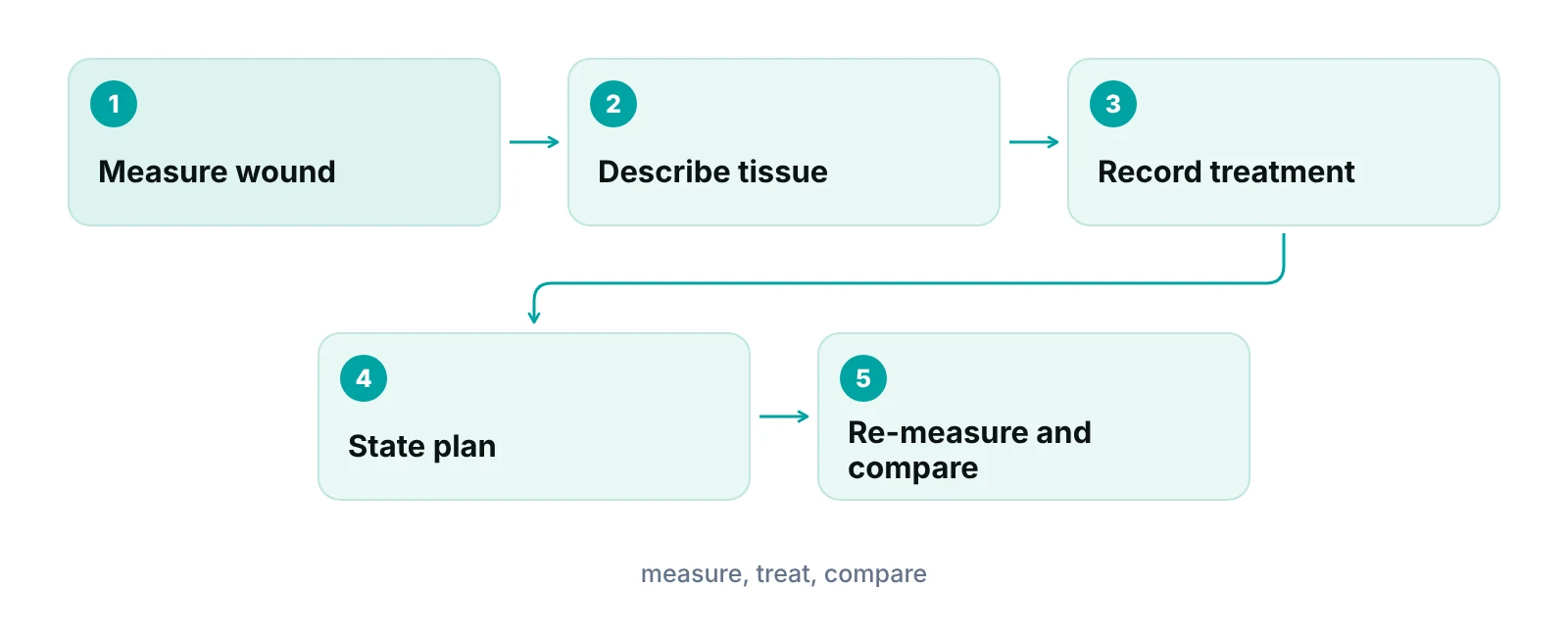
The repeat measurement is what turns a series of visits into evidence. Without a prior size to compare against, a reviewer cannot tell a healing wound from a stalled one, and several policies tie continued coverage to measurable change.
Where do wound care claims usually go wrong?
Most wound care denials trace to a mismatch between the service, the code family and the note, not to the wound itself. The sources reviewed point to a handful of repeat problems.
- Billing 11042-11047 and 97597 for the same wound.
- Billing a deep debridement code outside the settings a contractor allows.
- Reporting 97602 to Medicare, where it is bundled.
- Billing a dressing change, whirlpool or Unna boot supplies as separate items.
- Adding an E/M with modifier 25 for a wound check with no separately identifiable work.
- Submitting NPWT or hyperbaric claims without the measurements and failed-therapy history the coverage policy requires.
A coding review catches these early. Our overview of medical coding audits explains what a review covers, and clean claim practices cover the front-end checks. When a denial does arrive, work it by cause using a denial management process.
What does wound care leakage cost your practice?
Use the revenue calculator to estimate the effect of denied, short-paid and delayed claims before deciding where to start.
Our recommendations
- Build the service-to-code map into the charge screen. Give billers one reference that lists each wound service and its code family, with the bundling rules from Table 2. A short map beats a long code list.
- Require measurements at every visit. Make length, width and depth mandatory fields before a wound note can be signed, and display the prior visit’s numbers beside them.
- Name the tissue level and the method in the procedure note. For debridement, require the deepest tissue removed and the method. These two facts decide the code family and the depth.
- Scrub for same-wound conflicts. Add claim edits that stop 11042-11047 and 97597-97602 from posting together for the same wound, and flag 97602 on Medicare claims.
- Set a written modifier 25 rule. Define what counts as a separately identifiable E/M for wound visits, and have a second reader review every wound visit billed with modifier 25 until the habit is stable.
- Check each contractor's current policy yearly. Several wound care policies are old and contractor-specific. Keep a short table of the policy, effective date and place-of-service limits for each of your Medicare contractors.
Bottom line
Wound care coding gets simpler once each service has a home: debridement, pump therapy, compression, repair and E/M each follow different rules, and the note has to prove which one applied. Start with the map in Table 1, fix the bundling edits in Table 2, and tighten the measurements in Table 3. If wound claims keep returning, a review of your revenue cycle management process can show where they break, and you can ask for a free practice audit.
Frequently asked questions
What are the most common wound care CPT codes?
The usual families are 97597 and 97598 for selective debridement, 11042-11047 for surgical debridement, 97602 for non-selective debridement, 97605-97608 for negative pressure wound therapy, 29580 and 29581 for compression, 12001-13160 for repair, and E/M codes. The service performed decides the family, so map the note first. Then check each family for bundling rules and place-of-service limits before the claim goes out.
What is the difference between 97597 and 11042?
Both remove devitalized tissue. 97597 reports selective debridement by wound area, while 11042 starts the surgical series, which is chosen by the deepest tissue removed and the area at that depth. A Medicare contractor article says not to report both for the same wound. The detail is in the debridement guide linked above.
Can you bill a dressing change separately?
Under the Medicare contractor sources reviewed, a dressing change alone is not separately reported and is included in the E/M or procedure. Some state Medicaid programs differ; Delaware’s guide says certain E/M and nurse visit codes may cover dressing changes. Check each payer’s policy, and do not bill a dressing change as debridement.
Can an E/M be billed on the same day as a wound procedure?
Yes, when the E/M is significant and separately identifiable from the decision to do the procedure, and it carries modifier 25. A wound check alone does not qualify. The note must show distinct work, such as evaluating a new problem or changing the treatment plan. Without that, expect the E/M to be denied or bundled.
Does Medicare cover hyperbaric oxygen for a wound?
For wounds, Medicare covers it for diabetic lower-extremity wounds at Wagner grade III or higher after standard therapy fails, with evaluation every 30 days and no continued coverage without measurable healing. Pressure, venous stasis and other skin ulcers are excluded. Confirm the current coverage version before billing.
Which ICD-10-CM code goes with a diabetic foot ulcer?
Type 2 diabetes with a foot ulcer is E11.621, and the tabular notes tell coders to add a code for the ulcer site, such as an L97 code that also records depth. The note therefore needs the diabetes type, the ulcer site and the depth. Confirm the combination in the current ICD-10-CM tabular list before billing.
Get your free practice audit
Tell us about your practice. We will contact you using the details you give.
- A review of your recent claims, denials and A/R aging
- Where your front desk and prior authorizations slow payment
- A prioritized fix list you keep, whether or not you hire us
Pricing is quoted after the audit, based on your volume and the services you choose. Prefer to talk? Call +1 (302) 556-2288.
Sources
- Billing and Coding Guidelines for Wound Care (L34587) — Medicare Coverage Database (Medicare contractor attachment) (2017)
- Coding Guidelines: Wound Debridement Services (L33566) — First Coast Service Options via Medicare Coverage Database (2017)
- Wound Care, Article 4S-150AB (R8) — TrailBlazer Health Enterprises via Medicare Coverage Database (2011)
- GSURG-051 Wound Care coding and billing guidelines (L28572) — WPS via Medicare Coverage Database (2012)
- Wound Care & Debridement – Provided by Therapist — Noridian Healthcare Solutions (JE Part A) (2025)
- Hyperbaric Oxygen (HBO) Therapy coding and billing — Noridian Healthcare Solutions (JE Part A) (2026)
- NCD 20.29 Hyperbaric Oxygen Therapy — Centers for Medicare & Medicaid Services (Medicare Coverage Database) (2017)
- Negative Pressure Wound Therapy (Medicare Provider Compliance Tips) — CMS Medicare Learning Network (2026)
- Coverage Reminder – Negative Pressure Wound Therapy Devices (Revised) — Noridian Healthcare Solutions (JA DME) (2016)
- Billing and Coding: Spiracur SNaP Wound Care System (A53781) — Palmetto GBA via Medicare Coverage Database (2024)
- Billing and Coding: Treatment of Chronic Venous Insufficiency of the Lower Extremities (A58250) — First Coast Service Options via Medicare Coverage Database (2026)
- Billing and Coding: Lymphedema Decongestive Treatment (A52959) — Noridian Healthcare Solutions via Medicare Coverage Database (2018)
- Medicare NCCI Policy Manual, Chapter III (CPT 10000-19999) — Centers for Medicare & Medicaid Services (2026)
- CMS Transmittal 805 (Pub. 100-04, CR 4226) — Centers for Medicare & Medicaid Services (2006)
- ICD-10-CM Official Guidelines for Coding and Reporting, FY 2027 — CDC National Center for Health Statistics (2026)
- Wound Care Billing Quick Reference Guide — Delaware Division of Medicaid and Medical Assistance (2024)
- Common ICD-10 Codes: Wound Care Management — American Physical Therapy Association (2020)
- Negative Pressure Wound Therapy (North Carolina Only), policy CSNCT0594.07 — UnitedHealthcare (2026)
- V.A.C. Therapy System 2025 DME coding sheet — Solventum (3M) (2025)
Disclaimer: This article is educational and is not legal, coding, billing, medical or compliance advice. CPT codes are owned by the AMA, and code descriptors, Medicare contractor policies and payer rules change and vary by payer, contractor and state. Verify current requirements with the official CPT manual, your payers and your counsel before you act.
