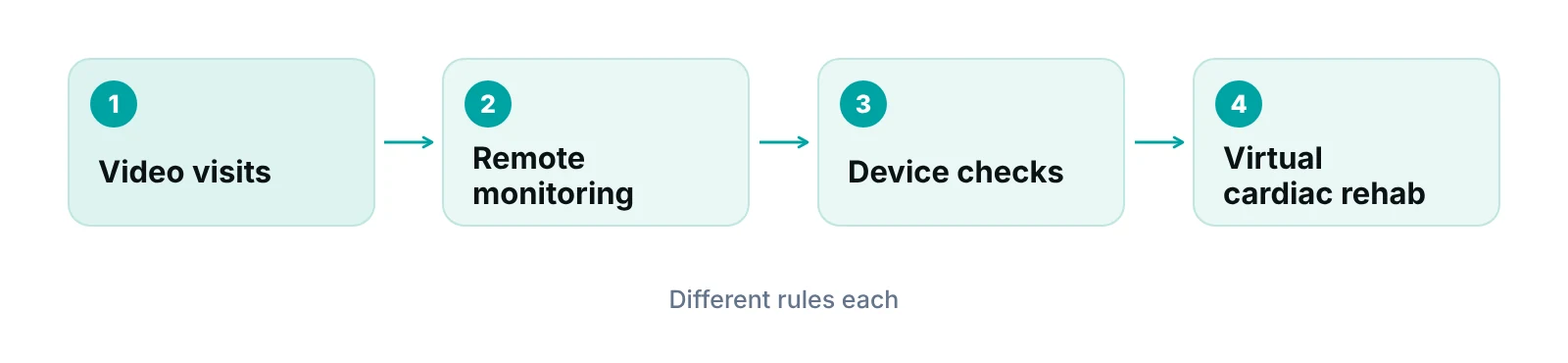
Cardiology telehealth covers video visits, remote physiologic monitoring and remote cardiac device checks, and each follows different Medicare rules. As of October 22, 2026, Medicare pays for home-based telehealth through December 31, 2027. Monitoring and device checks carry their own documentation and frequency limits. Add patient consent, state licensure and a signed platform business associate agreement.
Most pages on this topic are clinical reviews or vendor pages. This one is for the owner or manager who must decide what to offer, how to document it and what the paperwork must say. It complements our cardiology practice management software checklist and does not repeat the claim-level detail in cardiology billing services or cardiology revenue cycle management.
Every date below was checked on October 22, 2026. Medicare telehealth rules are time-limited and a new fee schedule rule is due, so treat it as a snapshot.
Key takeaways
- Treat video visits, remote monitoring and device checks as three service lines with three sets of rules.
- Medicare’s home-based telehealth flexibilities run through December 31, 2027, and the CY 2027 fee schedule rule is still proposed.
- Remote device checks follow your MAC’s policy: one billable service per 90 days, a physician-reviewed report and a full record.
- Record patient location and consent at every visit; licensure follows the patient.
- Sign a business associate agreement with any vendor that touches patient data before the first patient.
What counts as cardiology telehealth, and which service lines should you offer?
Cardiology telehealth is three different jobs that share a platform: live video visits, remote physiologic monitoring and remote checks of implanted devices. The Medicare treatment, staff and paperwork differ for each. CMS also tells practices that remote monitoring is a non-face-to-face service outside the telehealth services list, so telehealth location limits do not apply to it (CMS telehealth FAQ (updated October 9, 2026), Q13).
| Service line | What it is | How Medicare treats it (sources fetched) | Check before launch |
|---|---|---|---|
| Video visit | Real-time audio and video with the cardiologist or an advanced practice clinician | Home allowed as patient location through Dec. 31, 2027 | Payer policy, consent, patient location, POS 02 or 10 |
| Audio-only visit | Two-way voice without video | Allowed for home patients through Dec. 31, 2027 | Document why video was not used; plan for 2028 |
| Remote physiologic monitoring | Patient-collected readings uploaded from a medical device for the practitioner to review | Needs an established patient, consent and a qualifying device; one practitioner per patient per 30 days | Who owns device supply, staff review and escalation |
| Remote cardiac device check | Interrogation of a pacemaker or defibrillator by remote transmission | Governed by NCD and MAC policy; one service per 90 days | Physician review, signed report, order and device records |
| Virtual cardiac rehabilitation (hospital outpatient) | Rehab sessions delivered by real-time audio and video | Allowed through Dec. 31, 2027 for hospital outpatient departments | Hospital departments only; confirm with your compliance lead |
Source: CMS Medicare telehealth FAQ (updated Oct. 9, 2026); CMS MLN901705 (Dec. 2025); Medicare Coverage Database A53018 and NCD 20.8.1.1; CMS virtual cardiac rehabilitation FAQ (Apr. 9, 2026).
Where does Medicare telehealth stand as of October 22, 2026?
Medicare pays for telehealth to patients anywhere in the United States, including the home, through December 31, 2027. That date comes from the CMS telehealth FAQ (updated October 9, 2026). On January 1, 2028, the location limits return unless Congress acts, so a cardiology telehealth program built on home visits has a known cliff.
| Item | Status today | Key date | What it means for you |
|---|---|---|---|
| Patient location | Anywhere in the U.S., including home | Through Dec. 31, 2027 | From Jan. 1, 2028, outside behavioral health, patients generally must be in a medical facility in a rural area |
| Audio-only at home | Allowed | Through Dec. 31, 2027 | From 2028, limited to home behavioral health when video is not possible or not consented |
| Virtual direct supervision | Permanent definition using real-time audio and video | In force since Jan. 1, 2026 | Excludes audio-only and 010 or 090 global services; covers many diagnostic tests and cardiac rehab |
| Place of service | POS 02 away from home; POS 10 at home | Current | Home claims are paid at the non-facility rate, effective Jan. 1, 2024 |
| Modifiers BB and BC | Required for certain virtual-platform and incident-to telehealth | From Jan. 1, 2027 per CMS FAQ | No payment effect; confirm scope in the final rule |
| CY 2027 fee schedule | Proposed July 14, 2026 | Effective on or after Jan. 1, 2027 | Final rule is expected before then; re-check on publish date |
Source: CMS Medicare Telehealth FAQ (updated Oct. 9, 2026); CMS CY 2026 and CY 2027 Physician Fee Schedule fact sheets.
CMS describes the annual fee schedule cycle as a proposed rule in summer and a final rule by November 1 (CMS telehealth page). Check the final CY 2027 rule before you commit to a plan. The American College of Cardiology reported the same extension date when Congress passed the funding law in February 2026 (ACC).
Medicare is not your only payer
This section covers Original Medicare only. Medicare Advantage plans, Medicaid and commercial payers set their own telehealth and remote monitoring rules. For general coding, see our telehealth billing guide, the place of service 10 guide and the telehealth modifiers guide.
What does CMS say about remote physiologic monitoring?
Remote physiologic monitoring means a practitioner tracks a patient’s readings, such as blood pressure or weight, from a device the patient uses at home. CMS’s CMS MLN901705 (December 2025) says the practitioner must be monitoring an acute or chronic condition, and the monitoring must be medically reasonable and necessary. Its examples include blood pressure and weight changes.
Turn these rules from the same booklet into a checklist:
- Only physicians and non-physician practitioners who can bill evaluation and management services can bill remote monitoring.
- The patient must be established with the practice, and patient consent must be on file when services begin.
- Auxiliary personnel can furnish the service under the general supervision of the billing practitioner, and they can obtain consent without direct supervision.
- The device must meet the FDA definition of a medical device, collect data electronically and upload it automatically to a secure place where the practitioner can interpret it.
- Only one practitioner can bill remote monitoring for a patient in a 30-day period, and remote physiologic and remote therapeutic monitoring cannot be billed together.
- Data must be collected on a set number of days in the 30-day period for the set-up and device codes, but the treatment-management codes 99457 and 99458 are exempt from that day requirement.
Proposals are pending. In the CY 2027 proposed rule fact sheet (issued July 14, 2026), CMS proposes that remote monitoring services count only when clinical staff employed by the practice perform them, not contractors. CMS also proposes a separately reportable initiating visit tied to the start of monitoring, and it is considering bundling the monitoring codes and creating four new G-codes, following OIG recommendations.
“Do not build a monitoring program around contractors until the final rule is read. One staffing clause can undo a plan overnight.”
— Awais Afzal, Healthcare Operations & Data Analyst
How do remote pacemaker and defibrillator checks work for billing and records?
Remote device checks are billed as periodic services, not per transmission, and the rules come from your Medicare Administrative Contractor. The examples below use two contractors. Other MACs may differ, so read your own LCD and billing article before you set your workflow.
| Topic | Novitas (LCD L34833, Article A56602) | Wellpoint Federal (Article A53018, ICDs) |
|---|---|---|
| Frequency | Codes 93293 through 93296 reported no more than once every 90 days | Remote ICD interrogation is one 90-day service, whatever the number of transmissions |
| Minimum period | Do not report 93293 to 93296 if the monitoring period is under 30 days | Period starts when remote monitoring begins or on day 91 after implant |
| Review and report | Results from a pacemaker clinic must reach the attending physician and be documented | Physician must personally review the data and sign the report; a countersigned technical review is not enough |
| Records to keep | Legible pages with patient ID, dates and a signature; documentation of medical necessity | Implant date, device ID, order, all transmissions, interpretations and reports |
| Other points | Wearable defibrillators bill through the DME contractor | Place of service is the physician or service center, not the patient; internet-based services may need a signed manufacturer agreement on file |
Source: Medicare Coverage Database, LCD L34833 and Article A56602 (Novitas); Article A53018 (Wellpoint Federal, effective Apr. 1, 2026).
Medicare’s older national policy for transtelephonic pacemaker monitoring still frames the work. The NCD 20.8.1.1 says the transmitter is part of the diagnostic system, not durable medical equipment, and that monitoring needs readable strips of at least 30 seconds. It sets maximum screening intervals that contractors use to review claims. They are not minimums, and more frequent monitoring may be covered with medical justification.
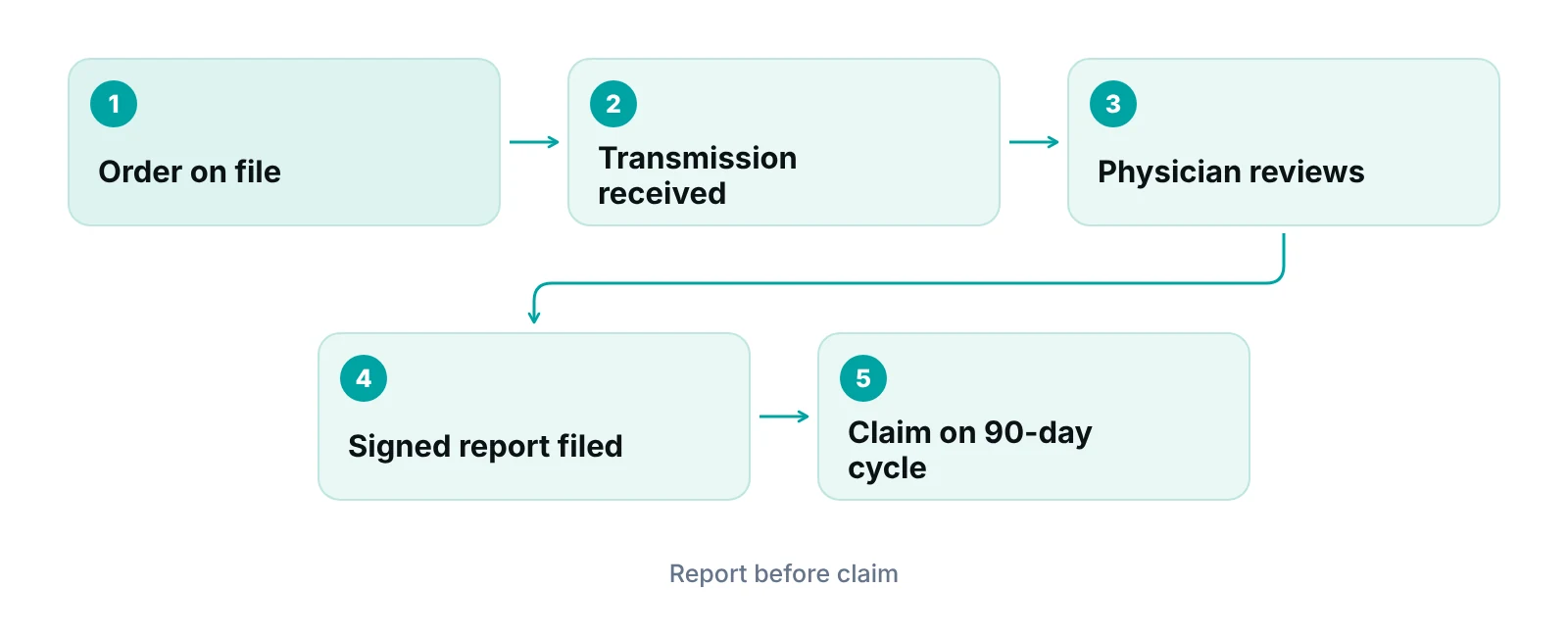
Track the 90-day window as a field in your system, not in staff memory. The claim-side coding sits in our cardiology billing services guide.
What documentation and consent should every cardiology telehealth service carry?
Every telehealth service needs a record that shows who was where, how the service was delivered and that the patient agreed. Telehealth.HHS.gov advises providers to verify the patient’s location and obtain consent before an appointment (Telehealth.HHS.gov). CMS adds that the place-of-service code must reflect the setting: POS 02 for telehealth away from the patient’s home and POS 10 for the home (CMS FAQ, Q8).
A practical minimum for each service line
- Video or audio-only visit: patient location (address or state), clinician location, the technology used, who joined, consent, and the reason audio-only was used if video was not.
- Remote monitoring: consent at the start, the device and its serial number, the dates data were received, the review notes, and any action taken on out-of-range readings.
- Remote device check: the physician’s order, device details, each transmission, the signed interpretation, and whether the check was routine or for symptoms, as the Wellpoint article requires.
- Virtual cardiac rehab (hospital outpatient): the CMS FAQ says the service facility address on the claim must match the beneficiary’s address, and claims carry modifier 95 with the usual rehab modifiers.
Put consent wording in your intake packet. Have your attorney approve a short consent covering telehealth limits, who can see the session and what happens in an emergency.
Which state licensure rules apply to cardiology telehealth?
In general, the clinician must be authorized in the state where the patient is located at the time of the visit. Telehealth.HHS.gov says rules differ by state and lists the options: a full license, temporary practice laws for existing patients who are visiting, reciprocity between neighboring states, compacts and telehealth registration.
Registration, where a state offers it, typically asks for an unrestricted license in another state, no disciplinary history, proof of liability insurance, no office in that state and an annual fee. The HHS compact page describes the Interstate Medical Licensure Compact as a way to practice in several member states, and it notes that a visit takes place where the patient is located (Telehealth.HHS.gov compacts). Check your state board for current members and fees.
- Capture patient location at scheduling and again at check-in. Patients travel, and snowbirds are common in cardiology.
- Keep a licensure grid per clinician: states, expiry, compact status.
What privacy and platform checks must a cardiology practice make?
Any vendor that creates, receives, maintains or transmits patient information for you needs a signed business associate agreement before the first patient. HHS says that applies to cloud providers even when they hold only encrypted data and no key (HHS cloud computing guidance). A video platform, a remote monitoring portal and a device-transmission service all need this check.
HHS’s sample BAA provisions list what the contract must address: permitted uses, safeguards including the Security Rule, reporting of breaches, support for patient access and amendment, subcontractor flow-down, return or destruction of data and termination for a material breach. HHS also ended its COVID-era enforcement discretion for telehealth in 2023, so ordinary HIPAA rules apply (HHS telehealth page).
- Ask each vendor for the signed BAA, not a marketing page that mentions HIPAA.
- List every subcontractor that touches data, including the device maker’s cloud.
- Use role-based access so only assigned staff see monitoring alerts and device reports.
- Stop staff texting patients on personal phones. Our HIPAA compliance checklist covers the basics.
How should a practice roll out cardiology telehealth?
Settle the paperwork before the first patient and review at 90 days.
- Pick one service line and one patient group, such as stable follow-ups or one device population.
- Write a physician-approved rule for which visits go to video.
- Confirm payer policies in writing.
- Check clinician licensure for the patient states you expect.
- Sign BAAs and finish the consent and intake forms.
- Train staff on patient-location capture, POS selection and the device-check order.
- Pilot for 90 days, then review rejected claims and documentation gaps.
Front-desk work is where programs fail. A virtual medical assistant can handle scheduling, intake and eligibility checks inside your EHR, so clinicians keep their time for review and reports. That fits our virtual medical assistant service. To promote a new telehealth line, see our cardiology marketing guide.
Want a second pair of eyes on your telehealth workflow?
A free practice audit reviews how visits, eligibility checks and claims flow today, so a telehealth pilot starts on a clean base.
Our recommendations
- Decide the service line before the vendor. Choose from your patient mix, then shop for tools.
- Put Medicare dates on a calendar. December 31, 2027 and the final CY 2027 rule are the two dates we watch. Review quarterly.
- Track the 90-day device-check window as a field. Build a report showing the last billed service and next eligible date per device patient.
- Keep monitoring staff on payroll until the rule settles. CMS proposes counting only employed clinical staff. Avoid long contractor commitments for now.
- Require the signed BAA before onboarding any tool. If a vendor will not sign, do not send a patient through it.
- Capture patient location every time. One field at booking and one at check-in prevents most licensure and POS errors.
Bottom line
Cardiology telehealth works when the service line, Medicare dates, MAC rules, consent, licensure and BAAs are settled before patients are booked. If you want claim tracking and reporting around the new visit types, see our practice management system page, and our revenue cycle management service for the billing side.
Frequently asked questions
Does Medicare pay for cardiology telehealth visits at the patient's home?
Yes, through December 31, 2027. The CMS telehealth FAQ updated October 9, 2026 says beneficiaries can receive Medicare telehealth anywhere in the United States, including the home, through that date. From January 1, 2028 the location limits return, with an exception for behavioral health, unless Congress changes the law again.
Do telehealth location rules apply to remote monitoring and device checks?
CMS lists remote monitoring as a non-face-to-face service that is not on the telehealth services list, so telehealth restrictions do not apply to it. Remote device checks follow their own national and MAC policies, including a 90-day limit and a place of service based on the physician or service center, not the patient.
Who can provide remote physiologic monitoring in my practice?
Per CMS’s December 2025 booklet, only physicians and practitioners who can bill evaluation and management services can bill it, with auxiliary staff working under general supervision. CMS’s CY 2027 proposal would count only services by clinical staff the practice employs, so check the final rule before using contractors.
How often can we bill a remote pacemaker or ICD check?
Under the Novitas and Wellpoint Federal policies fetched for this article, remote checks are limited to one service per 90 days, regardless of the number of transmissions. Your own MAC may differ, so read its LCD and billing article before setting your workflow.
Is a patient's consent required for cardiology telehealth?
CMS requires patient consent for remote physiologic monitoring at the time services are provided. For telehealth in general, Telehealth.HHS.gov advises providers to verify patient location and obtain consent before the visit. Your state and payers may add rules, so have counsel approve the consent wording.
Do we need a BAA with our telehealth video platform?
Yes, if the platform creates, receives, maintains or transmits patient information for you. HHS says a cloud provider is a business associate even when it holds only encrypted data, and a BAA must be in place before use. Ask for the signed document and the vendor’s subcontractor list.
Get your free practice audit
Tell us about your practice. We will contact you using the details you give.
- A review of your recent claims, denials and A/R aging
- Where your front desk and prior authorizations slow payment
- A prioritized fix list you keep, whether or not you hire us
Pricing is quoted after the audit, based on your volume and the services you choose. Prefer to talk? Call +1 (302) 556-2288.
Sources
- Telehealth — CMS (2026)
- Medicare Telehealth FAQ (updated Oct. 9, 2026) — CMS (2026)
- CY 2027 Medicare Physician Fee Schedule Proposed Rule fact sheet — CMS (2026)
- CY 2026 Medicare Physician Fee Schedule Final Rule fact sheet (CMS-1832-F) — CMS (2025)
- Telehealth & Remote Monitoring MLN901705 — CMS (2025)
- Virtual Cardiac Rehabilitation, ICR and Pulmonary Rehabilitation FAQ — CMS (2026)
- LCD Cardiac Rhythm Device Evaluation (L34833) — CMS Medicare Coverage Database (Novitas) (2020)
- Billing and Coding: Cardiac Rhythm Device Evaluation (A56602) — CMS Medicare Coverage Database (Novitas) (2025)
- Billing and Coding: Surveillance of ICDs (A53018) — CMS Medicare Coverage Database (Wellpoint Federal) (2026)
- NCD Transtelephonic Monitoring of Cardiac Pacemakers (20.8.1.1) — CMS Medicare Coverage Database (2003)
- HIPAA and Telehealth — HHS Office for Civil Rights (2023)
- Guidance on HIPAA and Cloud Computing — HHS Office for Civil Rights (2022)
- Sample Business Associate Agreement Provisions — HHS Office for Civil Rights (2017)
- Licensing across state lines — Telehealth.HHS.gov (2025)
- Licensure compacts — Telehealth.HHS.gov (2025)
- Congress Passes Critical Health Program Funding, Extends Telehealth Flexibilities — American College of Cardiology (2026)
Disclaimer: This article is educational and is not legal, coding, clinical or compliance advice. CPT is a registered trademark of the American Medical Association, and its official descriptors are not reproduced here. Medicare policy is time-limited, MAC policies differ, and consent, licensure, privacy and payer rules vary by state and payer, so confirm current requirements with your attorney, privacy officer, payers and Medicare contractor before acting.