Cardiology marketing is how a cardiology practice earns referrals and patient trust. It means building working relationships with primary care offices and hospitals, keeping listings and provider bios accurate, publishing physician-reviewed patient education, and tracking each referral to a completed visit, all inside advertising, kickback and HIPAA rules.
Most guides on this topic list the same tactics in the same order. This one starts where cardiology differs: many new patients are sent by another clinician, so the first reader of your website and listings is often a referral coordinator, not a patient. It also covers the rules that limit what you can offer, say and measure, and uses no agency benchmarks. For the wider channel mix, see our healthcare SEO guide.
Key takeaways
- Referral coordinators and primary care staff are a core audience for your site, listings and bios.
- Anything of value tied to referrals for federal program business can break the Anti-Kickback Statute; get counsel before any arrangement.
- Keep Google, Medicare, NPPES and website data consistent, and write bios with verifiable credentials.
- Never pay for or gate reviews, and never reply with patient details.
- Track every referral to a completed visit; one cited study found only about 35% of scheduling attempts ended in one.
What does cardiology marketing involve, and how is it different?
Cardiology marketing makes a practice easy to find, trust and refer to. It differs from consumer-facing specialties because two audiences decide: the clinician or coordinator who refers, and the patient who has to say yes.
Demand is not the problem. The CDC reports that heart disease is the leading cause of death in the United States and that 919,032 people died of cardiovascular disease in 2023 (CDC heart disease facts). The practical question is which sources reach your schedule and how many patients arrive.
Split your sources into three groups before spending anything. Clinician referrals need access and communication. Network and directory listings need accurate data. Patient self-search, including local search and reviews, needs credibility and clear instructions. Your own scheduling data should say how big each group is; the mix of cardiology digital marketing follows from that.
How do you build PCP and hospital referral relationships lawfully?
Make it easy for referrers to send a patient and get the result back, and give nothing of value in return for referrals. Information, access and communication are the safe core; gifts, meals and free services tied to referrals are where the risk sits.
HHS-OIG describes the Anti-Kickback Statute as a criminal law against knowingly and willfully offering, paying, soliciting or accepting anything of value to induce or reward referrals of business paid for by federal health care programs. Payer and recipient can both be liable; civil penalties can reach $50,000 per kickback plus three times the remuneration (HHS-OIG, Fraud and Abuse Laws). The page adds that the Stark law restricts physician referrals for designated health services, including imaging, to entities with which the physician has a financial relationship, and is a strict liability law.
OIG’s FAQ adds that entertainment such as event tickets given to induce or reward referrals could violate the statute if the intent is present, and that fair market value is not a complete defense (HHS-OIG FAQs). Have healthcare counsel review any arrangement with a referring office or hospital.
| Activity | What it does | Question to ask first |
|---|---|---|
| Referral guide for offices | How to refer, urgent slots, forms, contact | Is it operational information only? |
| Consult note turnaround | Returns the visit note to the referrer | Is it done for every referral? |
| Clinical education session | A cardiology talk for an office or hospital group | Is it truly educational, and has counsel reviewed any meal or payment? |
| Meals, tickets, gifts, free staff | Something of value to a referral source | Could it read as payment for referrals? Ask counsel first. |
| Hospital directory or co-branding | Lists the practice with the hospital | What are the hospital’s rules; is any money involved? |
Source: HHS-OIG, Fraud and Abuse Laws and OIG FAQs (read 2026). The table frames questions; it is not legal advice.
HIPAA does not block the referral conversation itself. HHS says a communication made for treatment of the individual is not marketing, and it lists a physician referring a patient to a specialist as an example (HHS, Marketing). The marketing rule applies when patient information is used for promotion, for example a patient list handed to a third party for payment.
How do you track a referral from the first call to a completed visit?
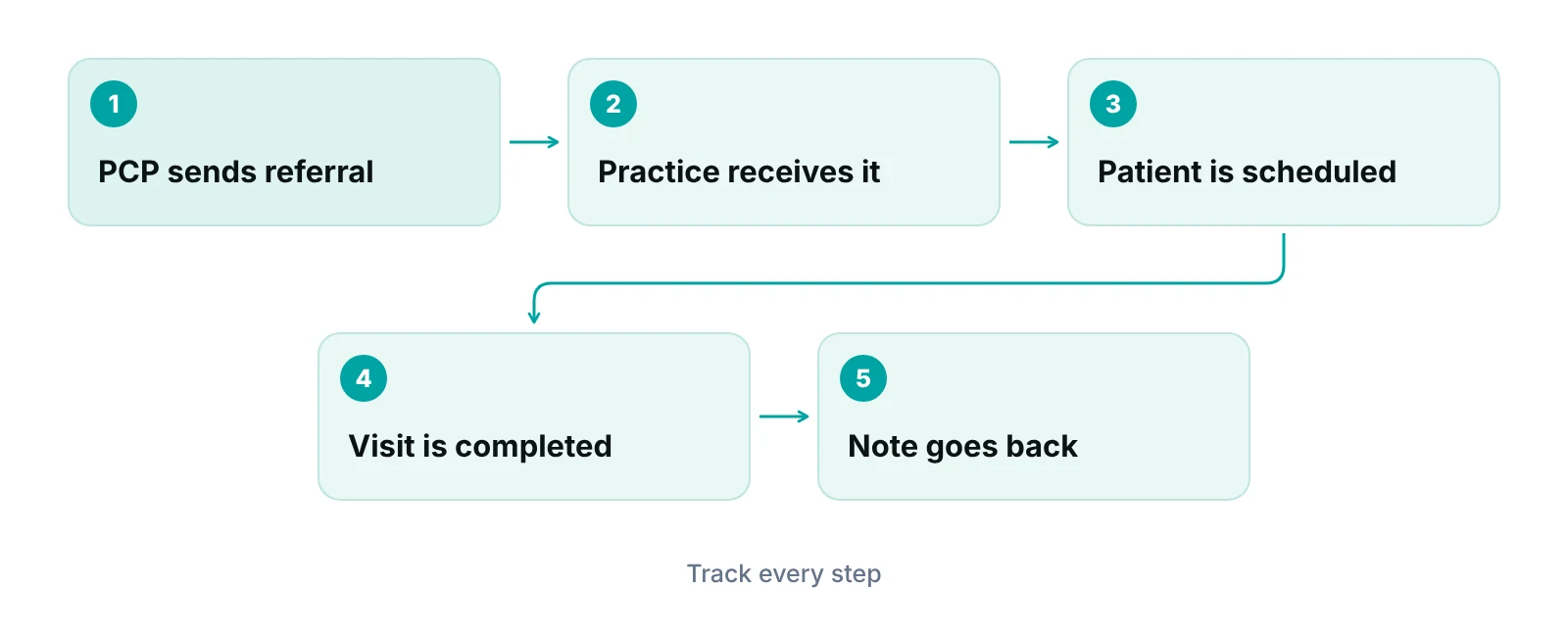
Give every referral a source and dates for each step, then review the gaps monthly. Without it, you cannot tell whether a source is valuable or your intake is losing patients.
The gap can be large. An MGMA article cites a 2018 study of one large primary care network in which about 35% of referral scheduling attempts led to a documented completed appointment, and a 2007 study in which staff scheduling of the visit predicted completion (MGMA). We read both through MGMA’s summary, and they describe other systems, so use them as a reason to measure your own numbers, not as a benchmark.
MGMA suggests tracking time from order to scheduled appointment, completion rate and aged open referrals. Add what happens before the visit: whether insurance and referral requirements were checked. Those steps sit with the front desk; see the guide on the front desk and the revenue cycle covers that handoff, and a virtual medical assistant team can own call-back and scheduling follow-up inside your existing EHR.
What to record for each referral
- Referral source (practice, hospital unit, self) and how it arrived (fax, portal, phone, web form).
- Dates received, scheduled and seen, and the date the consult note went back.
- Outcome if not seen: could not reach, declined, authorization problem, went elsewhere.
- For self-referred patients, the marketing source, via a tracking number or a form field with no health details.
“I would rather learn that referrals are being lost at the phone than add one more ad. The first fix is almost always inside the practice.”
— Awais Afzal, Healthcare Operations & Data Analyst
Referral value depends on collection, and authorization or eligibility misses come back as denials; see cardiology billing services and cardiology revenue cycle management. For tools that hold referral status, see the cardiology practice management software checklist. To judge results by revenue, not clicks, use our medical marketing ROI guide.
Where do your cardiology referrals drop off?
A free practice audit looks at referral intake, scheduling, eligibility and claims together, so marketing effort is not lost after the call. Pricing is quoted after the audit.
Which listings and profiles should a cardiology practice keep accurate?
Keep the practice location, each physician’s profile and your public Medicare data consistent with your website. Someone who sees three different phone numbers will go to the next name on the list.
Google’s Business Profile guidelines say a public-facing practitioner who can be contacted at the verified location during stated hours should get a profile, with one profile per practitioner, and that support staff should not create their own. They also require the real business name without added service descriptions, a real street address and a local phone number the business controls (Google Business Profile Help).
| Where it appears | What shows | What to check |
|---|---|---|
| Google Business Profile | Name, address, phone, hours, categories, reviews, practitioner listings | Name matches signage; one profile per location and per eligible practitioner |
| Medicare Care Compare (Doctors and Clinicians) | Specialty, practice address and phone, group, hospital affiliation, board certification, telehealth indicator | Data comes mainly from PECOS; board certification and hospital affiliation updates go by email to the QPP Service Center |
| NPPES (NPI record) | Provider taxonomy and practice address | Covered providers must report changes within 30 days of the change |
Source: Google Business Profile Help; CMS Care Compare Doctors and Clinicians pages; CMS NPPES FAQs (read 2026).
CMS says profile data comes primarily from PECOS, board certification from certifying organizations such as the American Board of Medical Specialties, and PECOS changes take about four months to appear (CMS, About the Data). Profiles can include hospital affiliations and a telehealth indicator (CMS, Care Compare Doctors and Clinicians). If you offer remote visits, check the indicator and read cardiology telehealth. NPPES updates carry a 30-day deadline for covered providers (CMS, NPI FAQs).
How should provider bios and credentials be written to build trust?
Write each bio so a stranger can verify it: the physician’s name, board certifications with the certifying board, current hospital affiliations, and the conditions and procedures the physician sees.
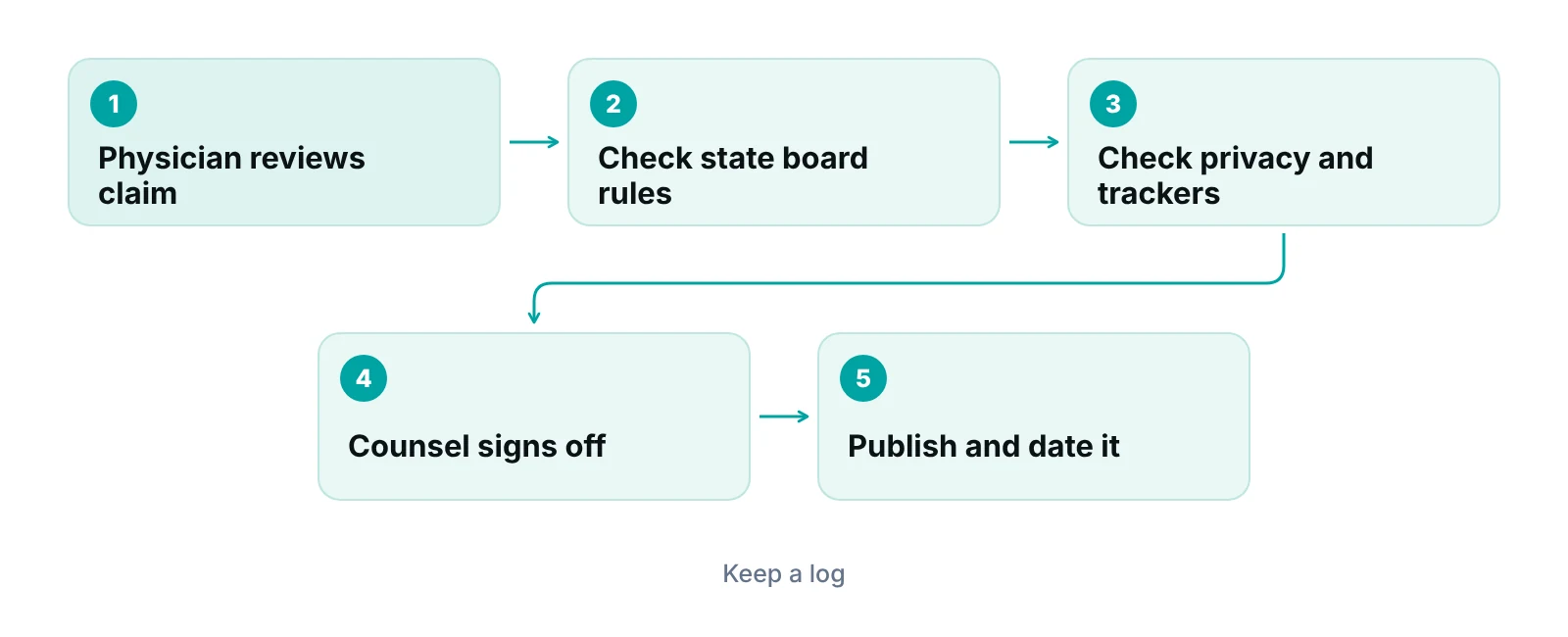
Google says E-E-A-T is not a specific ranking factor, trust is its most important part, and health topics get extra weight. It asks for clear authorship (“Who”), genuine bylines linked to author background, and it warns against fabricated creator profiles or false credentials (Google Search Central). On a cardiology site, name the reviewing physician and review date on every educational page.
- Board certification: say which board and which certificate, and check it with the ABMS “Is My Doctor ABMS Board Certified” tool before you publish (Certification Matters).
- Hospital affiliation: list only active privileges.
- Services: plain words, and no superiority claims you cannot substantiate.
- Patient stories: only with written HIPAA authorization.
State rules on "board certified" and specialist claims
State law can control how you describe certification. California’s section 651, for example, limits “board certified” to recognized boards and requires the full board name with comparable prominence (summary from California Public Law). Other states differ; check your state medical board.
What patient education content should a cardiology practice publish?
Publish short, physician-reviewed pages on conditions and tests patients are told about, each with a clear next step. They earn trust and answer questions that otherwise fill the phone queue.
Choose topics from your call log and referral reasons, such as what to expect at a first visit or how to prepare for a test. Physicians decide the clinical wording, including when to seek urgent care.
Coding teams see the terms patients search; our chest pain ICD-10 codes guide shows how a symptom becomes a diagnosis. Keep these pages free of patient identifiers, and settle how a symptom form is protected before adding one (see the tracker rules below).
What are the rules for asking for and answering patient reviews?
Ask every patient the same way, never reward a review, never filter who is asked, and never put patient details in a reply. The FTC, Google and HIPAA all apply.
The FTC’s consumer reviews rule took effect on October 21, 2024. It bars fake reviews, paying for reviews tied to a sentiment, undisclosed insider reviews, company-controlled sites posing as independent, and review suppression through unjustified threats, across industries (Federal Register, 2024; FTC).
Google defines incentivized reviews as those influenced by payment, discounts, free goods or services, or a conflict of interest (Google Maps policy). It can remove them and restrict a Business Profile, for example by blocking new reviews or showing a warning (Google Business Profile Help).
On replies, HHS-OCR settled with a New Jersey psychiatric practice for $30,000 after it answered negative online reviews with patients’ health information, and its director said, “Simply put, this is not allowed” (HHS, 2023). A safe reply thanks the person, says you cannot discuss care publicly and gives a phone number. For tactics, see our online reputation management guide.
Which advertising and HIPAA rules limit cardiology digital marketing?
Five rules set the limits. Check each before a campaign or page goes live.
| Rule | What it says | What it means for a cardiology practice |
|---|---|---|
| FTC advertising guidance | Objective claims need support; net impression counts; agencies can be liable | Have a physician support each claim. The FTC page covers health products, so ask counsel about services |
| State medical board advertising rules | Vary by state; California section 651 is one example (false or misleading claims, testimonials, certification wording) | Check your board before publishing bios, testimonials, discounts or superiority claims |
| HIPAA marketing rule | Communications for treatment are not marketing; paid disclosures of PHI for another party’s promotion need authorization | Referral conversations are fine; do not sell or hand over patient lists for promotion |
| HHS tracking technologies bulletin | Trackers can touch PHI on portal and scheduling pages; vendors handling PHI need a BAA | Review tags on scheduling, portal and condition pages; one part was vacated in 2024 |
| Google health ad policy | Advertiser-curated audiences such as customer match are not supported for health-related sensitive categories | Do not upload patient lists or build remarketing lists from health pages |
Source: FTC Health Products Compliance Guidance; California B&P Code section 651; HHS Marketing guidance; HHS Online Tracking Technologies bulletin; Google Ads policy help (all read 2026).
The FTC says anyone taking part in deceptive marketing can be liable, and a testimonial does not replace substantiation (FTC). Treat that as a caution for patient-story pages.
HHS says tracking on public pages can involve PHI when it reaches health-related information, such as scheduling an appointment, and that a vendor handling PHI needs a business associate agreement that a cookie banner cannot replace. A Texas federal court vacated one part of the bulletin on June 20, 2024, and HHS said it was evaluating next steps (HHS, Online Tracking Technologies). Re-check before relying on it.
Google’s policy says customer match, your data segments, audience expansion and lookalike segments are not supported for ads in health-related sensitive categories (Google Ads policy). The page does not say which cardiology services are in scope. See also our HIPAA compliance checklist.
Our recommendations
- Count your referral sources first. Label the last six months of new patients by source before you spend anything.
- Write a one-page referral guide. How to refer, urgent slots, forms, phone and portal path, a named contact. Offer nothing of value.
- Name an owner for every referral step. One person each for intake, scheduling and the note back; review open referrals weekly.
- Align every profile with the website. Check Google, Medicare profile data and NPPES against the site each quarter.
- Make each bio verifiable. Name the certifying board, confirm it with ABMS and date every physician-reviewed page.
- Use a review and ad checklist. Ask all patients alike, never reward reviews, and run trackers and ad audiences past counsel before launch.
Bottom line
Cardiology marketing pays when referral sources can reach you quickly, patients can verify your physicians, and every referral is followed to a completed visit, all inside the rules on kickbacks, advertising and privacy. Fix intake and data first, then add channels. If you want help with local search, Google Ads and reputation, RCM Finder’s healthcare digital marketing work covers them, and pricing is quoted after a free practice audit.
Frequently asked questions
What is cardiology marketing?
Cardiology marketing is the work of getting a cardiology practice found, trusted and referred to. It includes relationships with primary care offices and hospitals, accurate listings and physician bios, patient education, reviews and tracking referrals to completed visits. It has to follow advertising, kickback and HIPAA rules.
How do cardiologists get more referrals from primary care?
Make referring easy and give timely results back: a clear referral guide, fast scheduling, a named contact and prompt consult notes. Do not offer gifts or anything of value tied to referrals. The Anti-Kickback Statute can apply when federal program business is involved, so have healthcare counsel review any arrangement.
Is it legal to take a referring office to lunch?
It depends on the facts, and you should ask counsel first. HHS-OIG says giving entertainment to induce or reward referrals could violate the Anti-Kickback Statute if the required intent is present, and fair market value is not a complete defense. Educational information without anything of value is the lower-risk path.
Can we respond to a negative Google review?
Yes, but never include patient health information or confirm the person is a patient. HHS-OCR settled with a New Jersey practice for $30,000 over replies that disclosed patient details. Thank the reviewer, say you cannot discuss care publicly, and give a phone number to continue the conversation.
Can we offer patients a discount for leaving a review?
No. Google treats reviews influenced by payment, discounts or free goods as incentivized and can remove them and restrict your profile. The FTC rule also bars paying for reviews tied to a sentiment. Ask every patient the same way and do not reward the review.
Do website trackers create HIPAA risk for a cardiology practice?
They can. HHS says trackers on pages tied to scheduling or to researching a specific condition may touch health information, and a vendor handling that information needs a business associate agreement. A 2024 court order vacated one part of the bulletin, so have counsel review your site and tags.
Get your free practice audit
Tell us about your practice. We will contact you using the details you give.
- A review of your recent claims, denials and A/R aging
- Where your front desk and prior authorizations slow payment
- A prioritized fix list you keep, whether or not you hire us
Pricing is quoted after the audit, based on your volume and the services you choose. Prefer to talk? Call +1 (302) 556-2288.
Sources
- Heart Disease Facts — CDC (2026)
- Fraud & Abuse Laws — HHS-OIG (2026)
- General Questions Regarding Certain Fraud and Abuse Authorities — HHS-OIG (2026)
- Marketing — HHS (HIPAA Privacy Rule guidance) (2026)
- Guidance on HIPAA & Online Tracking Technologies — HHS OCR (2026)
- Closed-loop referral management: who owns each step — MGMA (2025)
- Guidelines for representing your business on Google — Google Business Profile Help (2026)
- Care Compare: Doctors and Clinicians Initiative — CMS (2026)
- Doctors and Clinicians: About the Data — CMS (2026)
- Unique Identifiers FAQs (NPI/NPPES) — CMS (2026)
- Creating Helpful, Reliable, People-First Content — Google Search Central (2026)
- Consumer Reviews and Testimonials Rule (final rule) — Federal Register (2024)
- Final rule banning fake reviews and testimonials — FTC (2024)
- Incentivized or Biased Reviews — Google Maps User Contributed Content Policy (2026)
- Business Profile restrictions for policy violations — Google Business Profile Help (2026)
- HHS OCR settlement with a New Jersey provider over responses to online reviews — HHS (2023)
- Health Products Compliance Guidance — FTC (2022)
- Health in personalized advertising — Google Ads Policy Help (2026)
- How can I verify a doctor's board certification for professional use? — Certification Matters (ABMS) (2026)
- Business and Professions Code section 651 — California Public Law (secondary site) (2026)
- Cardiology marketing guide — WebFX (2026)
- Cardiology Marketing Strategies — Weave (2026)
Disclaimer: This article is educational information for practice owners and managers. It is not legal, compliance, advertising-regulation, billing or medical advice. Federal and state rules, payer policies and platform policies change and vary by state; confirm current requirements with qualified healthcare counsel and your state medical board before acting.