
TIA icd 10 coding uses G45.9 when the provider documents a transient ischemic attack and no more specific G45 code applies. If stroke-like symptoms are documented without a confirmed TIA, report the symptoms. A past TIA with no residual deficit is Z86.73. A stroke with infarction belongs to I63, not G45.
A patient arrives with slurred speech that has already cleared. Was that a TIA, a symptom, or a stroke? The code follows what the provider documents, and it can change from one visit to the next.
This guide sorts three situations that coders mix up: a confirmed TIA, stroke-like symptoms with no confirmed diagnosis, and a history of TIA. It covers the Excludes notes that connect them and the claim edits to expect. It is written for coders, billers and practice managers, and it is about coding only, not clinical care.
Key takeaways
- G45.9 is the unspecified TIA code; G45.0, G45.1, G45.3 and G45.4 name specific syndromes.
- Without a confirmed TIA on an outpatient claim, code the documented symptoms, not G45.9.
- Z86.73 is history of TIA or stroke without residual deficits; deficits that remain go to I69.
- G45 and I63 are different events: a stroke with infarction is not coded to G45.
- Check every code against the FY2027 tabular list, effective 1 October 2026.
What are the main TIA ICD-10 codes?
The main code is G45.9, transient cerebral ischemic attack, unspecified. Its listing shows TIA, spasm of cerebral artery and transient cerebral ischemia NOS as inclusion terms. G45 itself is a nonbillable heading, so a claim needs a billable code under it. The table shows the G45 codes, the stroke code that G45 is separate from, and the history code.
| Code | What it describes | When it fits | Status checked |
|---|---|---|---|
| G45.9 | Transient cerebral ischemic attack, unspecified (TIA) | The provider documents a TIA with no named syndrome | FY2027 listing: billable |
| G45.0 | Vertebro-basilar artery syndrome | The provider documents the vertebro-basilar syndrome | FY2027 listing: billable |
| G45.1 | Carotid artery syndrome (hemispheric) | The provider documents the carotid syndrome | FY2027 listing: billable |
| G45.3 | Amaurosis fugax | The provider documents amaurosis fugax | FY2027 listing: billable |
| G45.4 | Transient global amnesia | The provider documents transient global amnesia | FY2027 listing: billable |
| G45.8 | Other transient cerebral ischemic attacks and related syndromes | The provider documents another specified TIA syndrome | FY2027 listing: billable |
| I63.9 | Cerebral infarction, unspecified (stroke NOS) | The provider documents a stroke, not a TIA | Billable on a page of unclear edition; confirm in FY2027 |
| Z86.73 | Personal history of TIA and cerebral infarction without residual deficits | The TIA is in the past and no deficits remain | FY2027 listing: billable |
Source: HCC Buddy FY2027 code pages; Unbound Medicine; AAPC (2026). Secondary references; confirm against the CMS FY2027 tabular list.
G45 also has an Excludes1 note for neonatal cerebral ischemia (P91.0) and transient retinal artery occlusion (H34.0-). G45.2, multiple and bilateral precerebral artery syndromes, completes the block. If a note describes vision loss in one eye, read the provider’s exact words before you choose between G45.3 and an eye code.
Code set year
The FY2027 code set took effect on 1 October 2026 and runs to 30 September 2027, per the CDC FY2027 guidelines. Code status here comes from reference pages that state they use the FY2027 order file. Confirm each code in the official tabular list before you load it.
Confirmed TIA, stroke-like symptoms or history: which one applies?
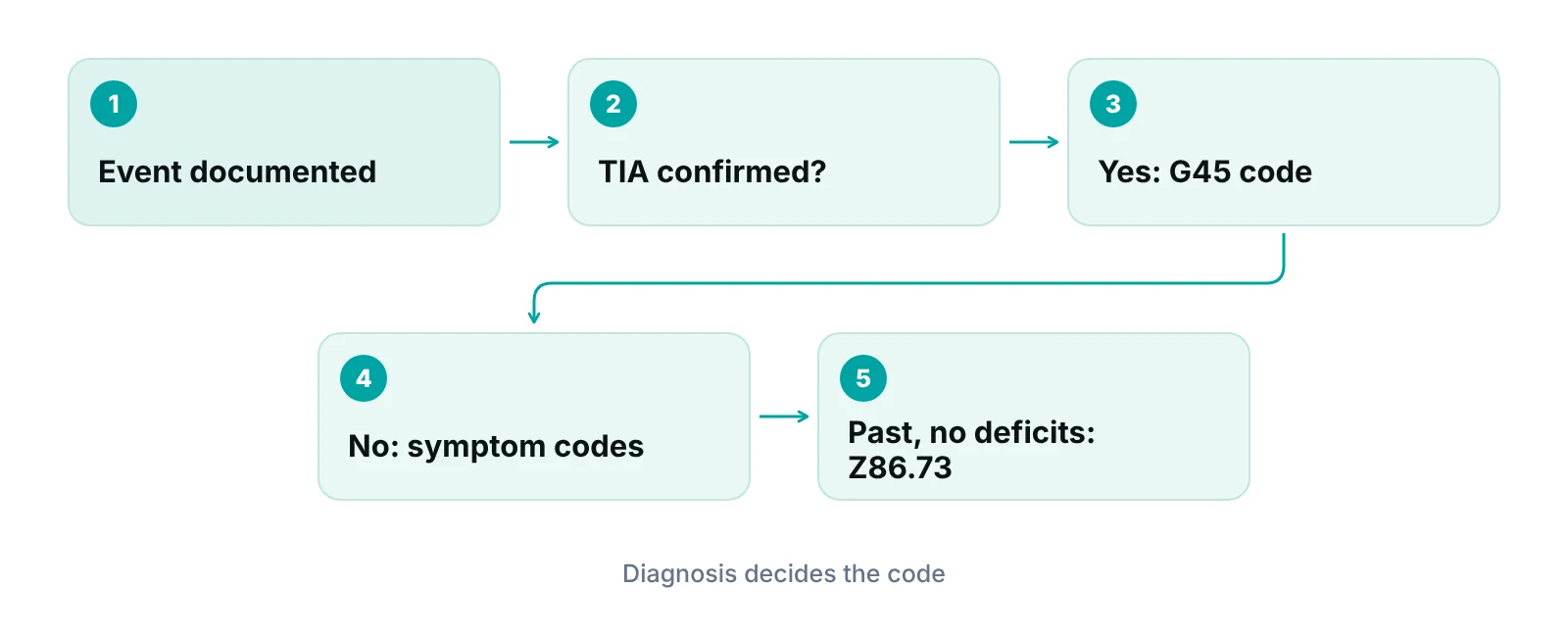
The provider’s documented diagnosis decides it. A confirmed TIA goes to G45, symptoms with no confirmed diagnosis go to symptom codes, and a past event with no deficits goes to Z86.73. A coder does not decide between them from how long the symptoms lasted.
The clinical definition explains why the wording matters. A 2010 American Heart Association scientific statement defines a TIA as a transient episode of neurological dysfunction caused by focal brain, spinal cord or retinal ischemia, without acute infarction. It notes that time cutoffs do not reliably separate events with and without brain injury, so imaging is central. The National Institute of Neurological Disorders and Stroke says symptoms typically go away within an hour, can last up to 24 hours, and cannot be told apart from a stroke at the first look. That is why an early note may read “stroke-like symptoms” and a later note may name a TIA or a stroke.
| Provider documents | Code direction | Why |
|---|---|---|
| A transient ischemic attack | G45.9, or a more specific G45 code when a syndrome is named | G45.9 lists TIA as an inclusion term |
| Transient stroke-like symptoms, TIA not confirmed | The documented symptom codes | Symptom codes are acceptable when no related definitive diagnosis is confirmed (I.B.4) |
| A stroke with infarction | I63.-, for example I63.9 if nothing more is documented | The G45 block is for transient events; I63.9 lists G45 in an Excludes2 note |
| A past TIA or stroke with no residual deficits | Z86.73 | Z86.73 covers history of TIA and cerebral infarction without residual deficits |
| Deficits that remain after a stroke | An I69 sequela code | Z86.73 lists I69 in an Excludes1 note, and I69 lists Z86.73 in return |
Source: CDC FY2027 ICD-10-CM Guidelines (2026); HCC Buddy FY2027 code pages and AAPC I63.9 listing (2026). Confirm in the official tabular list.
How do you code stroke-like symptoms when no TIA is confirmed?
Code the symptoms the provider documents. The FY2027 guidelines (section I.B.4) allow sign and symptom codes in place of a diagnosis when a related definitive diagnosis has not been confirmed. Outpatient and professional coders do not code “possible” or “probable” diagnoses and report the symptoms instead, as Healthicity’s summary of the outpatient guidelines explains.
Three symptom codes come up often in this setting:
- R29.810, facial weakness. Facial droop is listed as an inclusion term. The code has an Excludes1 note for Bell’s palsy (G51.0) and for facial weakness following cerebrovascular disease.
- R47.01, aphasia. Excludes1 notes apply to aphasia following cerebrovascular disease and to progressive isolated aphasia (G31.01).
- R47.81, slurred speech. It inherits an Excludes1 note for dysarthria following cerebrovascular disease.
The “following cerebrovascular disease” notes matter. They send lasting deficits to the I69 sequela codes, so these symptom codes belong to a current event, not to a deficit left by an earlier stroke. For generalized weakness codes, see the weakness ICD-10 codes guide. If chest pain is also documented, the chest pain ICD-10 codes guide covers that series. A sudden memory problem has its own rules in the memory loss ICD-10 codes guide.
Symptoms stop being coded once the TIA is confirmed
Guideline I.B.5 says signs and symptoms routinely associated with a disease process should not be coded in addition to it, unless the classification says otherwise. Once the provider confirms a TIA, the transient speech or facial symptoms that define the event do not need their own codes. A symptom the provider documents as separate from the TIA is a query, not a guess. The same logic applies to the end of an encounter: section I.B.18 says it is appropriate to report sign or symptom codes when a definitive diagnosis has not been established by the end of the encounter.
Do not code a TIA from the symptom list
A note that lists slurred speech and facial droop is not a TIA diagnosis. If the provider writes “TIA” elsewhere in the note, code it. If the note says “rule out TIA” or “possible TIA” on an outpatient claim, report the symptoms and send a query if the final assessment is unclear.
Where does a TIA end and a stroke, sequela or history code begin?
A TIA is a transient event without infarction. When the provider documents an infarct, the diagnosis moves to the I63 block. When deficits remain, the I69 sequela block applies. When the event is past and no deficits remain, Z86.73 is the history code. The Excludes notes keep these apart:
- Z86.73 Excludes1: sequelae of cerebrovascular disease (I69.-) and personal history of traumatic brain injury (Z87.820). The code also covers history of a prolonged reversible ischemic neurological deficit.
- I63 Excludes2 (as shown on one listing): chronic cerebral infarction without residual deficits (Z86.73) and sequelae of cerebral infarction (I69.3-). I63.9 also lists G45.- in an Excludes2 note.
- I69 Excludes1: personal history of cerebral infarction without residual deficit (Z86.73). I69 also lists transient cerebral ischemic attacks (G45.-) in an Excludes2 note.
Excludes2 means both codes can be reported when both apply. A claim with G45.9 and I63.9 is therefore not a hard conflict, but it describes two separate events and needs a note that supports both. Expect a reviewer to ask.
Hypertension is often documented in these patients. The I60-I69 section carries a note to code hypertension (I10-I1A) alongside, which is covered in the hypertension ICD-10 codes guide. G45 has no such note on the listing we read, so follow the provider’s documentation of each condition.
| Pattern | Why it fails | Fix | Owner |
|---|---|---|---|
| G45.9 reported on a later visit for a resolved TIA | G45.9 describes the event; Z86.73 covers a past TIA without deficits | Ask the provider whether the TIA is current; report history when it is not | Coder |
| Z86.73 and an I69 code on one claim | Each lists the other in an Excludes1 note | Choose I69 when deficits are documented and Z86.73 when none remain | Coder |
| “Possible TIA” coded as G45.9 on an outpatient claim | Outpatient claims cannot carry uncertain diagnoses | Code the documented symptoms until the provider confirms | Coder |
| G45.9 when the note names a syndrome | A more specific G45 code exists for the named syndrome | Read the assessment for a named syndrome and query if unclear | Coder |
| G45.4 reported with R41.3 | Each lists the other in an Excludes1 note | Report G45.4 alone when transient global amnesia is documented | Coder |
| Speech or facial symptom codes for a deficit left by an old stroke | The symptom codes exclude deficits following cerebrovascular disease | Use the I69 sequela code that matches the deficit | Coder |
Source: CDC FY2027 ICD-10-CM Guidelines (2026); HCC Buddy FY2027 code pages (2026); Healthicity (2020). Payer-specific edits vary.
Are neurology claims coming back on diagnosis?
Send a sample of denied claims with the notes behind them. A free practice audit shows whether the gap is the note, the code pair or the payer list.
What must the provider document for each TIA code?
The note must contain the provider’s diagnostic statement, not only the symptoms. Coders code from what is written, so the wording decides the code. These elements make each choice defensible:
- For G45.-: the words “TIA” or “transient ischemic attack” in the assessment, stated as a diagnosis and not as a possibility. If a syndrome is named, such as a carotid or vertebro-basilar syndrome, include it.
- For symptom codes: each symptom the provider documents, and a statement that no diagnosis is established yet.
- For I63.-: the provider’s diagnosis of stroke or infarction. Imaging findings in the chart do not replace the provider’s statement.
- For Z86.73: a statement of a history of TIA or stroke and that no residual deficits remain. If deficits remain, document them so the I69 code can be chosen.
- For every code: the date, the reason for the service, and how the diagnosis supports the test or visit billed.
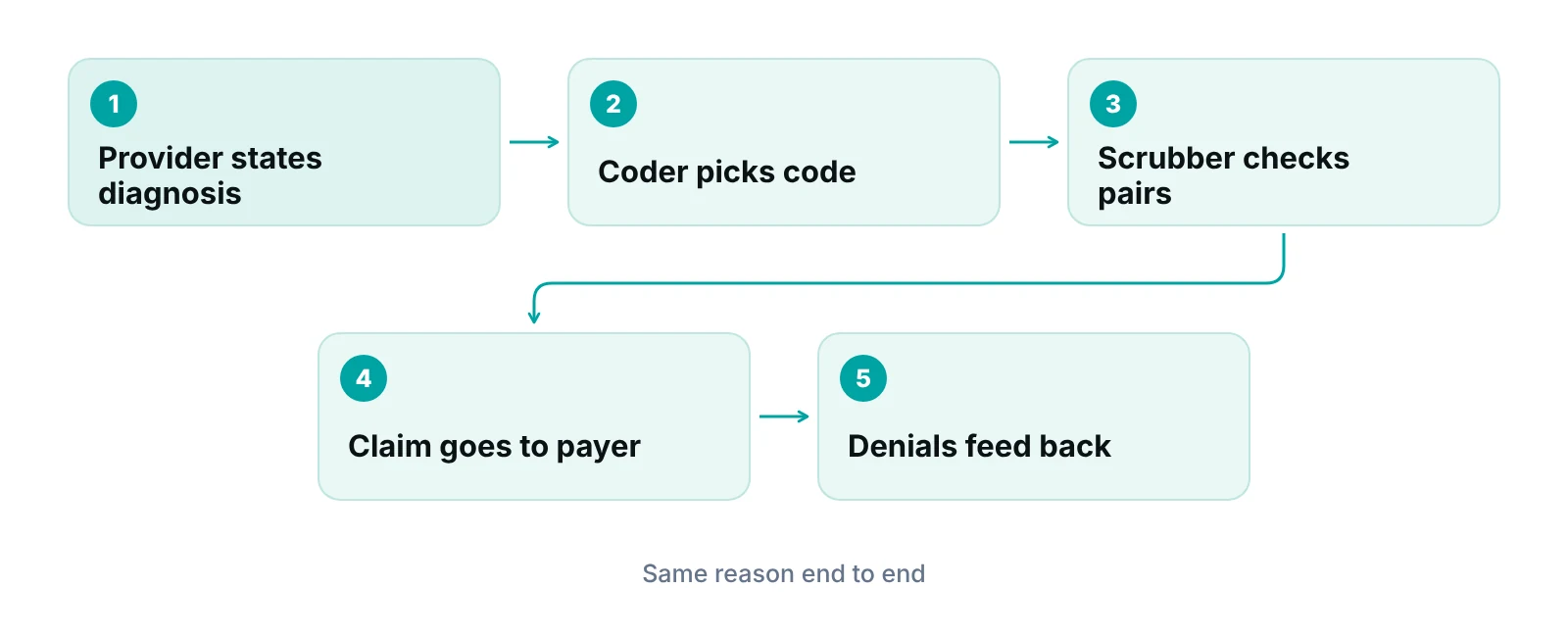
Pair checks like these can run before a claim goes out. Our claim scrubbing guide explains how a pre-submission check works, and the guide to medical billing denials covers how to sort denials already in your queue. Neurology practices can read about the billing context on our neurology page.
Worked example: one patient, three visits, three codes
Example (made up, de-identified). An adult is seen for slurred speech and a drooping face that have already resolved. Read how the code changes as the documentation changes.
- Visit 1. The provider documents transient slurred speech and facial droop, “possible TIA,” and sends the patient for a workup. The outpatient coder reports R47.81 and R29.810. G45.9 is not reported, because the diagnosis is uncertain.
- Visit 2. The workup is complete. The provider documents “TIA” with no infarct and no named syndrome. The coder reports G45.9 and drops the symptom codes, because the symptoms are routine parts of the diagnosis. If the provider had documented an infarct, the code would be from I63.-, not G45.
- Visit 3, six months later. The provider documents “history of TIA, no residual deficits.” The coder reports Z86.73. If the note had listed a lasting speech deficit after a stroke, the coder would query for the I69 code instead, because Z86.73 and I69 exclude each other.
The patient’s event did not change. The documentation did, and each change moved the code. A short query at visit 1 or visit 2 costs less than a rebill.
“A TIA code should never come from a symptom list. It should come from a sentence the provider wrote.”
— Awais Afzal, Healthcare Operations & Data Analyst
Already have diagnosis denials in the queue?
See how our denial management service sorts denials by cause, so code-pair and documentation problems are fixed at the source.
Our recommendations
- Build a three-way cheat sheet. Put the three situations side by side: confirmed TIA (G45), symptoms only, and history (Z86.73). Coders should be able to answer “which one is this?” from the assessment line alone.
- Ask for the diagnostic sentence. Ask providers to end the assessment with a clear statement: TIA, stroke, symptoms with no diagnosis yet, or history of TIA. Keep the answer in the note, not in a side message.
- Add pair checks for G45, I63, I69 and Z86.73. Hold claims that carry Z86.73 with an I69 code, or G45.4 with R41.3. Our workflow rules can flag a claim for review so a person looks at the pair before release.
- Never code uncertain outpatient diagnoses. Teach billers that “possible” and “rule out” mean symptom codes on an outpatient claim. Review a sample each quarter.
- Revisit symptom-coded claims. When a claim carries symptom codes only, check at the next visit whether a diagnosis has been made, and make sure later claims use it.
- Refresh code tables every October. Assign one person to load the new code set and spot-check G45 and Z86.73 against the official tabular list before the first claims of the new fiscal year go out.
Bottom line
TIA icd 10 coding is a documentation decision. Report G45.9 or a specific G45 code for a confirmed TIA, code the symptoms when no TIA is confirmed, and use Z86.73 for a past TIA without deficits. If your neurology claims keep stalling on diagnosis, our medical billing services and denial management services can review the pattern with you.
Frequently asked questions
What is the ICD-10 code for TIA?
G45.9, transient cerebral ischemic attack, unspecified. TIA is an inclusion term under it. If the provider names a syndrome, such as amaurosis fugax (G45.3) or transient global amnesia (G45.4), use the more specific code.
What code do I use for stroke-like symptoms with no TIA diagnosis?
The documented symptom codes, for example R29.810 for facial weakness, R47.01 for aphasia or R47.81 for slurred speech. Guideline I.B.4 allows symptom codes when a related definitive diagnosis has not been confirmed. Do not report G45.9 for a possible TIA on an outpatient claim. Once the provider confirms the TIA, switch to the G45 code and stop reporting the symptoms.
What is the ICD-10 code for history of TIA?
Z86.73, personal history of TIA and cerebral infarction without residual deficits. If deficits remain after a stroke, the I69 sequela codes apply instead, because Z86.73 and I69 exclude each other. Ask the provider to document whether deficits remain, and keep that sentence in the assessment.
Can I report G45.9 and I63.9 together?
I63.9 lists G45.- in an Excludes2 note, so both can be reported when both apply. The claim then describes two separate events, and the note must support both. A TIA by definition occurs without acute infarction, so expect questions from a reviewer.
Should I keep coding G45.9 at follow-up visits?
Only if the provider documents the TIA as current. Once the event is past and no deficits remain, the history code Z86.73 describes it. If the note is unclear, send a query before you choose.
Did FY2027 change the TIA codes?
A published summary of the FY2027 update did not mention G45, Z86 or I63, but a summary is not the addenda. Read the FY2027 addenda and tabular list for the codes you use. New, revised and deleted codes took effect on 1 October 2026.
Get your free practice audit
Tell us about your practice. We will contact you using the details you give.
- A review of your recent claims, denials and A/R aging
- Where your front desk and prior authorizations slow payment
- A prioritized fix list you keep, whether or not you hire us
Pricing is quoted after the audit, based on your volume and the services you choose. Prefer to talk? Call +1 (302) 556-2288.
Sources
- FY 2027 ICD-10-CM Official Guidelines for Coding and Reporting — CDC/NCHS (2026)
- ICD-10 codes (FY 2027 files listing) — CMS (2026)
- G45 Transient cerebral ischemic attacks and related syndromes (FY2027) — HCC Buddy (2026)
- G45.9 Transient cerebral ischemic attack, unspecified (FY2027) — HCC Buddy (2026)
- G45.4 Transient global amnesia (FY2027) — HCC Buddy (2026)
- G45.3 Amaurosis fugax (FY2027) — HCC Buddy (2026)
- Z86.73 Personal history of TIA and cerebral infarction without residual deficits (FY2027) — HCC Buddy (2026)
- I69 Sequelae of cerebrovascular disease (FY2027) — HCC Buddy (2026)
- R29.810 Facial weakness (FY2027) — HCC Buddy (2026)
- R47.01 Aphasia (FY2027) — HCC Buddy (2026)
- R47.81 Slurred speech (FY2027) — HCC Buddy (2026)
- I63.9 Cerebral infarction, unspecified — AAPC (2026)
- I63.9 Cerebral infarction, unspecified — Unbound Medicine (2026)
- Definition and Evaluation of Transient Ischemic Attack (scientific statement) — American Heart Association (2010)
- Transient Ischemic Attack (TIA) information page — NINDS (2026)
- ICD-10 Reminder Series: Section IV outpatient guidelines — Healthicity (2020)
- G45 Transient cerebral ischemic attacks and related syndromes — AAPC (2026)
- FY 2027 ICD-10-CM Update: What Your Practice Needs to Know — KZA (2026)
Disclaimer: This article is educational and is not legal, coding, billing, medical or compliance advice. ICD-10-CM codes, guidelines and payer policies change each fiscal year and vary by payer. Verify current requirements with the official code set, your payers and your counsel before you act.
