
CO-97 is a contractual adjustment with the reason code 97: the benefit for this service is included in the payment or allowance for another service or procedure that has already been adjudicated. The payer is saying the line was bundled into a different line, so you find that other service and decide whether the bundling is correct.
CO-97 is one of the most common bundling denials. It often looks like a coding error, but it is just as often correct. The skill is working out which, quickly, so you neither give up paid money nor appeal a denial you cannot win.
This guide explains what CARC 97 means, what usually causes it, how modifiers and NCCI edits fit in, and how to decide between correcting, appealing and writing off. Remittance code wording comes from the X12 list, and bundling rules vary by payer, so confirm details with each payer.
Key takeaways
- CARC 97 says the service is included in payment for another service that was already adjudicated.
- The group code CO means the provider usually cannot bill the patient for the amount.
- A modifier fixes the denial only when the documentation shows a truly separate service.
- Adding a modifier to force payment, without support, creates compliance risk.
What does CO-97 mean?
CO is the group code for contractual obligation. 97 is the claim adjustment reason code: the benefit for the service is included in the payment or allowance for another service or procedure that has already been adjudicated. In plain terms, the payer paid another line and says this one is part of it.
| Part | Meaning | What to do |
|---|---|---|
| CO | Contractual obligation | Do not bill the patient unless the contract allows it |
| 97 | Benefit included in another service | Identify the line it was bundled into |
| RARC | Remark code, if present | Read it. It often names the reason, such as same-day service or component code |
Reason code wording follows the X12 claim adjustment reason code list. For the structure of all three parts, see our guide to CARC codes.
What causes a CO-97 denial?
The causes fall into a few groups. Some are valid bundling and some are payer errors.
| Cause | Example | Likely outcome |
|---|---|---|
| Component code billed with a comprehensive code | A part of a procedure billed alongside the whole | Denial is usually correct |
| Same-day E/M with a minor procedure | Visit billed with a procedure, no modifier 25 | Fixable if the visit was separate. See modifiers 25 and 59 |
| Missing or wrong modifier | Distinct service with no modifier | Fixable with documentation. See X modifiers |
| Add-on or timed code bundled | Time-based codes counted together | Check units and rules. See the 8-minute rule |
| Payer error | Services at different sites or times were treated as one | Appeal with the record |
Examples are illustrative. Each payer sets its own edits.
The National Correct Coding Initiative publishes edits for Medicare that many commercial payers copy. Not every edit allows a modifier. Some pairs are never payable together, and adding a modifier will not change that.
How do you find the service CO-97 was bundled into?
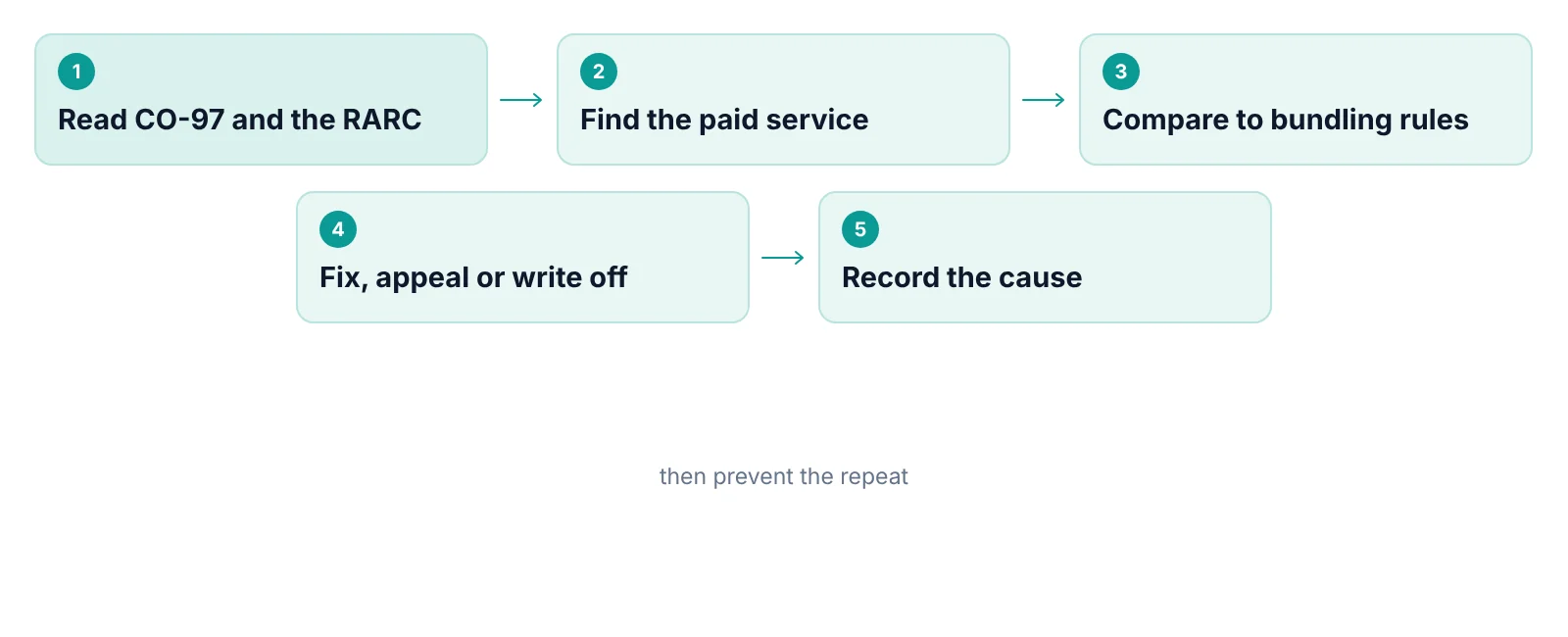
Open the remittance and look at the other lines for the same date of service and the same patient. The paid line is the one that included this service. Compare the two codes. If one is a component of the other, the denial is probably right. If they describe different anatomic sites, encounters or practitioners, there may be a basis to appeal.
- Check the date and place of service. Separate encounters on the same day can support a modifier.
- Check the body site. Different sites can support an anatomic modifier.
- Check the practitioner. Different practitioners can support a different modifier.
Want a second pair of eyes on your claims?
Send us your recent denials and we will show where the same issue repeats. The audit is free and the fix list is yours to keep.
Should you correct, appeal or write off?
Decide on the record, not on the dollar amount. If the record shows a separate and distinct service, correct the claim with the right modifier or appeal with documentation. If it does not, write off the amount as contractual and fix the process.
| Finding | Action | Notes |
|---|---|---|
| Truly bundled | Write off | Do not bill the patient |
| Distinct service, modifier missing | Submit a corrected claim with the modifier | Attach the note if asked |
| Distinct service, modifier present | Appeal with documentation | Cite the edit and the record |
| Payer treated separate lines as one | Appeal | State the facts plainly |
Use the steps in our appeal letter guide when you appeal.
Never add a modifier only to get paid. Modifiers state a fact about the service, and the record has to support it.
How do you prevent CO-97 denials?
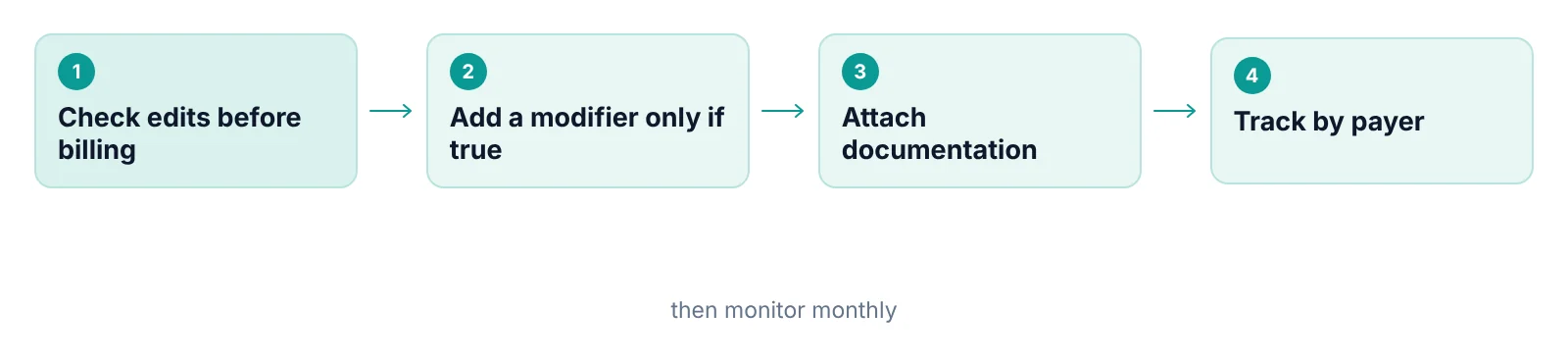
Most repeat CO-97 denials start before the claim is sent. A claim scrubber with current edits catches many of them, and a short review of the common pairs in your specialty catches the rest. See our guide to claim scrubbing for how those checks work.
Track CO-97 by payer and by code pair. If one pair repeats, the fix is usually a charge entry rule, a template change or a provider conversation. The method in denial root cause analysis applies directly.
Related denial guides
CO-97 is one of several common contractual denials. See CO-16 for missing information, CO-45 for fee schedule adjustments, and CO-197 for authorization problems. For the overall process, read medical billing denial management.
Our recommendations
- Keep a bundling pair list. List the 20 code pairs your practice sees most, with the rule for each.
- Scrub before you submit. Use current NCCI-based edits in your scrubber.
- Train on modifiers. Everyone who enters charges should know what each modifier states.
- Attach records only when needed. Do not flood payers with records on clean claims.
- Track by payer. A single payer with an unusual edit is worth a call.
- Review monthly. Look at CO-97 dollars and the top five pairs.
Bottom line
CO-97 is a pointer to another service. Find it, compare the codes and the record, then correct, appeal or write off. Prevention is cheaper than appeals. For more help, see our denial management services.
Frequently asked questions
What does CO-97 mean on a remittance?
CO-97 means the payer adjusted the line under a contractual obligation because the benefit for the service is included in the payment or allowance for another service or procedure that has already been adjudicated. The payer treats the service as part of another paid line. Find that other line, then compare the services and the record before you decide what to do.
Can I bill the patient for a CO-97 denial?
Usually no. CO is the contractual obligation group code, which means the provider is responsible for the amount under the payer contract. Billing the patient could breach the contract. If the contract or state rules allow patient billing in specific cases, confirm that with the payer or your counsel before you send a statement.
Will modifier 59 fix a CO-97 denial?
Only when the record shows a truly separate and distinct service, such as a different encounter, site, practitioner or non-overlapping service. CMS suggests choosing a more specific X modifier where possible. A modifier added without support is a compliance risk, and some code pairs cannot be unbundled at all.
How is CO-97 different from CO-45?
CO-45 means the charge exceeds the fee schedule or contracted amount, so it is the normal write-off for the difference between billed and allowed. CO-97 means the service was bundled into another service and not paid separately. The first is routine pricing. The second needs a check of bundling rules and the record.
How long do I have to appeal a CO-97 denial?
The deadline depends on the payer and the contract. Medicare redeterminations have a fixed window, and commercial payers set their own. Check the remittance and the payer manual on the day the denial arrives, and calendar the deadline. Missing it turns a fixable denial into a write-off.
What should an appeal for CO-97 include?
Include the claim details, the paid line the service was bundled into, the reason the services are distinct, and the supporting record, such as the operative or visit note. Cite the payer policy or coding rule that applies. Keep it short and factual, and attach only the pages that prove the point.
Get your free practice audit
Tell us about your practice. We will contact you using the details you give.
- A review of your recent claims, denials and A/R aging
- Where your front desk and prior authorizations slow payment
- A prioritized fix list you keep, whether or not you hire us
Pricing is quoted after the audit, based on your volume and the services you choose. Prefer to talk? Call +1 (302) 556-2288.
Sources
- Claim adjustment reason codes — X12 (2026)
- Remittance advice remark codes — X12 (2026)
- Proper use of modifiers 59, XE, XP, XS and XU (MLN1783722) — Centers for Medicare & Medicaid Services (2025)
- National Correct Coding Initiative edits — Centers for Medicare & Medicaid Services (2026)
- Medicare Claims Processing Manual, Chapter 22 — Centers for Medicare & Medicaid Services (2026)
- Medicare appeals process — Centers for Medicare & Medicaid Services (2026)
Disclaimer: This article is educational and is not legal, coding, billing, medical or compliance advice. CPT codes and modifier descriptions are owned by the AMA, and code meanings, Medicare contractor policies and payer rules change and vary by payer, contractor and state. Verify current requirements with the official CPT manual, your payers and your counsel before you act.
