
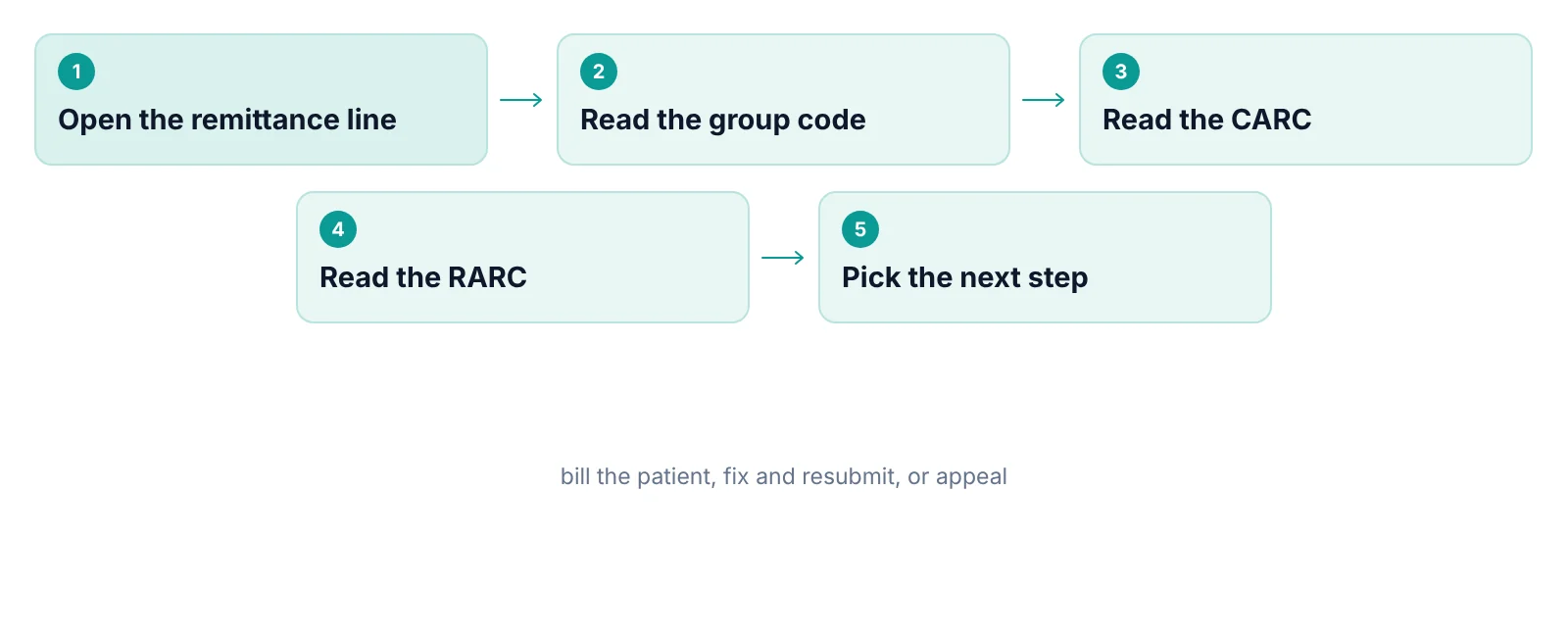
A CARC, or claim adjustment reason code, is a standard code on a remittance advice that explains why a payer paid a claim line differently from the amount billed. It is read together with a group code, which says who is responsible for the amount, and often a remark code (RARC) that adds detail.
Every payment posting team reads CARCs all day, but many practices only see them when a denial reaches the billing queue. That is late. The same few codes explain most of the money lost between charge and payment, and understanding them turns a remittance from a list of numbers into a work list.
This guide explains how a CARC fits with group codes and RARCs, and gives the meaning of the codes you will see most. Code descriptions come from the X12 code list, which is maintained as a standard and updated several times a year, so check the current list before you build rules around a specific code.
Key takeaways
- A CARC says why the amount changed. A group code says who owes it. A RARC adds detail.
- Group codes: CO contractual, PR patient responsibility, OA other adjustment, PI payer initiated, CR correction and reversal.
- The same CARC can mean different things with different group codes, so never read the number alone.
- Build your denial work queues from CARC and RARC pairs, not from free-text notes.
What is a CARC code?
A claim adjustment reason code is a numeric code in the electronic remittance advice, the 835 file, that explains an adjustment to a claim line. The X12 standards body maintains the list, and payers must use it on 835 files. The same codes appear in print on paper remits. If you are new to the file itself, read what an ERA is first.
| Part | What it answers | Example |
|---|---|---|
| Group code | Who is responsible for the adjusted amount | CO, PR or OA |
| CARC | Why the amount was adjusted | 45, 97, 16 or 50 |
| RARC | Extra detail or next step for that adjustment | MA130 or N20 |
Structure as described in X12 code list documentation and CMS remittance guidance.
What do the group codes mean?
The group code tells you where the amount goes next. A CO adjustment is contractual, so the provider writes it off and does not bill the patient. A PR adjustment is patient responsibility, such as deductible or coinsurance, so it moves to the patient balance.
| Group code | Meaning | Usual action |
|---|---|---|
| CO | Contractual obligation | Write off, or fix and appeal if it is wrong |
| PR | Patient responsibility | Bill the patient, or verify the plan applied the benefit correctly |
| OA | Other adjustment | Read the CARC and RARC to decide |
| PI | Payer initiated reduction | Read the CARC and appeal if unjustified |
| CR | Correction and reversal | Match to the original claim and rebalance |
Meanings as defined in the X12 group code list.
Posting teams should follow the rules in our guide to payment posting so that each adjustment lands in the right bucket.
What are the most common CARCs?
A short list covers a large share of adjustments. The wording below paraphrases the X12 descriptions.
| CARC | Meaning (paraphrased) | Typical follow-up |
|---|---|---|
| 1 | Deductible amount | Bill the patient if PR |
| 2 | Coinsurance amount | Bill the patient if PR |
| 3 | Co-payment amount | Verify it was collected at the visit |
| 4 | Procedure code inconsistent with the modifier used | Correct the modifier and resubmit |
| 16 | Claim or service lacks information or has a billing error | Read the RARC, then correct and resubmit. See CO-16 |
| 18 | Exact duplicate claim or service | Check whether the first claim was paid |
| 29 | Time limit for filing has expired | Check proof of timely filing. See filing time limits |
| 45 | Charge exceeds the fee schedule or contracted amount | Usually a write-off. See CO-45 |
| 50 | Not deemed a medical necessity by the payer | Review the policy and appeal if supported |
| 97 | Benefit included in payment for another service already adjudicated | Check bundling. See CO-97 |
Descriptions paraphrased from the X12 claim adjustment reason code list.
Codes 96, 109 and 119 also appear often. 96 is a non-covered charge and needs a remark code, 109 means the claim belongs with a different payer, and 119 means a benefit maximum has been reached.
How do RARCs work with CARCs?
Remittance advice remark codes add detail. X12 describes two kinds. Supplemental RARCs explain a specific CARC adjustment. Informational RARCs, called alerts, are not tied to one CARC. Some CARCs, such as 16 and 96, require at least one RARC, because the CARC alone is too general.
Always read the pair. CARC 16 with a remark about a missing field points you to the field. CARC 16 with a different remark may mean something unrelated. Our guide to RARC codes covers the prefixes and common examples.
Want a second pair of eyes on your claims?
Send us your recent denials and we will show where the same issue repeats. The audit is free and the fix list is yours to keep.
How should you work adjustments by CARC?
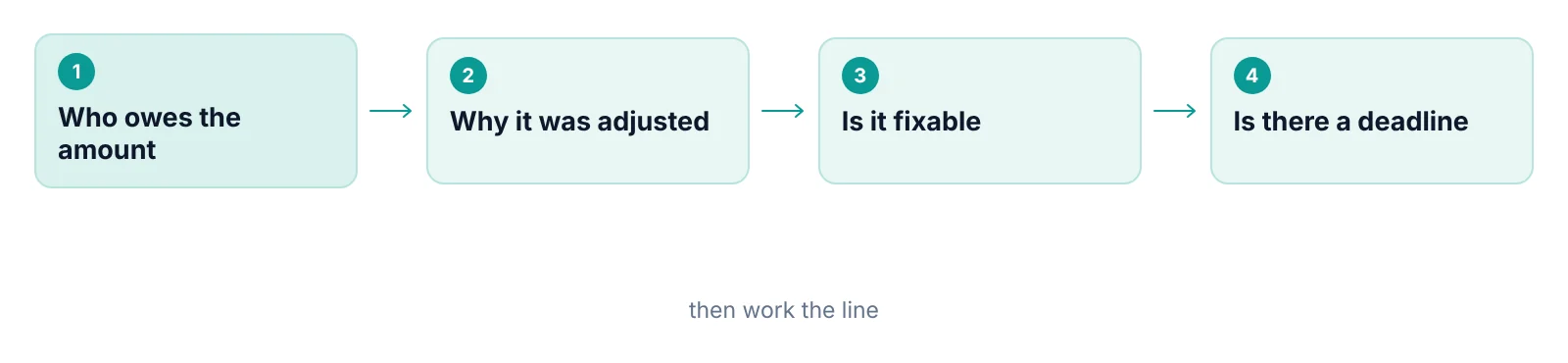
Sort adjustments into three buckets: expected, fixable and disputable. Expected adjustments, such as contractual write-offs and patient share, are posted and closed. Fixable adjustments, such as missing information or a wrong modifier, go to a correction queue. Disputable adjustments, such as medical necessity denials, go to an appeal queue.
| Bucket | Examples | Owner |
|---|---|---|
| Expected | CO-45, PR-1, PR-2 | Posting team |
| Fixable | CO-16, CO-4, CO-18 | Billing correction team |
| Disputable | CO-50, CO-97 when unbundling is wrong | Appeals team |
Buckets are a suggested starting point. Adapt them to your payer mix. For appeals, use our appeal letter guide.
Tracking denial volume by CARC each month tells you where the process breaks. The method in denial root cause analysis shows how to turn that into fixes.
Related denial and remittance guides
Many CARCs have their own guide. See CO-22 and CO-226 for specific cases. For the bigger picture, read medical billing denial management and understanding the EOB.
Our recommendations
- Map CARC and RARC pairs to work queues. Automatic routing removes guesswork.
- Train posters on group codes first. A wrong group code sends money to the wrong party.
- Keep a CARC cheat sheet. Two pages covering your top 20 codes beats a full list.
- Report denials by CARC every month. Rank by dollars, not by count.
- Update the list each year. X12 revises the code list regularly. Review rules after each update.
- Appeal on facts. Cite the policy and the record, not just the code.
Bottom line
A CARC is only one third of the story. Read it with the group code and the RARC, route the line to the right queue, and track patterns by month. For help turning those patterns into fixes, see our denial management services.
Frequently asked questions
What does CARC stand for?
CARC stands for claim adjustment reason code. It is a standard code in the electronic remittance advice that explains why a payer adjusted a claim line from the billed amount. The X12 standards organization maintains the list, and payers use it on 835 files and on paper remits so that providers can interpret adjustments consistently.
What is the difference between CARC and RARC?
A CARC states the reason for an adjustment. A RARC, or remittance advice remark code, adds detail or explains the next step. Some CARCs require a RARC because the CARC alone is too general. Read both together, along with the group code, before deciding whether to correct, appeal or write off the amount.
What do CO, PR and OA mean?
They are group codes. CO means contractual obligation, so the provider writes off the amount. PR means patient responsibility, such as deductible or coinsurance. OA means other adjustment, and you read the CARC and RARC to decide the action. The group code tells you who owes the amount, not why it was adjusted.
Where do I find the official CARC list?
The X12 organization publishes the claim adjustment reason code list on its website, and many payers and clearinghouses mirror it. The list is updated several times a year. Use the current version when building posting rules or work queues, and note that payers may use a code differently, so confirm with the payer if a meaning is unclear.
Can the same CARC mean different things?
The CARC has one standard meaning, but its effect depends on the group code and any RARC. CARC 45 with CO is usually a write-off. The same number with PR, when allowed, shifts responsibility to the patient. Always read the full set of codes and compare to your contract before you act on an adjustment.
How do I reduce denials tied to CARCs?
Group denials by CARC and RARC pair, rank them by dollars, and fix the highest-cost cause first. Many repeat causes are front-end issues such as registration errors, missing modifiers or authorization gaps. Track the rate monthly so you can tell whether a change worked, and train staff on the top five pairs.
Get your free practice audit
Tell us about your practice. We will contact you using the details you give.
- A review of your recent claims, denials and A/R aging
- Where your front desk and prior authorizations slow payment
- A prioritized fix list you keep, whether or not you hire us
Pricing is quoted after the audit, based on your volume and the services you choose. Prefer to talk? Call +1 (302) 556-2288.
Sources
- Claim adjustment reason codes — X12 (2026)
- Remittance advice remark codes — X12 (2026)
- Medicare Claims Processing Manual, Chapter 22 (Remittance Advice) — Centers for Medicare & Medicaid Services (2026)
- Electronic remittance advice — Centers for Medicare & Medicaid Services (2026)
- Medicare Claims Processing Manual, Chapter 1 — Centers for Medicare & Medicaid Services (2026)
- HIPAA transaction standards — Centers for Medicare & Medicaid Services (2026)
Disclaimer: This article is educational and is not legal, coding, billing, medical or compliance advice. CPT codes and modifier descriptions are owned by the AMA, and code meanings, Medicare contractor policies and payer rules change and vary by payer, contractor and state. Verify current requirements with the official CPT manual, your payers and your counsel before you act.
