
A RARC, or remittance advice remark code, is a standard code that gives extra detail about a claim adjustment or about how a remittance was processed. Supplemental RARCs explain a specific adjustment, and informational RARCs, called alerts, are not tied to a single claim adjustment reason code.
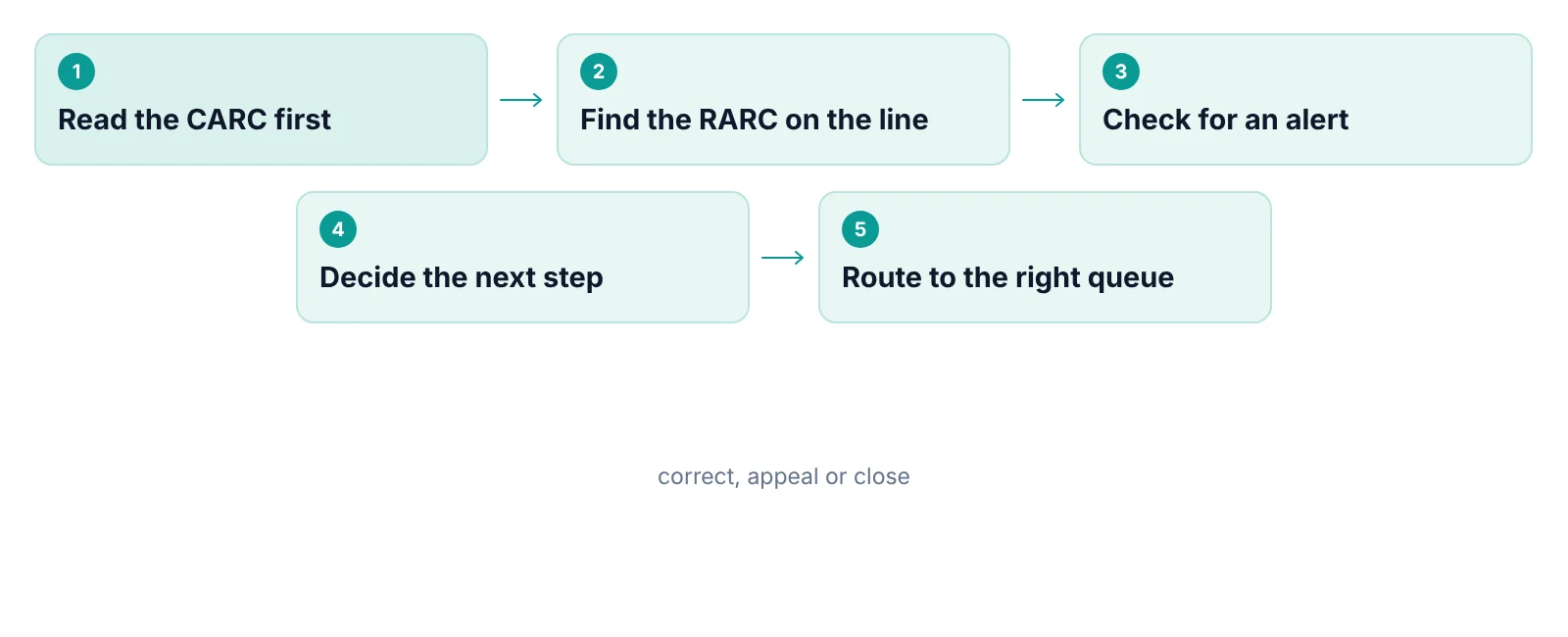
A remittance line often carries a claim adjustment reason code and one or more remark codes. The CARC says why the payer adjusted. The RARC says more, and sometimes tells you exactly what to do. Teams that ignore the RARC often fix the wrong thing.
This guide explains what RARCs are, how the prefixes are used, and how to turn them into routing rules. Descriptions come from the X12 remark code list, which is updated several times a year.
Key takeaways
- A RARC adds detail to a CARC adjustment or explains how a remittance was processed.
- Supplemental RARCs explain an adjustment. Alerts are informational and not tied to one CARC.
- Some CARCs, such as 16 and 96, require a RARC, because the CARC alone is too general.
- Route work by CARC and RARC pair, not by CARC alone.
What is a RARC?
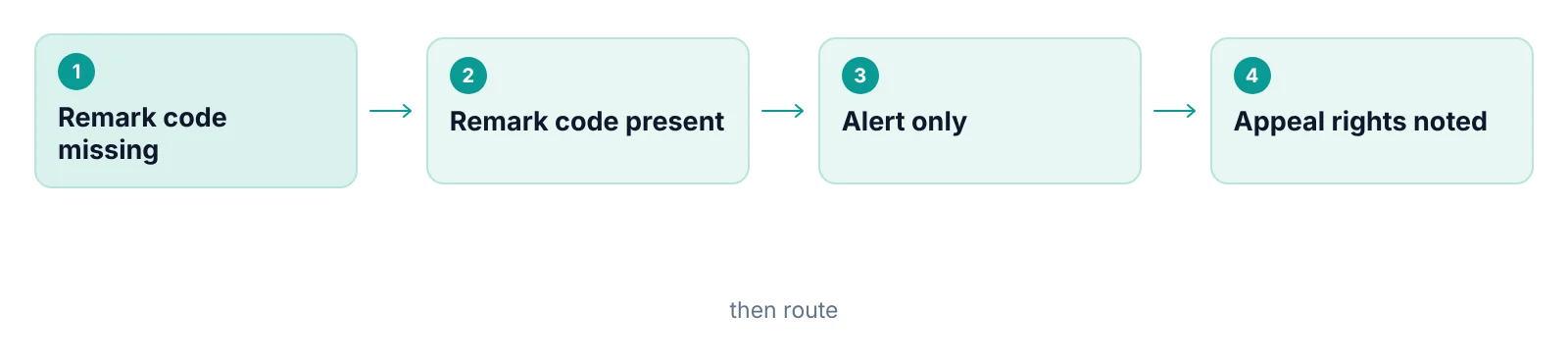
RARC stands for remittance advice remark code. The X12 organization maintains the list, and payers use it on electronic remittance advice and on paper remits. X12 describes two types: supplemental codes, which add explanation to a CARC adjustment, and informational codes, called alerts, which start with the word Alert and are never tied to a specific CARC.
| Type | What it does | How to use it |
|---|---|---|
| Supplemental | Explains a specific adjustment | Read it with the CARC to choose the fix |
| Informational (alert) | Gives general information | Note it, and act if it names a deadline or right |
Types as described on the X12 remittance advice remark code list.
What do the M, MA and N prefixes mean?
Remark codes carry prefixes such as M, MA and N. The X12 list does not explain the letters on its page. In practice, MA and M codes originate from Medicare and often appear on Medicare remittances, while N codes are the larger general set used across payers. Treat the prefix as an identifier, not as a category of meaning, and always read the code description.
| Code | Description (paraphrased) | Typical action |
|---|---|---|
| MA130 | Claim has incomplete or invalid information and is unprocessable, with no appeal rights | Correct and submit a new, complete claim |
| M86 | Service denied because payment was already made for the same or a similar procedure within a set time frame | Check for a duplicate or overlapping service |
| N20 | Service not payable with another service rendered on the same date | Check bundling. See CO-97 |
| MA01 | Alert: you may appeal if you disagree with what was approved | Note the appeal deadline |
Descriptions paraphrased from the X12 remittance advice remark code list.
Medicare notes that a request for review under MA01 must be made within a set period, so always calendar the date on the remittance.
How do RARCs pair with CARCs?
A CARC can have more than one remark code, and the same RARC can sit under different CARCs. The pair tells you what to do. For example, CARC 16 means the claim lacks information or has a billing error, and X12 requires at least one remark code with it. The RARC names the missing item.
| CARC | Needs a RARC? | Why it matters |
|---|---|---|
| 16 | Yes | The remark names what is missing. See CO-16 |
| 96 | Yes | The remark explains why the charge is not covered |
| 97 | Often | The remark can name the bundled service or rule |
| 45 | Rarely | Usually routine pricing. See CO-45 |
Requirement for 16 and 96 is stated on the X12 CARC list. Our guide to CARC codes covers the reason codes.
Want a second pair of eyes on your claims?
Send us your recent denials and we will show where the same issue repeats. The audit is free and the fix list is yours to keep.
How should you use RARCs in work queues?
Build queue rules in two steps. First, route by CARC and group code. Second, refine by RARC for the common pairs. Keep the rules in a table that staff can read and change.
- Missing information pairs: route to a correction queue with the field named.
- Duplicate or overlap pairs: route to a research queue that checks the original claim.
- Appeal rights pairs: route to an appeals queue with the deadline.
Posting teams who follow payment posting best practices can capture the RARC at posting so the data is available for reporting.
What should you report on RARCs?
Count adjustments by CARC and RARC pair, rank by dollars and track the top pairs monthly. The aim is to find repeat causes. If one pair accounts for a large share of write-offs, the fix may be a front-end rule rather than a billing rule.
| Column | Purpose | Example |
|---|---|---|
| CARC and RARC pair | Identify the cause | 16 with a missing-field remark |
| Payer | Find payer-specific patterns | Payer A versus Payer B |
| Dollars | Rank by impact | Top ten pairs |
| Owner | Assign the fix | Front desk, coding or billing |
Adapt the columns to your system. See denial root cause analysis for the full method.
Alerts should also be logged when they name a deadline or a right to appeal.
Related remittance and denial guides
Read what an ERA is and the EOB for the documents that carry these codes. For appeals, see appeal letters. For the wider process, denial management ties it together.
Our recommendations
- Capture RARCs at posting. If staff do not record them, reports cannot use them.
- Maintain a pair table. Map your top 30 pairs to a queue and an owner.
- Log alerts with deadlines. A missed appeal window cannot be fixed.
- Check the list quarterly. X12 updates codes several times a year.
- Ask payers when unclear. Some payers use remark codes in their own way.
- Report monthly. Rank pairs by dollars.
Bottom line
RARCs are short, but they hold the detail that decides your next step. Capture them, pair them with CARCs, and route by the pair. For help building those queues, see our denial management services.
Frequently asked questions
What does RARC stand for?
RARC stands for remittance advice remark code. It is a standard code on a remittance that adds detail to a claim adjustment or explains how the remittance was processed. The X12 organization maintains the list, and payers use it on electronic and paper remittances alongside claim adjustment reason codes and group codes.
What is the difference between a CARC and a RARC?
The CARC says why a claim line was adjusted. The RARC adds detail, such as which field was missing or what rule applied. Some CARCs, such as 16 and 96, require a RARC because the reason alone is too general. You read both together to choose the next step.
What is an alert RARC?
An alert is an informational remark code that starts with the word Alert and is not tied to a specific CARC adjustment. It might note an appeal right or give general information. Treat alerts as notes to record, and act on them if they name a deadline or a right you want to use.
What does MA130 mean?
MA130 states that the claim contains incomplete or invalid information and cannot be processed, and that no appeal rights are given. The fix is usually to submit a new, complete claim, not to appeal. Check which information was missing, correct it, and resubmit before the filing limit expires.
Do all payers use the same remark codes?
Payers must use the standard X12 remark code list on electronic remittances, but they choose which codes to apply and how. The same adjustment can come with different remark codes from different payers. Build your rules from the code descriptions and confirm with the payer if the meaning is unclear.
Where do I find the official RARC list?
X12 publishes the remittance advice remark code list on its website, and many payers and clearinghouses mirror it. The list is updated several times a year. Use the current version when you build queue rules, and keep a note of the date you last checked it.
Get your free practice audit
Tell us about your practice. We will contact you using the details you give.
- A review of your recent claims, denials and A/R aging
- Where your front desk and prior authorizations slow payment
- A prioritized fix list you keep, whether or not you hire us
Pricing is quoted after the audit, based on your volume and the services you choose. Prefer to talk? Call +1 (302) 556-2288.
Sources
- Remittance advice remark codes — X12 (2026)
- Claim adjustment reason codes — X12 (2026)
- Medicare Claims Processing Manual, Chapter 22 — Centers for Medicare & Medicaid Services (2026)
- Electronic remittance advice — Centers for Medicare & Medicaid Services (2026)
- HIPAA transaction standards — Centers for Medicare & Medicaid Services (2026)
- Medicare appeals process — Centers for Medicare & Medicaid Services (2026)
Disclaimer: This article is educational and is not legal, coding, billing, medical or compliance advice. CPT codes and modifier descriptions are owned by the AMA, and code meanings, Medicare contractor policies and payer rules change and vary by payer, contractor and state. Verify current requirements with the official CPT manual, your payers and your counsel before you act.
