
XE, XS, XP and XU are HCPCS modifiers that CMS created to give more specific reasons than modifier 59 for a distinct service. XE means separate encounter, XS separate structure, XP separate practitioner, and XU unusual non-overlapping service. CMS says to use them instead of 59 whenever possible.
Modifier 59 has long been the most overused modifier in billing, because it can mean four different things. The X modifiers were created to say which one. Not every payer accepts them yet, but the rules behind them apply to 59 as well.
This guide explains each X modifier, when it fits, how it relates to 59, and the documentation CMS expects. It draws on the CMS MLN booklet on modifiers 59, XE, XP, XS and XU. Payers differ, so confirm their policy before you bill.
Key takeaways
- XE separate encounter, XS separate structure, XP separate practitioner, XU unusual non-overlapping service.
- CMS says to use the X modifier instead of 59 when one fits, and to use 59 only when none does.
- A modifier is only valid if the record supports it. Different diagnoses alone are not enough.
- Some code pairs are never payable together, and no modifier changes that.
What are the X modifiers?
They are four modifiers that describe subsets of modifier 59, distinct procedural service. Modifier 59 identifies procedures or services that are not normally reported together but are appropriate under the circumstances. The X modifiers say which circumstance.
| Modifier | Meaning | When it fits |
|---|---|---|
| XE | Separate encounter | The service happened during a separate encounter on the same date |
| XS | Separate structure | The service was on a separate organ or structure |
| XP | Separate practitioner | A different practitioner performed the service |
| XU | Unusual non-overlapping service | The service does not overlap the usual components of the main service |
Definitions from CMS MLN1783722, Proper Use of Modifiers 59, XE, XP, XS, and XU.
When should you use an X modifier instead of 59?
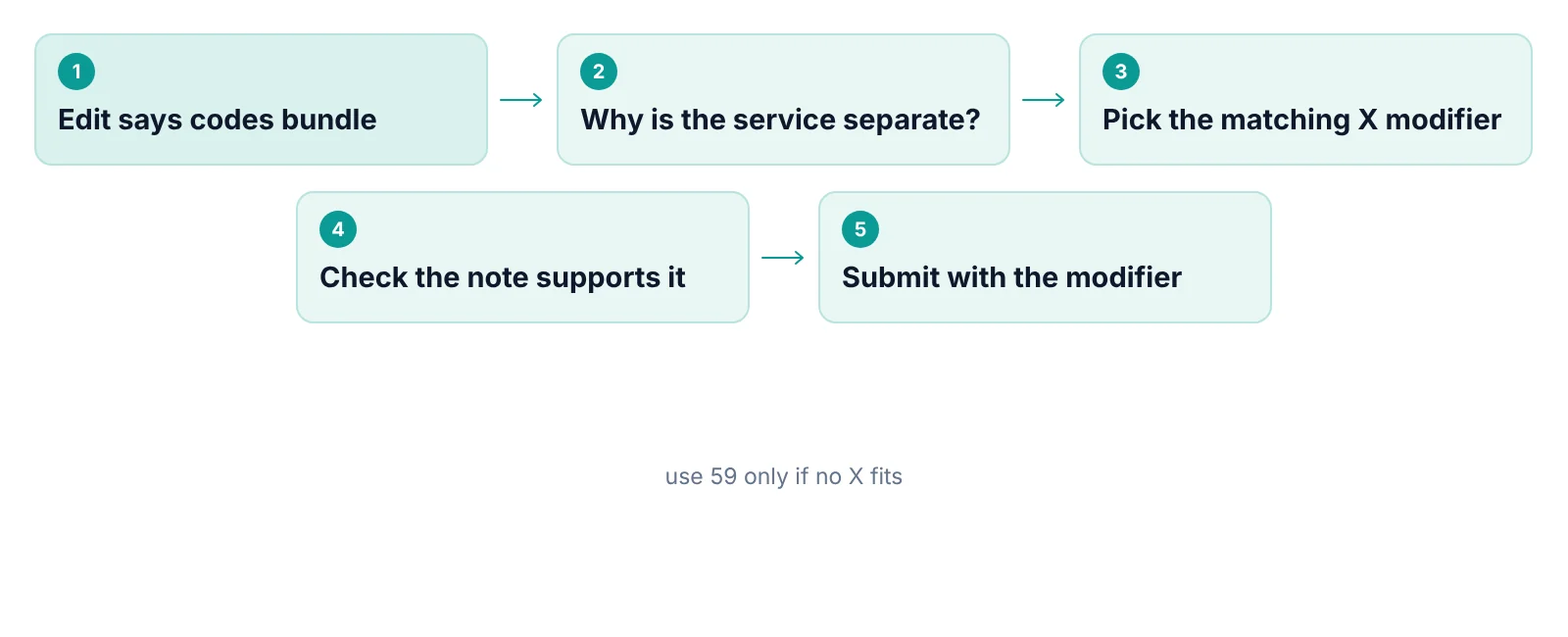
CMS says the X modifiers give more specific reporting than 59 and should be used whenever possible. Modifier 59 should be used only when no more specific modifier fits. CPT likewise says to use an established, more descriptive modifier rather than 59. Our guides to modifier 59 and modifiers 25 and 59 cover the basics.
| Situation | 59 or X | Notes |
|---|---|---|
| Different anatomic site in the same encounter | 59 or XS | Do not use if a more specific anatomic modifier applies, such as RT or LT |
| Different encounter on the same date | 59 or XE | Not if modifiers 24, 25, 27, 57, 58, 78, 79 or 91 describe it |
| Timed codes in separate, non-mingled periods | 59 or XE | Per CMS example |
| Diagnostic service before a therapeutic service that drove the decision | 59 or XU | If it is not part of the therapy |
Summarized from CMS MLN1783722.
Contiguous structures in the same organ or region usually count as a single site, so do not treat them as separate structures.
How do X modifiers work with NCCI edits?
Medicare publishes procedure-to-procedure edits. Each edit has a modifier indicator. With an indicator of 0, the pair is never payable together for the same patient, provider and date, and the Column 2 code is denied. With an indicator of 1, the pair can be reported together only in limited circumstances when a modifier applies.
- Indicator 0: no modifier overrides the edit.
- Indicator 1: a modifier may apply if the criteria are met.
- Where it goes: 59 and the X modifiers can be placed on either the Column 1 or the Column 2 code, as the CMS booklet describes.
If the denial you see is CO-97, our guide to CO-97 shows how to find the paid line first.
Want a second pair of eyes on your claims?
Send us your recent denials and we will show where the same issue repeats. The audit is free and the fix list is yours to keep.
What documentation does CMS expect?
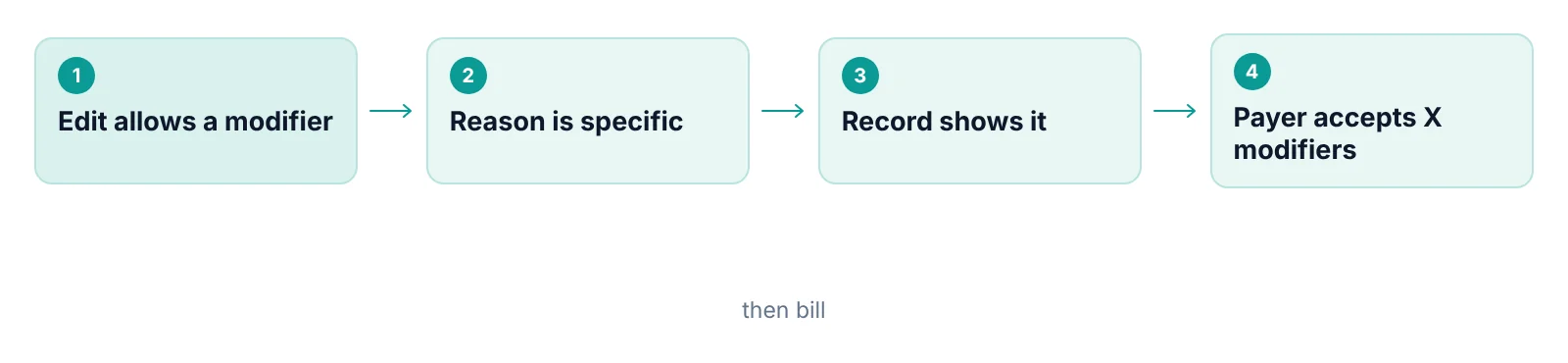
The record must support the modifier. CMS lists what that means: a different session, a different procedure or surgery, a different site or organ system, a separate incision or excision, a separate lesion, or a separate injury. Different diagnoses alone are not enough, and different code descriptors alone do not justify it.
| Modifier | What the record should show | Weak support |
|---|---|---|
| XE | Times and details of each encounter | Both services shown at one time |
| XS | Site or organ for each service | Same region for both |
| XP | Names and roles of each practitioner | Same practitioner for both |
| XU | Why the service does not overlap the main one | No reason given |
Based on MLN1783722. Add detail specific to the payer.
See clear documentation for note habits that make this easier.
Do all payers accept X modifiers?
No. Medicare accepts them, and many commercial payers have adopted them with their own policies. Some still want 59 only, and some limit X modifiers to certain code families. Read the policy for each payer, and test with a small set of claims before you change a workflow.
| Question | Why it matters | Where to look |
|---|---|---|
| Does the payer accept X modifiers? | Some reject them | Reimbursement policy or provider manual |
| Does it prefer 59 for certain codes? | Policies vary | Payer modifier policy |
| Does it ask for records? | Some require documentation | Payer policy and remittance notes |
Use our claim scrubbing guide to add payer rules to your scrubber.
What mistakes cause X modifier denials?
| Mistake | Why it fails | Fix |
|---|---|---|
| Adding a modifier to bypass an edit | The record does not support it | Add only when criteria are met |
| Using XS on contiguous structures | They count as one site | Do not use it |
| Using 59 when an X fits | Less specific, may be rejected | Use the X modifier |
| Using it on an E/M | 59 does not belong on E/M services | Use modifier 25 where it applies |
See also modifier 24 and modifier 79 for other modifiers that describe a reason.
An internal coding audit of modifier use will show where your team over- or underuses them.
Related modifier guides
X modifiers sit in a family. Read modifier 51 for multiple procedures, modifier 52 for reduced services and modifier 91 for repeat tests.
Our recommendations
- Map your common edits. List the pairs you see and the right modifier for each.
- Prefer X over 59. Follow CMS where the payer accepts it.
- Teach the reasons. Staff should know what each modifier states.
- Check payer policies. Keep a one-page table by payer.
- Audit modifier use. Track the share of claims with 59 or X.
- Never use modifiers to force payment. The record must support the claim.
Bottom line
The X modifiers say why a service is separate. Pick the one that fits, support it in the record, and check each payer. For billing support, see our medical billing services.
Frequently asked questions
What do XE, XS, XP and XU mean?
XE means separate encounter, XS means separate structure, XP means separate practitioner, and XU means unusual non-overlapping service. They are HCPCS modifiers that give a more specific reason than modifier 59 for why two services are distinct. CMS says to use them instead of 59 whenever one fits.
Can I still use modifier 59?
Yes, but CMS says to use 59 only when no more specific modifier fits. If an X modifier or another established modifier describes the situation, use that one. Some payers still accept 59 only, so check the policy. Either way, the record must support the claim.
Do X modifiers bypass NCCI edits?
They can, but only for edits that allow a modifier, and only when the criteria are met. If an edit has a modifier indicator of 0, no modifier overrides it. If the indicator is 1, the services must truly be separate. Using a modifier just to get paid is a compliance risk.
When do I use XS?
Use XS when a service was performed on a separate organ or structure from the other service. Contiguous structures in the same organ or region usually count as a single site, so XS would not apply. If a more specific anatomic modifier, such as RT or LT, fits, use that instead.
When do I use XE?
Use XE when the service was performed during a separate encounter on the same date of service. The note should show the separate encounters. XE is not meant for services that happened in the same encounter, and it should not be used when another modifier, such as 25 or 58, describes the situation better.
Do commercial payers accept X modifiers?
Many do, but not all, and policies differ. Some accept only certain code families, and some still require 59. Read each payer’s modifier policy, test with a few claims, and track denials by payer so you can adjust. Medicare accepts the X modifiers, per CMS guidance.
Get your free practice audit
Tell us about your practice. We will contact you using the details you give.
- A review of your recent claims, denials and A/R aging
- Where your front desk and prior authorizations slow payment
- A prioritized fix list you keep, whether or not you hire us
Pricing is quoted after the audit, based on your volume and the services you choose. Prefer to talk? Call +1 (302) 556-2288.
Sources
- Proper use of modifiers 59, XE, XP, XS and XU (MLN1783722) — Centers for Medicare & Medicaid Services (2025)
- Transmittal R2259OTN — Centers for Medicare & Medicaid Services (2019)
- National Correct Coding Initiative edits — Centers for Medicare & Medicaid Services (2026)
- NCCI Policy Manual for Medicare Services — Centers for Medicare & Medicaid Services (2026)
- Modifiers XE XS XP XU 59 Distinct Procedural Service (RPM027) — Moda Health (2025)
- Modifiers 59, XE, XP, XS, XU (Policy 105) — Regence (2025)
Disclaimer: This article is educational and is not legal, coding, billing, medical or compliance advice. CPT codes and modifier descriptions are owned by the AMA, and code meanings, Medicare contractor policies and payer rules change and vary by payer, contractor and state. Verify current requirements with the official CPT manual, your payers and your counsel before you act.
