
Medical claim forms follow who is billing: practitioners use the CMS-1500 on paper or the 837P electronically, hospitals and facilities use the UB-04 or the 837I, and dental offices use the ADA form or the 837D. Medicare expects electronic claims unless an exception or waiver applies.
You are setting up billing, changing a clearinghouse, or reading a rejection, and three names keep coming up: CMS-1500, UB-04 and 837. They are not three rivals. They are the paper form and the electronic file for different kinds of billers.
This guide is the hub. It tells you which family you are in, how paper and electronic relate, and what Medicare expects today. For the box-by-box detail, it sends you to the dedicated CMS-1500 and UB-04 guides. It is written for practice owners, managers and billers.
Key takeaways
- Medical claim forms split into professional (CMS-1500 / 837P), institutional (UB-04 / 837I) and dental (ADA form / 837D).
- The 837 is the electronic file; the paper form is the same kind of claim on a printed layout.
- Medicare expects electronic claims; paper needs an exception or a waiver.
- Medicare’s filing limit is one calendar year after the date of service; other payers set their own.
What are medical claim forms, and why are there three families?
A medical claim form is how a provider asks a payer to pay for a service. It tells the payer who the patient is, who treated them, what was done, why it was done and what is being charged. There is no single form for every claim. The right one depends on who is billing: a professional such as a physician or therapist, an institution such as a hospital, or a dental office.
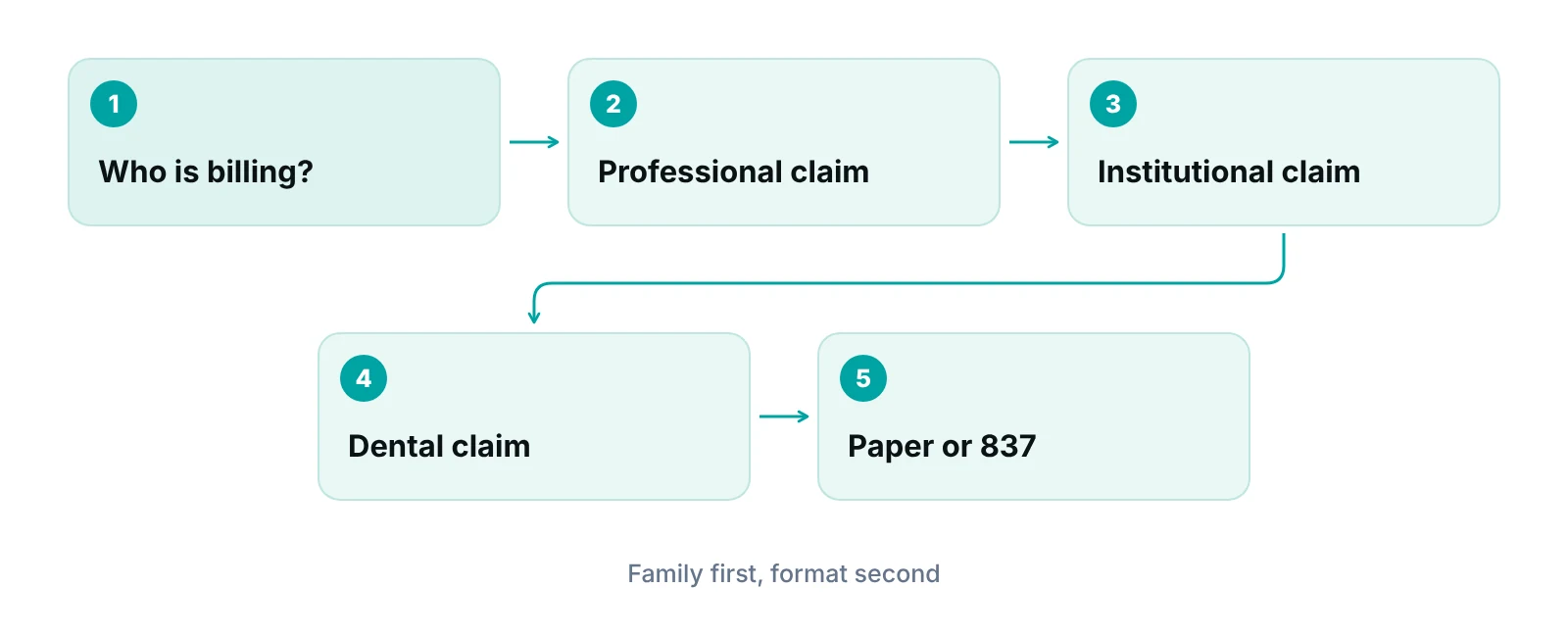
Each family has a paper layout and an electronic file. The electronic file is called an 837, named after the ASC X12 transaction. Federal rules adopt a separate 837 for professional, institutional and dental claims (eCFR, 45 CFR 162.1102). So “CMS-1500 vs UB-04 vs 837” is not really a three-way choice. You pick the billing family first, then paper or electronic.
For almost every practice, electronic is the working method. The paper forms still matter because payers, billers and software use their names and data fields as shorthand, and some claims are still allowed on paper. This page is the hub. It tells you which form applies and where to read the detail. It does not repeat the field-by-field instructions that live in the dedicated guides.
Which claim form applies to your billing?
If a physician, therapist or other practitioner bills, the claim is professional: CMS-1500 on paper or 837P electronically. If a hospital or another facility bills, it is institutional: UB-04 (also called CMS-1450) on paper or 837I electronically. Dental offices use the ADA dental claim form or the 837D.
| Billing family | Who uses it | Paper form | Electronic format |
|---|---|---|---|
| Professional | Physicians, other health care professionals and suppliers | CMS-1500 | 837P (X12 005010X222) |
| Institutional | Hospitals, critical access hospitals, skilled nursing facilities, home health, hospice, FQHCs, rural health clinics, ESRD facilities | UB-04 (CMS-1450) | 837I (X12 005010X223) |
| Dental | Dental offices | ADA Dental Claim Form (2024 version) | 837D (X12 005010X224) |
Source: CMS MLN fact sheets on the 837P/CMS-1500 and 837I/CMS-1450 (CMS); 45 CFR 162.1102 (eCFR); ADA Dental Claim Form page (American Dental Association).
Two dedicated guides go deeper once you know your family. Our CMS-1500 claim form guide covers the professional paper form. Our UB-04 claim form guide covers the institutional one. If you are not sure which side your claims fall on, start with institutional vs professional billing claims.
How does the paper form relate to the 837?
The paper form and the 837 carry the same kind of claim. The 837 is the electronic file. The paper form is the printed layout. CMS says the UB-04 data elements are designed to match the electronic billing specifications so one processing system can handle both, and that contractors may post a crosswalk between the CMS-1450 and the 837I (CMS MLN006926).
The professional side works the same way. The National Uniform Claim Committee developed a crosswalk between the 837P and the hard-copy claim form (CMS MLN006976). On the institutional side, the National Uniform Billing Committee maintains the code lists used on the form, including revenue codes, type of bill and condition codes.
A common myth about the UB-04
Some guides say the UB-04 is the form to use when a claim needs extra paperwork that the electronic version cannot hold. CMS describes it differently: it is the paper form for the same institutional claim the 837I carries. It is not a special route for attachments.
In practice you rarely type an 837. Your practice management system builds the file from the charges and demographics you entered, and many practices send it through a clearinghouse that checks it before the payer sees it. Our guides to EDI in medical billing and clearinghouses for medical claims explain that step.
What does Medicare expect: electronic claims or paper?
Medicare expects electronic claims. CMS states that initial Medicare claims must be submitted electronically unless the provider qualifies for an exception or holds a waiver. Paper is the exception, not a free choice, and a provider is expected to check whether an exception applies.
| Checkpoint | What the source says | Where it comes from |
|---|---|---|
| Electronic filing | Initial Medicare claims must be submitted electronically unless an exception or waiver applies | CMS MLN006976 |
| Small professional practice | Providers with fewer than 10 full-time equivalent employees billing a fee-for-service contractor may be exempt and self-assess | CMS MLN006976 |
| Small institutional provider | Providers with fewer than 25 full-time equivalent employees billing a Medicare Administrative Contractor may file on paper | CMS MLN006926 |
| Dental claims | Listed by a Medicare contractor among the paper exceptions | Noridian Medicare |
| No exception, no waiver | Paper claims are denied; pre-approval is needed through a waiver request | CMS MLN006976; Noridian Medicare |
| Timely filing | The claim is due by the end of the period ending one calendar year after the date of service, with limited extensions | 42 CFR 424.44 |
Source: CMS MLN006976 and MLN006926 (CMS); Noridian Medicare ASCA page; 42 CFR 424.44 (eCFR). Rules checked October 2026; confirm current thresholds with your Medicare contractor.
Commercial and Medicaid payers set their own filing limits and paper rules, usually in your contract or provider manual. They can differ from Medicare’s one-year rule, so read each contract rather than assume one number. Our medical billing time limits guide covers how to track them.
Where do dental claims fit?
Dental offices use the ADA Dental Claim Form on paper and the 837D electronically. The American Dental Association names the 2024 ADA Dental Claim Form as its current version and encourages dentists and payers to use the most current one (American Dental Association). If your office still prints an older version, update the stock and your payer settings.
The 837D is the dental version of the HIPAA claim standard, adopted as X12 005010X224 (eCFR). Dental billing has its own code set and benefit rules, so the medical forms above will not carry over. Our dental billing and coding guide covers that side, and our dental practice billing support page shows how we work with dental offices.
How do you choose between paper and electronic?
Choose electronic unless a documented exception applies or a payer instructs otherwise. The table below turns that into the questions a practice manager asks before changing a billing setup.
| Your situation | Family | Form or format | Check first |
|---|---|---|---|
| Physician or therapist practice billing under its own name | Professional | 837P, or CMS-1500 where paper is allowed | Payer’s paper rule and any ASCA exception |
| Hospital, skilled nursing, home health or hospice | Institutional | 837I, or UB-04 where paper is allowed | Type of bill and revenue code requirements |
| Rural health clinic or FQHC | Institutional | 837I, or UB-04 where paper is allowed | Payer-specific billing instructions |
| Dental office | Dental | 837D, or the 2024 ADA Dental Claim Form | Whether your stock and software use the current version |
| Claims that involve both a physician and a facility | Both | Separate claims by billing party | Our institutional vs professional guide |
Source: CMS MLN006976 and MLN006926 (CMS); ADA Dental Claim Form page (American Dental Association).
Staff often skip the last row. A physician’s services and a facility’s charges are billed by different parties, so they do not belong on one claim. The institutional vs professional claims guide explains the split in detail.
Which mistakes do practices make with claim forms?
The most common mix-ups are about choosing the wrong family, treating paper as the default and confusing the form with the file. Each is easy to prevent once someone owns the check.
- Wrong family. A professional claim sent on an institutional format, or the reverse, is a setup error that repeats on every claim until someone fixes it.
- Paper by habit. For Medicare, paper needs an exception or a waiver. Mailing forms because “we always have” is not a reason payers accept.
- Form and file mixed up. You cannot mail an 837, and you do not key a CMS-1500 into a clearinghouse. The form is a layout; the 837 is the transmission.
- Outdated forms. Forms and code lists get revised. Dental offices in particular should confirm they use the current ADA version.
- Missed filing limits. Medicare allows one calendar year after the date of service, with limited extensions. Other payers vary, so track each one.
- Unchecked data. A correct form with a missing ID or a mismatched date still fails. Our clean claims guide and claim scrubbing guide cover the checks to run before submission.
See what your claim mix is worth
Estimate how much revenue is tied up in claims that need fixing, then compare it to what a cleaner claim process could recover for your practice.
What happens to a claim after you pick the form?
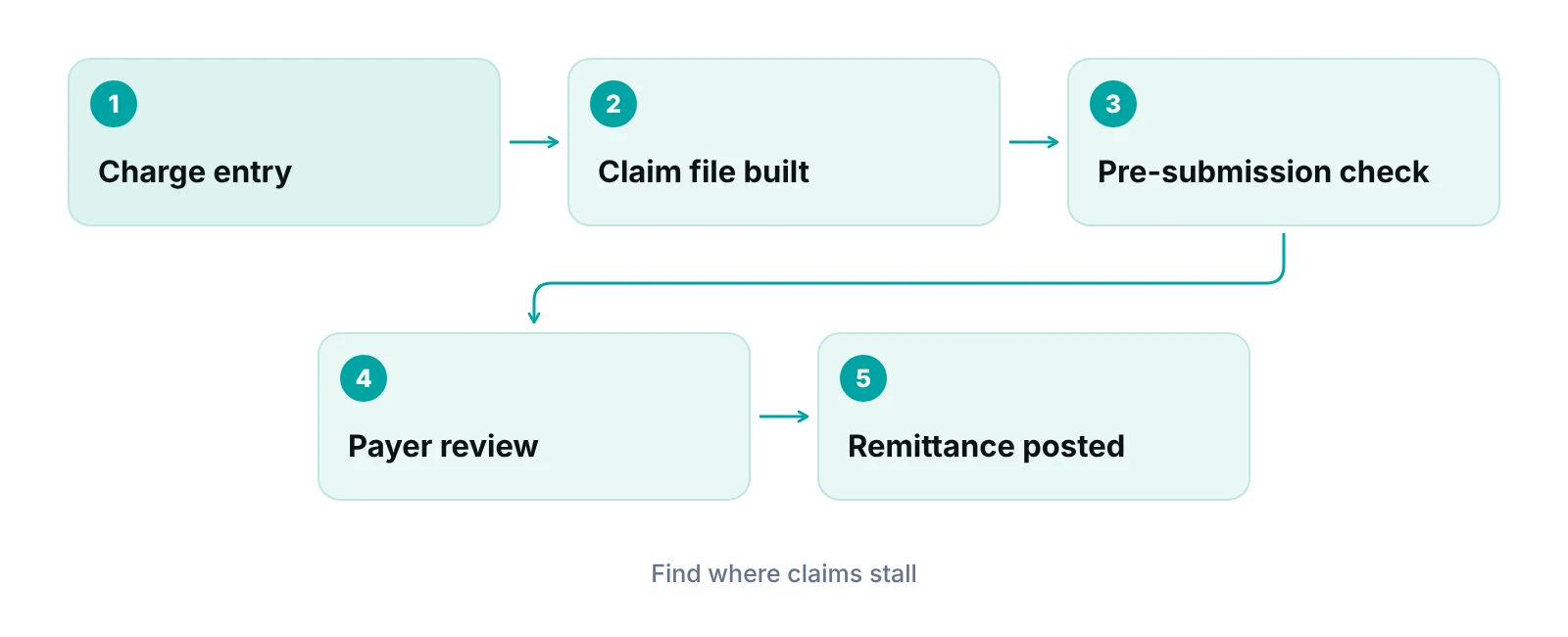
After the form or file is chosen, the claim moves through the same stages: charge entry, claim creation, a pre-submission check, payer review and payment posting. Where it stalls tells you whether the problem is the form, the data or the payer.
The payer’s answer comes back as an electronic remittance advice, which your team posts and reconciles. Our guide to electronic remittance advice shows how to read it.
A tracking system makes the stalls visible. We built a practice management system that tracks claims by stage with an owner on each claim, data-completeness checks before submission and flags when a payment lands below the expected amount. It is claim-centred and is not an EHR.
Our recommendations
- Write down your billing family. We would put one line in the billing procedure: who bills, which family, which format. Most form problems start when nobody can say it in one sentence.
- Default to electronic and document any paper exception. If you file on paper, we would record which exception applies and who confirmed it. That note is what you show a contractor if asked.
- Use the dedicated guide as the field reference. Keep the CMS-1500 or UB-04 guide next to the biller. A hub like this one should not be where staff learn box-by-box rules.
- Keep a filing-limit sheet per payer. We would list each payer’s timely filing limit from the contract in one place, so nobody relies on Medicare’s rule for every payer.
- Check forms and software versions each year. Once a year, we would confirm that stock, templates and software settings match current versions, dental offices especially.
Know where every claim stands before it goes out.
Our practice management system tracks claims by stage with an owner, runs data-completeness checks before submission and flags payments below the expected amount. It is claim-centred, not an EHR.
See how the RCM Finder portal works · Create a portal account
Disclosure: RCM Finder builds and sells this portal. It is a practice management system, not an EHR.
Bottom line
Pick the family first, then the format, then check the payer’s rules. If you want a second pair of eyes on your claim setup, our medical billing services team works inside your existing EHR (for example PrognoCIS, eClinicalWorks or athenahealth). Start with a free practice audit to see where claims stall.
Frequently asked questions
What is the difference between the CMS-1500 and the UB-04?
The CMS-1500 is the paper form for professional claims from physicians and other practitioners. The UB-04, also called CMS-1450, is the paper form for institutional claims from hospitals, skilled nursing facilities, home health agencies and similar providers. Each has an electronic equivalent: the 837P for professional and the 837I for institutional.
Is the 837 a claim form?
The 837 is the electronic claim file rather than a form. It carries the same kind of data as the paper form, in a standard format. Federal rules adopt a professional 837P, an institutional 837I and a dental 837D. You send it through your software or a clearinghouse, not by mail.
Can I still submit paper claims to Medicare?
Only in limited cases. CMS says initial Medicare claims must be submitted electronically unless an exception or waiver applies. One exception covers small providers: fewer than 10 full-time equivalent employees for professional billing, fewer than 25 for institutional. Confirm your status with your Medicare contractor before sending paper.
Which form do dental offices use?
Dental offices use the ADA Dental Claim Form on paper and the 837D electronically. The American Dental Association lists the 2024 ADA Dental Claim Form as current. Older versions may still circulate, so check the version your office prints and what your payers accept.
How long do I have to file a Medicare claim?
Under 42 CFR 424.44, a Medicare claim is due by the end of the period ending one calendar year after the date of service, with limited extensions for specific situations. Other payers set their own limits in contracts, so check each one and track them separately.
Which form should I use if I am not sure?
Start with who is billing. A practitioner or supplier billing for professional services uses the professional family. A hospital or facility uses the institutional family. A dental office uses the dental family. If your claims mix both, our institutional vs professional guide explains the split. Then confirm the payer’s instructions.
Get your free practice audit
Tell us about your practice. We will contact you using the details you give.
- A review of your recent claims, denials and A/R aging
- Where your front desk and prior authorizations slow payment
- A prioritized fix list you keep, whether or not you hire us
Pricing is quoted after the audit, based on your volume and the services you choose. Prefer to talk? Call +1 (302) 556-2288.
Sources
- Medicare Billing: 837P and Form CMS-1500 — Centers for Medicare & Medicaid Services (MLN006976) (2013 (fact sheet; read 2026))
- Medicare Billing: Form CMS-1450 and the 837I — Centers for Medicare & Medicaid Services (MLN006926) (2021 (fact sheet; read 2026))
- 45 CFR 162.1102 Standards for health care claims or equivalent encounter information transactions — eCFR (HHS) (2026)
- 42 CFR 424.44 Time limits for filing claims — eCFR (CMS) (2026)
- Administrative Simplification Compliance Act (ASCA) — Noridian Healthcare Solutions (Medicare Administrative Contractor) (2026)
- ADA Dental Claim Form — American Dental Association (2026)
Disclaimer: This article is educational and is not legal, coding or compliance advice. Form versions, Medicare thresholds and payer rules change and differ by payer, so confirm the current rule with your payer, your Medicare contractor and the official form publisher before you bill.
