
Dog bite ICD-10 codes work in pairs: an injury code for the wound, plus W54.0XXA to show a dog caused it. The injury code (for example S61.451A, open bite of the right hand) carries the clinical detail and severity. W54.0XXA only records the cause. Add infection, place and rabies-related codes when the note supports them.
A dog bite visit looks simple on the schedule and often goes wrong on the claim. The usual mistakes are reporting W54.0XXA alone, picking a code for a different kind of injury, or using the same seventh character for every visit. This guide is for billers, coders and practice managers. It covers how the codes fit together, how injury severity changes the code choice, how rabies exposure and vaccination visits are reported and what to fix before a claim leaves the building. Cat bites follow different cause codes and have their own page: see our cat bite ICD-10 coding guide.
Key takeaways
- W54.0XXA means bitten by a dog. It is a cause code, so it supports an injury code and never replaces one.
- Severity lives in the injury code: open bites, superficial bites, open fractures and amputations are separate code families.
- Code any associated wound infection in addition to the bite wound, as the injury categories instruct.
- The seventh character (A, D, S) follows active treatment, not whether it is the first visit, and the cause code should match the injury code.
- Rabies exposure (Z20.3) and immunization encounters (Z23) are reported only when documented, and a vaccine series can create several dates of service.
Why a dog bite needs two kinds of code
A dog bite claim has an injury code and a cause code, and they do different jobs. The injury code says what happened to the body. The cause code, from the external cause chapter, says that a dog was involved. The old version of this post described W54.0XXA as carrying the body part. It does not. The two X characters are placeholders, and the body part comes from the injury code.
The Chapter 19 injury codes for the forearm carry a note to use Chapter 20 external cause codes to indicate the cause of injury, as shown on the S51.851A code page (FY 2027). W54 is a category of contact-with-dog codes in Chapter 20 (V00-Y99), with three subcategories listed in the FY 2027 code reference on VeroScribe.
| Code family | Meaning | Seventh character options | Use it when the note says |
|---|---|---|---|
| W54.0XXA / D / S | Bitten by dog | A initial, D subsequent, S sequela | A dog bit the patient |
| W54.1XXA / D / S | Struck by dog | A, D, S | A dog knocked into or hit the patient, with no bite described |
| W54.8XXA / D / S | Other contact with dog | A, D, S | Contact with a dog that is neither a bite nor a strike |
Source: VeroScribe ICD-10-CM FY 2027 reference for W54 (accessed October 2026), a secondary mirror of the official code set. Confirm in the FY 2027 Tabular List.
For a bite, W54.0XXA is the cause code. W54.1 and W54.8 matter when the note describes a knockdown or a scratch from a dog without a bite. That is a documentation question, so the coder should read the note rather than default to W54.0.
What W54.0XXA is not
It is not the diagnosis, it does not say which body part was hurt and it says nothing about severity. A claim that lists only W54.0XXA tells the payer a dog was involved and nothing about what was treated.
How common dog bite visits are
The latest national figures this post could confirm are old, so treat them as scale, not as a current rate. A CDC MMWR report (2003) estimated 368,245 nonfatal dog bite injuries treated in U.S. emergency departments in 2001. The same report cites an estimate of 4.7 million dog bites in 1994, with about 799,700 people needing medical care.
Two cautions follow. The emergency department number leaves out care in offices and urgent care centers, which the CDC report says it does not capture. And an earlier version of this page showed a year-by-year table for 2020 to 2022 with no source. That table has been removed. If your practice needs a current local volume, count your own encounters instead.
Choosing the injury code: severity decides the family
Pick the injury code that matches what the provider documented about depth and structures involved. An open bite breaks the skin and sits in an open-bite subcategory for the body site. A superficial bite is coded elsewhere. A bite that also breaks a bone or removes a part belongs with fracture or amputation codes.
| What the note documents | Code family to look at | Verified example or rule | Watch for |
|---|---|---|---|
| Bite that breaks the skin on the right hand | S61.45- open bite of hand | S61.451A, open bite of right hand, initial encounter | Do not use for superficial bites, which are excluded from S61.45 |
| Bite that breaks the skin on the right forearm | S51.85- open bite of forearm | S51.851A, open bite of right forearm, initial encounter | Forearm and wrist/hand are different categories; S51 excludes open wounds of the wrist and hand |
| Surface bite, skin not broken | Superficial bite codes (S60.56-, S60.57- for hand; S50.86, S50.87 for forearm) | Listed as Excludes1 under the open-bite subcategories | Only choose superficial when the provider documents it |
| Bite with an open fracture | Fracture codes, such as S62.- with an open-fracture seventh character for the wrist and hand | Open fracture of wrist, hand and finger is an Excludes1 at S61 | The fracture and bite wound may need separate injury codes; follow the Tabular instructions |
| Bite with traumatic amputation | S68.- (wrist and hand) or S58.- (elbow and forearm) | Traumatic amputation is an Excludes1 at S61 and S51 | Query the provider if the note is unclear about loss of tissue |
| Bite wound that has become infected | Code also any associated wound infection | Instruction appears under S61 and S51 | Infection is an added code, not a replacement for the bite code |
Source: AAPC code page for S61.451A and icd-10codes.com page for S51.851A, both FY 2027 mirrors (accessed October 2026). Confirm notes and codes in the FY 2027 Tabular List.
The codes above were checked for the hand and forearm only. Other sites, such as the face, scalp, leg or trunk, have their own open-bite and superficial-bite subcategories, and the left side has its own sixth character. Look each site up in the Tabular List rather than adapting a hand or forearm code. An earlier version of this post listed an unspecified forearm injury code as a bite code; that was removed because an unspecified injury is not a bite.
“The injury code tells the payer what was treated. The cause code only explains why. Never let the second stand in for the first.”
When the note says only “dog bite to the arm,” the coder cannot tell hand from forearm, open from superficial or infected from clean. That is a provider query, not a guess. Ask for the site, whether the skin was broken, whether anything deeper was involved and whether infection is present.
Infection, multiple wounds and associated injuries
Add a code for a wound infection when the provider documents one. Both the hand and forearm injury categories carry a note to code also any associated wound infection (S61 on the AAPC page, S51 on the icd-10codes.com page). The infection code is chosen from the infection itself, and the bite code stays on the claim.
Dog bites often leave more than one wound. If a provider documents wounds on different sites, report the site-specific code for each. Check the Tabular List for the injury category at each site, because the instructional notes (Excludes1 and Excludes2) differ between categories. A simple example is the pair above: S51 excludes open wounds of the wrist and hand, which belong to S61.
Do not stack codes to be safe
An Excludes1 note means the two codes should not be reported together. Check the note before adding a second injury code for the same area, and let the documentation decide which one applies.
The seventh character: A, D and S
The seventh character follows the stage of care, not whether it is the patient’s first visit. An AAPC article by Debra Mitchell, MSPH, CPC-H, explains that “A” is used while the patient is receiving active treatment, “D” after active treatment has ended and the patient is in routine healing or recovery care, and “S” for a late effect, such as a scar.
- A (initial): the emergency visit, an urgent care visit and a surgeon’s first visit for repair can all be “A” if each involves active treatment. See the AAPC explainer on initial, subsequent and sequela encounters.
- D (subsequent): routine follow-up during healing, such as a wound check or suture removal once active treatment is over.
- S (sequela): a condition that results from the injury, such as a scar. Code the late effect first, then the injury with S, according to the Tabular instructions.
The cause code carries a seventh character too. The California inpatient reporting manual, a state example, says the external cause code’s seventh character must match the associated injury code. In practice, a claim with S61.451A and W54.0XXD has a mismatch that a scrubber can catch.
Our guide to follow-up ICD-10 codes explains how to handle D encounters across other injuries.
Putting the codes in order on the claim
List the injury code first, then the dog bite cause code, then the place of occurrence when it is documented. The reason is simple: the injury explains why the visit happened, and the cause code adds context. The California manual states that the external cause that resulted in the injury is listed first among external causes, and that a place of occurrence code is reported when the principal cause code does not specify the place. W54.0XXA does not say where the bite happened, so a place code (Y92 family) fits when the home, park or street is documented.
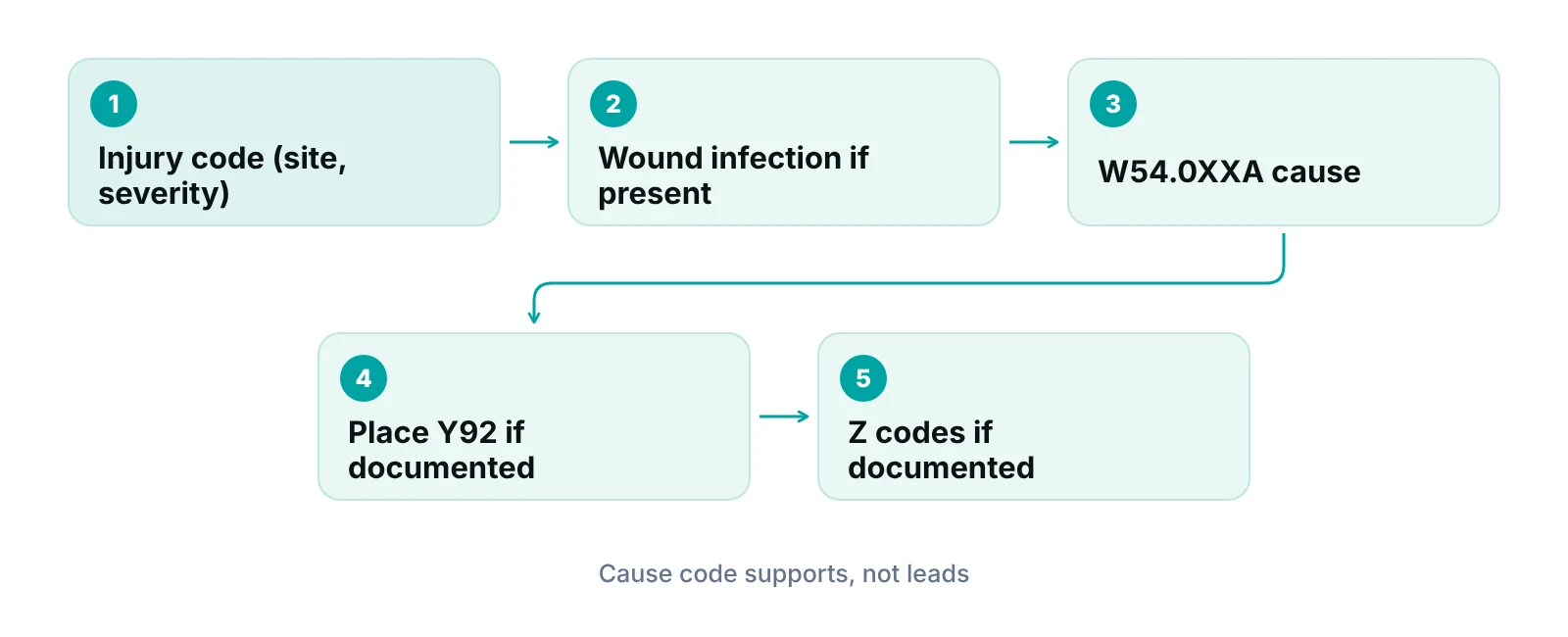
Whether external cause codes are mandatory depends on the payer and state. The California manual says its cause codes “shall be coded,” which is a state data rule, not a national one. Many payers accept them without requiring them. Check each payer’s policy, and consider a standing practice of adding W54.0XXA anyway: it gives the payer, and your own denial reports, a clean reason for the injury. The same logic applies to other injuries; see how the fall injury cause codes are sequenced.
Rabies-related coding and vaccine visits
Rabies exposure and rabies vaccination are reported with Z codes, not with the W54 code. Z20.3 is described as contact with and (suspected) exposure to rabies, according to the FY 2027 code page for Z20.3. Category Z20 excludes a diagnosed current infectious disease, so Z20.3 does not apply once the provider has diagnosed an infection.
Z23 is the category for encounter for immunization, as shown in the VeroScribe Z20-Z29 listing. A visit where the patient comes only for a vaccine dose is the typical use. A procedure code for the vaccine and its administration is billed separately and is outside this post. Check your payer’s coverage rules for rabies vaccine and immune globulin, as these are high-cost items.
The clinical schedule matters to billing because it creates repeat dates of service. Guidance from the North Carolina Department of Health and Human Services (August 2026), adapted from the Rhode Island Department of Health, describes this pattern for a person never vaccinated: immediate wound irrigation, human rabies immune globulin (HRIG) on day 0, and vaccine on days 0, 3, 7 and 14, with a fifth dose on day 28 for immunocompromised patients. Previously vaccinated patients get two booster doses, on days 0 and 3. Whether post-exposure treatment is needed is a clinical decision; coders only need the record to show it.
| Situation in the note | Code to consider | Source for the descriptor | Documentation to look for |
|---|---|---|---|
| Possible exposure, no disease diagnosed | Z20.3 contact with and (suspected) exposure to rabies | icd-10codes.com FY 2027 | Provider notes the rabies exposure concern or evaluation |
| Visit is for a vaccine dose | Z23 encounter for immunization (category) | VeroScribe FY 2027 | Vaccine given, lot and site recorded |
| Rabies infection diagnosed | Use the Alphabetic Index; Z20 does not apply to a diagnosed infection | icd-10codes.com Z20 Excludes1 | Provider’s diagnosis, not a suspicion |
| Return visits for the vaccine series | Same logic for each date of service | NC DHHS (2026) | A tracked schedule so no dose is missed or billed twice |
Source: icd-10codes.com Z20.3 page, VeroScribe Z20-Z29 listing and NC DHHS rabies PEP guidance (accessed October 2026). Confirm in the FY 2027 Tabular List and the Official Guidelines.
Tracking a multi-day series is an A/R and compliance task as much as a clinical one. Missed doses lose the patient and delayed claims lose the payment. The accounts receivable guide explains how to follow open balances across visits like these.
Where dog bite claims show up in a practice
Dog bites are seen in emergency departments, urgent care centers, primary care offices and wound care or surgical clinics. Urgent care is the setting where coding gaps most often hit revenue because the visit is short and the note may be thin. If your clinic fits that profile, the urgent care billing and RCM page and the urgent care billing mistakes guide are good next reads. Emergency departments should also read about medical billing for emergency services.
Wound repair, tetanus status, antibiotics and photographs are part of the clinical record, and the coder should pull the codes from the provider’s documentation. For the clinical side of wound care, our overview of wound care types is a good companion.
Some dog bite cases involve a liability claim, a workers’ compensation claim (for example a mail carrier on duty) or a home or auto policy. Payer order matters in those cases: ask who is responsible before billing health insurance. Our workers’ compensation revenue cycle guide covers that side.
Common denial and error risks
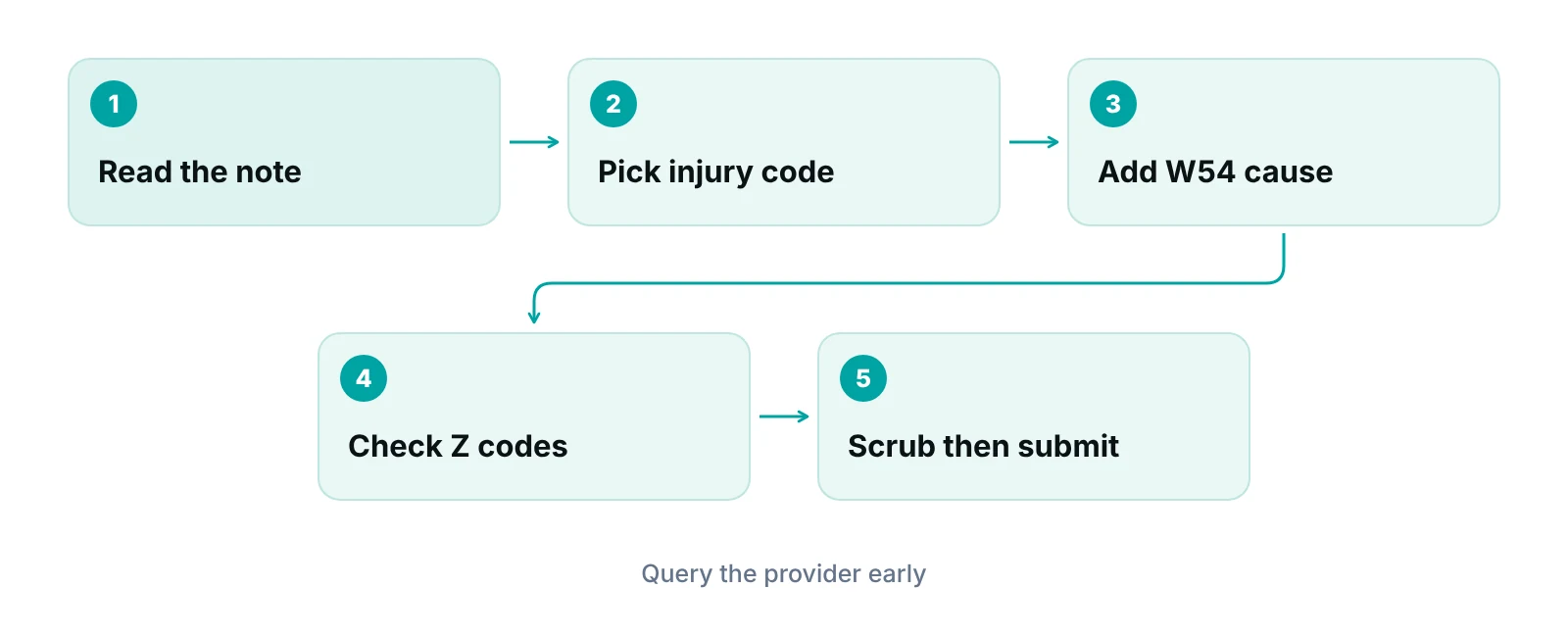
- Cause code only: W54.0XXA submitted without an injury code.
- Wrong site or type: a superficial bite coded as open, or a code from the wrong body-site category.
- Seventh character mismatch: A on the injury and D on the cause code, or the reverse.
- Missing infection code: an infected wound reported with the bite code alone.
- Stale code set: using a previous fiscal year’s file after the October 1 update.
- No payer check: billing health insurance when another party is responsible.
Most of these are caught by a pre-submission check, and the rest by a denial review. Our denial management guide and the guide to the pitfalls of inaccurate coding go further on how to read and prevent them.
Want a second pair of eyes on your injury coding?
Request a free practice audit and we will look at where coding gaps and claim errors may be slowing payment.
Our recommendations
- Make the injury code mandatory. Set a scrubber rule that stops any claim with W54 codes and no Chapter 19 injury code.
- Build a dog bite intake template. Prompt for the site, whether the skin is broken, depth, infection, where it happened and whether the dog is known. A short template cuts provider queries.
- Teach the seventh character by stage of care. Train staff that A, D and S follow active treatment, healing and late effects, not first and second visits.
- Match injury and cause characters. Add a check that the seventh character on W54 matches the injury code on the same claim.
- Track the vaccine series. If your site gives rabies vaccine doses, keep a dated schedule so each visit is coded and billed once.
- Confirm responsibility before billing. Ask whether a liability, workers’ compensation or other policy applies before sending the claim to health insurance.
- Refresh code files every October. The ICD-10-CM code set changes on October 1; update your encoder and review common bite codes each time.
Bottom line
Dog bite coding comes down to a few habits: pick the injury code that matches the documented site and severity, add W54.0XXA as the cause, code infection and rabies-related encounters only when documented and match the seventh character across codes. If your team wants help with that routine, see our medical billing and coding support and denial management services, or talk to us.
Frequently asked questions
What is the ICD-10 code for a dog bite?
W54.0XXA is the external cause code for bitten by a dog, initial encounter. It is never the only code. The injury code, such as S61.451A for an open bite of the right hand, goes with it and explains what was treated. Pick the injury code from the site and severity in the note.
What does the X mean in W54.0XXA?
The X characters are placeholders that fill the fifth and sixth positions so the seventh character can sit in the correct place. They do not stand for a body part. In W54.0XXA, the final A is the seventh character and shows the encounter stage. The body part comes from the injury code.
Should W54.0XXA be listed first on the claim?
List the injury code first, then W54.0XXA. The cause code adds context to an injury and does not name the problem treated. The Chapter 19 injury categories also instruct users to add Chapter 20 external cause codes for the cause of injury. Check payer policy for required fields.
Is there a different code for open and superficial dog bites?
Yes. Open bites are coded in subcategories such as S61.45- for the hand and S51.85- for the forearm. Superficial bites are in separate codes, listed as exclusions under the open-bite subcategories. Use open only when the provider documents that the skin was broken.
How do I code a rabies shot after a dog bite?
Z23, encounter for immunization, is the category for a visit made for a vaccine. Z20.3, contact with and suspected exposure to rabies, may apply when exposure is documented and no disease is diagnosed. Vaccine and immune globulin procedure codes are billed separately; check your payer’s rules.
Does the seventh character change at follow-up?
Yes, when care moves from active treatment to routine healing. A is used during active treatment, D for subsequent care and S for late effects. The cause code should carry the same seventh character as the injury code. A wound check after repair is usually D.
Get your free practice audit
Tell us about your practice. We will contact you using the details you give.
- A review of your recent claims, denials and A/R aging
- Where your front desk and prior authorizations slow payment
- A prioritized fix list you keep, whether or not you hire us
Pricing is quoted after the audit, based on your volume and the services you choose. Prefer to talk? Call +1 (302) 556-2288.
Sources
- Nonfatal Dog Bite-Related Injuries Treated in Hospital Emergency Departments, United States, 2001 — CDC (MMWR) (2003)
- ICD-10-CM W54 Contact with dog (FY 2027) — VeroScribe (2026)
- S61.451A Open bite of right hand, initial encounter — AAPC Codify (2026)
- S51.851A Open bite of right forearm, initial encounter — icd-10codes.com (2026)
- Z20.3 Contact with and (suspected) exposure to rabies — icd-10codes.com (2026)
- ICD-10-CM Z20-Z29 listing (FY 2027) — VeroScribe (2026)
- California Inpatient Data Reporting Manual, 8th edition, External Causes of Morbidity (Section 97227) — California OSHPD (HCAI) (2020)
- Initial, Subsequent, or Sequela Encounter? — AAPC (n.d.)
- Rabies Post-Exposure Prophylaxis (PEP) Guidance — North Carolina DHHS, adapted from Rhode Island Department of Health (2026)
Disclaimer: This article is educational and is not legal, coding, clinical or compliance advice. Code descriptors and reporting rules change each fiscal year and vary by payer and state; confirm against the current ICD-10-CM files, the Official Guidelines and your payer policies before billing.