

A radiology CPT code lookup works best in four steps: identify the modality and body area, match contrast and view count to the code descriptor, remove anything the code already includes, then add modifiers. Medicare's NCCI Chapter 9 sets the bundling limits; the AMA CPT book holds the exact descriptors.
Most code lists are arranged by number. A coder holding a finished study works the other way: what was done, to which body area, with what contrast, and how many views or units. This page follows that order. The selection rules come from the NCCI Policy Manual, Chapter 9 (rev. 1/1/2026). For how the 70000 series is grouped, and for modifiers 26 and TC and the bundling rules in our radiology CPT codes guide, see the linked guide. CPT descriptors belong to the American Medical Association, so the codes below are paired with short summaries in our own words. Confirm the exact descriptor in the current CPT book before you bill.
Key takeaways
- Look up a radiology code by study type first, then by body area, contrast, number of views and units.
- Contrast, views and some body areas have separate codes. Pick the one that matches what was documented, not the one that pays more.
- Several services report once per encounter or once per imaging session, including needle-guidance codes and brain or orbit MRI.
- Contrast, completion fluoroscopy, ECG monitoring on cardiac CT and PET glucose checks are included in the main code.
- Medicare’s manual is the baseline. Check the payer’s policy and the current CPT book before you finalize a code.
How to look up a radiology CPT code
Start from the report, not from a code list. The report tells you the modality, the body area, whether contrast was given, how many views or series were obtained and whether a needle or other procedure was guided. Each of those facts narrows the choice. A code list only helps after you have them.
- Modality and body area. X-ray, CT, MRI, ultrasound, mammography, bone density, nuclear medicine or radiation oncology, then the region studied.
- Contrast. The NCCI manual notes that some studies can be done without contrast, with contrast, or with and without, and each has its own code (section C.4). Match the report.
- Views, areas or units. Some descriptors set a minimum number of views. Others allow one code per session or one unit per encounter.
- Bundled items. Strip out anything the main code already includes, such as contrast administration or completion fluoroscopy.
- Component and modifiers. Decide global, professional (26) or technical (TC), then add any needed modifier.
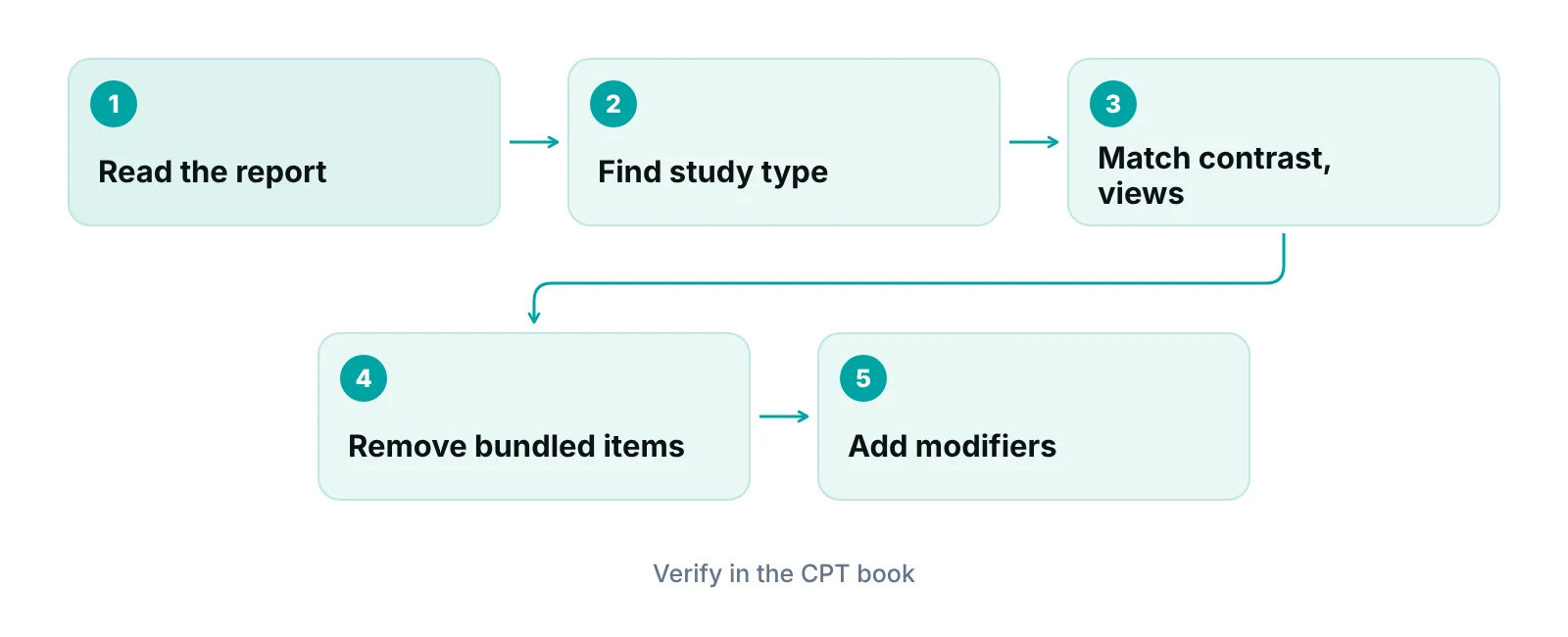
Step 5 is covered in depth elsewhere. If you need the rules for splitting a study between the professional and technical component, read modifiers 26 and TC and the bundling rules in our radiology CPT codes guide. This page stays on steps 1 to 4.
Diagnostic imaging lookup: X-ray, MRI, cardiac CT and ultrasound
The table below lists the imaging codes and ranges the NCCI Policy Manual, Chapter 9 uses as examples, with the selection rule attached to each. It is a starting point for the most common study types, not a complete code list.
| Study | Codes the manual names | How to choose | Manual section |
|---|---|---|---|
| Shoulder X-ray | 73020, 73030 | Report the one code that fits the total number of views. Three views is 73030 once, not 73020 plus 73030. | C.2 |
| Spine X-ray | 72020 to 72120; 72081 to 72084 (entire spine) | If an entire-spine study and regional spine views are done at one encounter, sum the views and report one entire-spine code. Do not add a regional code. | C.17 |
| Myelography | 72240 to 72270 | CT of the spine with intrathecal contrast is not reported with myelography unless both are medically necessary. | C.14 |
| MRI | 70540 to 70543, 70551 to 70553 | One code per imaging session, whether one, two or three areas are examined. Brain and orbit MRI are separate only if distinct, necessary studies. | H.17, H.18 |
| Cardiac CT | 75571 to 75574 | ECG monitoring is included if performed. Do not add 93000 to 93010 or 93040 to 93042. | D.10 |
| Abdominal and retroperitoneal ultrasound | 76700 to 76775 | A limited study is not reported in place of the complete retroperitoneal ultrasound, 76770, for urinary tract symptoms. | C.7, C.13 |
| Ultrasound or duplex of the same area | 76700 to 76775 with 93975, 93976 | Normally different clinical scenarios. If both are necessary, the ultrasound code takes an NCCI-associated modifier. | H.13 |
Source: CMS, Medicare NCCI Policy Manual, Chapter 9 (rev. 1/1/2026), sections C, D and H. Study labels and summaries are our own wording.
Two patterns show up in this table. First, a code that describes the total service already includes extra views, so you pick one code and stop. Second, some rules limit how often a code can be reported: one MRI code per session is the clearest example. Both rules protect against unbundling, which payers screen for automatically.
A note on repeat films and extra views
The manual says the code describing the total service should be reported (C.1), and that repeat films taken because of poor quality count as one unit of the same code. A retake is a quality issue, not a second billable study. If the report shows added views that were clinically needed, move to the code whose descriptor covers the full set, rather than adding a second line.
For a broader view of how procedure codes are built and maintained, see our guide to how CPT codes work in medical billing and the explainer on HCPCS vs CPT, since some imaging services, such as peripheral bone density, are reported with HCPCS codes.
Mammography, bone density, guidance, PET and radiation oncology
These study types carry the most specific reporting rules. A code picked from a general list often fails here because the rule depends on the date, the encounter or the equipment, not only on the descriptor.
| Area | Codes the manual names | How to choose | Manual section |
|---|---|---|---|
| Mammography, screening tomosynthesis | 77063, 77065 to 77067 | 77063 is an add-on for screening digital tomosynthesis. Since 2018 it may be reported with 77067. A post-procedure mammogram is not added to a mammographic-guided breast procedure at the same encounter. | C.15, D.11 |
| Same-day screening and diagnostic mammography | 77065 to 77067 | Report the diagnostic code with modifier GG and the screening code with modifier 59 or XU. | C.16 |
| Bone density | 77078, 77080, 77081, 76977, G0130 | Axial studies use 77078 or 77080, and only one axial study can be reported on the same date. Peripheral studies use 77081, 76977 or G0130. | H.15 |
| Needle-placement imaging guidance | 76942, 77002, 77003, 77012, 77021 | One unit per patient encounter, however many placements, lesions or injections. Not reported separately when the main procedure already includes guidance. | G.3, H.12 |
| PET/CT | 78811 to 78816 | When a concurrent CT is used for attenuation correction and localization, report 78814 to 78816, not 78811 to 78813. | E.14, H.14 |
| Radiation oncology planning and devices | 77261 to 77295, 77301, 77332 to 77334 | IMRT planning, 77301, includes many treatment devices. Devices 77332 to 77334 are generally for external beam treatment. | F.2, F.11 |
| Continuing physics consultation | 77336 | Report per week of therapy, generally after every five treatments. It is edited against planning codes 77261 to 77295. | F.2 |
Source: CMS, Medicare NCCI Policy Manual, Chapter 9 (rev. 1/1/2026), sections C, D, E, F, G and H. Summaries are our own wording.
Two cautions apply to this group. Guidance codes and a diagnostic ultrasound of a different anatomic region on the same date can both be reported (H.8), but guidance in the same region as the procedure it supports is usually part of that procedure. And PET rules depend on how the CT was acquired: a separately obtained, medically necessary diagnostic CT can be reported with an NCCI-associated modifier in defined situations, while a co-registered CT on the same integrated system cannot.
If your radiology practices also run mammography or bone density programs, set those up as separate charge-master families. Their same-day and per-date rules differ from general imaging, and a shared template tends to miss them.
Choosing between look-alike codes
Most code selection errors come from choosing between two neighbouring codes. The table lists the questions that settle the choice, using rules the NCCI manual states directly.
| If the question is | Choose | Why |
|---|---|---|
| Was contrast given? | The without, with, or with-and-without version that matches the report | Each combination has a separate code. Contrast administration and vascular access are not billed on top (C.4, D.1). |
| Was it one study or several? | One total-service code, not a stack of partial codes | The code describing the total service is the one to report (C.1). |
| Was the whole spine imaged? | An entire-spine code with views summed | Regional spine codes are not added when entire-spine views are reported (C.17). |
| Was the scan a screening or a diagnostic mammogram? | The code for the study performed, with GG or 59/XU if both were done the same day | Medicare requires GG on the diagnostic code in that case (C.16). |
| Did the PET have a concurrent CT for attenuation and localization? | 78814 to 78816 | The combined codes replace 78811 to 78813 and the localization CT is not reported separately (E.14). |
| Did a needle or injection need imaging guidance? | One unit of the guidance code, unless the main procedure includes it | Guidance is one unit per encounter and often integral (G.3, H.12). |
| Was 3D rendering done to map biopsy or needle sites? | No separate 3D rendering code | 76376 and 76377 are not reported for mapping multiple biopsy or needle-placement sites (D.15). |
Source: CMS, Medicare NCCI Policy Manual, Chapter 9 (rev. 1/1/2026), sections C, D, E, G and H. Paraphrased.
“The report decides the code. If the documentation does not support a detail, the claim line should not carry it.”
3D rendering deserves its own caution. The manual states it is not separately reportable with nuclear medicine procedures 78012 to 78999, with a narrow exception when it is done with a third, non-nuclear procedure that supports it, reported with modifier 59 or XS (E.4). Treat any 3D rendering line on an imaging claim as one to review.
When two related services are genuinely distinct, a modifier may be justified. Our modifier 59 guide explains how to document that, and why using it only to get past an edit invites audits.
What the main code already includes
Many denials come from adding a line for something that is part of the main service. The NCCI manual lists several such inclusions.
- Contrast and access: contrast administration and vascular access are integral to the imaging procedure (D.1).
- Completion fluoroscopy: fluoroscopy needed to finish a radiologic procedure and produce the permanent record is included (C.5), and 76000 is integral to many spinal, endoscopic and injection procedures (D.8).
- Cardiac CT monitoring: ECG monitoring during 75571 to 75574 is included if performed (D.10).
- PET glucose check: the finger-stick blood glucose is included in PET procedures, so 82948 and 82962 are not billed for it (E.7).
- Localization CT in PET/CT: the CT for attenuation correction and localization is part of 78814 to 78816 (E.14).
Check for deleted codes each January
The 2026 NCCI chapter states that CPT 77014 and HCPCS G6001 were deleted on January 1, 2026 (section F). If your charge master or a saved template still carries either one, review it against the current AMA code set and the payer’s instructions for what replaces it. Annual deletions and additions are why a lookup tool or old code sheet should never be treated as final.
The manual also has a section on medically unlikely edits, which cap the units a code can report per service date. Those limits are published separately from the policy text, so check the current MUE table for any code you bill in volume.
How to verify a code before the claim goes out
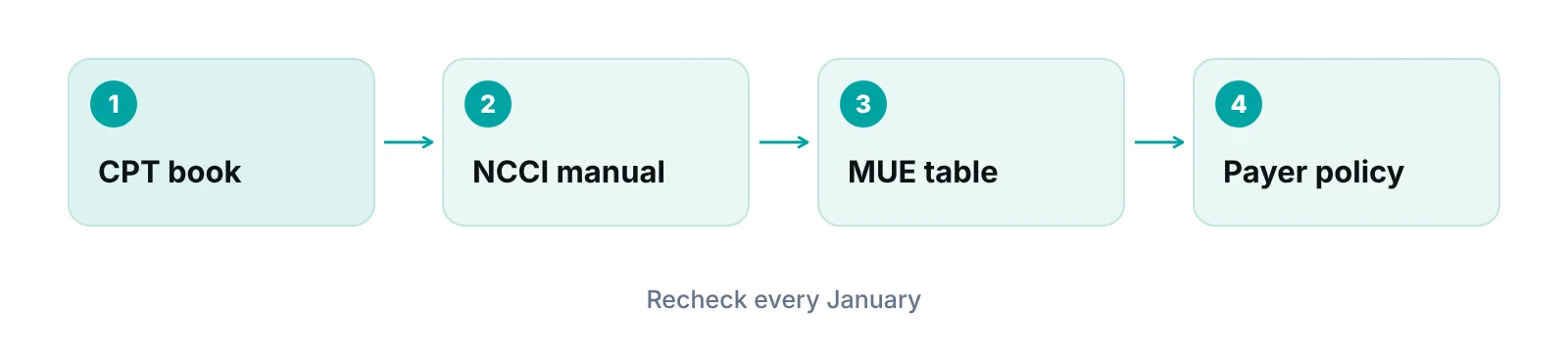
Even a careful lookup can drift from the current rules, because the CPT code set and the NCCI manual are both revised each year. A short routine keeps the lookup accurate.
- Confirm the descriptor in the current AMA CPT book or licensed coding software.
- Check the code against the current NCCI Chapter 9 and the MUE table.
- Match the diagnosis to the study, and check payer policy and authorization rules for advanced imaging.
- Decide the component (global, 26 or TC) and add modifiers only where documentation supports them.
- Run the claim through an edit check before submission, and group any rejections by reason.
Prior authorization is a separate gate for many CT, MRI and PET orders. Our prior authorization guide covers the process, and the clean claim checklist and claim scrubbing guide show how to catch coding errors at the edit step. For the operational side of imaging billing, see radiology billing services and the post on the challenges of radiology medical billing. If your team would rather hand off code selection, our medical billing and coding support covers charge entry and coding review.
Have a coder check your imaging code selection
A free practice audit reviews how your radiology claims are coded, which lines are bundled, and where denials start.
Our recommendations
- Build the lookup into the charge master by study type. Group imaging charges by modality and body area, with the contrast and view variants side by side, so a coder picks from a short, relevant list.
- Store the selection rule next to the code. For each high-volume code, note the unit limit, the included items and the section of the NCCI manual it comes from, so a new coder does not have to rediscover it.
- Require the report to name contrast, views and areas. Ask radiologists to state contrast use, the number of views or areas and any guidance in the report. Those facts pick the code.
- Block bundled lines in the scrubber. Add edits for contrast administration, completion fluoroscopy, ECG monitoring on cardiac CT and 3D rendering on mapped biopsies.
- Review mammography and PET claims as their own family. Same-day screening and diagnostic mammograms, and PET with concurrent CT, have specific modifier and code rules.
- Re-verify every January. After the CPT and NCCI updates, compare your imaging charge lines to the new code set and remove deleted codes before the first claim of the year.
Bottom line
A radiology CPT code lookup is a short chain of decisions: study type, contrast, views or units, bundled items, then component and modifiers. Work the chain from the report, and use the AMA CPT book and Medicare’s NCCI manual to confirm the final code. If imaging denials are costing your radiology practice revenue, send the hard cases to a coder. Our denial management team can review denied claims, and a free practice audit is the place to start.
Frequently asked questions
How do I find the right CPT code for a radiology study?
Start with the report: modality, body area, contrast, number of views and any guidance. Then match those facts to the descriptor in the current AMA CPT book. Check the NCCI Chapter 9 manual for bundling and unit limits before you finalize the line.
Do CT and MRI have separate codes for contrast?
Yes for many studies. The NCCI manual notes that a study can be performed without contrast, with contrast, or with and without contrast, and that each combination has a separate code. Choose the one that matches the report, and do not bill contrast administration separately.
How many MRI codes can I report in one session?
For the MRI codes the manual lists (70540 to 70543 and 70551 to 70553), only one code may be reported for an imaging session, whether one, two or three areas are evaluated. Brain and orbit MRI are separately reportable only if both are necessary and performed as distinct studies.
What is the difference between 78811 to 78813 and 78814 to 78816?
The manual says that when a concurrent CT is used for attenuation correction and anatomical localization, report 78814 to 78816 rather than 78811 to 78813. The localization CT is not reported separately. Confirm the exact descriptors in the current CPT book.
Can I bill ultrasound guidance with a needle procedure?
Sometimes. Guidance codes 76942, 77002, 77003, 77012 and 77021 allow one unit per patient encounter, and are not reported separately when the main procedure already includes guidance. A diagnostic ultrasound of a different anatomic region on the same date can be reported alongside guidance.
Where can I find the full list of radiology CPT codes?
The complete list and official descriptors are in the AMA’s CPT book, which the AMA owns and updates each year. CMS publishes the NCCI policy manual and edit files that show how codes can be combined. Use both, since a code can exist yet still be bundled.
Get your free practice audit
Tell us about your practice. We will contact you using the details you give.
- A review of your recent claims, denials and A/R aging
- Where your front desk and prior authorizations slow payment
- A prioritized fix list you keep, whether or not you hire us
Pricing is quoted after the audit, based on your volume and the services you choose. Prefer to talk? Call +1 (302) 556-2288.
Sources
- Medicare NCCI Policy Manual, Chapter IX: Radiology Services (CPT 70000-79999) — CMS (2026 (rev. 1/1/2026; accessed 2026-10-15))
Disclaimer: This article is educational and is not legal, coding, billing or compliance advice. CPT is a trademark of the American Medical Association, and the code descriptions here are our own summaries. Payer rules and contracts vary, and CMS updates its manuals each year. Check the current CPT book, CMS and payer sources before you bill.
