
The ICD-10 code for weight loss that a provider documents as abnormal is R63.4, Abnormal weight loss. It is a symptom code, so it fits while the cause is still being worked up. Underweight is R63.6, BMI codes in Z68 are secondary only, and obesity sits in E66.
Most weight-loss claim problems start with one of two things: a symptom code with no workup behind it, or a code that does not match what the note says. This guide sets out what the official code set says about R63.4 and its neighbors, using the FY 2027 ICD-10-CM guidelines and the tabular list. It is written for billing and coding staff, not for patients, and it gives no clinical or diet advice.
Key takeaways
- R63.4 is titled Abnormal weight loss and is a symptom code with no Excludes notes of its own.
- R63.6 Underweight and R64 Cachexia both carry an Excludes1 note for R63.4, so they do not pair with it.
- Z68 BMI codes are reported only as secondary diagnoses, and the associated diagnosis must come from the patient’s provider.
- A symptom code is acceptable when no definitive diagnosis is established, but payers expect the note to show what was assessed.
- When the note and the code disagree, send a provider query before the claim goes out.
What is the ICD-10 code for weight loss?
The code is R63.4, titled “Abnormal weight loss” in the ICD-10-CM tabular list. It sits in category R63, “Symptoms and signs concerning food and fluid intake,” in the chapter for symptoms and signs. The tabular list shows no inclusion terms and no Excludes notes under R63.4 itself.
Two words in the title matter. “Abnormal” tells the coder this code is for weight loss the provider treats as a finding, not for a change the patient is aiming for. And because it is a symptom code, the guidelines treat it as a stand-in until a cause is named. Section I.B.4 says codes that describe symptoms and signs are acceptable for reporting, and Section I.B.18 says sign and symptom codes can be reported when a definitive diagnosis has not been established by the end of the encounter.
The same guidelines draw the other boundary. Section I.B.5 says signs and symptoms routinely associated with a disease process should not be coded in addition to it, and Section I.B.6 says symptoms not routinely associated with it should be coded when present. In practice, once a provider documents a diagnosis that explains the weight loss, the symptom usually drops off the claim. Whether a given weight loss is “routinely associated” with a condition is a provider and coding-policy call, so send a query rather than assume.
Code assignment follows the provider’s words
Section I.A.19 says code assignment is based on the provider’s diagnostic statement, not on the clinical criteria the provider used. Coders do not decide that a weight change is abnormal. The note has to say so.
Which related codes sit around R63.4?
Several codes describe a patient’s weight, and they answer different questions. Some report a symptom, some report a measured BMI, and some report a diagnosis. The table lines them up with the notes that matter on a claim.
| Code | Title in the code set | Note that affects the claim | When it fits |
|---|---|---|---|
| R63.4 | Abnormal weight loss | No Excludes notes listed | Provider documents abnormal weight loss and no definitive cause yet |
| R63.6 | Underweight | Use additional code for BMI (Z68.-), if known; Excludes1: R63.4, anorexia nervosa (F50.0-), malnutrition (E40-E46) | Provider documents the patient as underweight, not a loss over time |
| R64 | Cachexia | Excludes1: R63.4, cachexia due to underlying condition (E88.A), nutritional marasmus (E41) | Provider documents cachexia; do not add R63.4 |
| R62.51 | Failure to thrive (child) | Inclusion terms: failure to gain weight, faltering growth | Provider documents failure to thrive in a child |
| R62.7 | Adult failure to thrive | No notes listed | Provider documents adult failure to thrive |
| E66.- | Overweight and obesity | Add a BMI code, if known (Z68.1-Z68.45 adult, Z68.5- pediatric) | Provider documents overweight or obesity |
| Z68.- | Body mass index [BMI] | Reported only as a secondary diagnosis | BMI is recorded and an associated diagnosis is documented |
| Z71.3 | Dietary counseling and surveillance | Use additional code for any associated underlying condition and for BMI, if known | The encounter documents dietary counseling |
Source: ICD-10-CM tabular list (R-chapter and E65-E68 editions as fetched), FY 2027 code pages for E66.81, Z68 and Z71.3, FY 2027 ICD-10-CM Official Guidelines (2026). Titles are the code set’s wording.
Two rows carry a correction from the older version of this post. Cachexia due to an underlying condition belongs to E88.A, and R64 has an Excludes1 note for it. And R63.6 is not a synonym for weight loss. It describes the patient’s state, and its Excludes1 note names R63.4, so the two are not reported together.
Why does a symptom code need a documented workup?
Because a symptom code tells the payer the cause is unknown, and the payer then looks for evidence that someone is finding out. The official guidelines allow R63.4 to be reported. They do not promise that a payer will pay for tests or visits on a code alone. That second step is medical necessity, and it is set by each payer’s policy.
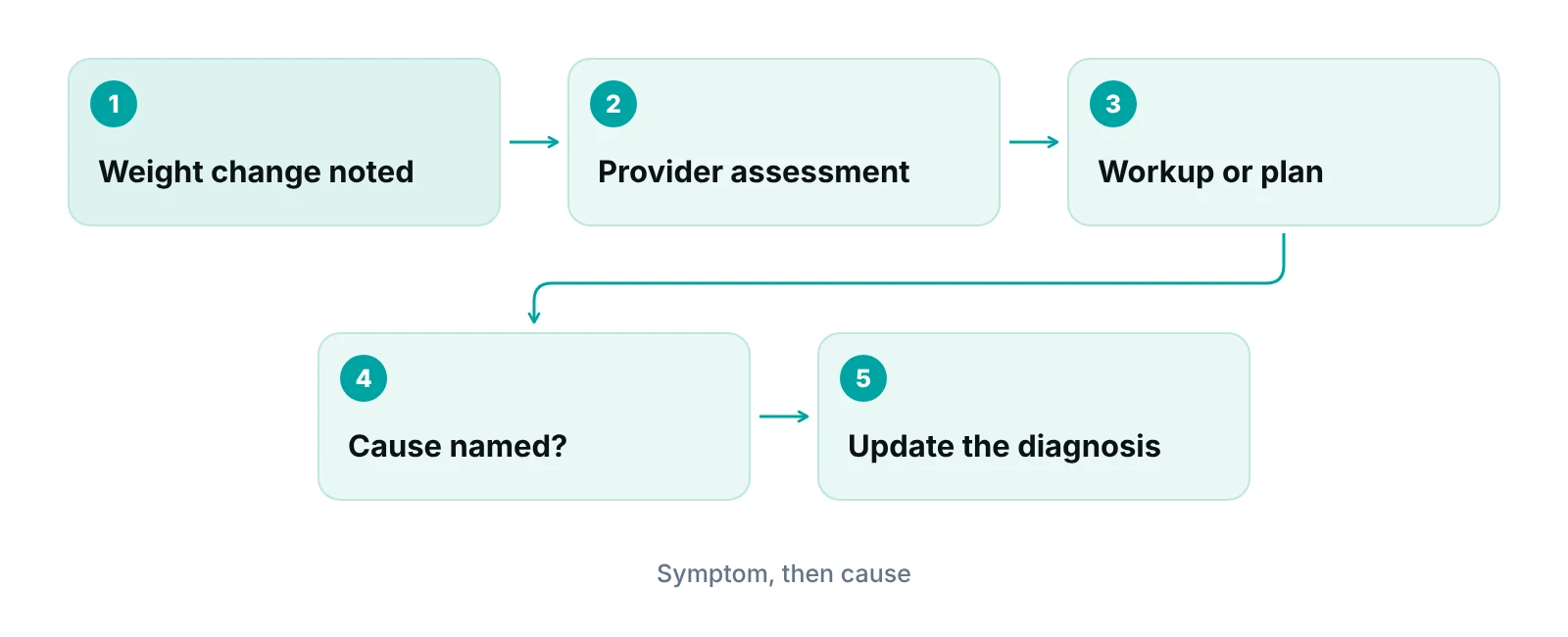
A note that supports R63.4 usually shows the same thread from the first line to the last: the weight change, the provider’s assessment, and a plan. The elements below are a practical checklist, not an official rule. They help a reviewer see that the diagnosis on the claim matches the story in the chart.
- The change itself: a stated starting weight, a current weight and the time between them, not just the current weight.
- The provider’s wording: the note calls the loss abnormal, unintentional or unexplained, in words a coder can quote.
- The assessment: what the provider evaluated, such as history, exam findings or tests ordered, and what they concluded.
- The plan: follow-up, referral or further testing, so the code is not repeated visit after visit with no next step.
- The update: a new diagnosis replaces the symptom once the cause is established.
“A symptom code is a placeholder for a question. The chart should show that someone is working on the answer.”
The same logic explains repeat use. If R63.4 appears on every visit and the note never changes, a reviewer can fairly ask whether the code still reflects the problem being managed. Rather than quote a threshold, we recommend running your own report of how often each symptom code is billed by provider and reading a sample of charts. Our guide to clear documentation in medical billing covers why the note is the foundation for the claim.
How do Z68 BMI and E66 obesity codes fit in?
They describe weight status, not weight change. E66 reports a diagnosis of overweight or obesity, and Z68 reports the BMI number. Neither one replaces R63.4 when the provider documents abnormal weight loss, and neither belongs on a claim without the documentation behind it.
E66: the diagnosis
E66 is titled “Overweight and obesity.” The category includes E66.3 for overweight, E66.9 for obesity unspecified, and a class-based group, E66.81, with E66.811, E66.812 and E66.813 for obesity class 1, 2 and 3, per the FY 2027 code page and the tabular index. Check your coder’s code reference to see when the class codes entered the set; this post does not state that date. The category instructs the coder to add a BMI code, if known.
Z68: the BMI, secondary only
Z68 is titled “Body mass index [BMI].” The code page says adult BMI codes apply to people 20 or older and pediatric codes to ages 2 to 19. The guidelines, in Section I.B.14, allow clinicians other than the provider to document BMI, but the associated diagnosis, such as overweight or obesity, must be documented by the patient’s provider. The same section says BMI codes should only be reported as secondary diagnoses. A claim that leads with Z68 is reporting a measurement, not a reason for the visit.
R63.6: underweight, not weight loss
R63.6 carries a “use additional code” note for Z68, so an underweight diagnosis with a recorded BMI takes both. Its Excludes1 note lists R63.4, anorexia nervosa (F50.0-) and malnutrition (E40-E46). For eating-disorder and mental health coding more broadly, see our ICD-10 mental health codes guide.
| What the note says | Codes to look at | Check before you submit |
|---|---|---|
| Patient lost weight without trying; evaluation under way | R63.4 | Is the change and the assessment documented? Is a diagnosis still missing? |
| Patient is underweight; BMI recorded | R63.6, then Z68.1 for adult BMI 19.9 or less | R63.6 excludes R63.4; confirm the provider documented the underweight diagnosis |
| Provider diagnoses obesity; BMI recorded | E66.- (class codes where documented), then Z68.- | The provider, not a nurse or dietitian, must document the obesity |
| Provider documents cachexia due to a known condition | E88.A and the underlying condition | R64 excludes E88.A; do not add R63.4 |
| Child is not gaining weight | R62.51 where the provider documents failure to thrive | Do not guess; query if the note says only “poor weight gain” |
Source: ICD-10-CM tabular list; FY 2027 ICD-10-CM Official Guidelines, Section I.B.14 (2026). Row choices follow the tabular notes quoted above, not payer policy.
What if the weight change is intended?
Then R63.4 usually does not describe the visit. The title says “abnormal,” and a note that describes a planned change with no concern attached does not read as a symptom. Which code fits depends on what the provider documents the visit was for.
If the encounter includes dietary counseling, Z71.3 is titled “Dietary counseling and surveillance.” Its notes say to use an additional code for any associated underlying medical condition and for BMI, if known, per the FY 2027 code page. That pairing is why a counseling visit for a patient with obesity commonly shows an E66 code too. We do not give a rule about which code comes first, because sequencing depends on the reason for the encounter in the note and on the payer.
Payer coverage for weight-management services, including newer medications, varies and has been changing. This post does not describe any payer’s policy. Check each payer’s current coverage and documentation rules before you build billing rules around them. Our explainer on how CPT, ICD-10 and HCPCS codes differ is a useful reference for the claim as a whole.
Do not choose a code to fit coverage
Picking a diagnosis because it is more likely to be paid, when the note does not support it, is a compliance problem. If the documented diagnosis does not meet a payer’s policy, the answer is a provider query or a patient-responsibility conversation, not a different code.
What claim checks catch weight-loss coding errors?
Most errors are visible before submission if the claim is checked against the note. The table below lists mismatches that can be built into a scrubber or a pre-bill review, and the question to ask for each.
| Mismatch | Why it matters | Action |
|---|---|---|
| R63.4 and R63.6 on the same claim | R63.6 has an Excludes1 note for R63.4 | Remove one after reading the note; query if unclear |
| R63.4 and R64 on the same claim | R64 has an Excludes1 note for R63.4 | Keep the code the provider’s wording supports |
| R63.4 with a note showing weight gain or a stable weight | Code and chart disagree | Query the provider to correct the note or the code |
| Z68 as the first-listed diagnosis | Guidelines say BMI is reported only as a secondary diagnosis | Add the provider’s associated diagnosis and resequence |
| Z68 with no provider-documented weight diagnosis | The associated diagnosis must come from the patient’s provider | Hold the claim and query |
| R63.4 repeated with no change in the note | The symptom may have a diagnosis by now | Review a chart sample; update the diagnosis where the provider has named a cause |
Source: ICD-10-CM tabular list; FY 2027 ICD-10-CM Official Guidelines, Sections I.B.14 and I.B.18 (2026). The last row is a review suggestion, not an official rule.
When a payer denies a claim on a weight-loss diagnosis, read the denial reason before touching the code. A diagnosis mismatch, a missing documentation request and a medical-necessity denial each call for a different response. Our denial management guide explains how to sort denials by cause, and coding audit basics explains how to review a chart sample.
Specialty matters too. Internal medicine practices see weight change as a presenting problem more often than most, and internal medicine billing and coding support is a good place to see how workup-driven visits are handled. Related symptom codes follow the same logic, as in our posts on ICD-10 weakness codes and chest pain coding.
If denials on symptom codes are a pattern in your practice, medical billing services with coding support can review the codes against your notes and payer edits.
Want a second set of eyes on your diagnosis coding?
A free practice audit looks at where diagnosis coding, edits and denials may be costing your practice time and revenue.
Our recommendations
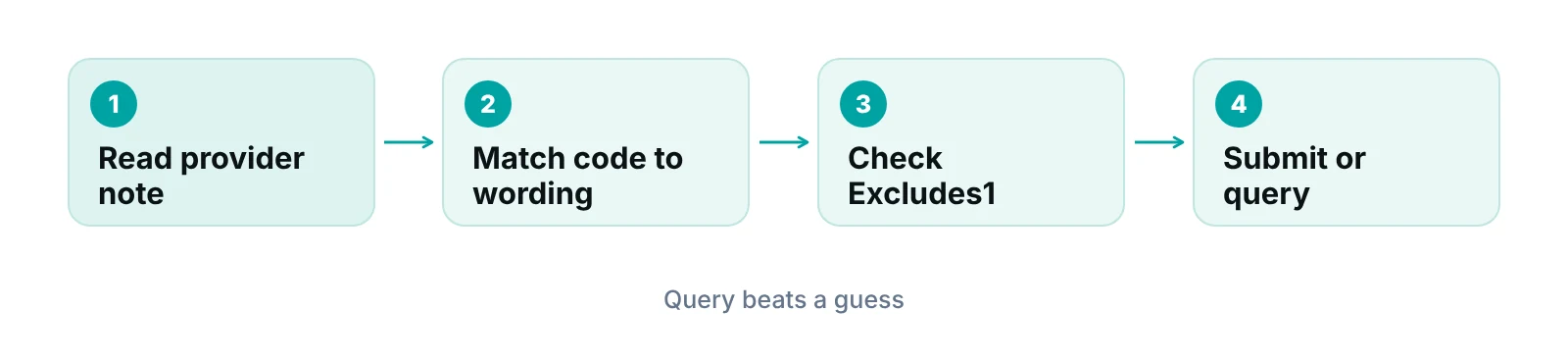
- Make the provider’s wording the source of the code. We recommend that coders quote the documented phrase (for example, abnormal or unintentional weight loss) before assigning R63.4, and query when the note says only that the patient weighs less.
- Build the Excludes1 pairs into your scrubber. Add rules that flag R63.4 with R63.6 or R64, and Z68 as a first-listed diagnosis. These come directly from the tabular list and the guidelines.
- Review symptom-code frequency by provider. Run a periodic report of symptom codes by provider and read a chart sample. Look for repeat use with no assessment or plan, and for favorites lists that make one symptom code a default.
- Replace the symptom when the cause is documented. When a provider names a diagnosis that explains the weight loss, update the claim. Check Sections I.B.5 and I.B.6 for when the symptom is still reported.
- Keep payer policy separate from code selection. Check each payer’s coverage rules for tests and weight-management services, but never pick a diagnosis to fit coverage. Query the provider if the documented diagnosis does not meet policy.
- Use the current-year code set. ICD-10-CM changes each October 1. Confirm any code you hard-code in a template against the version in force on the date of service.
Bottom line
R63.4 is the ICD-10 code for abnormal weight loss, but it is only as strong as the note behind it. R63.6, R64, Z68 and E66 each describe something different and follow their own notes. If symptom-code denials keep recurring, our denial management services can trace them to the note, the code or the payer rule.
Frequently asked questions
What is the ICD-10 code for unintentional weight loss?
R63.4, Abnormal weight loss, is the code for weight loss the provider documents as abnormal. The tabular list has no separate code titled “unintentional weight loss.” Report it when the note supports it and no definitive cause is established, and update the diagnosis once the provider names one. If the note only says the patient weighs less, ask the provider to state whether the loss is abnormal before you assign it.
Can R63.4 and R63.6 be on the same claim?
No. The tabular list gives R63.6 Underweight an Excludes1 note for R63.4, Abnormal weight loss. Read the provider’s wording to decide which one the note supports: a documented loss over time points to R63.4, a documented underweight state points to R63.6. Query the provider if the note is unclear.
Is a BMI code enough to bill on its own?
No. Z68 BMI codes are reported only as secondary diagnoses, and the associated diagnosis, such as overweight or obesity, must be documented by the patient’s provider. Other clinicians may document the BMI itself under Section I.B.14.
Which code reports obesity?
Obesity is reported with the E66 category, titled Overweight and obesity. It includes E66.9 for obesity unspecified and E66.811, E66.812 and E66.813 for obesity class 1, 2 and 3. The category says to add a BMI code if known. Check your code reference for the current set.
Does R63.4 mean a claim will be paid?
No. The code set says R63.4 can be reported, but payment depends on each payer’s medical necessity policy and on the note supporting the service. A documented assessment and plan make the symptom code easier to defend, and an appeal or records request goes better when the chart already tells that story.
Does Z71.3 replace R63.4 for a patient with planned weight change?
Not as a rule. Z71.3 reports dietary counseling and surveillance, and it asks for an additional code for any underlying condition. Which codes fit depends on what the provider documents the visit was for. Query the provider when the note is unclear.
Get your free practice audit
Tell us about your practice. We will contact you using the details you give.
- A review of your recent claims, denials and A/R aging
- Where your front desk and prior authorizations slow payment
- A prioritized fix list you keep, whether or not you hire us
Pricing is quoted after the audit, based on your volume and the services you choose. Prefer to talk? Call +1 (302) 556-2288.
Sources
- ICD-10-CM Official Guidelines for Coding and Reporting FY 2027 — CDC / NCHS (2026)
- ICD-10-CM tabular list, R-chapter (Skyscape-hosted ed25 edition) — Skyscape (hosts ICD-10-CM tabular data) (2025)
- ICD-10-CM tabular, Overweight, obesity and other hyperalimentation (E65-E68) — Skyscape (hosts ICD-10-CM tabular data) (2025)
- E66.81 Obesity class (FY 2027 page) — icd-10codes.com (secondary) (2026)
- Z68 Body mass index [BMI] (FY 2027 page) — icd-10codes.com (secondary) (2026)
- Z71.3 Dietary counseling and surveillance (FY 2027 page) — icd-10codes.com (secondary) (2026)
- ICD-10 codes (FY 2027 files) — CMS (2026)
Disclaimer: This article is educational and is not legal, coding, billing, clinical or compliance advice. ICD-10-CM code sets and guidelines are updated each October, and payer policies vary. Verify current requirements against the official code set, your payers and qualified counsel before you act. It does not give medical or weight-management advice.