
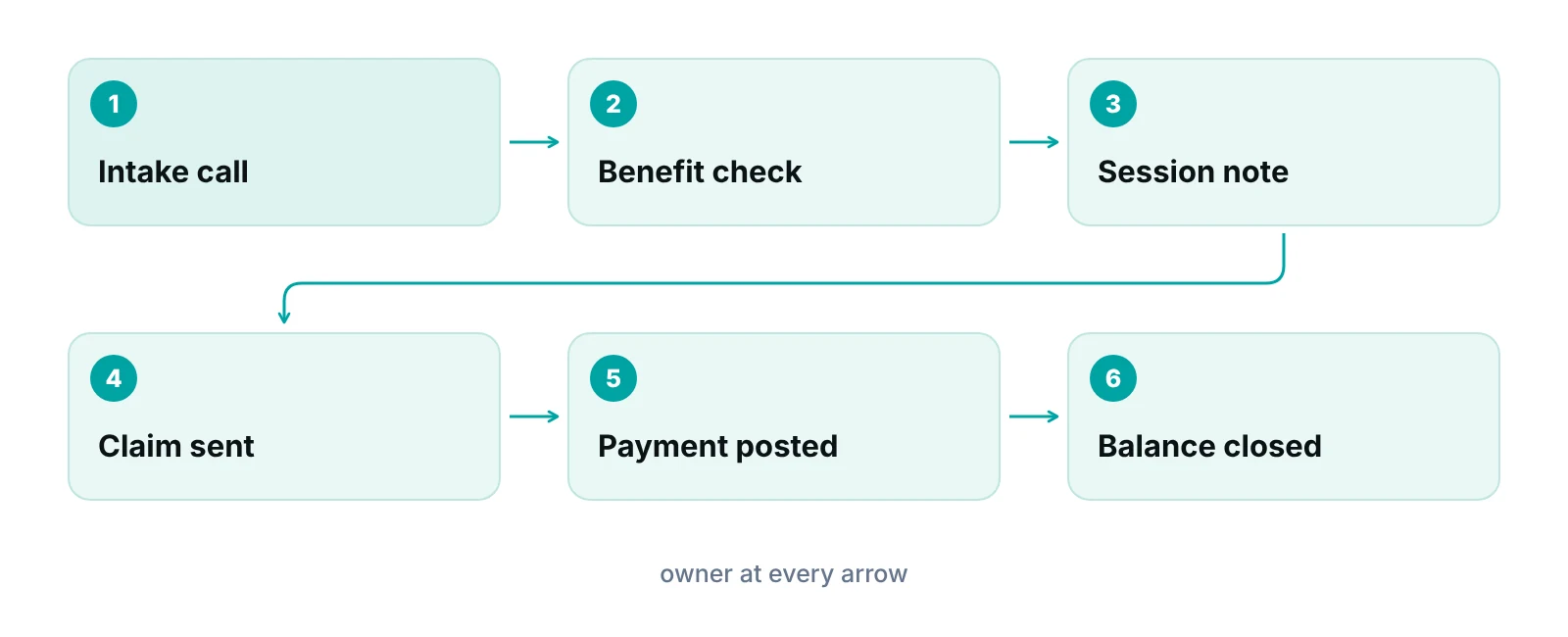
Behavioral health revenue cycle management covers every step from the first intake call to the final payment: eligibility, authorization, session documentation, coding, claims, denials and patient balances. Revenue is usually lost between steps rather than inside one, so each handoff needs a named owner and a simple check.
A new client calls on Monday. The front desk books a first session, the clinician sees the client on Thursday, and three weeks later the claim comes back because the plan was inactive. Nobody made a bad decision. The handoff between booking and benefit checking simply had no owner.
This guide is for owners and managers of therapy, psychiatry and substance use practices. It follows the whole cycle in order and links to deeper posts on each stage, including the behavioral health billing partner guide, the eligibility verification post and the registration and billing post. Patients reach the front of the cycle through behavioral health marketing, digital channels and local search, and the software behind it is covered in the practice management software guide.
Key takeaways
- The cycle has eight stages. Most revenue is lost at the handoffs between them, not inside a single stage.
- Session time is a billing fact. Medicare contractors expect the record to show it, and psychotherapy notes kept apart from the chart cannot be the only place it lives.
- Medicare claims must be filed within one calendar year of the date of service, and a redetermination request is due 120 days after the remittance.
- Self-pay and uninsured clients have their own rule: a good faith estimate on a set schedule.
- A monthly review of a few numbers finds problems while they are still cheap to fix.
What does behavioral health revenue cycle management include?
It includes every task that turns a booked session into collected money. The ordinary RCM stages apply, but behavioral practices add recurring weekly visits, time-based codes, strict privacy rules and frequent self-pay, which change where problems appear.
The table lists eight stages, where revenue usually leaks and a check that closes the gap.
| Stage | What happens | Where revenue leaks | Control to add |
|---|---|---|---|
| 1. Intake and registration | Demographics, insurance card, consents, first appointment | Wrong subscriber data; missing consent forms | Two-person check of card and ID at booking |
| 2. Eligibility and authorization | Benefits, visit limits, authorization rules | Inactive coverage; visit caps found late | Verify before the first visit and again on a set schedule |
| 3. Session and documentation | Therapy delivered, note signed | Missing session time; unsigned notes | Time field required before sign-off |
| 4. Coding and charge entry | Code chosen from documented minutes | Code above the documented time | Compare minutes with the code band before release |
| 5. Claim submission | Data checks, scrub, send | Rejections for demographic or format errors | Pre-submission completeness check |
| 6. Payment posting and denials | Remittance posted, denials worked | Denials left unworked past the appeal date | Denial worklist with deadline dates |
| 7. Patient balance | Copay, deductible, self-pay, late-cancel fees | Balances not collected at the visit | Collect at check-in; send a clear statement |
| 8. Reporting | Monthly numbers reviewed | Problems noticed months late | Fixed monthly review with an owner |
Source: RCM Finder summary of a general revenue cycle; the control column is a workflow suggestion, not a payer rule.
How should the front end of the cycle work?
The front end should confirm who the client is, what the plan covers and what the client will owe, before the first session. Errors made here are the cheapest to prevent and the most expensive to find after a denial.
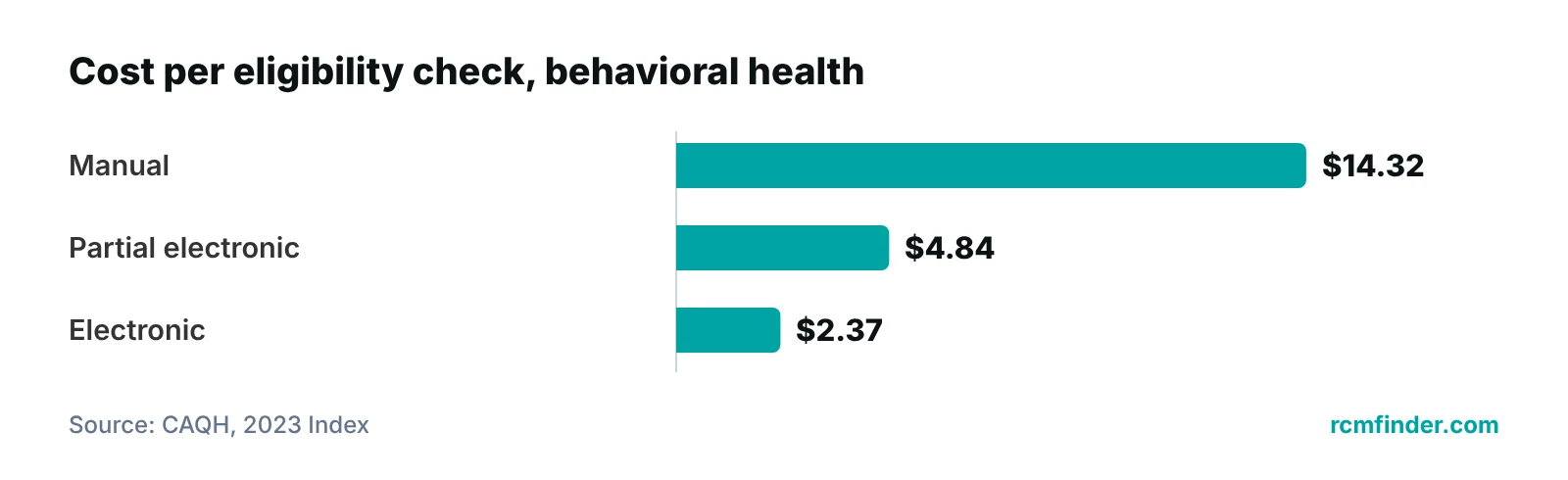
Eligibility is the clearest example. The CAQH Index, an annual industry study, reported for 2023 that a manual eligibility and benefit verification costs a behavioral health provider $14.32 per transaction, against $2.37 when fully electronic (CAQH, 2023).
Two habits matter for behavioral practices. Ask about visit limits and authorization rules at the start, because therapy repeats weekly. Then re-verify on a schedule instead of once.
Federal parity law shapes what plans may do, at headline level. The Mental Health Parity and Addiction Equity Act generally bars group plans and insurers from imposing financial requirements or treatment limits on mental health and substance use benefits that are more restrictive than those on medical and surgical benefits. It does not require a plan to cover those benefits, and plans using non-quantitative limits must document comparative analyses for regulators (CMS). Federal agencies released new final rules on September 9, 2024; confirm their current status before relying on them.
The step-by-step benefit-check work is in the eligibility verification post linked above.
How do self-pay and uninsured clients fit into the cycle?
They need a good faith estimate on a fixed schedule. Many therapy practices see self-pay clients, so this is a routine billing step.
A CMS document on the patient-provider dispute process says the estimate applies to uninsured or self-pay individuals, including people who choose not to use insurance for an item or service. Enrollees in federal health care programs such as Medicare and Medicaid are not eligible for one. If the service is scheduled at least 3 business days ahead, the estimate is due no later than 1 business day after scheduling. If it is scheduled at least 10 business days ahead, or the person asks for cost information, it is due within 3 business days (CMS). A bill at least $400 above the estimate for a provider can open the dispute process.
Open question for a series of visits
The CMS document does not explain how an estimate works for open-ended weekly therapy. Ask counsel how to document an estimate for a recurring course of care.
Why do documentation and coding decide the revenue?
Psychotherapy codes depend on minutes, and the record must prove the minutes. A Medicare contractor lists 90832 at 16 to 37 minutes, 90834 at 38 to 52 minutes and 90837 at 53 minutes or longer, and says not to report psychotherapy for any session under 16 minutes. The same page says the record must show the length of the encounter and that CERT data flagged missing face-to-face time (First Coast Service Options, page dated August 6, 2026).
The audit evidence is stark. The HHS Office of Inspector General reviewed Medicare psychotherapy payments from March 2020 to February 2021. Of 216 sampled enrollee days, 128 did not meet Medicare requirements, and OIG estimated $580 million of roughly $1 billion in payments was improper. Failures included psychotherapy time that was not documented and missing provider signatures (HHS OIG, report A-09-21-03021, May 2023).
One behavioral-specific trap: HHS describes psychotherapy notes as notes kept separate from the rest of the record, and says they exclude items such as session times, medication monitoring and diagnosis summaries (HHS OCR). Session time therefore belongs in the regular chart, where billing staff can see it, not only in separate notes.
| Topic | What the source says | Source |
|---|---|---|
| Psychotherapy time bands | 90832 is 16 to 37 minutes, 90834 is 38 to 52, 90837 is 53 or more; none under 16 | First Coast Service Options (2026) |
| One unit per code | Claims with more than one unit of these codes are denied outside partial hospitalization (POS 52), effective July 1, 2022 | First Coast Service Options (2026) |
| Medicare timely filing | Claims are untimely when received more than one calendar year after the service; the denial is not appealable | CMS transmittal 12909 (October 2024) |
| Redetermination deadline | 120 days from receipt of the remittance advice; receipt presumed 5 days after the notice date | CMS MLN006562 (September 2025) |
| Good faith estimate | 1 or 3 business days after scheduling, depending on lead time; not for federal program enrollees | CMS (CCIIO) document |
| Substance use records (Part 2) | Compliance date February 16, 2026; counseling notes need a separate, specific consent | HHS fact sheet (2024 final rule) |
Source: First Coast Service Options (2026); CMS (2024, 2025); HHS (2024). Commercial payers set their own limits.
Code-level detail is in the mental health CPT codes guide.
What happens after the claim leaves the practice?
The claim must be accurate, on time and followed through. Each of those has a hard edge for Medicare, and commercial payers set their own.
On timing, Medicare requires claims to be filed within 12 months of the date of service. A CMS transmittal effective November 26, 2024 states that a claim is untimely when received more than one calendar year after the service, and that the untimely-filing denial is not an initial determination, so it cannot be appealed. The listed exceptions are narrow, such as an administrative error by Medicare or retroactive entitlement (CMS transmittal 12909). A contractor page adds that exceptions are limited and very specific (First Coast).
On appeals, a Medicare Learning Network guide dated September 2025 says the first level, a redetermination, must be requested within 120 days of receiving the remittance advice (CMS MLN006562). A denial worklist with dates on each line keeps that deadline visible.
Enrollment is part of this stage. Honigman, a law firm, reported that marriage and family therapists and mental health counselors became eligible to enroll in Medicare Part B on January 1, 2024, through Form CMS-855I, with a two-year supervised experience requirement (Honigman, January 2024). A clinician who is not enrolled cannot bill, whatever the schedule shows.
Denial work is covered in the medical billing denial management post.
How do no-shows, telehealth and privacy rules affect revenue?
They change how many billable sessions happen and how they must be recorded. Behavioral practices feel all three more than most.
No-shows
A 2024 systematic review in Health Science Reports looked at open-access scheduling and found no-show rates that varied widely, from 12% to 42% in some studies. One study found rates of about 8%, 16% and 22% for lead times of 0 to 3, 4 to 6 and 28 to 30 days. The studies were mostly in family medicine and pediatrics, not behavioral health, and mostly before-and-after designs, so treat them as a pointer (Mazaheri Habibi et al., 2024). A written late-cancel policy and reminders are practical responses.
Telehealth
Telehealth rules for Medicare behavioral health have moved repeatedly. The American Psychiatric Association noted in January 2026 that, unless Congress acted, an in-person visit would be required before home-based behavioral telehealth after January 30, 2026 (APA, January 2026). Penn State’s rural health office reported in February 2026 that the Consolidated Appropriations Act, 2026 extended the flexibilities through December 31, 2027, including delaying that requirement (Penn State Office of Rural Health).
Privacy at the billing desk
HHS states that the Privacy Rule applies the same protections to most mental health information, with psychotherapy notes as the main exception, and that state law may be stricter. Practices treating substance use disorders also face 42 CFR Part 2. HHS’s fact sheet on the 2024 final rule says covered persons must comply by February 16, 2026, that a single consent can cover future treatment, payment and operations uses, and that counseling notes need a separate consent (HHS). Billing staff should know which records carry those limits.
Who should own each stage: staff, remote assistants or a billing partner?
There is no single right split. Many practices keep clinical work in-house, support front-end tasks with remote staff and hand claims follow-through to a billing partner.
| Stage | Often kept in-house | Can be supported by remote front-desk staff | Often handed to a billing partner |
|---|---|---|---|
| Intake calls and forms | Clinical screening, consent discussion | Call handling, form collection, scheduling | Not usual |
| Eligibility and authorization | Final decision on coverage questions | Benefit checks and authorization requests | Sometimes, with the practice approving |
| Documentation and coding review | Clinician notes and sign-off | Reminder follow-up on unsigned notes | Coding review and audits |
| Claims and payment posting | Oversight and exceptions | Status checks | Submission, posting, follow-up |
| Denials and appeals | Clinical letters | Gathering records | Worklist, appeals, deadlines |
| Patient balances | Policy decisions | Reminders and payment plans | Statements and collections follow-up |
Source: RCM Finder summary of common ownership models; the right split depends on the practice.
RCM Finder’s Virtual Medical Assistant service provides remote front-desk staff for scheduling, eligibility checks, prior authorizations and intake, working in the practice’s time zone. The end-to-end RCM service covers claims through payment, and the behavioral and mental health RCM operations page shows how both fit a therapy practice.
See where the cycle leaks
A free practice audit reviews how a practice moves from intake to payment and where the handoffs lack an owner. Pricing is quoted after the audit.
Which numbers should be reviewed each month?
A short list reviewed on a fixed day beats a long dashboard that nobody opens. Five measures cover most of the cycle.
- Share of first visits verified before the session.
- Claims rejected or denied, grouped by cause.
- Sessions with a signed note and a recorded time.
- Open claims past 30, 60 and 90 days, and the oldest unworked item.
- Patient balances older than 60 days and the no-show count.
Benchmarks vary by payer mix, so compare a practice with its own earlier months first. Software choices affect how easily these numbers can be pulled; see behavioral health practice management software for the questions to ask.
“Revenue leaks at handoffs, not inside tasks. Name an owner for each handoff and most of the cycle starts to repair itself.”
— Awais Afzal, Healthcare Operations & Data Analyst
Our recommendations
- Name one owner per handoff. Write down who passes work from booking to benefit check, from note to coding, and from remittance to denial work. A task without an owner is where the claim stalls.
- Make session time a required field. Build start and stop time, or total minutes, into the note template so it cannot be signed without them. Keep it in the regular chart.
- Verify benefits on a schedule. Check before the first session and again at set intervals for recurring therapy. Log visit limits and authorization rules where billing staff can see them.
- Put dates on every denial. Add the 120-day Medicare redetermination date, and each commercial payer’s own date, to the denial worklist. A denial without a deadline is easy to lose.
- Document the self-pay path. Decide how the practice issues good faith estimates, collects at check-in and handles late cancellations. Confirm the details for recurring care with counsel.
- Review five numbers monthly. Pick the five measures above, assign an owner and compare each month with the last. Small trends show up early.
Bottom line
Behavioral health revenue cycle management works when each stage has an owner and a check: verified benefits before the first session, session time in the record, claims filed well inside the deadline, and denials worked against dated deadlines. If a second set of eyes would help, a free audit can map where the cycle leaks. Start with the behavioral and mental health RCM operations page or the end-to-end RCM service.
Frequently asked questions
What is behavioral health revenue cycle management?
It is the full process of getting paid for behavioral health care, from the first intake call through eligibility, documentation, coding, claims, denials and patient balances. It adds attention to time-based psychotherapy codes, recurring visits, self-pay clients and strict privacy rules.
How is it different from behavioral health billing?
Billing is one part of the cycle: coding, claims and payment posting. Revenue cycle management also covers what happens before the visit, such as intake and benefit checks, and after payment, such as patient balances and reporting. Problems at the front often show up as billing denials later.
What is the Medicare timely filing limit for therapy claims?
Medicare requires claims within one calendar year of the date of service, according to a CMS transmittal effective November 26, 2024. A claim received later is denied as untimely, and that denial cannot be appealed. Commercial payers set their own limits, so check each contract.
Do self-pay therapy clients need a good faith estimate?
Uninsured or self-pay individuals generally do, according to CMS. If the visit is scheduled at least 3 business days ahead, the estimate is due within 1 business day of scheduling. Enrollees in federal programs such as Medicare and Medicaid are not eligible. Ask counsel how to handle recurring weekly sessions.
Where do behavioral health practices lose the most revenue?
There is no single answer, but evidence points to documentation and handoffs. An OIG audit of Medicare psychotherapy payments found many sampled days failed requirements such as undocumented time and missing signatures. Late benefit checks and unworked denials are other common leaks.
Can a practice outsource only part of the cycle?
Yes. Many practices keep clinical work in-house and hand off single stages, such as intake support, benefit checks, claims follow-up or denial work. The split depends on volume, staff skills and where the practice sees the most delay. A short audit can show which stage to start with.
Get your free practice audit
Tell us about your practice. We will contact you using the details you give.
- A review of your recent claims, denials and A/R aging
- Where your front desk and prior authorizations slow payment
- A prioritized fix list you keep, whether or not you hire us
Pricing is quoted after the audit, based on your volume and the services you choose. Prefer to talk? Call +1 (302) 556-2288.
Sources
- Psychotherapy services — First Coast Service Options (Medicare) (2026)
- Timely filing (page node/5026) — First Coast Service Options (Medicare) (2025)
- Transmittal 12909, Changes to the Time Limits for Filing Medicare FFS Claims — CMS (2024)
- Medicare Parts B Appeals Process (MLN006562) — CMS Medicare Learning Network (2025)
- Administrative Transaction Costs by Provider Specialty (2023 Index) — CAQH (2023)
- Medicare improperly paid providers for some psychotherapy services (A-09-21-03021) — HHS Office of Inspector General (2023)
- Mental Health Parity and Addiction Equity Act — CMS (2024)
- Good faith estimate and patient-provider dispute resolution for uninsured or self-pay individuals — CMS (CCIIO) (2022)
- Medicare Telehealth Updates: What Psychiatrists Need to Know for 2026 — American Psychiatric Association (2026)
- Medicare Telehealth Waivers Extended Through 2027 — Penn State Office of Rural Health (2026)
- Mental health and HIPAA guidance — HHS Office for Civil Rights (2014)
- Fact Sheet: 42 CFR Part 2 Final Rule — HHS (2024)
- Evaluation of no-show rate in outpatient clinics with open access scheduling: a systematic review — Health Science Reports (PubMed Central) (2024)
- Medicare Now Covering Services Provided by Marriage and Family Therapists and Mental Health Counselors — Honigman LLP (2024)
Disclaimer: This article is educational and is not legal, coding, billing or compliance advice. CPT is a registered trademark of the American Medical Association. Payer rules, Medicare contractor policies and state laws differ and change, so confirm current requirements with your payers, your Medicare contractor and counsel before you act.
